Our new Nature Review gives a pretty good overview of what we are working towards at @feyerlabs: A world full of crazy innovative hardware that goes beyond human intuition, improves our lives, and enables us to ask better questions to the universe.
https://t.co/JM9Dj9egW9
Studies show that negative headlines get more clicks.
As a result, media outlets compete for your attention by producing more and more bad news.
To counteract that torrent of negativity, here's a list of all the good news we collected in 2025.
https://t.co/nBfqfOJmO0
We’re helping to unlock the mysteries of the universe with AI. 🌌
Our novel Deep Loop Shaping method
published in @ScienceMagazine could help astronomers observe more events like collisions and mergers of black holes in greater detail, and gather more data about rare space phenomena. 🧵
I'm constantly irritated that I don't have time to read the torrent of cool papers coming faster and faster from amazing people in relevant fields. Other scientists have the same issue and have no time to read most of my lengthy conceptual papers either. So whom are we writing these papers for?
I guess, at least until they fall in to the same issue from their own work, AI's will be the only ones who actually have the bandwidth to read all this stuff. I'm not specifically talking about today's language models - let's assume we mean whatever inevitable AI shows up, that is able to read the literature and have impact on the research (whether by talking to humans or by running lab automation/robot scientist platforms).
So then: how should we be writing, knowing that a lot of our audience will be AI (plus cyborgs, hybrots, augmented humans, etc.)? Maybe it's too early to know what to do, but we better start thinking about it because assuming our audience will always be today's humans seems untenable. Taking seriously the idea that someday the impactful audience will be very different, and that the things we write now are in some sense a training set for truly diverse future beings, how does our writing change? or does it?
what say you @danfaggella@mpshanahan@Plinz@blaiseaguera ?
i wish i could do more - i wish i had a thousand hands and a thousand eyes and a thousand years and army of angels and a thousand stars that lit the sky so bright that the night would never come and that our sleepless dreams would fill this world
Very excited to have officially joined @MarioKrenn6240 as a PhD student at the @uni_tue. Looking forward to the next few years of cool research on AI-driven detector design!
If you’re in Tübingen, I’d be happy to discuss research ideas over lunch or coffee!
Happy to introduce AlphaGenome, @GoogleDeepMind's new AI model for genomics.
AlphaGenome offers a comprehensive view of the human non-coding genome by predicting the impact of DNA variations. It will deepen our understanding of disease biology and open new avenues of research.
We have numerous open, fully-funded PhD and Postdoc positions at my group, now at the University of Tübingen (one of Europe's largest hub for AI research 🇩🇪🇪🇺). Please #RT and share with potential candidates!
Generally: AI for scientific discoveries in physics 🔥.
Concrete topics:
- Development of modern auto-differentiation (JAX-based) physics simulators for the discovery of new physics experiments
- AI-driven discovery of hardware for some of the most thought after quantum information technology, quantum-enhanced microscopes and telescopes, and AI-driven discovery of new physics experiments to test quantum-gravity and observe gravitational waves
- Inventing state-of-the-art AI-driven exploration, optimization, and search algorithms in extremely complex and enormously large spaces motivated by physics and chemistry
- Developing interpretable AI for scientific discovery in physics
- Formal mathematics (using Lean’s mathlib) for Automated Discovery in Physics
- Agentic frameworks (e.g. LLMs with tool-use) for closed-loop idea generation for physics
Other projects are certainly possible too. In general, we believe that building autonomous scientific systems is not just a technical question, but requires understanding and insights from the philosophy of science.
📢 AI-discovered Gravitational Wave Detectors published in @PhysRevX
with @RanaXAdhikari & Yehonathan Drori @LIGO@Caltech
Extremely happy to see this paper online after 3.5 years of work. We show that AI can discover new GW detector ideas that are more sensitive than those designed by humans.
It profoundly changed my perspective on what's possible: I now firmly believe that nearly all areas of experimental physics could greatly benefit from entirely de-novo, tabula rasa discovery of experimental hardware through AI -- with huge potential to find entirely new ways for observing the universe. I am extremely grateful that @ERC_Research and @uni_tue recognize these potentials and support us to push these techniques much further.
This work highlights an important challenge we'll increasingly face in the near future: How can we understand super-human discoveries by non-human intelligence?
We spent at least 6 months trying to understand the new solutions -- but many of the tricks are still alien to us. It actually feels like exploring alien-technology at times. I have no good answer yet.
Lastly, i want to thank @anilananth for indirectly connecting us. Rana and Yehonathan contacted me after reading Anil's text about our work on quantum experiment design in 2021, and have already suspected that very similar ways of thinking can be applied in more generality, for instance in gravitational wave detector design.
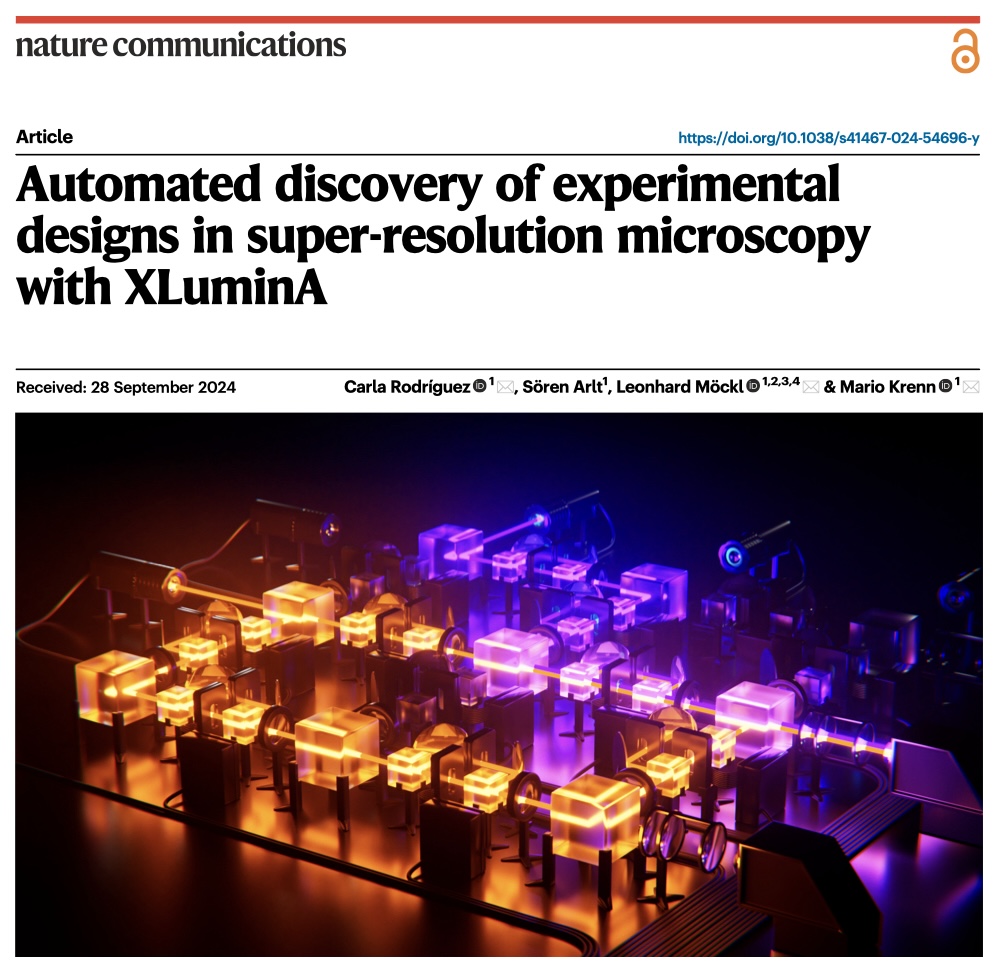
Happy to see our work in its published version at @NatureComms !
We developed an AI framework that autonomously discovers new experimental designs in super-resolution microscopy 🔬🤖✨
1/🧵
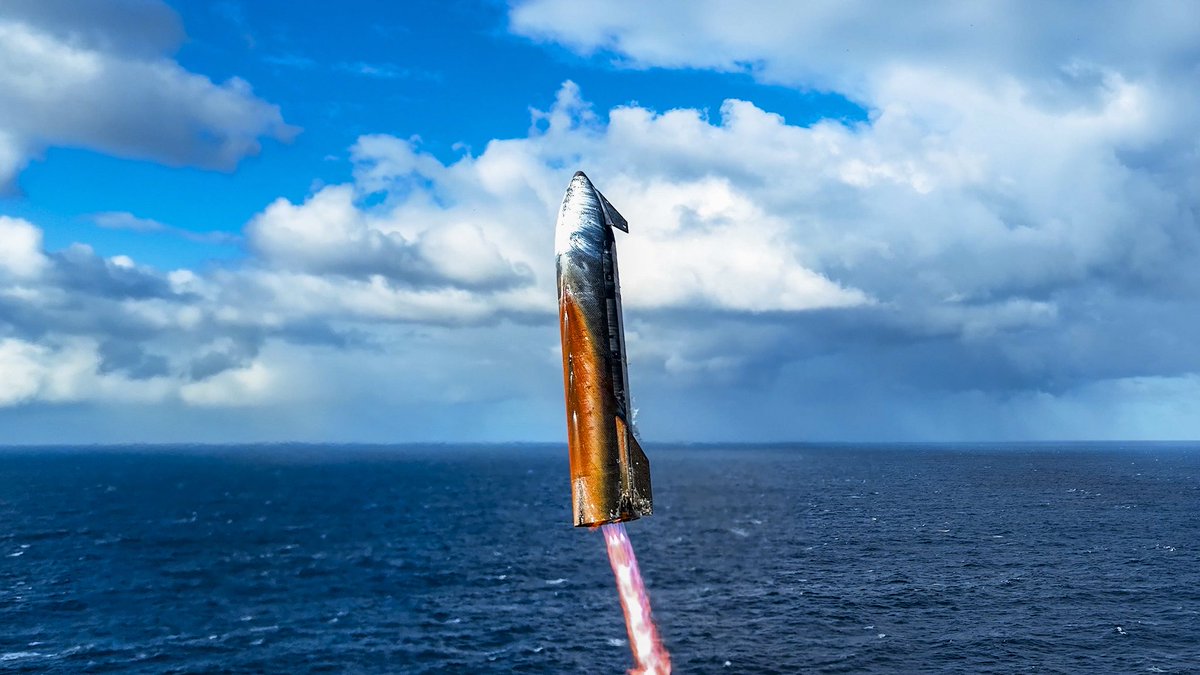
For decades I suffered psychological pain because the most powerful flying object ever built was a decade in the past, two, three … half a CENTURY in the past … longer than from the Sopwith Camel to Saturn V, and now finally SpaceX has eased that pain. Thank you.
The goal is to rewrite parts of the Finesse3 interferometer simulator (by @gwoptics et al.) in JAX to enable automatic differentiation, and then use this in a systematic search for novel gravitational wave detector designs similar to https://t.co/YLFpRt7W9u.
I started a master project in @MarioKrenn6240's Artificial Scientist Lab at the @MPI_Light! The topic is the "Implementation of a differentiable interferometer simulator for gravitational wave detector discovery". @lukasheinrich_ is my supervisor from @TU_Muenchen's side.
@NPCollapse Here you reduce the superiority of modern humans to a gradual increase in intelligence. Could it not also be that this superiority is due to the advent of Enlightenment and “the beginning of infinity” to put it in @DavidDeutschOxf speek?
https://t.co/6TsbppbfED
If it is not this marginal increase in intelligence, but some sort of singularity that has already happened in the form of enlightenment, I would expect it to be much more difficult for an AI to overtake an open society like ours than for an open society to overtake a static one.