@DividendDad1 Altria (MO) — the U.S. domestic tobacco business — is a true Dividend King with 56–60+ years of consecutive dividend increases (one of the longer streaks among Kings, and it offers a much higher yield, often 6%+).
I'm seeing a lot of misinformation about the oil market and the supply / demand balances leading up to the Iran war.
I did this webinar for clients of my investment firm last week. I focused most of it on this oil market question.
Hopefully this helps inform the discourse on the oil market, and what may happen if supplies through the Strait of Hormuz continue to be blocked and if they resume.
Not an offer, solicitation or recommendation. Bison is only available to accredited investors. Private strategies are risky and past performance may not be indicative.
The silence from 10 Downing Street didn't last long, but it wasn't an apology. Less than 12 hours after Katie Hopkins read Starmer’s posts aloud, an emergency legal injunction was issued to pull the broadcast from every UK platform. The reason? "Nati0nal Security."
Katie Hopkins responded within minutes, not with a lawyer, but with a livestream. "You can’t delete the truth once the nation has heard it," she declared, as she moved the "Banned Clip" to a US-based server where British censorship laws couldn't reach.
The hashtag #StarmerCensors exploded, trending #1 worldwide, with millions of users re-uploading the video every second.
While Starmer’s team scrambles to contain the digital wildfire, a massive "Free Speech" rally is being organized in Parliament Square for this Saturday. The government tried to silence one voice—now, they are facing a roar from the entire country. The era of "controlling the narrative" is officially over.
This Stanford paper pokes a hole in one of finance’s favorite excuses: “the data is too noisy.”
For decades, quants have argued that raw prices are useless without handcrafted indicators layered on top. This paper asks a cleaner question. What if the signal is already there, and we’ve just been looking at it the wrong way?
The author builds a model that predicts bullish versus bearish moves for S&P 500 stocks using nothing but raw price data. No indicators. No factor libraries. Just daily OHLCV plus adjusted prices that explicitly reflect dividends and splits.
The trick isn’t more data. It’s representation.
Instead of treating time series as sequences, the paper treats rolling price windows as spatial objects. Each window becomes a structured matrix, closer to an image than a chart. That lets convolutional filters detect local patterns like momentum shifts, volatility clustering, and structural breaks from corporate actions.
This borrows intuition from computer vision, not classical econometrics.
The dataset spans up to twenty years per stock with institutional-grade pricing. Ten channels feed the model, and sliding windows create dense training samples without synthetic tricks. Normalization keeps everything scale-invariant across features.
Architecturally, it’s a deep 1D CNN. Early layers focus on short-term structure. Deeper layers pick up longer trends. Compared to recurrent models, the CNN handles volatility spikes and event-driven jumps with more stability.
The task is simple but strict: predict direction, not returns, across horizons from a few days to a month. Training is tuned carefully, and convergence looks clean rather than suspicious.
The results are what make people uncomfortable.
Several large-cap stocks hit validation accuracies in the high 80s and low 90s. JP Morgan reaches around 91 percent on longer horizons. The curves suggest real learning, not a quick overfit.
The author stays cautious. This doesn’t model costs, execution, or slippage. But it does show something important. Deep models can internalize market mechanics directly from raw price tensors, including distortions most pipelines smooth away.
The larger implication cuts deep.
Feature engineering may matter less than how you frame the data. By choosing the right inductive bias, the model learns structure humans usually try to hardcode.
Treating financial time series like image-like objects isn’t a gimmick. It’s a serious alternative to decades of handcrafted assumptions, and it challenges the idea that markets are unreadable without heavy human intervention.
Read the full paper: https://t.co/VcFfAPhjAf
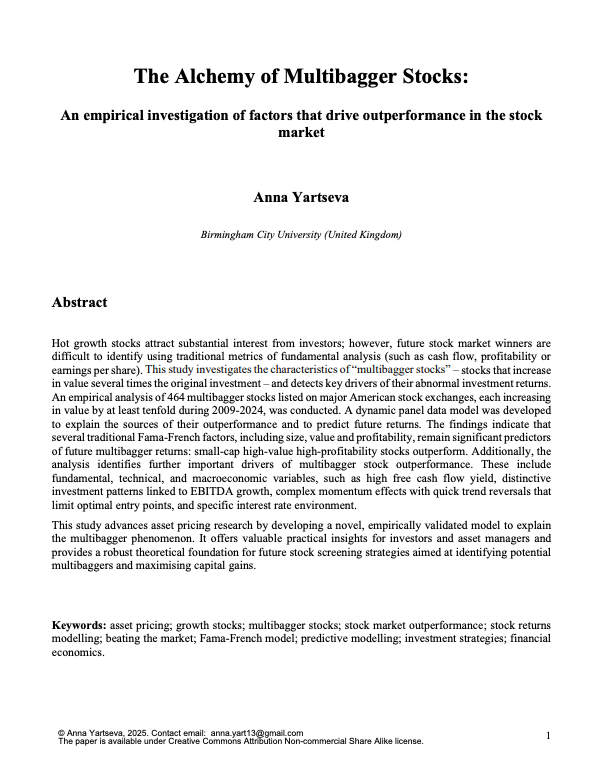
The secret of hedge funds is revealed in a 41-page PDF:
This paper analyzed 464 stocks that 10X-ed over a 24-year period.
Here are the best factors that drive outperformance: (number 3 is the best 🧵)
I DON'T UNDERSTAND WHY PEOPLE DON'T USE GROK FOR STOCKS.
Most traders are looking at charts from 3 months ago.
Grok analyzes real-time sentiment on X to predict tomorrow.
Here are 8 prompts to find the next 10x stock: