Glad to announce partnership with @CarbonArcAI to bring global regulatory risk intelligence to wall-street and beyond. Carbon Arc is building the next generation data infrastructure and marketplace for fast moving applications without the legal, engineering, and process overheads. We are glad to be adding the regulatory coverage for these applications.
Carver Agents tracks regulatory notifications from 1,000+ regulators across 50+ countries, spanning finance, AI, data, energy, healthcare and more. We ingest data from official government bodies including press releases and enforcement actions, then turn them structured machine-consumable data: source and jurisdiction, key dates, named entities, the functions and industries impacted, the actions they trigger, and more.
For teams whose risk crosses borders, that structured feed becomes real signal:
• Trade surveillance teams can spot jurisdictions where enforcement is accelerating before it shows up in a filing
• Supply chain teams can see where data, energy or environmental rules are tightening before they disrupt a build
• M&A teams can screen cross-border targets for regulatory exposure they'd otherwise catch too late
• PE and project teams can track how regulatory pressure is shifting in a sector before it changes the math on a deal
If you're managing cross-border risk, in trade, supply chains, M&A or project finance, this is a new lens worth having. Reach out to the fantastic team at @CarbonArcAI or us to discuss how to incorporate it into your workflows.
“Whoever produces and controls frontier models acquires global leverage over innovation, production, science, culture, and, ultimately, advanced thought.” Read @nfergus, Lisa Klaassen, and @ericschmidt on the imperial nature of AI:
https://t.co/1dI85Oxchm
Great explanation of what we are seeing and likely to see on AI rollout front. Two key ideas I picked up were (a) only when we try to automate we will discover that there were hidden dependencies and bottlenecks. Addressing them will take time. (b) Processes have to be have redesigned to with the new tech available. This will also take time and we cant mix and match old process with new tech.
On bottlenecks: 1) economists have been exactly right about little extra growth despite very fast tech change. They thought a group of econs I organized were crazy >2 yrs ago at the AI labs when we said "1pp extra growth/yr through 2030". 2) bottlenecks *still* not understood 1/8
Just spent the last 7 days on the front lines of the vulnpocalypse fending off an active cyber attack on one of our products.
Some thoughts:
- Software factories are going to be required equipment for everyone. There’s just no way to keep up with the pace of highly automated adversaries without one.
- We were lucky because we had spent the last few months getting our software factory running well. It is nice to have for product development but proved to be absolutely essential this week.
- At the minimum you need to have a coding server in the cloud pre-provisioned with read only access to all your logs and all the services you depend on for observability. With that in place you are a prompt away from reasonably good situational awareness, ongoing monitoring with loops, and ability for coding agents to validate fixes against your actual, observed attack patterns.
- Shared coding server also unlocks multiplayer incident response where everyone can see every session and jump in as needed. Sharing session links that can be forked is much higher bandwidth than re-explaining things.
- You don’t need to be Ramp/Stripe/Uber scale to have a working software factory in the cloud. We are a team of 3. Ours is built with an @opencode server (thanks @thdxr!), a forked version of compound engineering optimized for automated workflows (thanks @kieranklaassen!) and a multiplayer agent in slack that handles crons (we have our own harness but pick your favorite here).
- To get our software factory up and running well, we had to stop all new product development for ~6 weeks and just focus on getting the validation systems working that enabled us to reliably shipping PR without human code review. This felt very painful in the moment but was totally worth the eventual speedup in velocity.
- KYC for @AnthropicAI & @OpenAI cyber programs is now easy and quick (at least for defensive access), but a day felt like a lifetime this week. Submit your app now before you really need it.
- Getting Mythos access unlocked a deeper level of analysis that helped us shift from reactive mitigation to proactive patching. Wish we had done this a few weeks earlier. Get started now!
AI TIP FOR NON-LAWYERS
Health insurance denied a claim? Snap a photo of the denial letter and the coverage section of your policy, upload both to ChatGPT or Claude, and ask:
"Why was this denied, what's my deadline to appeal, and what does my policy say about this treatment? Quote the policy language."
Then have it draft the appeal letter using those quotes.
Two things before you send anything. Black out your member ID and Social Security number before you upload. And check the appeal deadline against the letter yourself, because if the AI gets that date wrong you can lose the appeal entirely.
Worst case, they say no twice.
@anitakirkovska Indeed. This will be a mega-usecase. I suspect a LOT of people are people are going to be checking legality for every contract they are signing. The examples gave were things like rent increase, minimum wage, eviction notice, non-compete etc. Imagine even if 1% are disputed.
👏👏We need a dependable repository like this one. Carver can help you with the task you wish to accomplish with this - legal engineering to take this through various approval/analytical/safety/implementation workflows.
👏👏We need a dependable repository like this one. Carver can help you with the task you wish to accomplish with this - legal engineering to take this through various approval/analytical/safety/implementation workflows.
Introducing the free Government & Legal Index for ChatGPT & Claude.
Give your AI agents 30M+ US government pages, from federal statutes and court opinions to city codes and permits.
Research tax rules, permits & case law with the Firecrawl plugin.
https://t.co/WT268coAo9
@BigDingus_72 Do we have any public stats beyond the paper that Ethan Mollick shared? @BigDingus_72@SMB_Attorney ?
Age of Cyborg (Human+Machine combined Action).
@heynavtoor This was always done (saw this in the fashion/ecommerce and food industry) and thats what the LLMs picked up. But this will be amplified further and made tangible to everyone. Agent builders will be expected to implement guardrails against such biases.
Dont understand why the NYTimes has to be so narrow minded. He is a well regarded monk with deep knowledge of vedanta, Hindu philosophy. The gray lady should retire.
Swami Sarvapriyananda calls out the New York Times for omitting the Hindu monk from their coverage of the Anthropic AI summit: "Islam, Judaism, Christianity, Buddhism… and Hinduism? New York Times ko yaad hi nahi aaya." #NDTVWorldSummit
"The Indian press picked it up and made it out as if I was the only person there. Well, that’s KARMA for you, New York Times—take that." 🔥
One pattern I observed is - whenever a task is well defined, you can package it into tool/sub-agent. But for any approach to emerge, you first have to characterize the tasks and their relationships. For example, "what changed since my iteration" could be a task/sub-agent (mechanical, limited, verifiable). But "do the updates add up to a change in counter-party posture" evaluation could stay with the main agent or be given to a powerful sub-agent with reasoning capability.
Instruction following might improve but the second multi-agent design is a manageable problem space (thats the CS research scientist in me talking). There is 30 years of research into task assignment, backtracking, workload scheduling etc. All that I am saying if the goal is worth going after, there are solution approaches.
My staff visited shops and establishments office multiple times now. The system never works, they have other priorities. They keep asking us to come again. It never seems to end. Not even sure why my supposedly fancy AI startup needs to register and file with S&E. British have left, Raj has not.
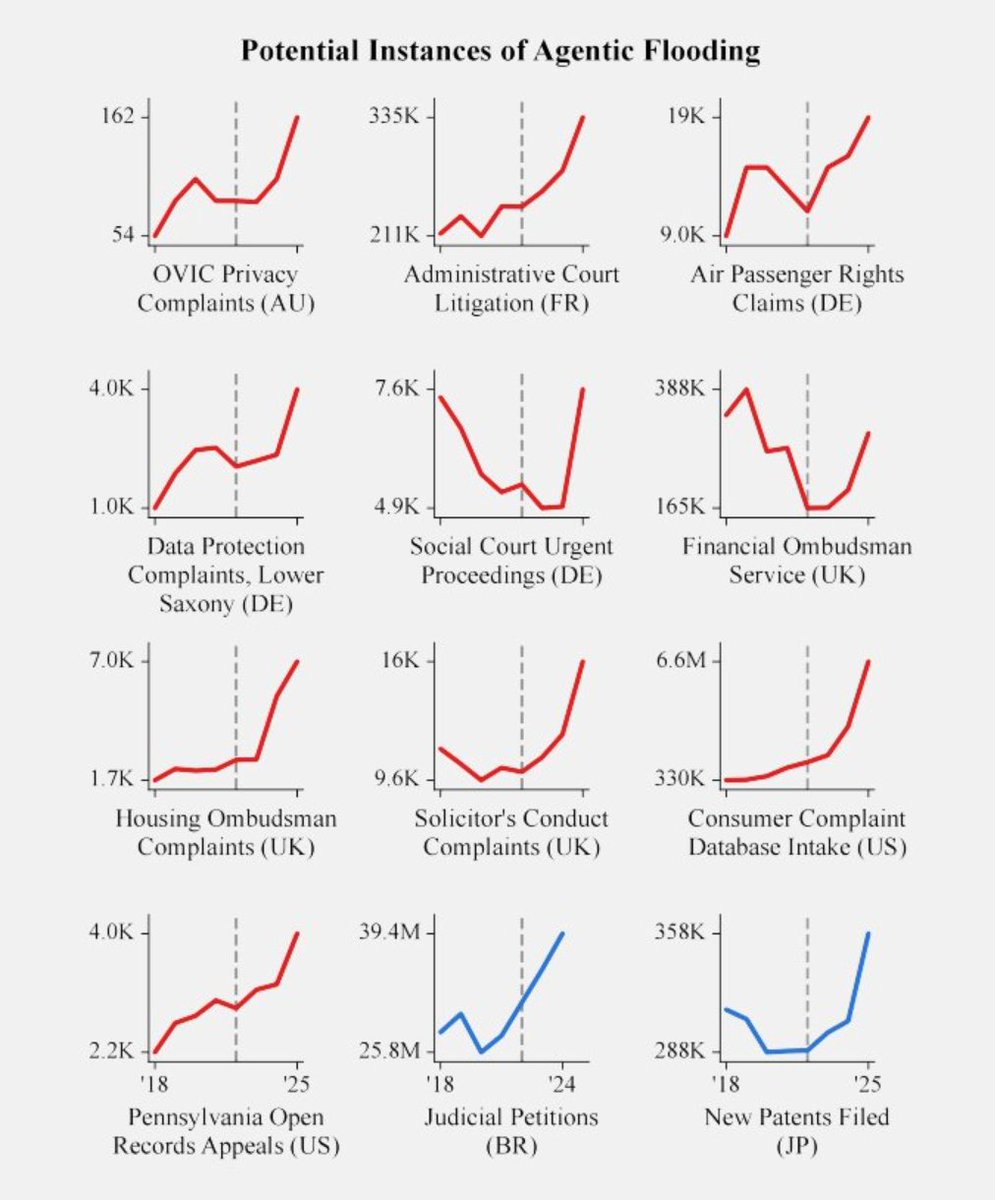
A legal tsunami is heading for government. They system is not built to handle the volume of input that agents are now able to produce. Without new infrastructure, our institutions will be under permanent DDOS attack. Who wants to build this?
Glad you posted. I have been thinking about how Coase's threshold will change and why. I think it will drop along the axes you mentioned but new axes are emerging:
(a) lower trust - whether you should be interacting with partner even with zero friction? (legality, IP etc)
(b) business velocity - cost of mistakes is higher (relatively speaking) than before because of pace of business
(c) deeper relationship - unlike before you are engaging more "full-stack" than before on the outcome. E.g., car painter service -> full visual experience partner?
Net: Fundamental insight still holds, but the thresholds lower triggering an explosion of transactions.
@tomcritchlow No, the dev cost is heading to zero and potentially taking an action. Testing (errors), security (system risks), legal costs (liability) are exploding.
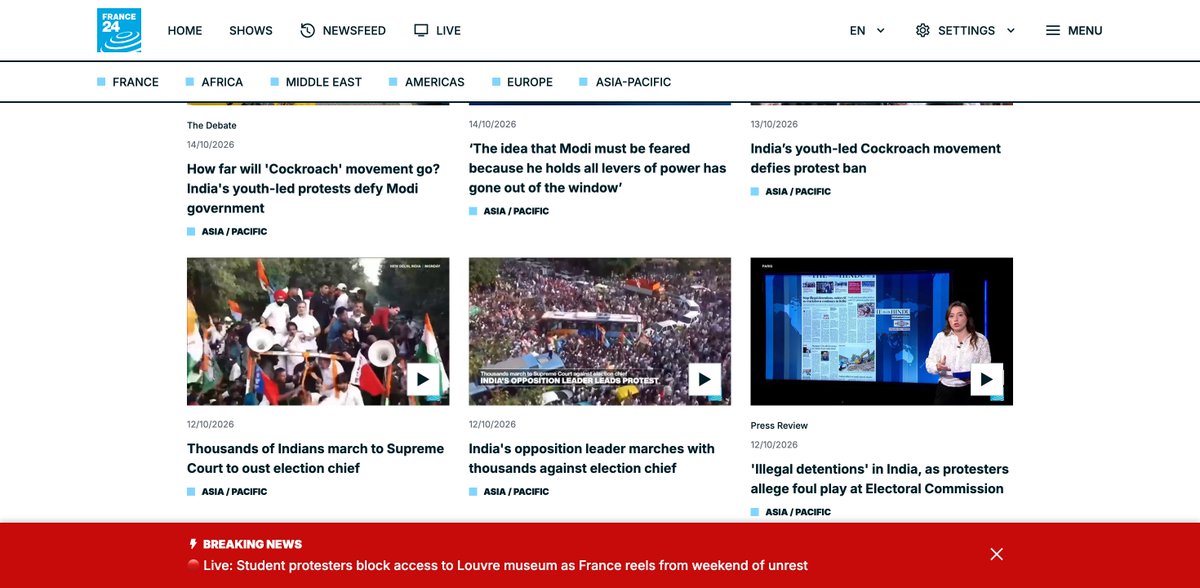
@FRANCE24 was relentless in support of rioting by CJP in India. Was sad when it didnt happen. Not "Un nouveau regard sur l'actualité" but rather "Jeter un nouveau regard sur la France" and "L'écho de la Françafrique : Jeter un regard impérialiste, vieux et fatigué sur l'actualité mondiale."