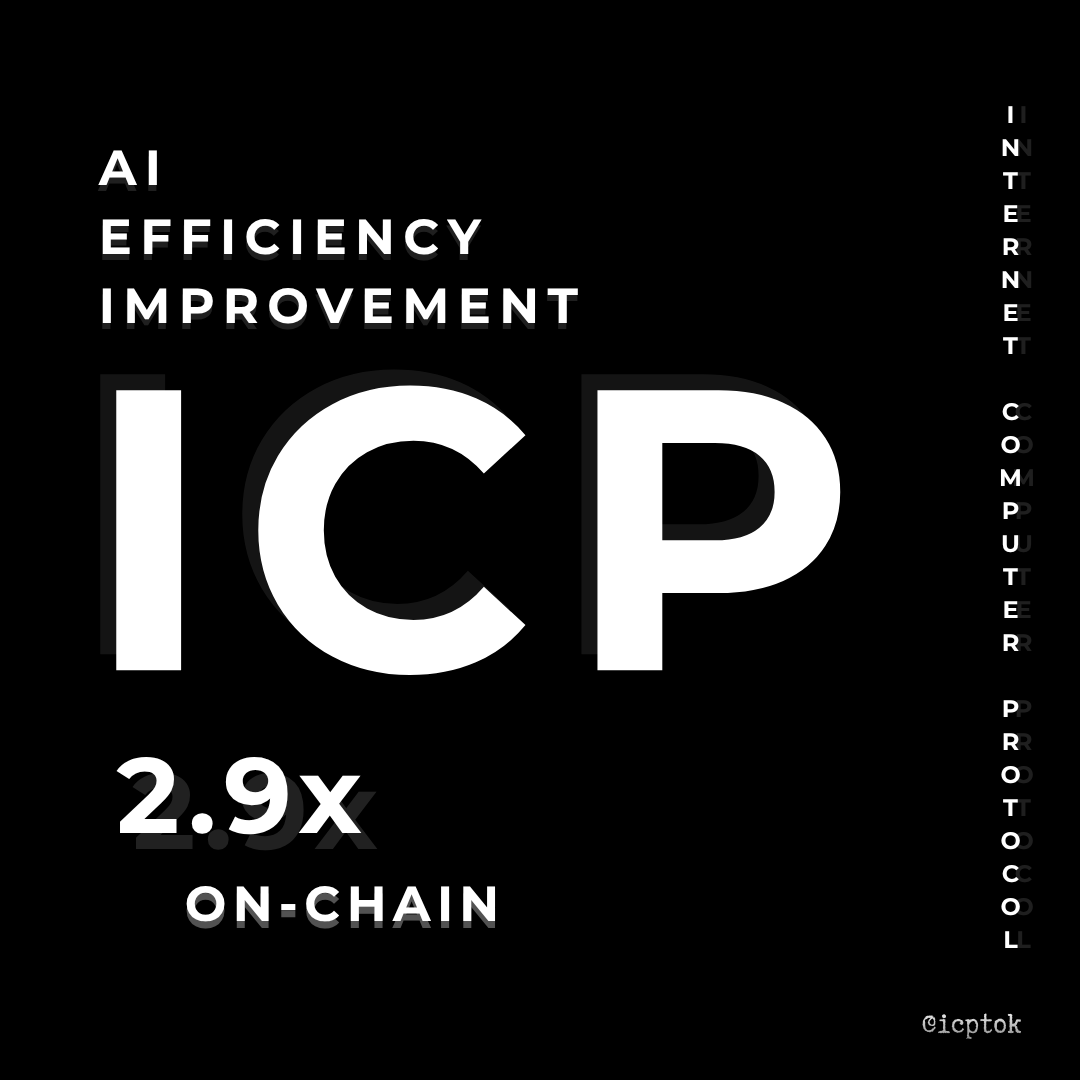
AI just became 2.9× more efficient on ICP.
Researchers from Meotis, Kaizen Corp and ORIGYN ran a small AI language model entirely inside ICP canisters without relying on external cloud servers.
Under the same computing limit, the optimized model generated 29 tokens instead of 10.
Why does this matter?
It’s another step toward AI agents and services that can run directly onchain, where their operation can be verified by the network instead of controlled by one company.
This is still research using a relatively small model, not “ChatGPT running on ICP.” But the results are transparent, with the paper, measurements and code publicly available.
Research: https://t.co/INn4PebxED
Paper: https://t.co/gMaUKtC5cX
Code: https://t.co/yLkXJ1S2CK
ICP uses a highly sophisticated security and decentralization model, which all blockchains that wish to function as clouds will need to copy.
Justin's latest misunderstandings (below) provide a good segue to talk about this, and share some expertise that even networks he's invested in might use.
1. Node count does not equal security or independence from centralized actors.
The claim that the number of nodes in a proof-of-stake network reflects decentralization and security is only an attractive idea that boils down to industry folklore and marketing. The node count doesn't matter per se, as I explain below.
For networks that depend on consensus to function, their security actually derives from the total number of *independent participants* involved consensus, and how voting power/participation power is divided between them.
In proof-of-stake networks, voting power derives from stake, rather than nodes. However, large stakers often stake via lots of nodes, sometimes to create the impression of decentralization, sometimes to partition access to their keys, and other times because their networks limit how much stake can be attached to a single node.
But here's the rub: if someone controls enough stake to control the network, it doesn't matter how many nodes they have spread their stake across.
Today, many networks have large numbers of nodes, but are in fact can be controlled by one entity, or a group of closely related entities.
This creates the following problems:
— They might make an honest mistake upgrading or configuring the network, and cause a disaster by accident;
— a hacker might commandeer their control to do something terrible;
— they might go bankrupt, and switch their nodes off, potentially causing loss of hosted data, and worse;
— they might subtly manipulate computations and data, to extact value from users somehow, sometimes without anyone being able to detect what is happening and;
— may other things
2. When someone says "the network is very secure and decentralized because it has lots of nodes..."
We know that across the "monolithic" proof-of-stake networks Justin is currently invested into, validator companies often operate tens of thousands of nodes using stake lent to them by customers in return for a share of the staking rewards.
In plain sight, this provides a demonstration of how the number of nodes in a network doesn't equal the number of independent consensus participants. However, hidden centralization is more of a problem.
For example, some time ago, the Crypto Leaks website shared video of a senior Ava Labs technical administrator claiming that in fact the company, and its founder and CEO, Emin Gün Sirer, own a huge portion of the AVAX supply that controls the Avalanche blockchain, and in fact, secretly operate the majority of its nodes, which they use to stake their holdings to both earn the lion's share of rewards and maintain hidden control.
They are not alone. Many proof-of-stake blockchains are run by companies and cabals of founders, execs and investors that secretly own a huge portion of the supply, and hide the fact by self-operating large numbers of nodes.
Aside from helping them get rich, this hidden centralization also helps them with two other things:
1) It provides them with hidden de facto control over their networks, which allows them to force through orderly node upgrades and configurations without the difficulty of decentralizing and having to invest effort developing specialized autonomous network governance and orchestration systems, such as the Internet Computer's Network Nervous System (NNS).
2) It inflates the price of their token: because they earn the lion's share of the staking rewards, they can stash them away for later, preventing them hitting the markets, which isn't a problem for them, because they have huge additional holdings they can sell from. By reducing the flow of tokens to the markets they keep the price higher, which i) enables to them to sell their holdings to the public at higher prices, and ii) keeps the market cap of their networks higher, which lends them prestige, which further attracts investors, including institutional investors who don't understand the game they're playing.
The public would be upset if they could see the truth. For this reasons, they often create large numbers of nodes while peddling the nonsense that the nodes are evidence of great decentralization.
3. Node count vs decentralization in open networks
For any decentralized network, whether its a monolithic network, or a subnet within a larger network, like a subnet on the Internet Computer, what matters for security and resilience is how consensus participation rights are divided amongst independent parties.
There are proven laws of mathematics governing how this works. If one party has 1/3 or more of the participation, then they can start exercising various forms of control over the network.
Thus, if participation is distributed equally over nodes, as it is on the Internet Computer (where the specialized hardware involved plays the role of a form of stake), it doesn't matter if a subnet has 1,000,000 nodes, and one party controls 333,334 of them, or 10 nodes, and one party controls 4 of them — each creates a similarly bad situation, since one party has 1/3 and can thus exert hidden control.
To capture this reality, the blockchain industry came up with the concept of the "Nakamoto Coefficient."
This is a number that tracks the number of independent parties that must collude to control a network. In both of the above examples, the Nakamoto coefficient is 1, even though vastly different numbers of nodes are involved, since a single party can exert control.
Again, what matters is the number of independent parties involved in consensus, not the number of nodes. People who claim otherwise are often just trotting out the same old snakeoil.
4. A key problem: the anonymity of node operators and stakers
A key challenge for proof-of-stake networks is that stakers/node operators are usually *anonymous*. This design choice is often sold to the public using old cypherpunk rubrics that anonymity allows networks to resist government control.
Of course, there is some truth in this, esepcially as concerns proof-of-work networks, but the proof-of-stake people making these argument are hardly ever cypherpunks!
The reality is that in practice anonymity has just become a way to fake decentralization, and hide massive unscrupulous profiteering.
(A further technical observation is that anonymity is anyway a weak shield in practice. For example, November 2022, Hetzner, one of Europe's largest clouds, decided to ban Solana nodes, and deleted 40% of the network's nodes overnight. The fact is they were able to easily identify the Solana nodes among the millions of other compute instances through technical means. The government could too.)
5. Moving on from anonymity, and creating powerful incentives for node operators not to be evil
The Internet Computer eschews node operator anonymity. When a prospective node operator wants go gain a "node provider" ID, through which they can join nodes to the network, they have to submit a proposal to the Network Nervous System, which includes identity and background information that allows the community to verify who they are, and what relationships they might have to other operators. Once they receive their node provider ID, this feeds back into how the Network Nervous System combines nodes.
Upon this foundation, the NNS combines nodes to form subnets that it knows are operated by independent parties — which combinations create the required levels of decentralization in a deterministic way, while using the minimum number of nodes for efficiency purposes.
Further, non-anonymous node providers join a system where they have powerful incentives to behave honestly.
Simply put, as the result of their declarations, if node providers act in an evil way, for example colluding to corrupt their subnets, they become legally liable, worldwide, for the results of their nefarious actions. Moreover, if they seriously disrupt the correct functioning of the network, they could additionally face criminal prosection under laws such as the UK's Computer Misuse Act from 1990.
The Internet Computer can slash misbehaving node providers, banishing their expensive hardware from the network, and proof-of-stake networks can similarly slash the stakes of their node operators.
However, slashing is a financial incentive that exists within a hypothesized microeconomic framework. In some scenarios, it's possible that a node operator might extract more value through dishonest actions than they lose when they get slashed.
The introduction of legal penalties for dishonest behavior act as a far more powerful real-world incentive.
The Internet Computer is more secure by design.
6. Scaling and efficiency using deterministic decentralization
The Internet Computer is essentially a network of super advanced subnet blockchains, which run under the control of its Network Nervous System, which runs on its own subnet (which also chains cryptographic keys to the subnets it creates, enabling the result of every call/tx into the network that triggers onchain computation to be transitively signed by the public key of the NNS — yes, Justin is talking nonsense when he says there is no shared security).
Individually, these subnets can host serious amounts of onchain computation and data, and they can even serve web. However, to scale-out horizontally, the network has to create additional subnets on demand.
This is only possible because the Network Nervous System can look at the available pool of nodes, and then draw down just the right combinations of nodes required to create new subnets with the necessary Nakamoto coefficients.
By design, it uses only the minimum number of nodes required to create the necessary Nakamoto coefficient, minimizing the replication of computation and data, driving incredible efficiency.
7. Going beyond node operator independence
Deterministic decentralization makes other considerations too, in addition to combining nodes from independent operators. Here they are:
Data centers — if a subnet's nodes are in the same data center, data center failure would also take the subnet down, so it combines nodes installed in different data centers.
Geographies — a nuclear strike might take out all the data centers in a geographical area, so its combines nodes in data centers that are geographically dispersed around the world.
Jurisdictions — if a jurisdiction such as the EU suddenly banned blockchain (hopefully not!) they might take down all nodes inside the regions they control, so it combines nodes based in different jurisdictions too.
Using this more nuanced understanding of decentralization, deterministic decentralization squeezes incredible security and resilience from the minimum number of nodes. This is something that just isn't possible on proof-of-stake networks with anonymous stakers and node operators.
8. Security and resilience on a cost curve
In practice, deterministic decentralization is also applied within the context of considerations about the most appropriate balance of security and cost.
Today, Ethereum replicates computation and data across hundreds of thousands of nodes. This is one of the reasons why its onchain computation costs are many orders of magnitude greater than on the Internet Computer. Yet, the computer science says that the amount of security and resilience they are gaining by adding more and more nodes exponentially decayed to zero long ago.
The Internet Computer, meanwhile, is focused on providing cloud, which demands efficiency.
In fact, the Internet Computer always aims to combine the minimum number of nodes required to produce the level of security and resilience appropriate for the application, because in reality, cost/benefit curves are often vastly different, and one size doesn't fit all.
Justin complains that shared public subnets used by the Internet Computer to host applications and services only use 13 nodes. In fact, this number of independent parties creates a Nakamoto coefficient of 5, which is much higher than actually exists on most proof-of-stake blockchains behind the scenes. Simply put, it is sufficient for these applications.
The soon to be released cloud engine technology will provide market validation (cloud engines are private subnets created by enterprises that wish to select their own nodes).
My bet is we will mostly see enterprises configure cloud engines with just 4 or 7 nodes, which will provide Nakamoto coefficients of 2 and 3 respectively, which they will see as easily sufficient for their needs. They will only add more nodes if they want to scale out query capacity, or reduce web latency times in different regions.
This works both ways.
For example, the Network Nervous System allocates ~50 nodes to its own subnet, and a similar number to subnets involved in the hosting of threshold cryptography, which allows hosted software to create public keys that the network can sign for on demand (e.g. to custody bitcoin within an application) and securely encrypt data stored on the network (e.g. the vetKeys functionality).
These subnets benefit from a huge Nakamoto coefficient of 17+, as well as the additional considerations that deterministic decentralization makes. If it wanted to, it could combine hundreds of nodes to create a subnet, thanks to the advanced nature of the network technology involved.
The ability of the Internet Computer to dynamically configure subnet nodes in pursuit of the precise amount of decentralization required, when considering all relevant factors, reflects its incredible sophistication, and why it can provide tamperproof unstoppable onchain cloud.
To date, the implementation of deterministic decentralization remains unique to the Internet Computer.
But, like other innovations the network pioneered years ago, which others are only now pursuing, such as reverse gas, chains that covet cloud provision will inevitably also attempt to adopt these methodologies.
Possibly, even those that Justin holds dear.
Project Spotlight: @dfinity – The first blockchain network built to host the next generation of internet onchain
Web3 was supposed to free the internet.
Instead, it built a new layer on top of centralized cloud servers, corporate-controlled APIs, and fragile bridge infrastructure.
Enter ICP.
Launched in 2021 by the DFINITY Foundation, ICP is an entirely new internet stack that can run dapps, AI models and entire social networks without any reliance on legacy cloud providers.
Here’s how ICP is replacing the old internet ↓
▫️ The End of Web2 Reliance
Web3 applications claim to be decentralized.
Yet, most of them are just smart contracts running on centralized servers.
• Frontends are hosted on AWS
• User data is stored in Web2 databases
• Node infrastructure depends on centralized RPC providers
This means even “unstoppable” dApps can be censored, taken offline, or manipulated.
ICP erases these dependencies by offering a fully on-chain alternative:
• Smart contracts that store and process both data and frontends
• Node machines that run by independent operators, eliminating single points of failure
• A decentralized storage layer replacing traditional databases, making applications permanently tamperproof
With ICP, dapps don’t just interact with a blockchain.
They live entirely on it.
▫️ DeFi Without Bridges
Bitcoin holds the deepest liquidity but bridging BTC has been a $2B security nightmare.
ICP changes that.
By directly integrating with Bitcoin’s network, ICP unlocks the ability to:
• Execute trustless BTC transactions from smart contracts
• Power Bitcoin-native DeFi, enabling lending, trading, and automated financial instruments
• Use Tap Protocol to bring full smart contract functionality to Bitcoin, without requiring Layer 2 infrastructure
This isn’t another workaround.
It’s Bitcoin, evolved.
▫️ Infinite Scalability Without Layer 2s
Every blockchain struggles with scaling.
Most have responded by either:
1/ Creating Layer 2s (which fragment liquidity and introduce added complexity), or
2/ Prioritizing speed over decentralization (centralizing validator power to increase throughput).
ICP solves scalability at the base layer:
• Dynamic subnets expand network capacity without splitting liquidity or composability
• Web-speed transactions with sub-second finality, eliminating the bottlenecks of monolithic chains
• Automated contract scaling, allowing applications to grow with demand, without hitting computational limits
Unlike traditional blockchains, ICP scales like the internet itself without breaking decentralization.
▫️The Proof of Adoption
ICP is already operating at scale:
• $1.22B TVL
• $2.51B Market Cap
• $167M raised, led by @polychain and @a16z
• 347+ projects live across DeFi, AI, gaming and more.
Unlike other blockchains, ICP doesn't just process transactions.
It runs the internet itself.
▫️ The Road to Internet’s First True Reset
The current Web3 model is a dead end.
Until blockchains can fully replace Web2 infrastructure, decentralization will remain a myth.
ICP is the only blockchain that eliminates Web2 dependencies entirely, delivering:
• An infinitely scalable, fully on-chain economy.
• A self-sustaining, scalable cloud for unstoppable applications.
• Trustless Bitcoin smart contracts without bridge vulnerabilities.
The next evolution of the internet isn’t about TPS.
It’s about being ownerless, unstoppable and built to last.
ICP is already making it happen.
Enterprise blockchain that saves billions?
Our ETHDenver conversation with Austin Fatheree covers @pan_industrial and @ICDevs_org innovations
Watch here: https://t.co/HGrNxy2Vae
Here's what the team is developing:
1️⃣ ICAIbus: one-line code implementation for data monetization
2️⃣ Enterprise-grade tools for shared industry data spaces
3️⃣ ICRC99 NFT router for cross-EVM asset movement
4️⃣ Motoko EVM with complete opcode support
5️⃣ Trust layer solutions for enterprise AI systems
The second episode of World Computer Tech Talks has just dropped ♾️
Every Wednesday a new film on the tech that ICP brings to you.
This week: The Bitcoin DeFi Renaissance 🟠
Discover how innovation in DeFi on Bitcoin is being fueled by ICP's tech stack.
Learn more 👉 https://t.co/hAcy9VWO0H
#BTC
What network has the highest growth in onchain compute, isn't threatened by pending unlocks, benefits from crypto's largest R&D operation, and boasts real game-changing technology?
– highest TX/s
– onchain as cloud
– real onchain apps, services
– value proposition=tech utility
– onchain compute growth 500%+
– onchain compute > total every other
– world-renowned, known team
– open source, with most commits
– ~20 papers describing its science
– product 1000+ person-years of R&D
– a crypto project dating from 2015
– something that's weathered storms
– smart contracts directly serve web
– smart contracts pay own compute
– users interact seamlessly w/o wallets
– trustless multichain w/o bridges
– sends bitcon 1s finality, near 0 cost
– powers a World Computer paradigm
– onchain open internet services e.g. OpenChat
– AI smart contracts (AI that's really onchain)
– SWI/self-writing internet ready - coming!!
– much more, and...
was so scary to corrupt industry titans, some spent years trying to keep it out of industry press, and other shenanigans
???
That's the Internet Computer | #ICP
When you're looking for the antidote to excessive
– vaporware
– snakeoil narratives
– impermanence
Look no further, join the ICP community, and help the Internet Computer take crypto to the moon 💪
By popular demand, here's a detailed post about https://t.co/IfQrVovF3L and the forthcoming "self-writing internet" (SWI) paradigm we in the ICP community are working to realize 🌐🧠
If you prefer pics, checkout my deck at https://t.co/jcUqAuQ6lu. Otherwise here goes...
Caffeine is meant for everybody. Using natural language, anybody will be able to create sovereign websites, web apps and internet services.
It might be an individual wanting to create something like a personal branding website, wedding planning app for their family, or portal for a sailing club. It might be an entrepreneur lauching an e-commerce website, or a sharing economy app with advanced Web3 rails. It might be a company or gov. dept. that needs a corporate portal, or some specific CRM (Customer Relationship Managment), ERP (Enterprise Resource Processing) or ARP (Accounts Receivable Processing) functionality.
The SWI paradigm is broad, and it involves anyone and everyone being able to create and own anything online from scratch, just by talking to AI. Over time, as the paradigm becomes more and more powerful, this will increasingly empower, democratize and decentralize tech worldwide.
Today, Large Language Models (a type of AI) have already become very good at writing code, and their abilities are continuing to improve rapidly. The Caffeine platform leverages this ability in combination with new specialized SWI infrastructure and technology that is being deployed to the Internet Computer network. This new tech infra has been especially designed to empower and enable AI to build effectively and safely solo on receipt of natural language instructions, without receiving any technical assistance from humans.
Caffeine has also been carefully designed to allow technical people, such as engineers and user experience designers, to build alongside AI, with purposes such as accelerating time-to-market, dramatically reducing costs while increasing quality, and using the AI as a tutor to learn new skills.
It's important to know that AI building apps solo is only one part of the SWI paradigm. It also involves apps and services being created on the decentralized internet, rather than inside some company's proprietary centralized platform, and drawing on this difference to provide 4 very important, defining characteristics:
1. Sovereignty
The SWI paradigm produces apps and services that become accessible via URLs (the addresses we enter into web browsers) that are *sovereign.* This property results from them being entirely hosted (running) on a decentralized, public network, in exactly the same way a bitcoin token lives on the Bitcoin blockchain. They are constructed from secure network-resident code/next-generation smart contracts, without any centralization or traditional backend IT needing to be involved, such as cloud computing services. This means that apps are not dependent on intermediaries that might censor them, or which might inflict harmful actions like massively hiking prices, which services typically seek to make them captive customers by locking them into their platforms. In addition, the underlying software and data of apps created by SWI belongs exclusively to their owners (which might be humans, an organization, DAO or yet another kind of entity), further preventing intermediaries gaining leverage. In production, these sovereign apps are controlled by a wallet (or assigned to a DAO, say), rather than a cloud account operated by a company.
2. Tamperproof security
Those building using traditional IT often euphemistically say their web apps and services are "secure," because they have carefully configured their cloud accounts to prevent exploits, and have purchased cybersecurity measures to protect hosted platform software like databases and their traditional custom code. However, in reality, such traditional IT infrastructure can never be truly secure, since the cybersecurity protections involved are highly fallible. In complete contrast, the websites, web apps and internet services created on SWI are "tamperproof," which means they are fundamentally secure, and don't need traditional cybersecurity measures for extra protection. This makes it much easier for AI to build solo, and also frees app owners from having to trust that centralized traditional IT service providers and SaaS platforms will successfully keep their data and systems secure using cybersecurity systems, which they cannot guarantee even if they wish to, because traditional IT is fundamentally insecure, and can only be patched by cybersecurity measures.
3. Updatable in production
The SWI paradigm requires that the owners of the apps and services produced can update them almost in real-time, simply by issuing additional natural language instructions to an AI, essentially evolving them at chat speed (in practice, with owners issuing instructions, and then refreshing the URL where their app is located). If you are non-technical, I need to tell you that this requirement is far more challenging than it might sound. Firstly, the process of upgrading/updating apps running in production must be sufficiently swift to occur at chat speed, which requires that the data involved can be transformed into new formats quickly. Secondly – and this is the really tough one – it is required that when the AI modifies the underlying software logic, and performs any required transformations/migrations of the app's data, that no data is accidentally lost, for example because the AI has made a mistake, which LLMs will continue to do because of the way they work, even as their overall abilities continue to improve.
4. Trustless Web3
SWI apps can incorporate many different types of functionalities, including AI functionalities. But there is a form of functionality that cannot be safely implemented on traditional IT stacks: Web3 functionality. SWI apps can securely hold and process tokens on multiple blockchains, trustlessly and seamlessly incorporating them into their own functionality, without requiring users use cumbersome traditional crypto wallets, which undermine user experience, and are themselves are vulnerable to hacks. The Internet Computer, in combination with the traditional blockchains it is directly interoperable with, forms a World Computer. The Internet Computer already hosts many onchain services that process tokens from multiple traditional chains, without the involvement of bridges and other systems that are often centralized in practice (note that in Web3, oftentimes people refer to apps built in a centralized way using traditional IT, which run on servers and compute platforms like Amazon Web Services, as "onchain," simply because they have an associated token, but in reality of course they are not, and therefore, cannot provide these guarantees). A great example of what's possible with the fully network-resident paradigm is , OpenChat, an open internet service that runs on the Internet Computer, which enables its users to instantly send bitcoins, ETH and SOL inside chat messages (the Internet Computer's "chain key" technology enables it to play the role of a kind of Layer 2 for blockchain assets). SWI will be able to build apps and services with similar functionality. Where required, those apps can also maintain their own treasuries using stablecoins (e.g. tokenized dollars) and other crypto innovations.
DFINITY is performing a wide range of technical work related to SWI. For example, we have an AI team that works with LLMs to make them better at coding SWI apps using specialized training and RAG infrastructures, and we are working to make efficient, seamless ICP network scaling even better, in anticipation of increased demands on the network created by SWI, and many other things, but in this post I'll talk more about our Motoko work.
Technical note (skip don't balk!): The Internet Computer hosts an entire serverless cloud, in which canister smart contracts are hosted and run, within a "virtual execution environment," which leverages the WebAssembly/Wasm virtual machine. (The virtual execution environment is hosted with the network's stateful decentralized network protocol, which is called Internet Computer Protocol, or ICP, which the network's sovereign node machines process).
This means both human developers, and AI, can write code in any programming language that compiles to Wasm byte code. Several languages are now popular in the ecosystem.
However, back in 2018, 3 years before the network launched, DFINITY decided to develop a completely new programming language for ICP platforms, called Motoko. Aside from applying advanced emerging concepts in programming language design, we were pursuing a number of objectives with Motoko:
1) To create a new, broadly accessible, simple-to-learn language, that was nonetheless powerful enough to build complex systems (addressing shortcomings of simple languages like JavaScript).
2) To create a language that leveraged special aspects of the Wasm virtual machine standard.
3) To create a language that was specifically designed for the Internet Computer's virtual execution environment, and some of the incredible advancements in the field of compute that it provides (in technical speak, Motoko is DSL/domain specific language).
Motoko is far more sophisticated and powerful than something like Solidity or Move, and developing a new language from scratch is not a simple undertaking, but we set to the task.
We were no doubt helped by the team being initially led by Andreas Rossberg, a co-inventor of WebAssembly, and leader within the Wasm community, who joined the DFINITY team in early 2017. He helped form a brilliant languages team, which continues to carry the torch today.
At some point, we realized that when AI builds solo, it might benefit from a language like Motoko, and thus, critical aspects of the language's design are being developed to empower human and AI developers alike.
Prima facie, without any special training, LLMs coding using Motoko already make far less mistakes than using Rust, an increasingly popular modern systems-programming language – despite their being far more training material available for Rust, in the form of online documentation, and open source code repositories.
But by developing special materials for training LLMs, and new technologies for Motoko, we are taking this much further.
One of the key advancements provided by ICP, is that software runs within a compute environment that providing something called "orthogonal persistence" (but don't balk, this is easy, keep reading!!)
This essentially means that software logic runs within persistent memory pages, and it's no longer necessary for developers to use database servers and file systems to persist data. In a sense, logic and data have become one, because developers can just define logical abstractions, and the data then automatically persists within them.
In summary, orthogonal persistence:
1) Massively simplifies software design, making it more abstract, which greatly helps AI.
2) Improves performance, since application data no longer has to be copied in and out of databases and files (this is part of the magic that allows, say, a social network to be built on the Internet Computer, while there is still not a single traditional blockchain that cfan store a simple photo taken with a phone).
Motoko development is leaning into orthogonal persistence, and I expect within 10 days, will release "enhanced orthogonal persistence," or "EOP," which takes things further still, especially with respect to AI empowerment.
With EOP, when canister smart contracts written in Motoko are upgraded, where the structure of data does not need to be transformed, it can be left completely alone during upgrades. This is another simplification, which will greatly help human and AI developers alike. But there's more...
When the SWI paradigm creates complex web applications and services online, inevitably changes to the structure of data in memory may occur.
For example, image an e-commerce website, with a Product object. The owner of the site might decide they wish to add comments functionality to listed products, which would require a Comments field being added to Product. At this stage, during the upgrade, the old Products objects must be transformed into new Products objects, and with EOP, some migration logic must thus be created.
EOP ensures that transformations can occur quickly, which is crucial for allowing SWI apps and services to be upgraded at chat speed, but it also addresses an even more important need.
Due to their design, LLMs will always occasionally hallucinate, and even though they are smart, they will make mistakes (and considering they are coding hundreds of times faster than humans, this is no surprise). What then if an AI building solo makes a mistake in the migration logic, causing app or service data to be lost?
For example, what if the AI defined the new Product format, adding the required comments feature, but in the process caused previously entered product data to be lost? (Of course, Caffeine will provide snapshotting and restore functionality, but this is last resort, not something a non-technical developer simply talking to build will want to use.)
The answer is that in EOP, when an upgrade is installed, the Motoko language platform checks the migration logic against the currently installed version to check that no data will be lost – and simply fails if it would be, forcing the AI to try again.
This is called "loss safe" programming, and it was invented at DFINITY.
I understand this is a bit of a technical story, but hopefully you can see that the "updatable" requirement of SWI is challenging to implement in practice, and thus that EOP delivers another groundbreaking ICP advance that will help AI and human builders alike.
None of this comes easy. Many aspects of EOP were envisaged back in the early days, but it has taken many years to realize the technology.
What is clear, is that AI must be empowered to build solo, because that is the future: AI is not human, and in the SWI paradigm, AI is required to build and update apps and services extremely rapidly, at the speed of chat.
To make all this possible, the bottom line is that AI requires its own environment to build in.
ICP already provides a tamperproof compute environment, so that a mistake by AI cannot lead to a hack and data exfiltration, or the installation of ransomware say – it is truly secure.
ICP already provides an unstoppable compute environment, relieving AI of the need to create things like failover and backup and restore systems, massively further simplifying software logic, enabling the AI to focus on what, not how, and further reducing the risk a mistake might cause data to be lost.
Now, Motoko's EOP will further accelerates upgrades on ICP, allowing them to run at chat speed, and most importantly, creates guardrails that prevent a simple mistake by AI causing data to be lost.
Of course, this is not all, and over time, I will have more to share with you about our SWI work.
What I hope I have conveyed, is that SWI is a new and emerging technical field, which is one that the Internet Computer, and the ICP community, is uniquely positioned to capitalize upon
In the future, human developers will build alongside AI developers (to reduce friction, we are also developing an in-browser development environment, called https://t.co/Wo21rVgxWI).
But also in the future, all 8 billion humans on earth without technical skills will also gain the ability to develop and own tamperproof and unstoppable sovereign websites, web apps and internet services, just by speaking in their local natural language.
When we release Caffeine, that will be only a beginning of a long and incredible journey into the future.
The SWI paradigm has no limits. As AI gets smarter, and as Caffeine, and the underlying SWI technology and infrastructure on the Internet Computer improves, it will be possible to create increasingly advanced apps and services.
Individuals, entrepreneurs, businesses, and governments, will increasingly choose to leverage SWI to create sovereign custom apps and services that are completely under their control, that they can update, customize and improve just by talking at any time of their choosing, and which slash their time to market and costs by orders of magnitude compared to today's tech – and the total addressable market will become unimaginably vast.
We want the SWI to explode on the Internet Computer, and are working towards that goal.
More news soon 💪
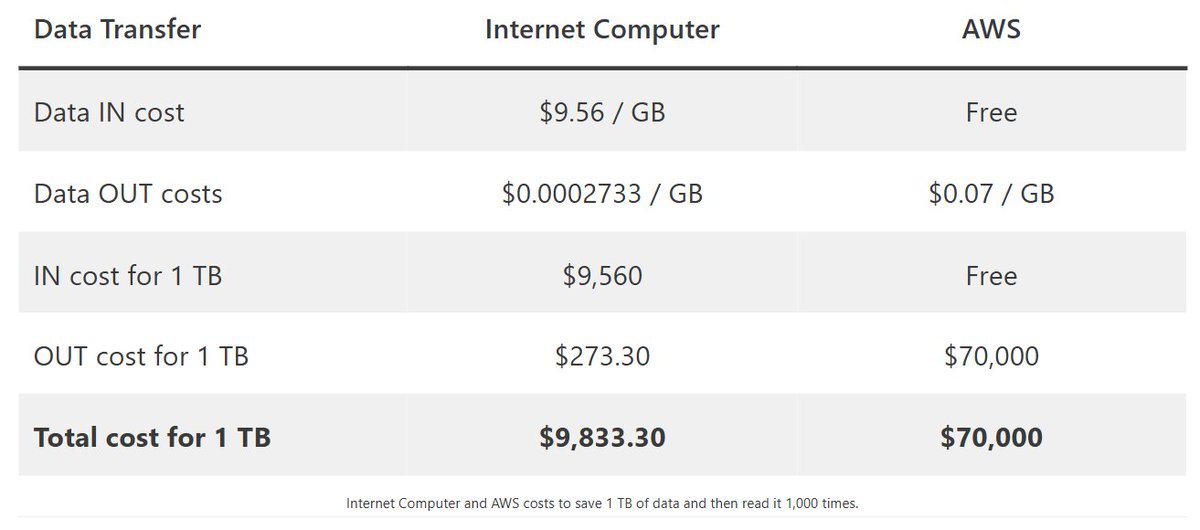
🚨 $ICP vs #AWS
Did you know that on-chain storage is already cheaper than traditional Web 2 storage solutions like AWS, or at the very least, extremely competitive?
Having been involved in #Crypto since 2013, I’ve witnessed countless hacks, especially targeting bridges, which have proven to be a major vulnerability in past cycles. Fortunately, I’ve never been a victim of one, but many were not so lucky.
One example of this risk can be found in a CNBC article, which highlights how $1.4 billion was stolen through crypto bridge hacks in just 2022. (Read more here: https://t.co/GOshT4Urs9)
ICP solves this critical issue by keeping all data fully on-chain, eliminating the need for bridges and their associated risks. Additionally, it achieves this at a lower cost while providing unmatched security and scalability.
This isn't just innovation; it’s the new standard for blockchain security and efficiency.
$ICP = World Computer♾