A recent post on 'How Employment is Changing at Anthropic' begs: are we any closer to an economy with some (many?) companies run by a single person. It's not that obvious to me. https://t.co/3XfQmy7QIB
The Cambridge Dictionary's 2026 word of the year is 'human'.
But as an adjective, not a noun -- as in, 'human art'. For those of us working in AI, what a moment to pause, reflect on humanity, and to be grateful for all the human relationships we have at home, work, and community! I've enjoyed getting to know new and old faces throughout this year.
https://t.co/WhzchuXkrf
A thought: should AI abstractions look like human ones? Humans design software for human readability. If AIs designed software with AI readability in mind instead, would they hold up better as projects grow in size and complexity? That seems like a better test: can a large-scale project built from 'vibe code', with abstractions humans may not understand, show sustained impact and success over time?
The underlying principle is that effective abstractions may depend on the reader's cognitive limits. This could explain why humans are best at teaching humans: a good teacher knows when a student will get stuck.
I see four assertions in this essay.
(i) AIs will be better than humans at AI research.
(ii) AIs trained autonomously will be more time/cost/compute-efficient comparatively.
(iii) New concepts/frameworks (e.g. topology, GR) are needed to make progress on hard problems.
(iv) Autonomously trained AIs will continuously improve at new concept/framework creation.
(i)-(ii) seem uncontroversial to me. (iii) seems intuitively right, but hard to know. (iv) is a form of extrapolation where humans seem still to have an advantage. Have we seen any strong evidence that this is an emerging behavior in AIs? By interpolation, by contrast, I mean solving within an established framework (e.g. Erdős' unit-distance problem) for which we have ample evidence an AI can do.
I'm not sure how "spark" and "software-only singularity", as currently constructed, help us to reason more clearly about (i)-(iv), although somewhat interesting to think about as a theoretical exercise.
---
Procuring healthcare services through a 2-sided market with reverse auctions is sensible. Theory says this will drive down prices to near cost. Empirically, Medicare ran equipment auctions repeatedly, and by 2021, 14/16 categories bid no further savings. So the win here would be matching on complete info at agent scale, while continuous bidding would reset prices once (where inefficient), then keep them near cost over time.
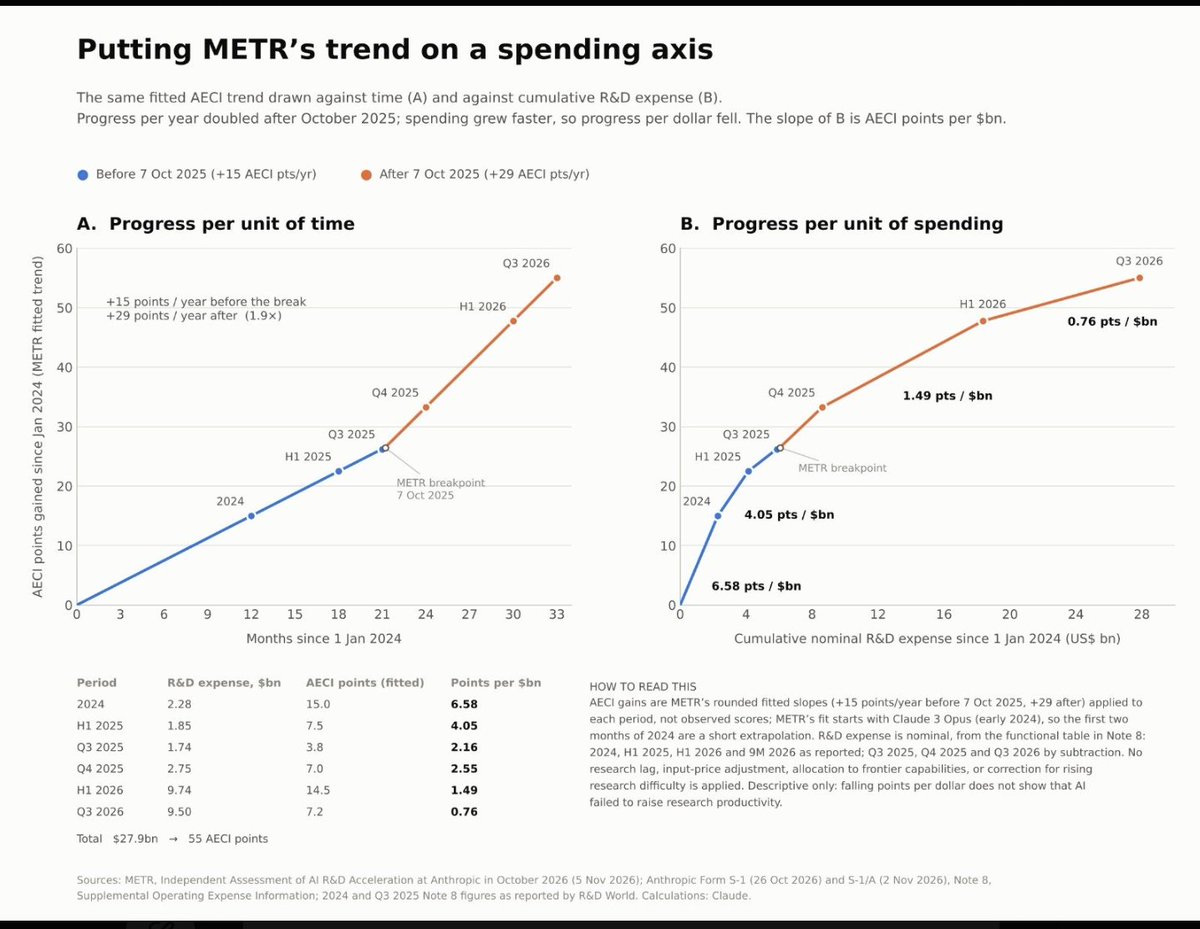
If you think about AI progress along interpolation and extrapolation, a la @demishassabis, it would seem these two charts tell you there's still a lot of interpolation 'juice' left through sheer test-time compute scaling. I.e., public human data is thinning (left-side) yet progress still doubled at a much higher cost per step (right-side).
I suppose the difference boils down to reversibility and blast radius. In software, post-merge remediation is now part of the 'verification' norm, which reduces the burden at review time. I don't know what % of law work is reversible (e.g. redlining), but it seems like a lot will still be held up at signing time for human approval when/if blast radius is large enough.
Hey @bunopus, I agree that we have to balance theory and practice when it comes to abstraction. In this model, notice, the abstract factory isn't a 'universal process'. It can be versioned. Rough analogy on how it plays out in practice: a platform team owns versions of the abstract factory, and apps team owns versions of the instance factories. To my mind, that offers both flexibility and structure at the team- and company-wide level. The closed-loop keeps everything grounded and tested on reality (i.e. did it achieve the business outcome?) -- otherwise, as you say, abstraction is disconnected from the real-world.
When I look at the alternative of how companies are managing and using agentic workflow across teams ('fine-tuning layer 2' with agents), I'm not currently convinced that it's scalable, cost-efficient, and or performant. In many cases, it's brittle and a lot of token spend for very little return.
You don’t need to buy a ‘software factory’ because of FOMO. Vendors need to show what the label delivers. Equally, calling it hype leaves the company-level engineering problems described herein unresolved. https://t.co/ICUUwmTVii
@linear’s London launch was a good one. Linear CTO, Granola CTO, and Raycast CEO all talked about how differently they now build and hire.
The standout: @artman said his agent rewrote a core piece of Linear over a weekend (4.5k, +1M LOC) with no post-merge issues. He said he wouldn’t have even attempted it pre-AI. 🤯
This sticker gave me strong Helsinki vibes. 🤟
—
You don’t need to buy a ‘software factory’ because of FOMO. Vendors need to show what the label delivers. Equally, calling it hype leaves the company-level engineering problems described herein unresolved. https://t.co/ICUUwmTVii
@thorstenball Thoughtful, but I do think abstractions that let humans understand and maintain code remains necessary in a world where humans are accountable for a code/service. That's a constraint of the human economy, which runs on trust, not a technical one.
@bendee983 I suspect the thing you want built into your factory/refinery is (i) defined human escalation paths; (ii) closed-loop remediation; (iii) human legibility. This enables you to scale both output while maintaining a quality standard floor. https://t.co/smWGcjBRkI
You don’t need to buy a ‘software factory’ because of FOMO. Vendors need to show what the label delivers. Equally, calling it hype leaves the company-level engineering problems described herein unresolved. https://t.co/ICUUwmTVii