Según la evaluación de resultados e impacto 2026, del @CNCSocial, que comparó 35 colegios CASE y 35 oficiales no CASE, los estudiantes en colegios CASE presentan una mayor probabilidad de graduarse (11% superior). De igual forma, un 10,9% más de estudiantes de CASE accede a educación superior, y en las pruebas #Saber11 el resultado global de los CASE se ubicó 14 puntos por encima respecto a otros colegios oficiales.
Hacer algo digital no significa necesariamente hacerlo fácil.
Una mala experiencia digital puede trasladar la fricción a otros canales. Una buena UX hace lo contrario: simplifica lo sencillo y permite concentrar el talento humano en lo complejo.
🔗 https://t.co/5yxn034b8Q
2023: The New York Times cites seriously academics who say AI might end the world
1881: The New York Times cites seriously academics who say telegraphy might end the world https://t.co/fxMQBCKWWQ
En #ANDICOM2026, la ministra TIC Alexandra Falla presentó indicadores que muestran la evolución digital de Colombia entre 2020 y 2025.
📈 Internet: 58% → 87%
📊 Apropiación Digital: 0,20 → 0,31
↘️ Gini Digital: 0,52 → 0,42
Indicadores del Estudio de AD del @CNCSocial
La transformación digital no hizo desaparecer lo físico.
Cambió su función.
La pregunta es: ¿cómo combinamos lo digital, lo físico y lo humano?
🔗https://t.co/56KB9oY3t2
@ricardomorenoII@Mineducacion La evidencia para Bogotá https://t.co/WpZuIVL0Yd indica que operadores no públicos de colegios públicos pueden generar mejores resultados en deserción y pruebas Saber 11 con menores costos por estudiante. Hay mucho que mejorar en eficiencia en los colegios públicos.
Over the last two days, I have been estimating statistical models to account for the evolution of total fertility rates (TFRs) worldwide since 1950.
Since I want to cover all countries and territories for several decades, I have little alternative but to use the UN World Population Prospects 2024. I have criticized this database in the past, and I will return to those criticisms at the bottom of this post.
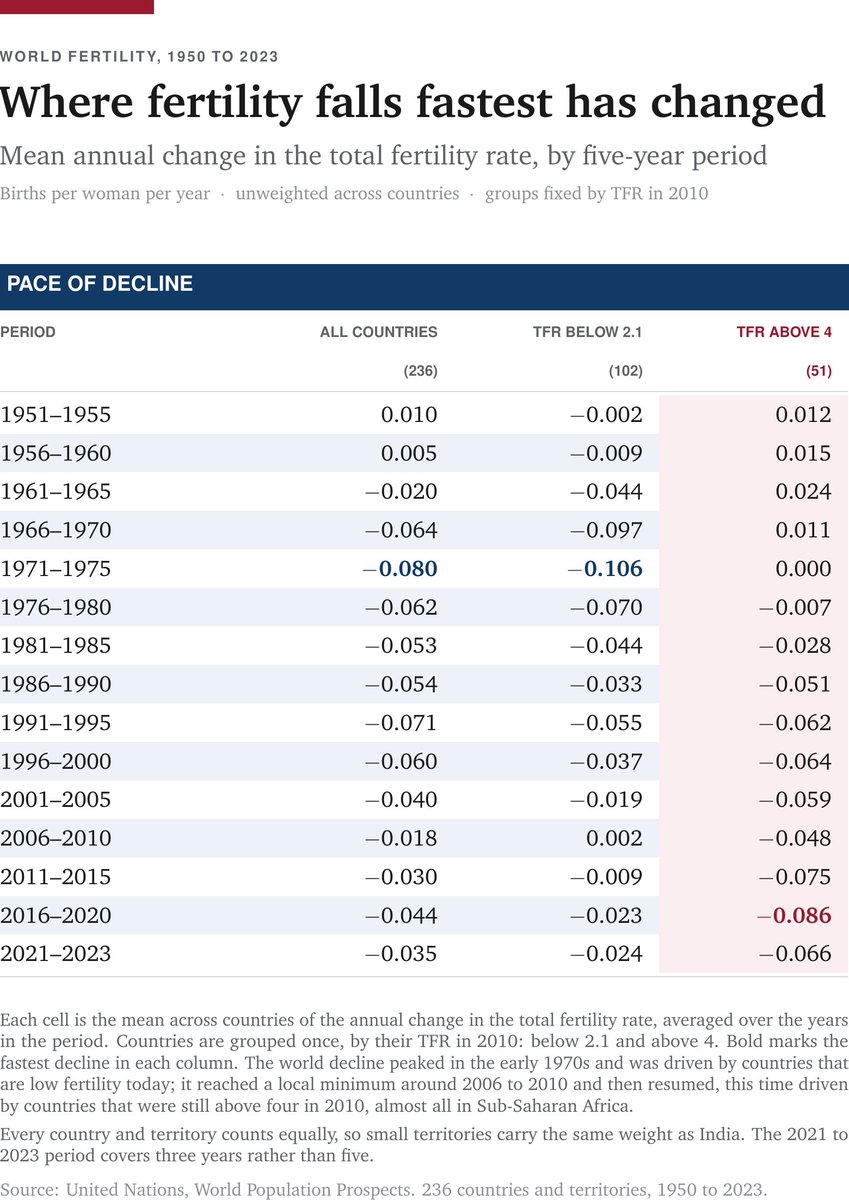
I compute the average fall of TFRs in all 236 countries and territories every five years, as well as the fall in countries that, according to the dataset, were below 2.1 (roughly the replacement rate) and above 4 in 2010. That gives us an indication of how TFRs are moving in low- and high-fertility countries.
For all countries and territories, the average TFR has been falling by 0.062 children per woman per year from 1950 to 2023 (the last year for which the database reports historical data rather than future scenarios). That is amazing, in particular because there was no drop to speak of before 1960. Interestingly, there is no acceleration in the last 10-15 years: the most recent drops follow historical patterns.
In low fertility countries, the interesting thing is that 2006-2015 were years of pause in the fall of fertility. 2016-2023 is not so much an acceleration as the resumption of a trend that had stopped momentarily. In high-fertility countries, we do see an acceleration of the fall since 2010. An annual drop of 0.086 children per woman, as we observed in 2016-2020, is truly exceptional. At that speed, you move from 4 to 3 children per woman in one decade.
Where do these observations leave us?
Two non-competing possibilities. First, that the UN World Population Prospects 2024 has missed part of the worldwide decline in fertility and that the new release will support the acceleration story more clearly.
Second, that the fall of fertility is an unrelenting consequence of modernity, that is, of the increasing rational organization of society, with higher degrees of division of labor and individualistic aspirations. I emphasize modernity, not capitalism: fertility fell earlier and faster in socialist economies than in comparable capitalist countries. So no, this is not about capitalism. Sometimes the fall is faster, perhaps aided by new technologies such as smartphones. Sometimes the fall is slower, perhaps because of economic booms as in the 1950s. But reading too much into transitory phenomena, as important as they are for understanding short-term dynamics, risks missing the main point: modernity means, sooner or later, ultra-low fertility nearly everywhere (yes, no need to mention Israel).
Humanity entered a whole new historical era in the late 18th century. We have not even started to see its first-round consequences.
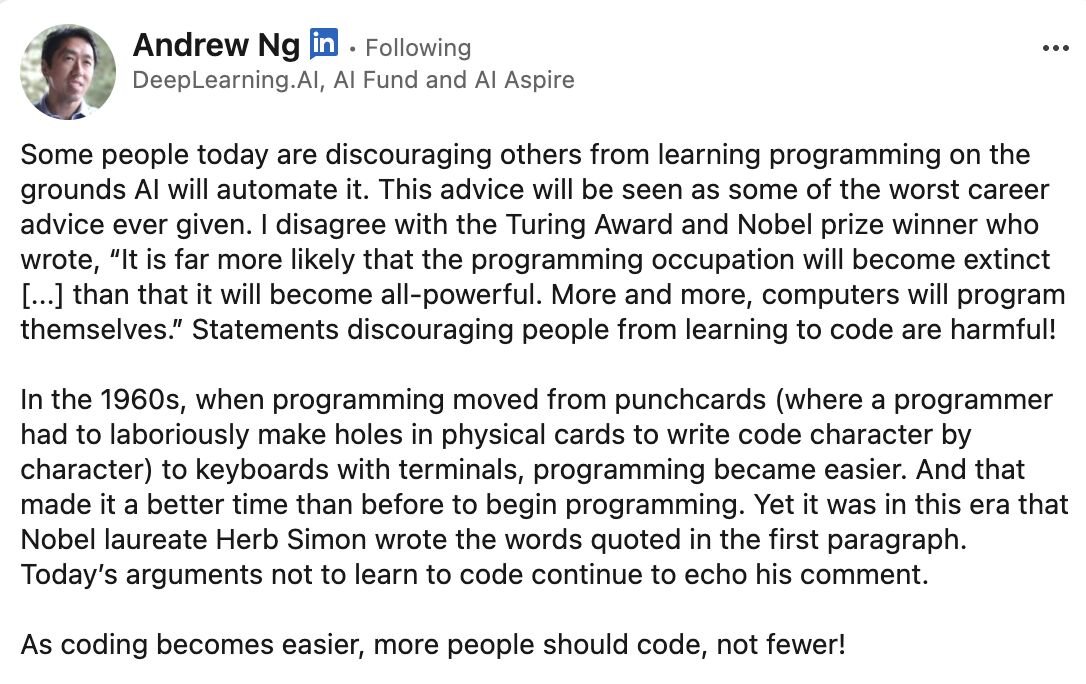
"Do not learn to code" is the worst career advice of the decade.
People are telling college students to skip Computer Science because AI will just automate it all. Andrew Ng just killed this myth at Stanford with a brilliant analogy.
When he tried to generate images with Midjourney, he typed: "make pretty pictures of robots" and got garbage.
His collaborator, however, understood Art History. He knew the exact vocabulary of lighting, genre, and palette. He spoke the "language of art," and generated masterpieces.
Andrew Ng is seeing the exact same thing happen in software engineering right now.
AI didn't replace the need to understand Computer Science. It made Computer Science the required vocabulary to control the AI.
If you don't understand how computers actually work, you are just typing "make a pretty app" into Cursor and shipping fragile, unscalable logic.
Here is Andrew Ng's exact hiring hierarchy today:
Level 1: 10 years of experience, but codes by hand (He won't hire them).
Level 2: Fresh college grad, but highly fluent in AI-assisted coding (He hires them over the 10-year veteran).
Level 3 (God Tier): Deeply understands CS fundamentals AND uses AI-assisted coding.
When humanity went from punch cards to keyboards, coding got easier, and more people coded. We are at that exact inflection point again.
AI doesn't replace fundamentals. It multiplies them.
@cesaretamayo Estudié este problema en Texas. La comida saludable pierde con la ultraprocesada (UP) en contextos de escasez y genera desiertos de comida. Satisfacerse con UP es más barato y requiere menos preparación; por su grasa, azúcar y sal genera adicción, con costos altísimos en salud.
hoy es un día terrible: los partidos de cada grupo pasan a ser a la misma hora. y el futuro es peor: cada vez menos partidos hasta que un día se termina el mundial.