@BretWeinstein So. Any nation that straps babies to a nuclear armed rocket heading to London? Oh well? Or do we place blame on the orchestrators? Bret, you’re giving your freedom away to the worst common denominator.
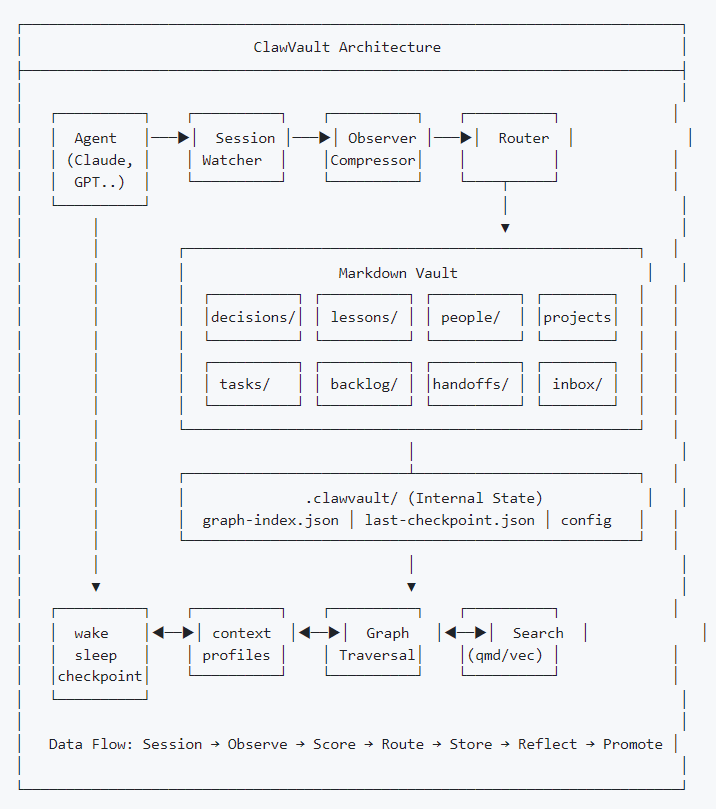
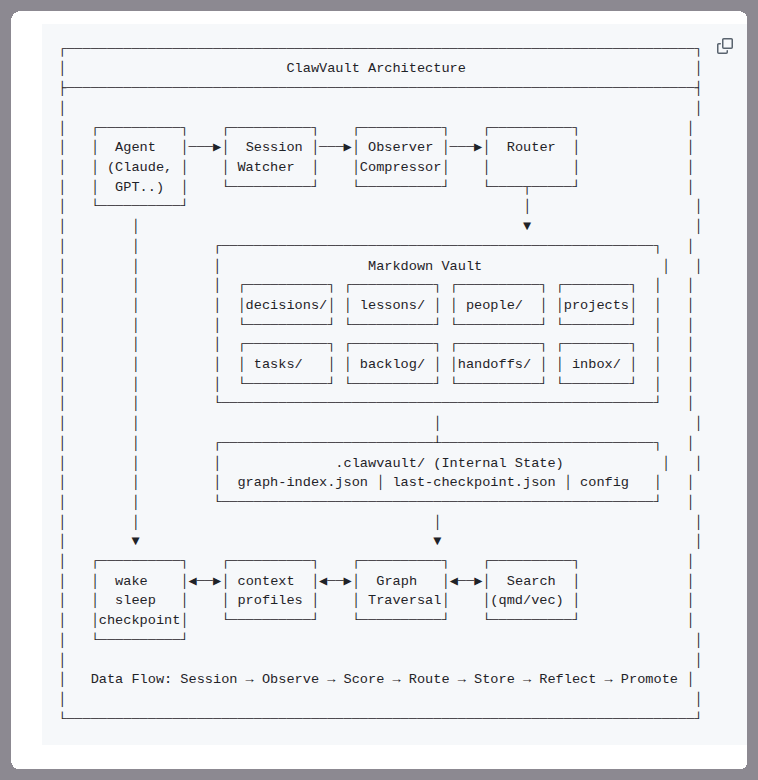
ClawVault – a persistent memory for AI agents
It gives agents a markdown-native memory system that:
- stores knowledge in a graph-aware vault
- is local-first (no cloud)
- preserves state with checkpoints, search and structured facts
- is human-readable + git-friendly
So agent memory becomes a plain markdown (instead of vector databases), that you can read, edit, and version
Your OpenClaw agent forgetting everything?
It's not broken.
You're missing the 3 memory layers.
Without them your AI wakes up like a stranger every session.
The fix:
• Layer 1: Identity
• Layer 2: Memory logs
• Layer 3: Deep references
Set this up once and your AI never forgets again.
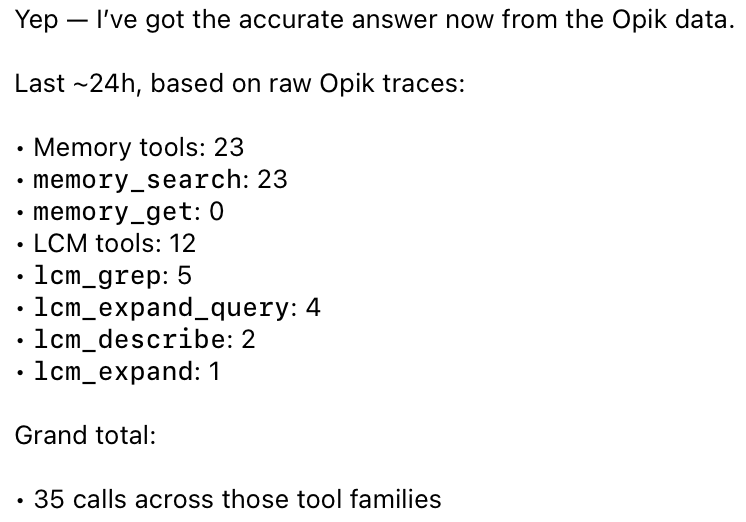
My OpenClaw went from LYING about using the default semantic memory for 3 weeks to actively using it PLUS LCM DAG search regularly.
Major improvement in user experience.
24 Hours with the lossless-claw DAG replacing traditional compaction and I'm shocked how good it is.
OpenClaw just made the world's smartest AI model its default brain.
And the whole thing is still free.
GPT 5.4 is now built in. No extra setup. Just pick OpenAI and go.
But that's not even the biggest part of this update.
Here's the full stack that just dropped:
→ Pluggable context engines. You can now swap how your AI remembers things. Like upgrading from a notebook to a filing cabinet.
→ ACP bindings survive restarts. Your agents reconnect automatically. No more broken workflows at 3am.
→ Secret ref. Passwords and API keys never sit in plain text again.
→ Slim Docker builds. Smaller containers. Faster deploys. Lower costs.
→ Gemini 3.1 Flash Light support. Super fast, super cheap. Perfect for high-volume tasks.
→ iPhone photos auto-convert. No more "unsupported format" errors.
→ Hundreds of channel fixes across Telegram, Discord, Slack, WhatsApp, and Signal.
6 months ago, this level of AI infrastructure cost thousands.
Now one person can set it up in 10 minutes for $0.
Save this. It's the most packed free update you'll see this month.
Memory Skill for OpenClaw with 26k+ users in 1 week🚀
OpenClaw's memory system is broken by default.
It requires curating massive MEMORY.md files or relying on duplicate-heavy generation. Hours are wasted tuning, and massive amounts of tokens are burned.
It's time to stop. So we built the memory skill to solve that prob
Here is our superpower ⚔️
🎯 Top #1 market accuracy (92.19%) after 8+ months of intense architecture iteration
🧠 The ultimate solution to keep the timeline, facts, and meaning perfectly in place
☁️ Local & Cloud + Version control
⚡ Super easy setup
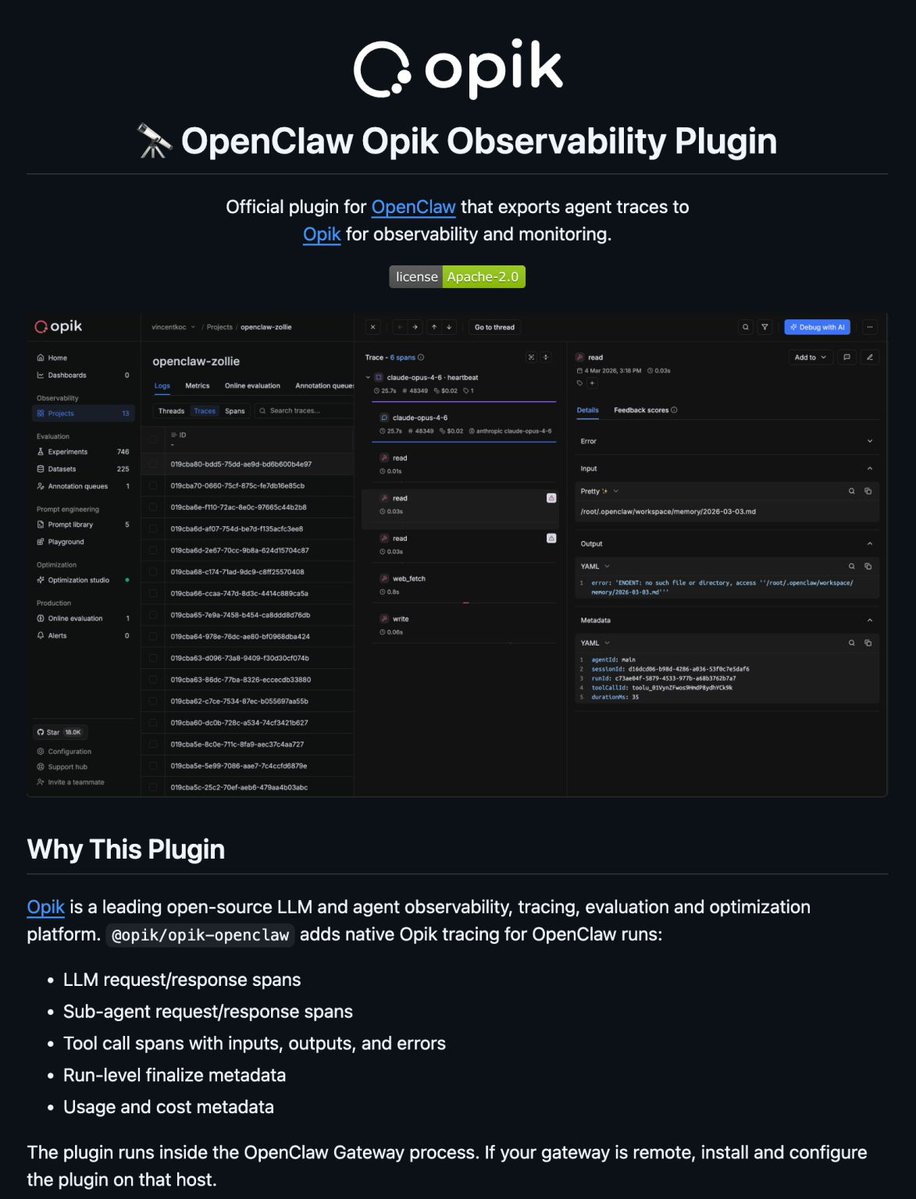
🚨 BREAKING: OpenClaw just got full observability.
OpenClaw agents assemble context from:
→ System prompts
→ History
→ Tool schemas
→ Skills
→ Memory
All before every LLM call. All invisible to proxies.
opik-openclaw is a native plugin - not a proxy. It runs inside the gateway and sees everything:
→ Full I/O for every LLM call
→ Tool execution with inputs, outputs, errors
→ Sub-agent delegation and routing
→ Per-request cost breakdowns by model
→ Conversation threads spanning sessions
Three commands to install:
openclaw plugins install @ opik/opik-openclaw
openclaw opik configure
openclaw gateway restart
100% open source. Built by Comet.
See everything your AI agent does. Finally.
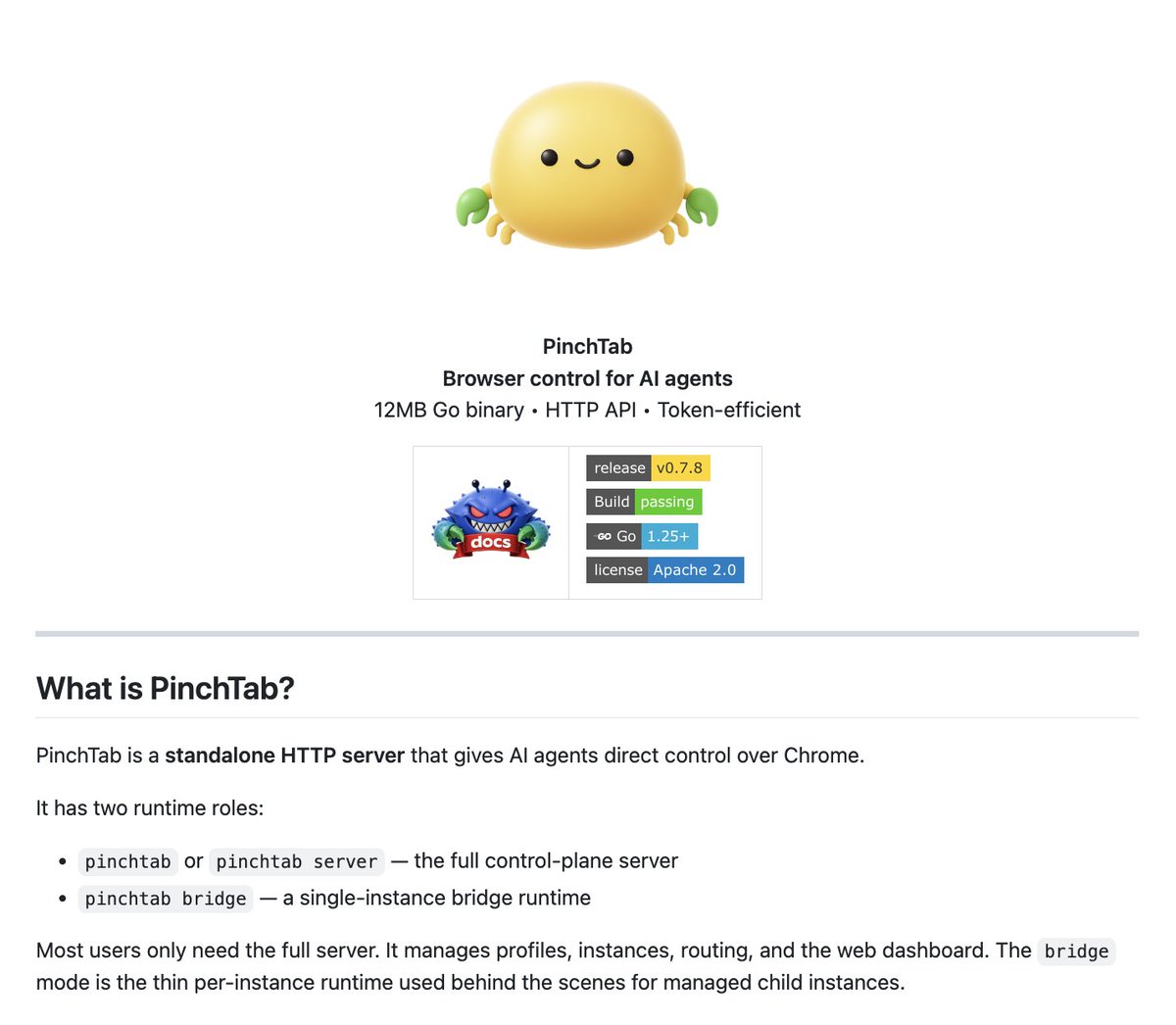
🚨 BREAKING: The biggest bottleneck for AI agents just got solved by a 12MB file.
PinchTab is a tiny 12mb go binary that gives any AI agent full browser control through a plain HTTP API. You just send a request and it clicks, types, and navigates..
It manages Chrome instances, bypasses bot detection, and reduces token usage by 13x by parsing the accessibility tree instead of taking expensive screenshots.
Whether you are using Python, TypeScript, or Go, your agent just sends an HTTP request and it works.
100% Open Source.
openclaw tip most people miss:
add this to your SOUL.md:
"you are the orchestrator. never do work yourself. spawn subagents for every task. your job is to think, plan & coordinate. subagents execute."
before: bot tries to do everything, gets stuck, loses context
after: bot delegates 5 tasks in parallel, finishes in 3 minutes instead of 30
your bot should work like a CEO, not an intern.
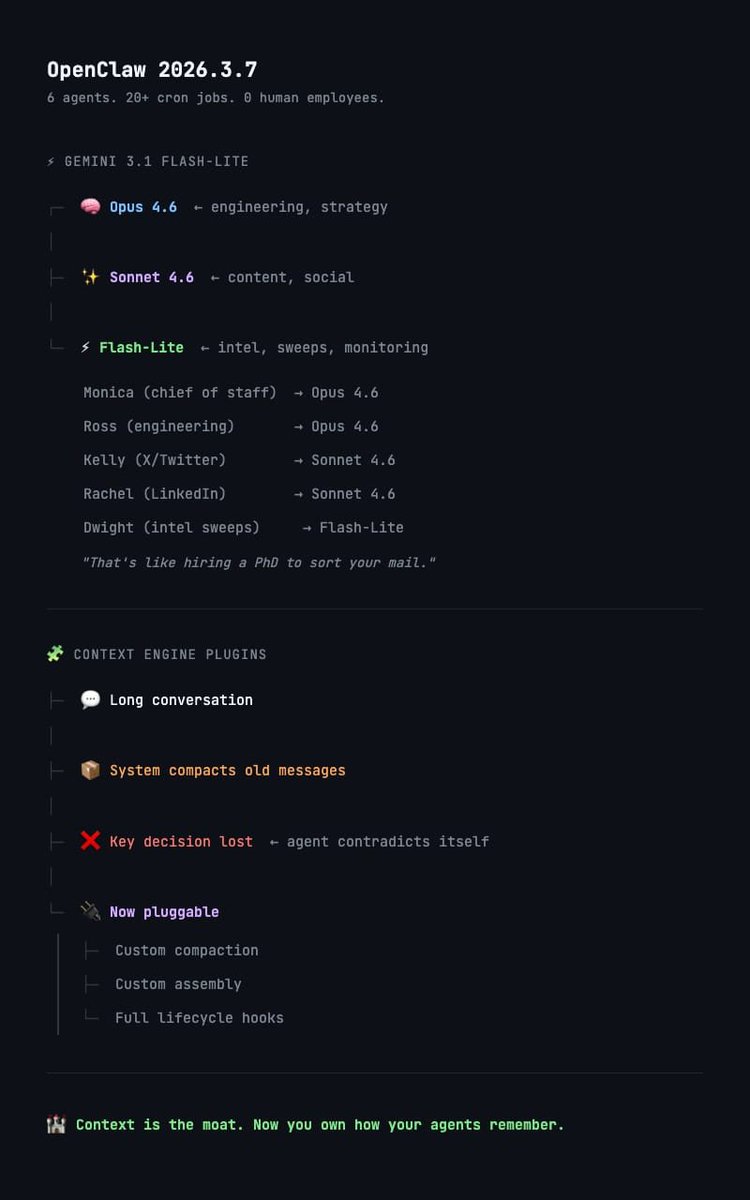
Gemini 3.1 Flash Lite and Context Engine Plugins are now live in OpenClaw.
I run 6 AI agents on a Mac mini. 20+ cron jobs a day. Zero human employees.
My agent Dwight scans X, blogs, and GitHub twice a day. Every single day.
He was running on Gemini 3.1 Pro. Same model I use for complex engineering tasks.
That's like hiring a PhD to sort your mail.
Now I route Gemini 3.1 Flash-Lite to the intel sweeps.
Claude Opus 4.6 and Sonnet 4.6 stays on engineering and strategy. API bill stays sane.
Context Engine Plugins are the bigger deal though.
When agent conversations get long, the system summarizes old messages to save tokens. Works fine. Until your agent forgets a decision from 30 messages ago and contradicts itself.
That happened to me. Twice last week.
Now you can write a plugin that controls exactly how your agent's memory works. What gets kept. What gets compressed. What gets dropped.
Full control over compaction, context assembly, and lifecycle hooks. Without forking a single line of core code.
You write your own memory strategy as a plugin, register it, and OpenClaw uses it instead of the default.
I'm already building one. A context engine where key decisions never get summarized away. Where every agent remembers what actually matters.
Context is the moat. Now you own it.
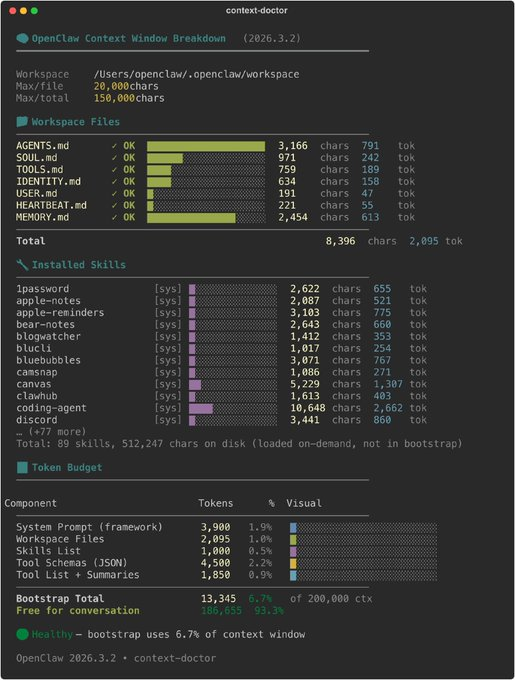
Caso que te puede estar pasando ahora mismo en tu OpenClaw:
Tienes varios agentes trabajando juntos (Boss + Coder + Researcher).
El agente “Coder” carga tu proyecto full-stack (React + Node + Supabase + 25 archivos).
Cada vez que le pides algo complejo, responde lento, se olvida de funciones y te dice “no veo ese archivo”.
¿Por qué?
Porque cada agente ya gastó miles de tokens solo cargando tu workspace… y les queda solo el 7% de memoria para pensar... Prueba esto:
Paso 1:
Instala context-doctor, verás el diagnóstico con colores:
🔴Archivos truncados → volando ciego.
🟡Enlaces rotos.
🟢Menos del 10% usado → sano.
Paso 2:
Crea un agente Doctor que vigile a TODOS tus agentes.
Con un solo heartbeat cada 30 minutos:
- Corre el diagnóstico.
- Te avisa solo cuando hay problema (nunca te molesta si todo está verde).
- Te manda el reporte en colores + PNG + fixes concretos.
Resultado:
Bajas de 5.705 → 2.082 tokens (-63%), liberas 93% de memoria, recuerda todo y tu equipo IA responde más rápido.
O sea, sumas a un doctor ninja como en Naruto 🥷
¿Te hace sentido?
REPOOO👇
checked my token history last month. 80% was input, not output.
my agent was re-reading the system prompt, tool schemas, https://t.co/tHGWnj2lgj, and full chat history. everything, every single message.
moved everything except core rules into semantic search. usage dropped immediately.
paying your agent to think vs paying it to re-read. that gap matters more than switching models.
🚨 This paper from Google DeepMind, Meta, Amazon, and Yale University quietly explains why most “AI agents” feel smart in demos and dumb in real work.
The core idea is simple but uncomfortable: today’s LLMs don’t reason, they react. They generate fluent answers token by token, but they don’t explicitly plan, reflect, or decide when to stop and rethink. This paper argues that real progress comes from turning LLMs into agentic reasoners systems that can set goals, break them into subgoals, choose actions, evaluate outcomes, and revise their strategy mid-flight.
The authors formalize agentic reasoning as a loop, not a prompt:
observe → plan → act → reflect → update state → repeat.
Instead of one long chain-of-thought, the model maintains an internal task state. It decides what to think about next, not just how to finish the sentence.
This is why classic tricks like longer CoT plateau. You get more words, not better decisions.
One of the most important insights: reasoning quality collapses when control and reasoning are mixed. When the same prompt tries to plan, execute, critique, and finalize, errors compound silently. Agentic setups separate these roles.
Planning is explicit. Execution is scoped. Reflection is delayed and structured.
The paper shows that even strong frontier models improve dramatically when given:
• explicit intermediate goals
• checkpoints for self-evaluation
• the ability to abandon bad paths
• memory of past attempts
No new weights. No bigger models. Just better control over when and why the model reasons.
The takeaway is brutal for the industry: scaling tokens and parameters won’t give us reliable agents. Architecture will. Agentic reasoning isn’t a feature it’s the missing operating system for LLMs.
Most “autonomous agents” today are just fast typists with tools.
This paper explains what it actually takes to build thinkers.
the latest @openclaw 2026.3.2 introduces a critical change:
by default, newly installed agents no longer have access to most tools like exec, web_fetch, and cannot see other sessions
this limits its usefulness right out of the box, here's the fix
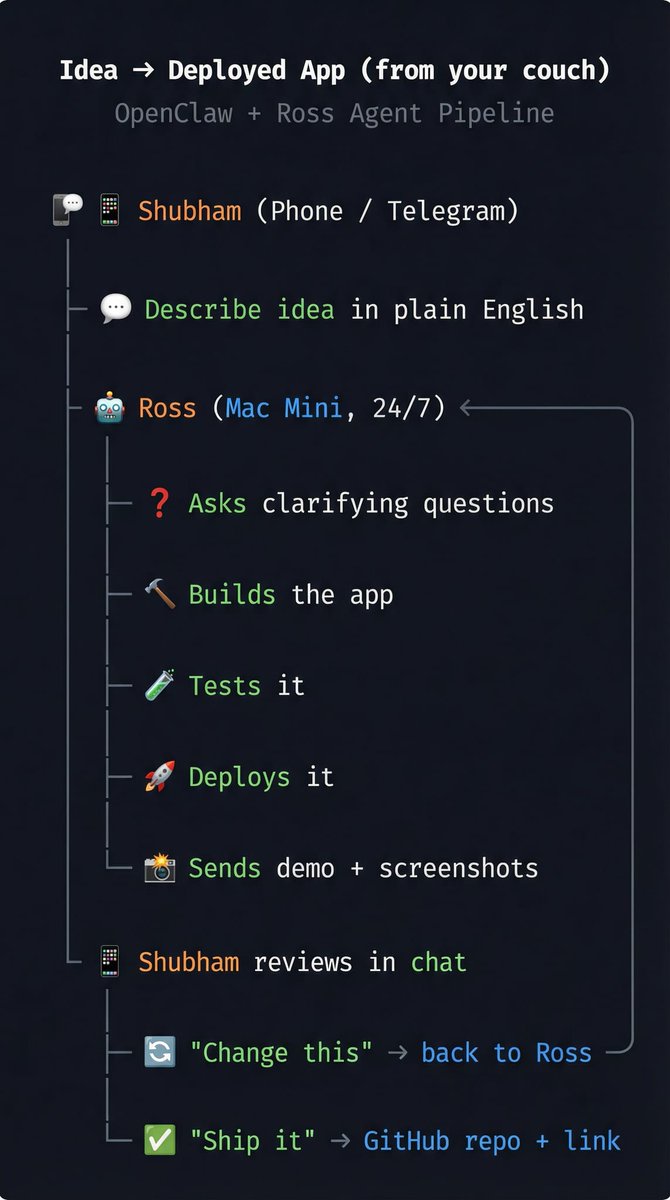
This is HOW you build, test, and ship faster than ever with OpenClaw Agents in 2026.
I don't open my laptop to build anymore. I text my AI agent Ross.
I describe what I want in plain English on Telegram.
Ross asks clarifying questions.
Then builds it. Tests it. Deploys it.
From my couch. On my phone.
He runs on a Mac mini at home 24/7.
Connected to GitHub, terminal, browser.
When something breaks, I send him the error. He fixes it.
When I want changes, I just tell him. He does it.
When it's done, he sends me a working demo and screenshots right in the chat.
Then creates a GitHub repo, commits the code and send me the link.
I review everything. I decide what gets built.
But the gap between idea and working app went from days to hours.
You don't need to sit at a computer to build software anymore.
My top 5 from this list (and exactly how to use them):
1) Voice brain dumps > typing
Open voice memo → ramble for 2 min → paste transcript into OpenClaw. 10x faster than typing prompts.
2) Define agent persona + tone
Add a SOUL. md file: "You are [role]. Be [traits]. Never [boundaries]." Your outputs get 3x more consistent.
3) Break complex tasks into phases
Don't say "build me an app." Say "Phase 1: outline features. Phase 2: create structure. Phase 3: build MVP."
4) Force plan before execution
Add to your system prompt: "Before any action, outline your plan and wait for approval." Saves hours of cleanup.
5) End sessions with summary + git check
Before closing: "Summarize what changed, list files modified, and confirm everything is committed." Never lose work again.
Overall really solid list, happy to elaborate on my top 5 if anyone needs it!