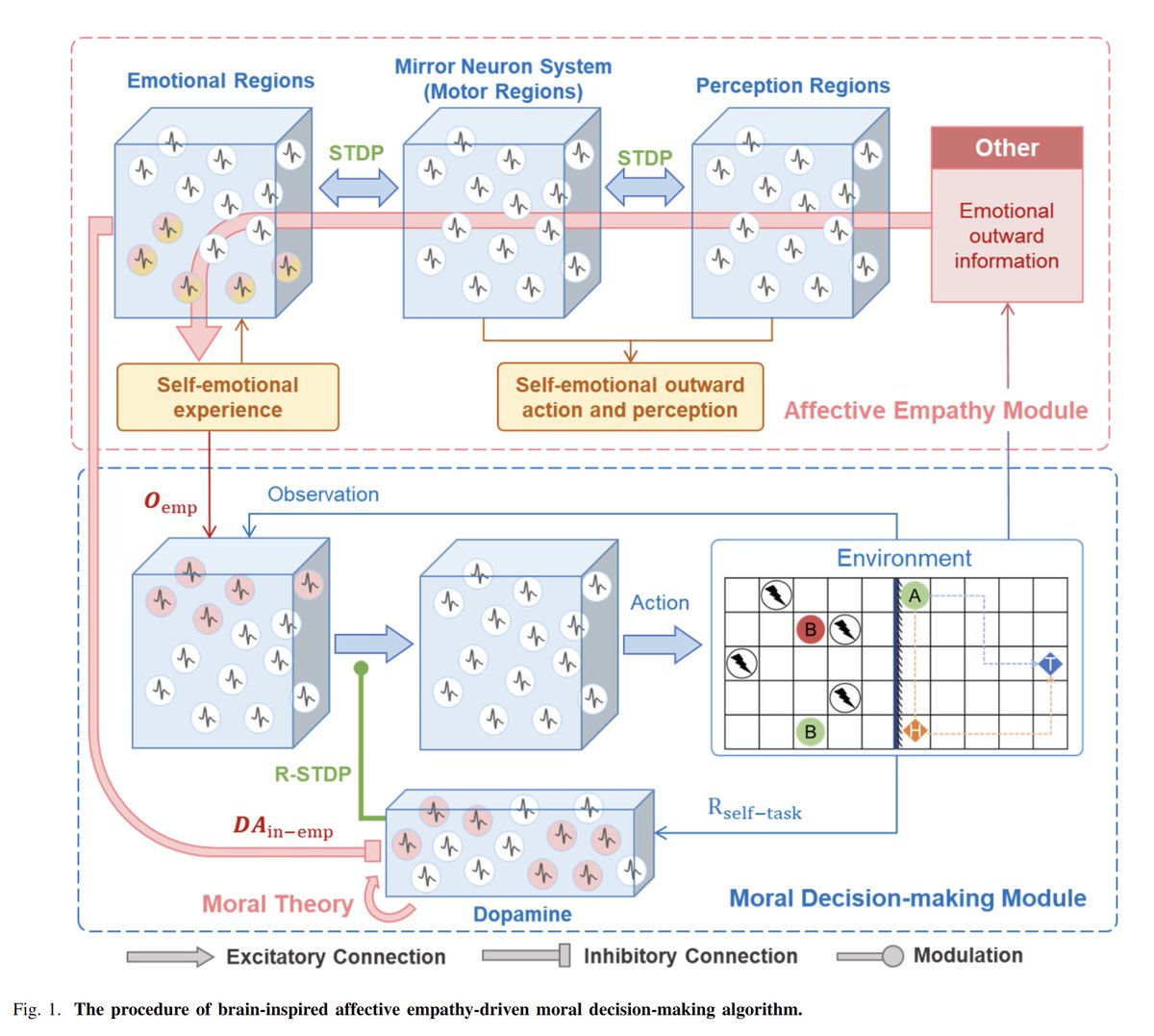
Researchers built an 'empathy mechanism' into an agent's architecture with a technique that mirrors neurons. So here (in a simple grid world) the reward comes from the agent's own emotional response through dopamine modulation, rather than from external rules or rewards. Cool approach to drive altruistic behavior, but less clear to me how that might apply to language models over SNNs. https://t.co/8JCa7qIavG
Over the past few months, our Interpretability team has put out a number of smaller research updates. Here’s a thread of some of the things we've been up to:
From breathtaking views to profound discussions on Responsible AI, @AILA_Community’s gathering was a powerful kickstart to the weekend. Panelists from government, industry, and academia shared how California can lead the way in ethical AI development. #LATechWeek
Honored to have moderated a panel today on personalized medicine and value-based care for health equity for @AILA_Community Life Summit. We explored the value and limits of existing use cases. Of course we discussed #ResponsibleAI 😊🚀
Amidst a stunning backdrop, an impactful evening of dialogue unfolded around Responsible AI, featuring insights from leaders in government, industry, and academia. 🌍 Panelists stressed the importance of collaboration across sectors to guide the future of AI ethics. #LATechWeek@AILA_Community
Super excited to be moderating this panel tomorrow to close @Techweek_ in LA! We’ll be discuss the state of #ResponsibleAI with representatives from govt, academia, industry and non-profits! Come join ☺️
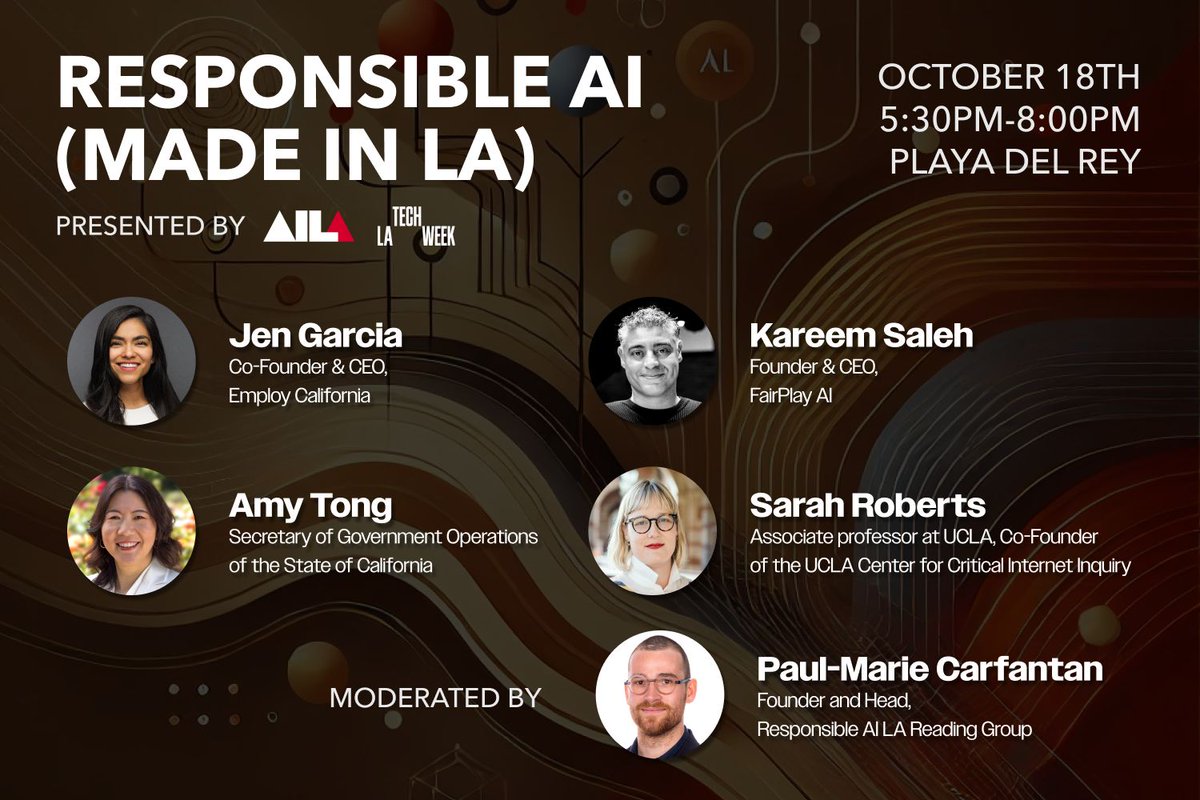
To kick-start the weekend of @Techweek_ , on October 18th, AI LA is hosting a special Responsible AI evening in Playa Del Rey, bringing together leading local voices in the field. This intimate rooftop gathering aims to elevate dialogue on Responsible AI development in the Greater Los Angeles area.
We are gathering four distinguished speakers to represent key perspectives on Responsible AI: academia, government, industry, and non-profits. Each speaker will share their unique insights on their Responsible AI work, engage in meaningful discussions on the state of the field in Los Angeles, and help shape the future of AI ethics in our region.
Introducing our speakers:
- Jen García – Co-Founder & CEO, Employ California
- Amy Tong – Secretary of Government Operations of the State of California
- Kareem Saleh – Founder & CEO, FairPlay AI
- Sarah T. Roberts, Ph.D. – Associate professor at UCLA, Co-Founder of the UCLA Center for Critical Internet Inquiry
This panel will be moderated by Paul-Marie Carfantan, Founder & Head of the AI LA reading group.
Join the waitlist for this event today! https://t.co/XciLM90jBk
This event offers not only a platform to learn from Responsible AI experts but also to network with influential figures in a relaxed, picturesque setting.
As this month focuses on AI’s impact on media & the election, the Responsible AI Reading Group welcomes Ulrike Klinger to discuss her paper on Algorithms, Power and Digital Politics.
Join us on 10/10 at 4:30pm PST! Register here https://t.co/bNuDjRJA55
Ulrike Klinger is a Professor for Digital Democracy at the European New School for Digital Studies at European University Viadrina in Frankfurt (Oder) in Germany, where she runs the Digital Campaigns and Elections Lab (DiCE), and an Associated Researcher at the Weizenbaum Institute for the Networked Society in Berlin. Her research focuses on political communication, the transformation of digital publics, and the role of technologies in democratic societies. From September to December 2024, Ulrike is a senior fellow at the Thomas Mann House Los Angeles.
#AILA #ReadingGroup #ResponsibleAI #LongLA
🚨 [AI REGULATION] @UNESCO published its "Consultation Paper on AI Regulation - Emerging Approaches Across the World," and it's a MUST-READ for everyone in AI governance. Important information:
➵ Among other topics, the consultation paper describes 9 regulatory approaches (with examples from around the world) that are extremely interesting to anyone working or studying AI governance & regulation:
"1️⃣ Principles-Based Approach: Offer stakeholders a set of fundamental propositions (principles) that provide guidance for developing and using AI systems through ethical, responsible, human-centric, and human-rights-abiding processes.
2️⃣ Standards-Based Approach: Delegate (totally or partially) the state’s
regulatory powers to organizations that produce technical standards that
will guide the interpretation and implementation of mandatory rules.
3️⃣ Agile and Experimentalist Approach: Generate flexible regulatory schemes, such as regulatory sandboxes and other testbeds, that allow organizations to test new business models, methods, infrastructure, and tools under more flexible regulatory conditions and with the oversight and accompaniment of public authorities.
4️⃣ Facilitating and Enabling Approach: Facilitate and enable an environment that encourages all stakeholders involved in the AI lifecycle to develop and use responsible, ethical, and human rights-compliant AI systems.
5️⃣ Adapting Existing Laws Approach: Amend sector-specific rules (e.g., health, finance, education, justice) and transversal rules (e.g., criminal codes, public procurement, data protection laws, labor laws) to make incremental improvements to the existing regulatory framework.
6️⃣ Access to Information and Transparency Mandates Approach: Require the
deployment of transparency instruments that enable the public to access basic information about AI systems.
7️⃣ Risk-Based Approach: Establish obligations and requirements in accordance with an assessment of the risks associated with the deployment and use of certain AI tools in specific contexts.
8️⃣ Rights-Based Approach: Establish obligations or requirements to protect individuals' rights and freedoms.
9️⃣ Liability Approach: Assign responsibility and sanctions to problematic
uses of AI systems."
➵ It's important to notice that the regulatory approaches described above are not mutually exclusive, and AI laws around the world will often combine two or more approaches.
➵ The paper will be available for open public consultation in English until 19 September 2024.
➵ Link to download the document below.
🔥 To stay up to date with the latest developments in AI policy, compliance & regulation, join 32,600 people who subscribe to my weekly newsletter (link below).
Researchers from MIT and other institutions have released the AI Risk Repository, a comprehensive database of hundreds of documented risks posed by AI systems! #AIGovernance#ResponsibleAI https://t.co/MisfSiY0ib
AI LA is excited to host Justin Wales, the Head of Legal for the Americas of https://t.co/1pbrdCTGKk for a conversation around digital assets and AI policy. Justin has recently published his authoritative book “Crypto Law Handbook,” which has been acclaimed for its in depth discussion of cutting edge crypto issues. The conversation will discuss issues surrounding crypto and its intersection with AI as both fields develop exponentially.
Date: Monday, August 19th
Location: Santa Monica, CA
RSVP: https://t.co/YpPENsOCfo
#AILA #ArtificialIntelligence #AIPolicy
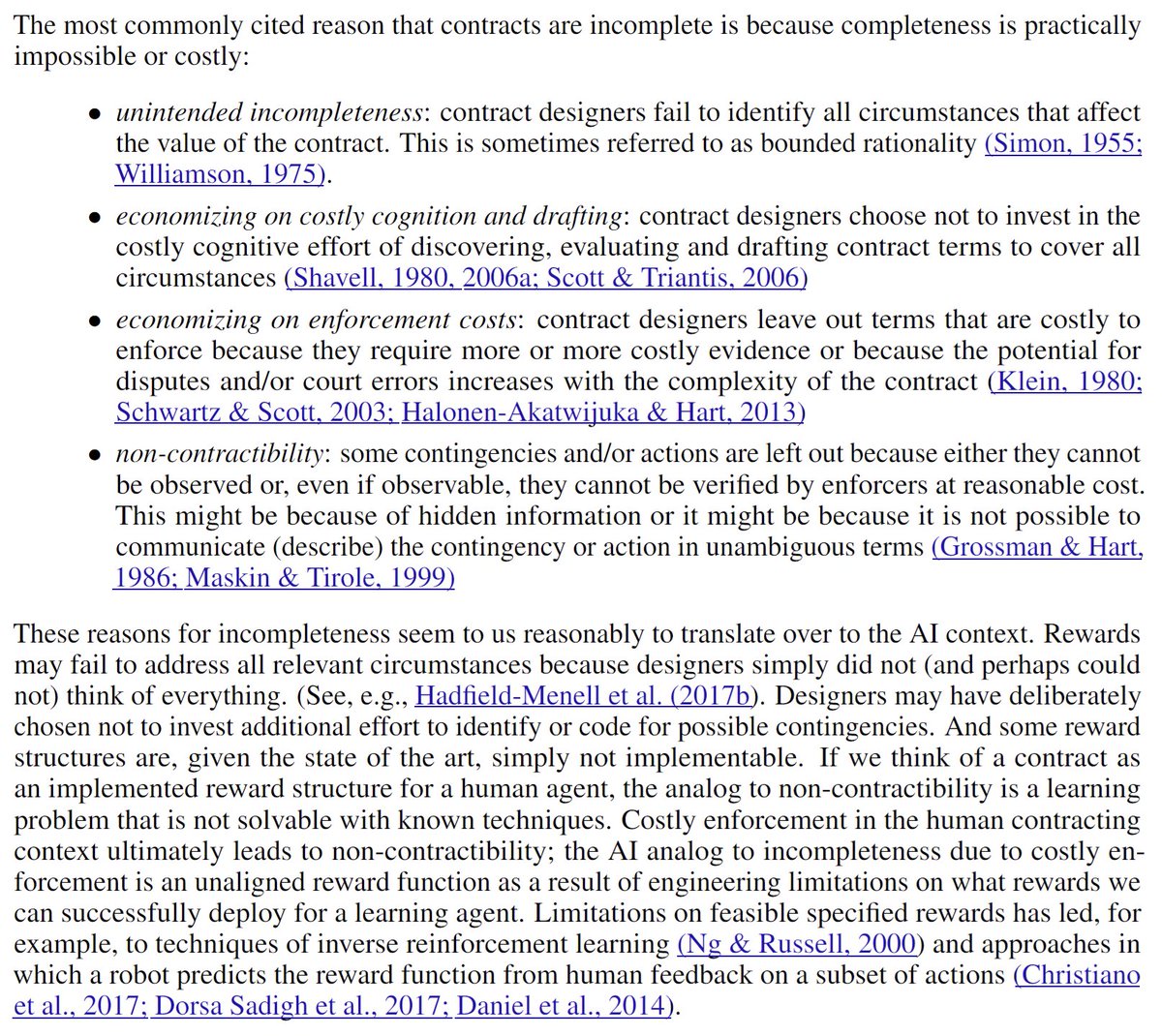
Nice paper by Gillian Hadfield and Dylan Hadfield-Mennel. Robust alignment will require developing artificial agents that can engage with broader human normative and social structures, rather than relying solely on pre-specified reward functions. At a high level this seems self-evident, but in practice this will lead to all kinds of interesting situations for us to deal with, learn from, and adapt to. https://t.co/NCmKlaDIQG
Tomorrow, I'll be joining this panel led by NIST & the National Artificial Intelligence Advisory Committee (NAIAC) on defining and operationalizing competing notions of "AI safety".
This is such an important, ongoing discussion; hope folks can tune in!
https://t.co/8kX0nNzSQr
🚨 Massive AI Security Release 🚨
@NIST just put out the best AI Security Publication that I've ever seen.
It is 106 pages of deep, technical content. It references real-world practical attacks. In this thread is the link and I'm going to cover a few highlights. 👇
My meta-takeaway from the full text of the Executive Order on AI is that in the next 6-12 months there will be an unfathomable number of guidelines, rulemaking processes, reports, whitepapers, working groups, public comments, panels, and whatnot. https://t.co/8L0ySlvqtl












![LuizaJarovsky's tweet photo. 🚨 [AI REGULATION] @UNESCO published its "Consultation Paper on AI Regulation - Emerging Approaches Across the World," and it's a MUST-READ for everyone in AI governance. Important information:
➵ Among other topics, the consultation paper describes 9 regulatory approaches (with examples from around the world) that are extremely interesting to anyone working or studying AI governance & regulation:
"1️⃣ Principles-Based Approach: Offer stakeholders a set of fundamental propositions (principles) that provide guidance for developing and using AI systems through ethical, responsible, human-centric, and human-rights-abiding processes.
2️⃣ Standards-Based Approach: Delegate (totally or partially) the state’s
regulatory powers to organizations that produce technical standards that
will guide the interpretation and implementation of mandatory rules.
3️⃣ Agile and Experimentalist Approach: Generate flexible regulatory schemes, such as regulatory sandboxes and other testbeds, that allow organizations to test new business models, methods, infrastructure, and tools under more flexible regulatory conditions and with the oversight and accompaniment of public authorities.
4️⃣ Facilitating and Enabling Approach: Facilitate and enable an environment that encourages all stakeholders involved in the AI lifecycle to develop and use responsible, ethical, and human rights-compliant AI systems.
5️⃣ Adapting Existing Laws Approach: Amend sector-specific rules (e.g., health, finance, education, justice) and transversal rules (e.g., criminal codes, public procurement, data protection laws, labor laws) to make incremental improvements to the existing regulatory framework.
6️⃣ Access to Information and Transparency Mandates Approach: Require the
deployment of transparency instruments that enable the public to access basic information about AI systems.
7️⃣ Risk-Based Approach: Establish obligations and requirements in accordance with an assessment of the risks associated with the deployment and use of certain AI tools in specific contexts.
8️⃣ Rights-Based Approach: Establish obligations or requirements to protect individuals' rights and freedoms.
9️⃣ Liability Approach: Assign responsibility and sanctions to problematic
uses of AI systems."
➵ It's important to notice that the regulatory approaches described above are not mutually exclusive, and AI laws around the world will often combine two or more approaches.
➵ The paper will be available for open public consultation in English until 19 September 2024.
➵ Link to download the document below.
🔥 To stay up to date with the latest developments in AI policy, compliance & regulation, join 32,600 people who subscribe to my weekly newsletter (link below).](https://pbs.twimg.com/media/GV02Nc_XsAA4LwQ.jpg)