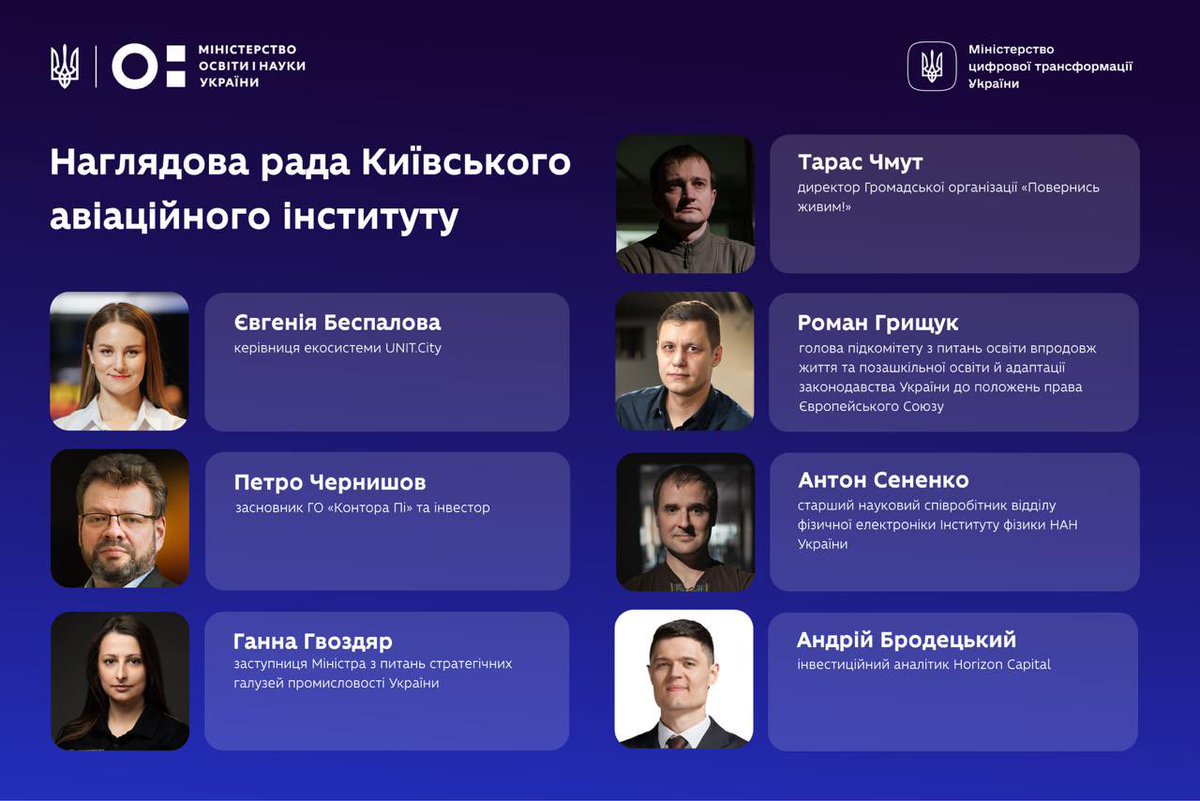
Нова Наглядова Рада КАІ
Вітаємо @TarasChmut@politehnik, Антона Сененко і Євгенію Беспалову,
які доєднались до великої справи зміни підходів до управління університетом.
Last quarter I rolled out Microsoft Copilot to 4,000 employees.
$30 per seat per month.
$1.4 million annually.
I called it "digital transformation."
The board loved that phrase.
They approved it in eleven minutes.
No one asked what it would actually do.
Including me.
I told everyone it would "10x productivity."
That's not a real number.
But it sounds like one.
HR asked how we'd measure the 10x.
I said we'd "leverage analytics dashboards."
They stopped asking.
Three months later I checked the usage reports.
47 people had opened it.
12 had used it more than once.
One of them was me.
I used it to summarize an email I could have read in 30 seconds.
It took 45 seconds.
Plus the time it took to fix the hallucinations.
But I called it a "pilot success."
Success means the pilot didn't visibly fail.
The CFO asked about ROI.
I showed him a graph.
The graph went up and to the right.
It measured "AI enablement."
I made that metric up.
He nodded approvingly.
We're "AI-enabled" now.
I don't know what that means.
But it's in our investor deck.
A senior developer asked why we didn't use Claude or ChatGPT.
I said we needed "enterprise-grade security."
He asked what that meant.
I said "compliance."
He asked which compliance.
I said "all of them."
He looked skeptical.
I scheduled him for a "career development conversation."
He stopped asking questions.
Microsoft sent a case study team.
They wanted to feature us as a success story.
I told them we "saved 40,000 hours."
I calculated that number by multiplying employees by a number I made up.
They didn't verify it.
They never do.
Now we're on Microsoft's website.
"Global enterprise achieves 40,000 hours of productivity gains with Copilot."
The CEO shared it on LinkedIn.
He got 3,000 likes.
He's never used Copilot.
None of the executives have.
We have an exemption.
"Strategic focus requires minimal digital distraction."
I wrote that policy.
The licenses renew next month.
I'm requesting an expansion.
5,000 more seats.
We haven't used the first 4,000.
But this time we'll "drive adoption."
Adoption means mandatory training.
Training means a 45-minute webinar no one watches.
But completion will be tracked.
Completion is a metric.
Metrics go in dashboards.
Dashboards go in board presentations.
Board presentations get me promoted.
I'll be SVP by Q3.
I still don't know what Copilot does.
But I know what it's for.
It's for showing we're "investing in AI."
Investment means spending.
Spending means commitment.
Commitment means we're serious about the future.
The future is whatever I say it is.
As long as the graph goes up and to the right.
People—teachers, students, parents—have been complaining for a century that memorization is pointless when ”you can just look it up“.
This complaint predates AI, it predates Google, it predates this internet.
But it’s wrong. Here’s Pauling on why he gave closed notes exams:
I spent 6 years at Enron right out of college, including through the bankruptcy, but I didn’t really grasp what happened until I studied GE. It’s basically the same story.
GE was an industrial company that transformed into a conglomerate under a hard-charging, visionary CEO. Early success and a high-growth culture led to significant expansion and a variety of business lines, including heavy industry, healthcare, media, appliances, financial services, and insurance.
The p/e multiple of each unit independently would have been roughly 10x (GE Capital) to 30x (Healthcare). But with years of high and consistent earnings growth, GE transcended their peer group and traded over 50x at the peak. But, this was dependent upon high and consistent earnings growth. If GE ever missed earnings, the company would be rerated. It wouldn't drop 10%; the stock would be cut in half. The pressure from the CEO to division heads was clear: make earnings or else.
This led to a culture of aggressive accounting practices, including using the financial arm to prop up underperforming units. Jack Welch defended this practice even after leaving the company, saying earnings management was a sign of operational excellence. GE Capital, the pension fund, actuarial assumptions in the insurance business, and a portfolio of appreciated real estate became an endless well that was used to manage earnings, at least for a long time.
Eventually severe underperformance in certain units, particularly insurance, after the 2000 bubble led to questions about quality of earnings, particularly in light of Enron's bankruptcy. The stock rerated over several years, falling 60% by 2003, where it stabilized until the GFC. By this point, GE Capital was roughly 50% of total earnings. It was easier to sell consumers more loans than refrigerators. The company had effectively become a bank, though avoided the capital requirements of one.
The financial crash in 2008 was the exogenous shock that sent the company into crisis as it was undercapitalized for the portfolio risks and dependent on Wall Street for financing. Having lost the market's trust, the company couldn't roll over its short term debt and the company was days away from bankruptcy in October '08. Worried about contagion effects, the Federal Reserve and FDIC decided to guarantee over $200 billion of new GE debt. Without this, GE would have met the same fate as Enron.
Still, GE was severely weakened and had to go back to its core. It took nearly 15 years for the company to recover and start to thrive again.
Enron was a similar story but a different ending. Enron was an industrial company (pipelines) that transformed into conglomerate under its own hard-charging, visionary CEO. Early success and a growth culture led it to expand into finance (trading and merchant bank) and then retail electricity, international assets, and broadband.
The alchemy of the agglomeration was similar to GE. Enron traded at 30-40x multiple for a collection of businesses that would have been worth <10x (trading) to maybe 20x (retail) if independent. During the broadband bubble in 2000, the p/e reached a staggering 60x.
Enron transcended its peer group because of high and consistent earnings growth. And like GE, the knowledge that the stock would substantially rerate if it ever missed estimates created a culture of "make the numbers," which led to aggressive accounting. Like GE, underperformance in some units was hidden by both real and managed profits in the financial unit. It was easier to give the traders more risk capital than grow an electric utility in Brazil that it owned for some reason.
The trigger for the initial decline was similar. A few outsiders pointed out major red flags in Enron’s financials, particularly the gap between reported profits and actual cash flow, which the company failed to adequately explain. This started a steady decline from the peak in 2000 through 2001. The broadband bubble popped, more accounting questions arose, the CEO resigned (within 1 month of Jack Welch leaving GE), and 9/11 happened. There was also a realization that the company, like GE, was heavily reliant on its trading operation. A credit downgrade could have jeopardized that entire unit.
With outsiders, internal accountants, and external auditors digging into the company's financials, the company announced a $618 million loss for 3q '21. That triggered the announcement of an SEC investigation. Like GE, Enron had significant exposure to the short-term, commercial paper market. With Wall Street skittish post 9/11, significant debt maturing in the near-term, questions about undisclosed liabilities, and no government bailout coming, the company’s collapse became inevitable. The credit agencies downgraded the debt, triggering collateral calls and restricting access to capital. Four days late, in December, 2001, Enron declared bankruptcy.
The similarities were stark: valuation that transcended the sector, earnings management, ‘growth at all costs’ culture, opaque and growing financial arms, reliance on short term debt, hyper-aggressive/illegal accounting, praise by analysts and media, weak internal controls, and hubris. Only government intervention in the case of GE kept their fates from being the same.
A collection of a few finance primers and slides I have posted on this platform for the past few months
🧵
1/ Career Advice 101: 7 Things to Consider for Private Equity & Buyside Roles
i get a lot of questions around what makes a good buyside associate, so here is some unsolicited advice for folks interested in private equity or similar roles
the tough part of a buyside role at the junior level really comes down to a few things:
> coming to the right assumptions around the model
> knowing what the right DD questions to ask are
> coordination and communication with your team to manage expectations
> being organized and having soft skills to deal with all the third parties
Lets break these down:
1. coming to the right assumptions around the model
> mgmt is telling you 12% top line growth for next 3 years. how much conviction do you have? how do you haircut the growth in your downside case?
> company is launching new product during the projected period. how do you factor that in? what about new sales people they need to hire? what about R&D and marketing costs? what are margins for new product line?
> what capital structure can the business support? does it break at 60% loan to value vs 50%? what pricing on the debt do we assume? can we stretch financing with a junior capital piece or is it better to put more equity dollars to work?
the excel part of any model is very simple. coming to the right assumptions around what to model is the tough part
this actually requires detailed understanding of the business, market conditions and industry
not something you can learn overnight, but the best juniors are able to think through these before their VPs and MDs ask them to
2. what are the right DD questions to ask?
in an ideal world, you pick apart every investment opportunity and analyze everything down to the very last detail
unfortunately, we do not live in an ideal world. if you work at a reasonably sized private equity firm, most of your processes are auction driven and run by professional investment banking firms
that means there is a timing pressure to get the work done so you can properly make a bid in time and not completely lose the deal to your competitors
in that sense, time is of the essence. and the way to maximize value of your time is to only spend due diligence time on the things that actually matter
the best juniors on the buyside are able to quickly identify the 3-5 things that really drive the business and dig into the data behind those items
this can be the top 10 products within the portfolio, operating risks specific to the business, unit or pricing risks etc.
this is a core skill that really takes a lot of time to build up, but one of the biggest differentiators between good juniors and bad ones
the best buyside people know exactly where to look
3. coordination and organization
going to lump these together but the idea here is self explanatory. in a deal driven role, there is a lot of process and administrative work. a lot of people wont like to admit this, but that is the reality
you are constantly working with third parties all the time (QoE providers, bankers, legal advisors, consultants, experts etc.)
soft skills are critical for juniors if they want to step up in their careers. what really sets a junior associate apart here is being able to understand the process, and then eventually being able to lead them
if your VP or MD can rely on you to properly lead the diligence session with accounting firms, bankers or the legal advisors, you become an invaluable asset to the deal process
a part of this is also handling all forms of internal communication well. keeping your VP or MD updated on the latest process update on where things are makes you valuable. they are busy themselves and will not always keep up with everything going on
the idea is very simple - you are reliable, you can lead calls and represent your firm well, and you communicate effectively to keep the process moving
As always, would love to hear anyone else' feedback on whether they would add anything else to this list. In my opinion, these are the core components of what makes a good buyside associate
The best juniors do these exceptionally well, and the ones who are able to do it well are usually the ones who end up being promoted
New 3h31m video on YouTube:
"Deep Dive into LLMs like ChatGPT"
This is a general audience deep dive into the Large Language Model (LLM) AI technology that powers ChatGPT and related products. It is covers the full training stack of how the models are developed, along with mental models of how to think about their "psychology", and how to get the best use them in practical applications.
We cover all the major stages:
1. pretraining: data, tokenization, Transformer neural network I/O and internals, inference, GPT-2 training example, Llama 3.1 base inference examples
2. supervised finetuning: conversations data, "LLM Psychology": hallucinations, tool use, knowledge/working memory, knowledge of self, models need tokens to think, spelling, jagged intelligence
3. reinforcement learning: practice makes perfect, DeepSeek-R1, AlphaGo, RLHF.
I designed this video for the "general audience" track of my videos, which I believe are accessible to most people, even without technical background. It should give you an intuitive understanding of the full training pipeline of LLMs like ChatGPT, with many examples along the way, and maybe some ways of thinking around current capabilities, where we are, and what's coming.
(Also, I have one "Intro to LLMs" video already from ~year ago, but that is just a re-recording of a random talk, so I wanted to loop around and do a lot more comprehensive version of this topic. They can still be combined, as the talk goes a lot deeper into other topics, e.g. LLM OS and LLM Security)
Hope it's fun & useful!
https://t.co/75mXcUBI8L
Нова Наглядова Рада КАІ
Вітаємо @TarasChmut@politehnik, Антона Сененко і Євгенію Беспалову,
які доєднались до великої справи зміни підходів до управління університетом.
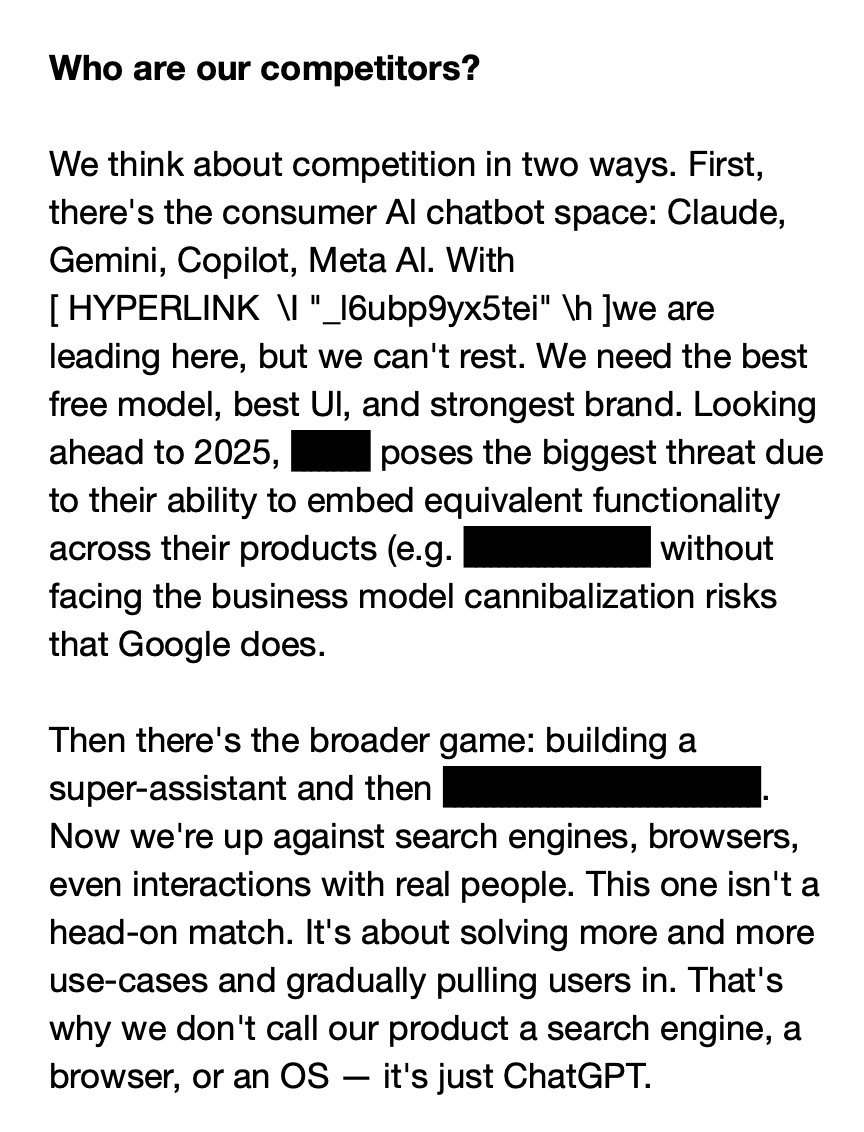
1/ This internal 2007 Nokia presentation on the first iPhone is a really good example of how incumbents actually get disrupted
Oftentimes, the incumbent already knows what needs to be done. It's just that organizational incentives inhibit the incumbent from doing it
Meet the first episode of the AI HOUSE Podcast in 2025 ⚡
Our host, Roman Kyslyi, and guest Andrii Brodetskyi @politehnik, Investment Associate at Horizon Capital, had an in-depth discussion about investments.
Here’s what they covered:
– how investment funds work and the types of startups they fund;
– the current state of the Ukrainian investment market;
– how startups can attract funding;
– the future of the software industry in the coming years;
– investments in GenAI, the vertical AI trend, and much more.
🎬 Watch and listen to the episode here: https://t.co/snP5gz61Z0
@ol_fakhivchinya З точки зору мікроекономіки цей ринок близький до ідеальної конкуренції. Низька диференціація, низька pricing power у гравців. На масштабі можна було б запустити фінансовий сервіс, як Starbucks (https://t.co/5dJvXLjwBW)
але не з нашою ємністю ринку
Raising a seed round 101
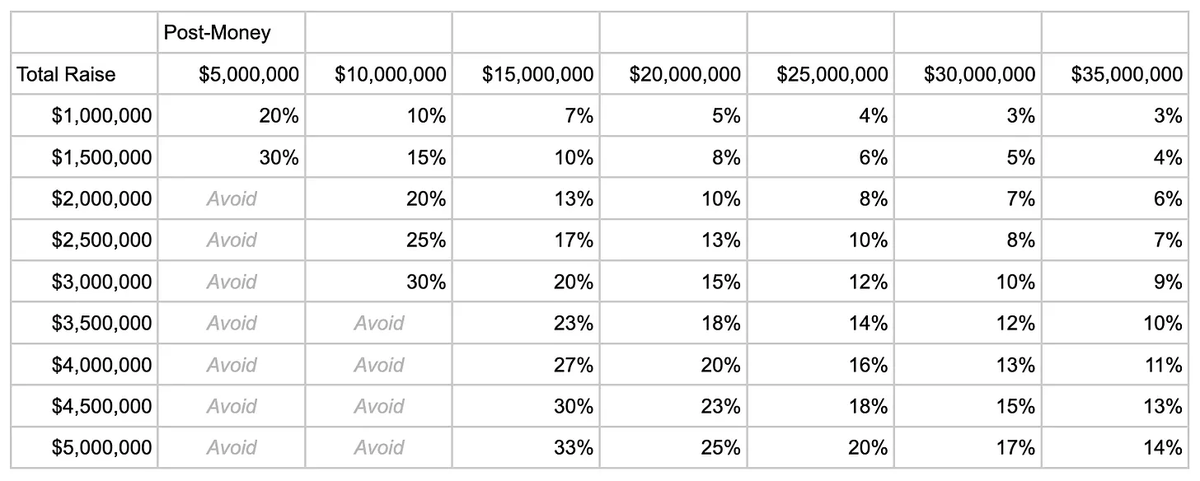
1. How much should you raise?
A simple formula is to aim for a 24- to 36-month runway, building in a 25% buffer.
Why 24 to 36 months? Generally, this is the right amount of time because it tends to be about how long it takes to hit product-market fit (and ideally become default alive) and/or raise a series A. As one data point, Carta has the median time from seed to Series A as 23 months.
You also probably want a 25% buffer because unexpected things always happen.
Here’s a simple spreadsheet illustrating how to model this out: https://t.co/4isR3KF19J
2. What do I need to prove to investors before I raise?
Generally speaking, before you raise, you should have taken the following steps:
- Proof of commitment: You have left your old job and are fully committed to being a founder. You can’t expect to raise capital if you aren’t yet fully committed yourself.
- Proof of work: You have done enough customer development and research on the problem to give yourself total conviction in the opportunity. Tomer London from Gusto puts it this way: “Validate the customer’s needs and your unique product insight. Speak with buyers (100+ in the consumer space, 30+ in SMB, 10+ in enterprise) to deeply understand their pain point, and offer them your solution in the most realistic way possible (a prototype is better than a pitch deck) and name a price. You’re looking for at least 40% of ‘wow!’ and ‘when can I get this?.’ Anything less is just people being nice to you.”
- Proof of insight: You have some expression of your thesis. At the most, you have built a simple product and have some paying customers. At the least, you have a clear written memo and/or deck that outlines what you plan to build (more on this below). According to Ivan at Notion, “Notion was like a better mousetrap but built differently. (We wanted to decompose SaaS into software Lego blocks—text editor, databases, charts—and allow end users to create their own tools with our Legos. The value prop is to reduce their tool fragmentations and give them new power.) We knew, or at least we had the conviction, that if we build it, people will come. That first-principle conviction turned out to be true. It is also why we started the company in the first place.”
3. How do I maximize the odds of raising a great seed round?
To maximize the odds of a successful raise, you need to choreograph your approach to maximize the number of potential options. Raising a seed round comes down to activating emotional triggers in prospective investors, including the fear of missing an incredible opportunity. The most surefire to get a yes from many investors is to get a yes from other investors.
In short, you have to create FOMO among investors. Here’s how to do that:
1. Plan your raise
You probably double the odds of success if you spend some time planning your raise. Carve out a two- to three-week window on your calendar to run your fundraise and speak to investors. Ideally, you want to speak to as many investors as possible in the shortest period of time. This compression of time creates the conditions for desire and scarcity, which can help prompt an investor to a yes.
Here is a link to a sample timeline you can use to plan your raise: https://t.co/9WYn8X0ptu
2. Do your research on investors
Assemble your target list and research each investor before your pitch window. Have they invested in similar companies? (Check Crunchbase and their LinkedIn.) What’s their check size and investment philosophy, and do they lead? (Check their fund and personal website.) What do other founders think of them? (Ask for references from other founders.)
Here is a spreadsheet to help organize your outreach: https://t.co/zfmGN7qZcF
3. Prepare (well-crafted) materials
A minimal deck and/or memo with a simple budget is all that you’ll need at this stage. You need to show there’s a real problem to solve, in a big enough market, and that you’re the one to solve it. That’s it.
However, the quality of this content matters a lot. The better crafted the materials, the more persuasive they will be, and the more likely they will result in capital. You should have all your materials polished and ready to go before your pitch window, and you should be ready to tailor your pitch to each prospective investor.
- Sequoia has a great template for a deck: https://t.co/m4sAxaZqIo
- As does YC: https://t.co/rbqh0b4WJB
- Rippling wrote the gold standard for a memo: https://t.co/IsiLeEUvO9
4. Get powerful, warm intros
Who introduces you to prospective investors matters a lot more than you might think. Take the time to consider your most powerful connection to each investor before you ask for introductions. High-influence intros for prospective investors include:
- Successful founders in the investors’ portfolios (regardless of investment)
- Other successful founders or influential operators
- Investors (angels, seed, or multi-stage) who are investing in your startup
Naturally, the stronger the relationship, the more powerful the intro will be.
There are also low-influence intros, such as investors who are not investing in your company (politely decline these, as they are a negative signal), and lawyers or other service providers (these are typically harmless but usually not very helpful).
If you can’t find a warm intro, craft a good cold email. These don’t convert as well, but there is almost zero downside to sending one.
5. Practice and prep your pitch
Your presence in a meeting matters even more than your materials. Showing up as the best version of your authentic, relaxed, and confident self is key. And that’s not something you can wing. Here’s what to do and know before you start speaking to investors:
- Prepare your pitch by writing a memo. Even if you don’t share it with investors, writing a memo is a great start to sharpening your ideas and communication.
- Practice your pitch a bunch of times before actually getting in front of an investor. Start real pitches with less important investors so you can iterate.
- Investors tend to overweight answers to their questions when evaluating your pitch, so answer their questions calmly and succinctly. If you don’t know, simply say, “I don’t know, but I’ll get that answer for you.” Preparing an FAQ can help.
- Acknowledge competitors factually, including their strengths. Then promptly move on to your strengths and your vision. Avoid disparaging competitors or spending too much time on them.
6. Start small to build social proof
You don’t need a lead investor to start taking on capital in a seed round. In fact, it is often better to open a SAFE (simple agreement for future equity) at reasonable valuation and start collecting the checks of smaller angels while you are having conversations with larger funds. Not only will you be taking on capital, but you’ll build social proof for the larger investors.
7. Follow up sparingly with investors, and never chase or “back-channel” them without strength
Interested investors will typically drive the process (more on this below). If you do have to follow up over email, do it sparingly, and don’t chase investors in a needy way. In such follow-ups, always pepper in some positive development, whether in revenue, a new hire or feature release, or additional angels closed (see above). Related, having an angel or existing investor check in, chase, or pressure lead checks often backfires. Savvy VCs and lead investors will take this pressure as a sign of weakness. If there is any sort of “back channel” that works, it’s having angel or existing investors saying they “vouched” for the lead check, as a type of reference. With this, you flip the power dynamic.
8. For bigger checks, never reveal who else you are talking to
Mystery is always more seductive than the truth. Never reveal the actual names of who gave you a term sheet. Just accurately describe them in the abstract (and never lie).
9. You don’t have a term sheet until you have an actual term sheet
Verbal commits are not term sheets. In seed, a term sheet is commonly a SAFE with a post-money cap. You don’t actually have a commitment from an investor until you have a term sheet or a SAFE. This carries through to every round you raise.
10. Your round is not closed until it’s closed
While less common at seed, rounds are actually not closed until the funds wire. Set reasonable but quick dates for closes (wires). Keep everyone moving toward those dates. This carries through to every round you raise.
For much more, including how to talk terms, how to choose investors, how to know if your raise is going well, and whether you should raise at all—don't miss the full post by @tmrohan and @jaltma: https://t.co/2Y79EcxHr5