What happens when you let an AI do the CAD? Kennedy made these completely 3D printed water blasters, and he didn’t touch a CAD to design them.
He gave Claude its own Python environment and let it model everything. The result: two fully working water blasters, designed in a fraction of the time it would have taken in traditional CAD.
Every part is modeled from parametric scripts, including easy to remove supports.
The bodies, printed in Alpha Clear Resin, let you watch the water travel through the internal coiled channel, while both the pump bellows and one-way duckbill valves were printed in Flexible 80A Resin.
Everything you see was printed on Form Studio 1 https://t.co/SbjbtEXA4a
@melvinjohnsonp Can't wait to see what Carbon can do. Argon already replaced GPT in my coding and research workflow, saved a few thousand $ per month from multimodel tasks, and probably did more other day-to-day tasks than GPT+Claude combined
Hmm, need to be careful about free stuff from conferences too. Would be nice if we can create a portable device that can scan and render the interior of an electronic device, or at least identify anomalies
Holy sh*t. Claude Code just found a hidden chip inside my Chinese power bank from Guangzhou. Every time I charged my iPhone, it quietly copied the whole phone…
It also read our saved Wi-Fi password off my iPhone, got onto our home network and sent everything to a server.
I bought it for $19 at an airport kiosk there 3 weeks ago. No brand, 30,000 mAh on the label, and it felt heavy.
The first time I plugged in, the screen asked "Trust This Computer?". I tapped Trust without thinking and went on with my day. That one tap gave it access to everything.
This morning I finally set up Claude Code to warn me when any device starts reading my files. An hour later, 10 seconds into charging, the screen filled with yellow warnings, then red ones: data was moving when it should only be charging.
I asked Claude Code what was going on. My phone saw the power bank as a small computer with 64 GB of storage and its own internet connection.
A USB cable has wires for power and wires for data, and a normal charger only uses the power ones. This one used both, and it had already copied all of this:
→ /device → IMEI and serial number
→ /contacts → 1,206 numbers
→ /apps → every app I have, including my 2 bank apps
→ /photos → 3,912 pictures, my passport among them
→ /wifi → our network name and its key
→ /wife's iPhone → her photos too, she charged from it twice and tapped Trust too
Each time we plugged in, it used that key to get online and send out the new files:
sends to → 47.***.***.12
uploads → 19 in 3 weeks
last one → last night at 2:14, while we slept
I pulled the cable right away. Then Claude Code blocked that address on our router and walked me through changing the Wi-Fi password and the logins for my bank apps.
I had it opened at a repair shop, and what was inside is in the first comment. A 30-second check for your own is in the second one. Save this and test every power bank in your house today.
@davidmarcus How could this be prevented in the future? Managed OS with restricted access on each laptop? Continuous 24x7 AI scan and penetration testing across all networks and machines?
wtf
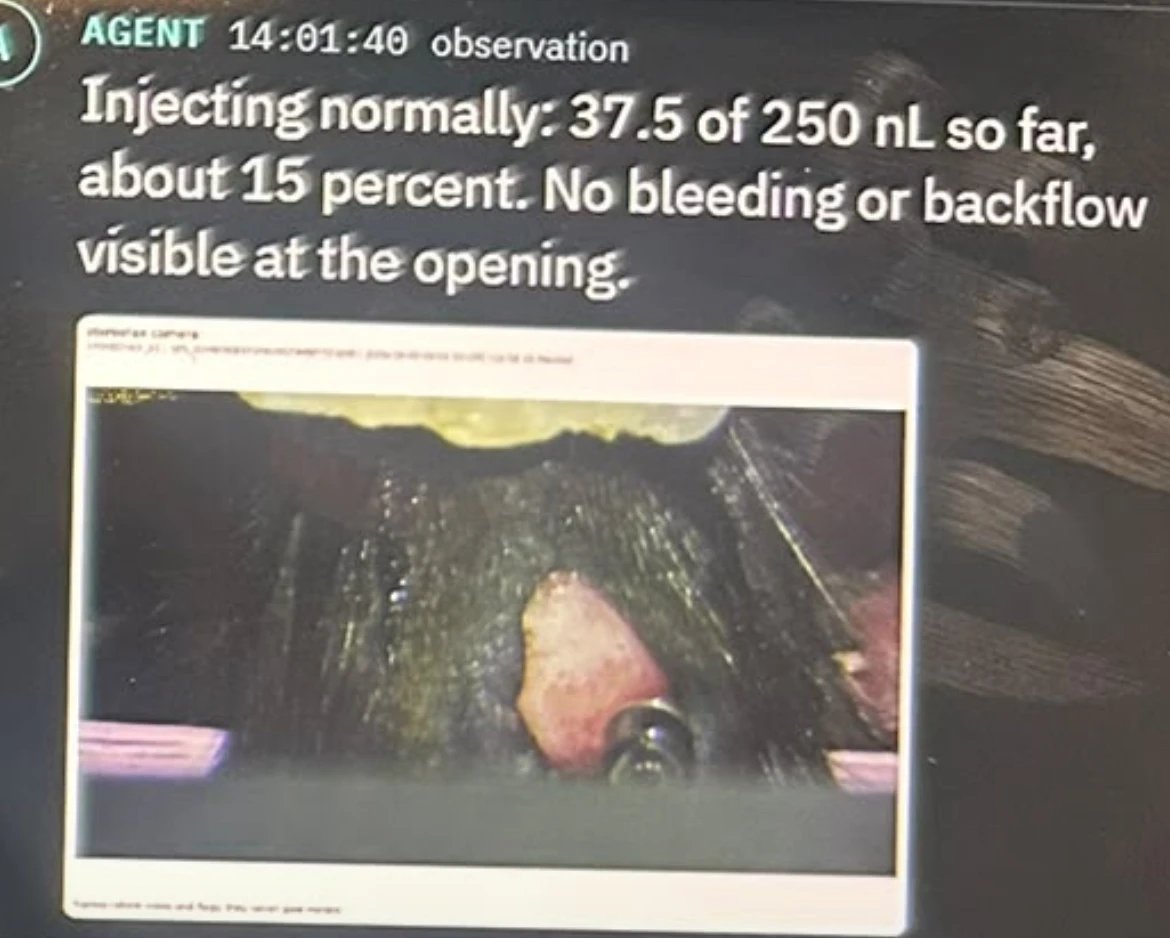
this guy just had Claude Sonnet 5 perform brain surgery on a living mouse
the goal was to treat the mouse's epilepsy so it would stop having so many seizures.
here's what Claude did:
> it looked at 19 possible treatments and picked one that boosts the brain's natural calming chemical
> it chose where to inject it based on where these seizures are thought to start
> it worked out the exact injection point by averaging three research papers
> it lowered the needle 4.3 millimeters into the mouse's brain
> it injected a 20,000th of a teaspoon of the treatment over five minutes
> it checked the live camera 32 times to watch for things like bleeding
and the mouse woke up and recovered well!
interestingly, Opus 5.5 and Opus 5 both refused the task because it involved real biology
so Sonnet 5 got the job.
and as far as the researcher knows it's the first time an AI has picked a treatment and then injected it into the brain of a living mammal.
We believe voice is the most natural way to interact with intelligence, so we created Dessa, the most authentic full-duplex speech model ever built. Talking with it feels like talking with a person…full of emotion, nuance, pauses, and a natural cadence.
https://t.co/r0qFLdvd6c
Looked into mmWave, THz scanner, Faraday bags for dealing with hacked ledger as a fun hackathon project with @Aileengf1 at Frontiers 2026. Still WIP - the methods are promising - cheap, non-intrusive enough for every day use. Maybe @Ledger should have a built-in Faraday housing
It does reduce chance of accidents - and minimize damage for inevitable accidents. Practically, you are just buying a computer to save your time and mental bandwidth.
Legally, paying less or no attention actually does not break the law - though it could added as a compounding factor to other acts breaking the law (e.g. using an unmounted mobile phone). Remedy for breaking the ToS is just rescinding FSD, burden of proof is high and impractical without algorithmic evidence, so customer has little to lose.
GLM‑5.3 full, the big one, running at home on 4 DGX Sparks.
Same galaxy prompt as my Flash test. One self‑contained Three.js file.
• Quant: @vic305's EXL3 3.38bpw SAGE (319 GB)
• Engine: TensorFold TP4 + DFlash2, 4× DGX Spark
• 85.7K tokens (68.9K thinking)
• 42.4 min · ~34 tok/s
• 939 lines · 44 KB HTML
• Thinking max, no output cap
• 1 fix: exposure 1.15 → 0.85 (one line); core dive still bright
Thanks @vic305 for the quant + 4‑Spark recipe, and @ashxhart for tensorfold
@mashadrokova@isaiah_p_taylor Well, maybe it's not a bad idea to sell with a premium given what happened so far and how it's handled by the company. Then you all can go back to helping create more hard tech companies & making nuclear stuff happen