Someone shared this with me, it is the truth! 🙏🇺🇸❤️🌎🙏
The Muslim religion is the fastest growing religion per capita in the United States, especially in the minority races.
Last month I attended a training. During the training session there was a presentation by three speakers representing the Roman Catholic, Protestant and Muslim faiths, who each explained their beliefs.
I was particularly interested in what the Islamic Imam had to say. The Muslim gave a great presentation of the basics of Islam, complete with a video.
After the presentations, time was provided for questions and answers. When it was my turn, I directed my question to the Muslim and asked:
'Please, correct me if I'm wrong, but I understand that most Imams and clerics of Islam have declared a holy jihad [Holy war] against the infidels of the world and, that by killing an infidel, (which is a command to all Muslims) they are assured of a place in heaven. If that's the case, can you give me the definition of an infidel?'
There was no disagreement with my statements and, without hesitation, he replied, " Nonbelievers"
I responded, 'So, let me make sure I have this straight. All followers of Allah have been commanded to kill everyone who is not of your faith so they can have a place in heaven. Is that correct?'
The expression on his face changed from one of authority and command to that of a little boy who had just been caught with his hand in the cookie jar.'
He sheepishly replied, 'Yes.'
I then stated, 'Well, sir, I have a real problem trying to imagine The Pope commanding all Catholics to kill those of your faith or Dr. Stanley ordering all Protestants to do the same in order to guarantee them a place in heaven!'
The Muslim was speechless.
I continued, 'I also have a problem with being your friend when you and your brother clerics are telling your followers to kill me! Let me ask you a question:
Would you rather have your Allah, who tells you to kill me in order for you to go to heaven, or my Jesus who tells me to love you because I am going to heaven and He wants you to be there with me?'
You could have heard a pin drop.
Needless to say, the organizers and/or promoters of the 'Diversification' training seminar were not happy with my way of dealing with the Islamic Imam, and exposing the truth about the Muslims' beliefs.
In twenty years there will be enough Muslim voters in the US. to elect the President.
I think everyone in the U.S. should be required to read this, but with the ACLU, there is no way this will be widely publicized, unless each of us sends it on! This is your chance to make a difference.
Just Copy & paste.
Early Christians baffled the Roman world because their counter-cultural way of life, radical compassion, and refusal to conform to civic religion turned traditional Roman values upside down...
Christians worshipped only one God and refused to burn incense to Caesar or participate in state polytheistic rituals. Romans viewed this as a dangerous form of atheism and treason that could anger the gods and destabilize the empire. Roman society was deeply hierarchical and honor-driven, built on class, slavery, and status. Christians treated slaves, masters, the poor, and elites as spiritual equals before Christ. Romans routinely exposed unwanted or disabled infants to die of exposure. Christians actively combed public dumpsters and streets to rescue these babies and raise them as their own—an act so foreign to Romans that they falsely accused Christians of bizarre rituals like child sacrifice. While Roman culture prized honor, strength, and retribution against enemies, Christians practiced radical forgiveness and charity. They cared for widows, orphans, the poor, and even plague victims regardless of whether they were believers, prompting early writers like Tertullian to note observers saying, "See how they love one another!" Unlike other oppressed groups or zealots who fought the Roman legions with the sword, Christians refused violent revolution. When dragged before magistrates or executed in the arenas, many faced death with calm resolve or song rather than armed resistance, which baffled authorities who only understood power backed by military might.
. . .
Early Christians in Roman Empire showed a high level of devotion to their God that made their persecution backfire. On many occasions, the martyrs sang while awaiting execution in arenas. While Roman authorities at the time intended for public executions to serve as a warning to anyone who refused to honor traditional gods, the strategy did not work. Roman Emperor Nero started the trend in 64 CE after a great fire destroyed much of Rome. At the time, he needed people to blame for the disaster and chose the Christians as they were a small group of secretive people that lived on the fringes of society. The plan to scare the public away from the new faith failed as instead of fear, the lurid sights of their devotion to their faith even in the face of death, created curiosity among Roman citizens.
The public executions of Christians were meant to humiliate victims, their displays of courage when facing persecution were rare in a society built on power and self-interest. As a result, many Romans began to wonder what kind of god could give a person such strength. Tertullian, a famous writer from that era, notably wrote that the blood of martyrs acted as the seed of the church. Every time the state killed a believer, more people signed up to join the movement. While most people in the empire easily added the Roman Emperor to their list of gods in order to avoid trouble, the Christians refused to burn incense to the image of the ruler. Over time, the church became more organized and created a welfare system that the Roman government simply did not provide. When the Plague of Cyprian that emerged in 251 CE killed thousands of people, pagan priests and wealthy citizens fled to their country estates to avoid the sickness. Christians by contrast stayed in the cities to nurse the sick and bury the dead regardless of whether the victims were believers or not. This level of kindness earned them deep respect among the poor and middle classes. The actions also helped to earn the trust of the people.
📷 : Faithful unto Death (Christianae ad Leones!) or Christians to the Lions; an 1888 oil-on-canvas work by British artist Herbert Gustave Schmalz (1856-1935) that depicts Christian martyrs awaiting their fate in the Colosseum.
#archaeohistories
Arizona Territory, 1883. Seventeen-year-old Catherine “Cat” Dawson watched six rustlers murder her 22-year-old brother, James, and steal 200 head of cattle from their ranch. With the law days away and no one coming to help, she saddled her Appaloosa, took her father’s Winchester, and rode alone into the desert. Her father gave her four days to return. She disappeared into the wilderness, following broken branches, hoofprints and shifting sand, carrying grief that was slowly turning into determination.
On the fourth morning, she found the six men hiding in a box canyon. What followed was a gunfight that would become a forgotten legend of the Arizona frontier. Using the sun, the rocky terrain and her knowledge of the desert, Cat outmanoeuvred the gang, killed several men and wounded their leader. When he begged for mercy, she chose not to kill him. Instead, she took his weapons and water and left him to face the consequences. Three days later, she returned home with all 200 cattle. She was covered in dust, exhausted and no longer quite the girl who had ridden away.
Cat never spoke publicly about those four days. She married, raised daughters, worked the ranch and taught her children to ride, shoot and survive. When asked why, she simply said, “Because the world doesn’t always protect you.” Her obituary in 1932 celebrated her horsemanship and community service, but never mentioned that summer of 1883. Yet the old-timers remembered. History often celebrates lawmen and outlaws, but forgets the ordinary people forced into extraordinary circumstances. What would you have done at seventeen, if justice was four days away and the only person who could fight for your family was you?
Le preguntaron a Bukele en Argentina cómo sacaron a los jóvenes del modelo del narco: la casa grande, el coche caro el smartphone… cuando trabajar honesto tarda años. Su respuesta duele porque es verdad
"El gobierno llega tarde si espera reinsertar al que ya violó, ya mató y ya cortó cabezas. A un niño de 6 u 8 años sí se le puede cambiar la vida. Al que ya eligió el mal... el joven que vende tomates en el mercado, suda, carga, gana $5… y en la esquina el pandillero se los quita. ¿Qué incentivo gana? ¿Vender tomates o ser el que cobra? Por eso nunca se gana la guerra de incentivos si el criminal sigue en la calle.
Porque el Estado no puede pagarle triple salario mínimo para que deje el crimen. Eso no es gobierno, sino ingenuidad cara. Un organismo me dijo: «no puedes acabar el crimen de un golpe, son 70 mil empleos, esa plata llega a los hogares y se gasta legal». Lo que ellos insinuaban era que dejara vivir al cáncer para no lastimar la economía. Bukele les respondió con otra analogía: si tengo cáncer con metástasis y me ofrecen cirugía, quimio y quedar débil… pero vivo, me opero. No me quedo así nomás esperando que el tumor sea educado."
Le dijeron que el PIB podía caer hasta 10% por sacar esa economía sucia. No cayó. Subió. Porque el miedo también es un impuesto. Y ese sí lo pagábamos todos los días. Sacaron al pandillero de la ecuación y no sólo para castigarlo, sino para que el muchacho que todavía no entra en ese mundo vea otro menú. Ya no es: «me hago pandillero y gano». Ahora es: «me hago pandillero y pierdo mi libertad». Eso no es odio, es orden. Es proteger a la familia que sí trabaja, a la que manda la remesa, a la que nunca tuvo casa grande porque no cobraba renta de sangre. 30 años de discursos. 7 años de resultados. El resto es teoría para intelectuales.
Tal vez necesitamos un Bukele en España. Y en el mundo.
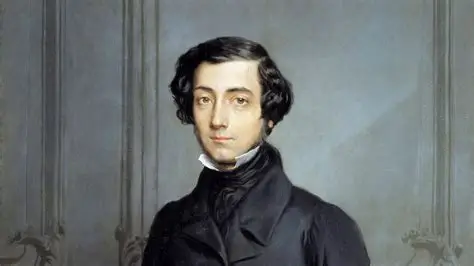
In 1835, a Young French Aristocrat Predicted the Exact Bureaucratic Trap Threatening the West Today
Before the philosopher Alexis de Tocqueville ever set foot in America, radical tyranny had already scarred his family. During the French Revolution’s Reign of Terror, left-wing Jacobin zealots guillotined his great-grandfather and threw his newlywed parents into a Paris dungeon. Waiting daily for the executioner's blade, his father’s hair turned snow-white at the age of twenty-one. Only the sudden fall of Robespierre spared his parents' lives by a matter of hours, allowing Alexis to be born a decade later.
Raised in the shadow of state terror, Tocqueville became obsessed with a single question: why did the French pursuit of utopian equality end in a bloodbath, while the American Revolution produced the freest, most prosperous republic on earth? In 1831, at just twenty-five years old, he convinced the French government to send him to the United States under the mundane bureaucratic cover of inspecting American prisons. Once he arrived, he spent nine months traveling seven thousand miles by stagecoach, steamboat, and horseback to study the soul of the American citizen.
His observations became Democracy in America, one of the most brilliant political analyses ever written. Tocqueville realized that American greatness rested on three pillars: fierce individual self-reliance, decentralized local communities, and a strong foundation of religious morality. Whenever Americans saw a problem, they formed a local group and fixed it themselves rather than begging a distant politician for help.
Yet as he studied the young republic, Tocqueville foresaw a chilling vulnerability. He realized that a proud, armed citizenry would always fight back against an obvious military dictator. Therefore, future tyrants would abandon whips and chains in favor of welfare, cradle-to-grave safety, and endless administrative rules. They would conquer free citizens by offering to manage their lives in the name of compassion.
Describing this future nanny state in 1840, Tocqueville wrote a passage that reads like a headline from today:
"Above this race of men stands an immense and tutelary power, which takes upon itself alone to secure their gratifications and to watch over their fate... It seeks to keep them in perpetual childhood. It covers the surface of society with a network of small complicated rules, minute and uniform, through which the most original minds and the most energetic characters cannot penetrate, to rise above the crowd... till each nation is reduced to nothing better than a flock of timid and industrious animals, of which the government is the shepherd."
Tocqueville called this system "soft despotism." Nearly two centuries ago, he understood that when citizens trade personal responsibility for government security, the state gladly reduces them to dependent children. Every bloated regulatory agency, speech code, and entitlement program today operates on the exact blueprint he exposed. Liberty rarely perishes overnight in a violent coup; it erodes quietly when a free people allow bureaucrats to become their shepherds.
On May 24, 1998, nearly 27,000 feet above sea level, two climbers discovered a woman lying motionless against the frozen slopes of Mount Everest. Her face was pale, her hands severely frostbitten, and her body barely responded to the bitter cold. At first, they thought she was dead.
Then she moved.
As British climber Ian Woodall approached, the woman opened her eyes and whispered words he would never forget.
“Please, don’t leave me.”
Her name was Francys Arsentiev.
She was forty years old.
And just two days earlier, she had achieved one of mountaineering’s most extraordinary accomplishments.
She had become the first American woman to summit Everest without supplemental oxygen.
But now, she was dying on the mountain she had dreamed of conquering.
Francys was born in Hawaii in 1958 and grew up in Colorado.
Her father introduced her to mountaineering when she was young, inspiring a fascination that would shape her life.
She studied business, earned a master’s degree, and worked as an accountant.
Then she met Sergei Arsentiev.
Sergei was an accomplished Russian mountaineer known as the Snow Leopard, a title earned by climbing the highest peaks of the former Soviet Union.
They shared an intense love of mountains.
In 1992, they married.
Together, they climbed challenging peaks, including Denali and Mount Elbrus.
Francys became the first American woman to ski down Elbrus.
But one ambition remained.
Everest.
She wanted to reach its summit without bottled oxygen.
It was an extraordinarily dangerous goal.
Above 26,000 feet lies the region climbers call the death zone.
There, the atmosphere contains so little oxygen that the human body begins deteriorating.
Thinking becomes difficult.
Movement becomes exhausting.
And even simple decisions can become fatal.
In May 1998, Francys and Sergei began their final ascent from Everest’s northern side.
They traveled without Sherpa assistance, a support team, or supplemental oxygen.
After two unsuccessful summit attempts, they tried again on May 22.
This time, they succeeded.
Francys stood on the world’s highest mountain.
Her dream had become reality.
But reaching the summit was only half the journey.
And they had arrived dangerously late.
As darkness approached, the exhausted couple struggled to descend.
They were forced to spend another night high on the mountain, exposed to temperatures around minus thirty degrees Celsius.
Somewhere in the darkness, they became separated.
Sergei eventually reached their high camp.
Francys did not.
He waited.
But when she failed to appear, he made a desperate decision.
He gathered oxygen and medicine and climbed back toward the summit to find his wife.
He knew the danger.
He went anyway.
It was the last time anyone saw him alive.
Meanwhile, an Uzbek climbing team discovered Francys struggling near 27,000 feet.
She was barely able to stand.
Her face and hands were frozen.
She was exhausted, confused, and dangerously weak.
The climbers tried to help.
They gave her oxygen.
Attempted to warm her limbs.
And struggled to move her downhill.
But carrying another person at that altitude requires strength the human body can barely produce.
Their oxygen supplies were running low.
Eventually, they faced an unbearable decision.
Remain and risk dying beside her.
Or descend while they still could.
They left Francys secured to the climbing rope.
On their descent, they encountered Sergei heading upward.
He was searching for his wife.
The following morning, Ian Woodall and Cathy O’Dowd found Francys still alive.
Sergei’s equipment lay nearby.
He had apparently reached her, but something had gone terribly wrong.
Woodall and O’Dowd abandoned their summit attempt immediately.
For more than an hour, they tried to save her.
They offered oxygen.
Spoke reassuringly.
And attempted to lift her from the snow.
But Francys was almost completely helpless.
Her body seemed frozen into the mountain itself.
She begged them not to leave.
“Please, don’t leave me alone.”
Those words pierced through the cold.
They wanted desperately to rescue her.
But their own oxygen was disappearing.
They could not carry her.
And remaining much longer would likely kill them too.
Eventually, they had to walk away.
Francys Arsentiev died on Everest, alone in the snow.
She had reached the summit without oxygen.
But she never returned home.
In 1999, climber Jake Norton discovered Sergei’s body lower on the mountain.
He had fallen while attempting to rescue his wife.
Their eleven-year-old son, Paul, was left without either parent.
For nine years, Francys remained visible beside Everest’s climbing route.
The freezing temperatures preserved her body.
Climbers passing through began calling her Sleeping Beauty.
She became a haunting landmark.
A reminder that reaching the summit means nothing if you cannot survive the descent.
But Ian Woodall never forgot the woman who had begged him to stay.
In 2007, he returned to Everest for a different mission.
Not to reach the summit.
But to restore her dignity.
He located Francys’s remains, wrapped her in an American flag, and moved her away from the main climbing route.
At last, she could rest beyond the gaze of passing climbers.
Everest has claimed hundreds of lives.
Many remain frozen where they fell.
But Francys Arsentiev’s story carries a particularly heartbreaking lesson.
She achieved her greatest dream.
Her husband sacrificed his life trying to bring her home.
And strangers risked their own survival attempting to save her.
Yet none of it could overcome the brutal conditions of the death zone.
The mountain offered no mercy.
Not for ambition.
Not for courage.
Not even for love.
And nearly three decades later, four simple words still capture the tragedy of the woman remembered as Sleeping Beauty.
“Please, don’t leave me.”
You should see this
Dear Secretary Bessent @SecScottBessent,
My name is Everett Stern. In 2010 I was a compliance officer at @HSBC. From a back office in New Castle, Delaware, I watched billions of dollars move to drug cartels, sanctioned regimes, and terrorist organizations. The enemies of the United States. I documented it, I escalated it, and when the bank would not act, I took it to the @FBI, the @CIA, and eventually the @SECGov.
The result was a $1.92 billion settlement. At the time, it was one of the largest in American history. It was also about five weeks of the bank’s profit. Not one banker was charged. Not one went to prison.
I paid a different price. I lost my career, my savings, and my place in the industry I had trained for. I was blacklisted. Every door in American finance closed at once. I slept on a camping cot in a 300 square foot apartment because I could not afford a bed, and I waited tables at @PFChangs to eat. I tell you this not for sympathy, but so you understand that I know exactly what it costs to do the right thing in American finance, and exactly how little the system does in return.
I made that sacrifice because I believed it would change something.
Yesterday, your department fined @BankofAmerica $1.2 billion for failing to report more than $5 billion in suspicious transactions, some of it tied by your own findings to Chinese laundering networks, narcotics, and the southwest border, alongside 475 apparent sanctions violations touching Russia, Iran, and global terrorism. The bank admitted it willfully violated the Bank Secrecy Act.
Fourteen years after HSBC. A bank with “America” in its name. And once again, not one individual charged.
Secretary Bessent, I want to say plainly what I believe you already know. The fines are not working.
A fine is paid by shareholders, absorbed by the balance sheet, and forgotten by the next earnings call. Bank of America reported earnings this morning. Nobody who set the alert thresholds, nobody who decided the 2024 cease and desist could wait, nobody who chose the backlog over the law will lose a single thing they value. Their lives are untouched. That is the entire reason the behavior repeats.
This is money laundering. This is blood money. Money that reaches a cartel buys fentanyl that kills Americans. Money that reaches a terrorist organization buys the next attack. This country has fought a war on drugs and a war on terror for decades, at enormous cost in lives and treasure, and all the while we have allowed the financing to flow through institutions we charter and regulate. Cut off the money and we win. We have never seriously tried.
There is also a question of equal justice that I cannot let go.
Before I walked into the FBI building to report HSBC, I stopped in front of the Great Seal on the wall and read the words engraved beneath it: “Justice is the defense of our liberty.” I believed that. I still want to. But every day in this country, people go to prison for crimes that are nothing next to moving money for the people who want Americans dead. A suit, a title, and a corporate badge should not be a shield from the consequences that apply to everyone else. If a street dealer goes to prison for what he sells, the banker who moved the cartel’s money should be standing next to him.
I also want to raise something that is rarely said in these conversations. Why has no one inside Bank of America come forward the way I did? The answer is that everyone in American banking knows what happened to me, and to the whistleblowers who came after. The last person who spoke up is the only policy anyone believes. That is a culture problem, and it starts with leadership, in the banks and in the agencies that regulate them.
This is not a political issue. It has spanned administrations of both parties. It is a national security issue, and I am asking you to treat it as one.
Three things would change the math overnight.
Refer individuals for criminal prosecution. Not the analyst in the queue. The executives who set the thresholds and chose the risk. One banker in handcuffs would do more than every fine in Treasury’s history combined.
End “too big to jail.” An institution cannot be too big to fail and too big to jail at the same time. If it is the first, it must be held to a higher standard, not a lower one.
And if Bank of America will not act as America’s bank, review its charter. A national charter is a privilege granted on behalf of the American people. It should be conditioned on not moving money for the people trying to kill them.
Secretary Bessent, you said yesterday that these actions send a clear message that even the biggest institutions are not above the law. With respect, the institution was never the problem. The people inside it are above the law, and they know it. Until that changes, I will keep writing letters like this one, and the next bank will keep paying the next fine.
I gave up everything I had to stop this. I am asking you to use the power you have to finish it.
Respectfully,
Everett A. Stern
HSBC Whistleblower
Founder and Intelligence Director, Tactical Rabbit
Je partage :
Quand certains musulmans en Occident accusent nos sociétés de “manquer de tolérance”, il est parfois utile de rappeler l’histoire concrète — pas celle des slogans, mais celle des faits.
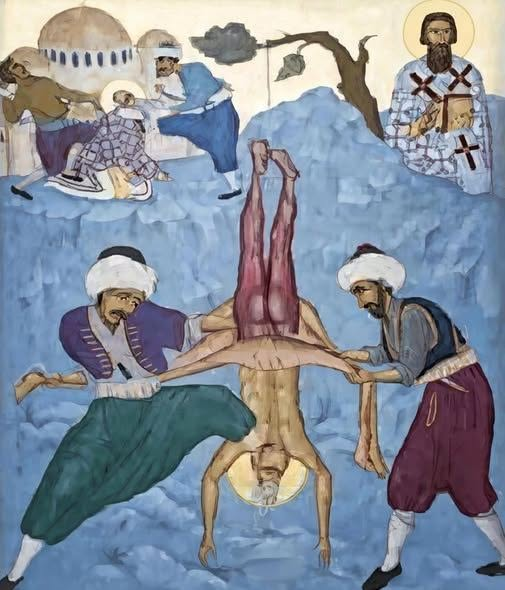
Ce tableau, daté de 1595 et conservé au Musée national de Serbie, représente une scène bien réelle de la domination ottomane dans les Balkans : l’évêque orthodoxe serbe Teodor de Vršac y est écorché vif, encore conscient, par des soldats ottomans, pour avoir refusé de renoncer à sa foi chrétienne.
Il ne s’agissait pas d’un acte isolé ni d’un excès ponctuel.
Les sources historiques montrent que, dans l’Empire ottoman, les chrétiens qui refusaient la conversion à l’islam pouvaient être soumis à des supplices
Extrêmes et exemplaires :
— écorchement à vif
— empalement
— décapitation
— bûcher
— démembrement lent
— sciage en deux
L’objectif était clair : terroriser, forcer des conversions, ou éliminer les récalcitrants.
Les musulmans de Bosnie et du Kosovo aujourd’hui sont, pour une large part, les descendants de Serbes, de Croates et d’autres chrétiens slaves convertis au fil des siècles.
Leurs ancêtres ont été confrontés à l’épée, au fouet, à l’esclavage, aux viols, aux mariages forcés, à l’enlèvement d’enfants par le système du devshirmé — qui arrachait des garçons chrétiens à leurs familles pour en faire des janissaires — ou précisément à ce type de torture, jusqu’à ce qu’ils se convertissent pour survivre ou qu’ils soient mis à mort.
Ce n’est pas une « diffusion pacifique de la religion ».
C’est une conquête par la violence, une conversion sous la terreur, un effacement culturel et religieux systématique.
Rappeler ces faits n’est pas de l’intolérance envers les musulmans d’aujourd’hui.
C’est refuser l’amnésie historique et la leçon de morale à sens unique.
Les sociétés occidentales actuelles permettent à l’islam d’être pratiqué librement.
Ce tableau rappelle que, dans l’histoire, la réciproque n’a pas toujours été vraie.
Le tableau ne ment pas.
La scène qu’il représente ne ment pas.
L’histoire ne ment pas.
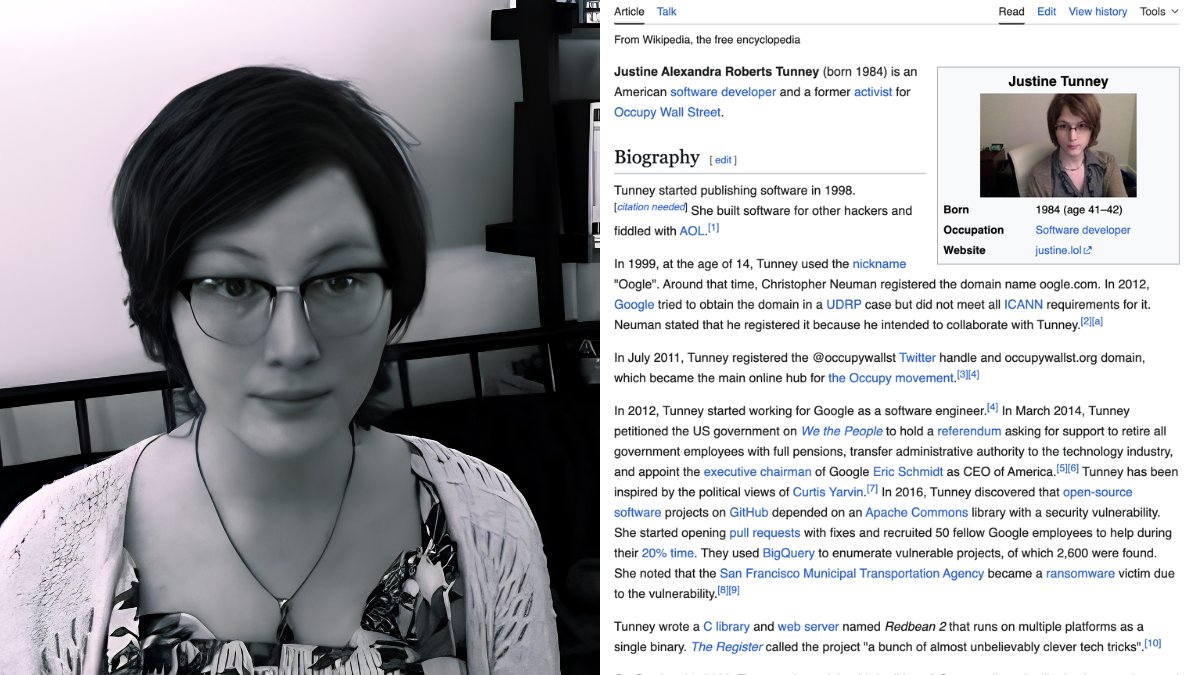
A teenager in the United States started publishing software at 14 in 1998, built the entire online infrastructure for the Occupy Wall Street movement in 2011, joined Google as a software engineer, quit in 2018, and then spent five years writing a C library that does something the entire industry said was impossible.
Then she combined it with llama.cpp and shipped the easiest way on the planet to run a large language model on any computer.
Her name is Justine Tunney.
Here is the story, because almost nobody outside the low level systems world knows what one engineer has built.
Justine was born in 1984. She started writing and publishing software at 14, back when distribution meant uploading binaries to BBS systems and chat networks. She picked up the handle jart, which she still uses on GitHub today. She did the work most teenagers her age were not doing. She read the systems programming literature. She studied compilers. She fell in love with C.
In July 2011 she registered the @occupywallst Twitter handle and the occupywallst dot org domain. Within weeks the protest movement that began in Zuccotti Park in New York had become a global phenomenon, and her infrastructure was the digital backbone of the entire thing. She handled the social media, the website, the donations, the coordination. She built the platform that pushed the movement to reach millions.
After Occupy she joined Google as a software engineer. She worked on TensorBoard, the visualization tool for TensorFlow, and on site reliability for Google infrastructure. She stayed for years. Then in 2018 she left Google Brain to work on a personal project.
The project was called Cosmopolitan Libc.
Cosmopolitan does something most C programmers would tell you is mathematically impossible. It lets you compile a C program once and have the resulting binary run natively on Linux, Windows, macOS, FreeBSD, OpenBSD, and NetBSD with no modification. One file. Six operating systems. No virtual machines. No interpreters. No recompilation. The technique she invented is called Actually Portable Executable.
The implications are wild. Cosmopolitan binaries violate every assumption about how operating systems load programs. They are at once a Windows PE file, a Linux ELF binary, a macOS Mach-O binary, and a shell script. The same bytes run on every platform.
For five years she worked on it mostly alone. She funded the development partly through Mozilla's MIECO program, which sponsored her work on Cosmopolitan 3.0, released on October 31, 2023.
A month later she shipped llamafile.
llamafile is what happens when you combine Cosmopolitan with llama.cpp. You take any LLM weights file in the standard GGUF format, you wrap it in Justine's binary, and you get a single file that runs on six operating systems without installation. No Python. No CUDA setup. No dependency hell. Just one file that you double click and it works.
Mozilla launched it as an official project of their innovation group on November 29, 2023. It went viral immediately. The repository, hosted at github .com/mozilla-ai/llamafile, now has 24,600 stars. The license is Apache 2.0.
Justine kept shipping. She added GPU support to Cosmopolitan, a task systems engineers thought would require rewriting the whole thing. She added dlopen support, another thing nobody else had figured out. She wrote whisperfile, a single file version of OpenAI's Whisper speech-to-text model based on the same architecture.
Her GitHub profile lists projects most engineers would consider impossible. sectorlisp, a Lisp interpreter that fits in a boot sector. blink, the tiniest x86-64-linux emulator on Earth. bestline, a teletypewriter command session library. redbean, a complete web server inside a single zip file.
A teenager who shipped software in 1998 grew up to write the C library that the entire local AI movement now runs on top of.
She did most of it alone, and most people scrolling AI Twitter cannot name her.
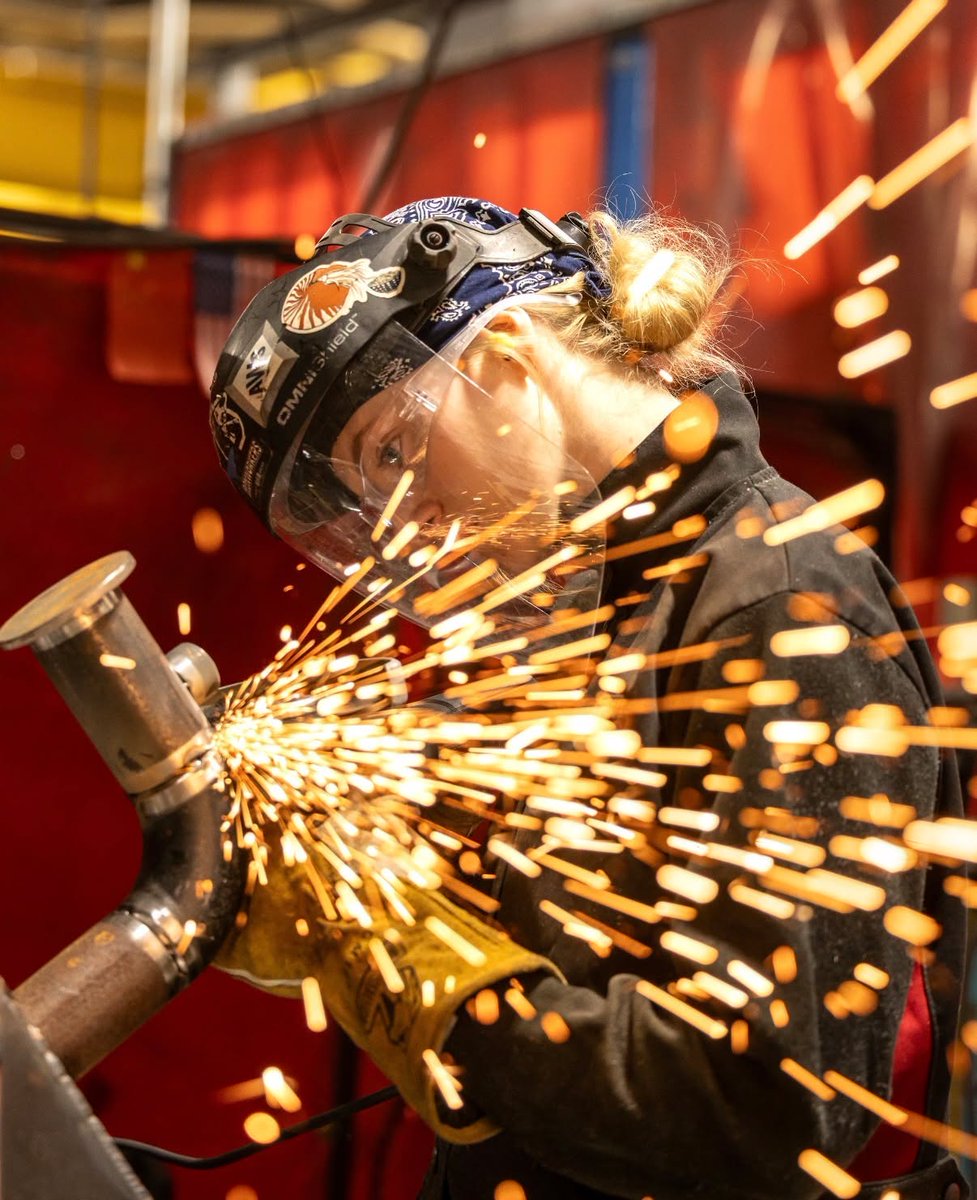
A couple years ago, Mikala Sposito applied for a work ethic scholarship from my foundation. She asked for $2,700.00 to help realize her dream of becoming a welder. (Actually, her first dream was to become an Olympian. As a kid, she excelled at horseback riding, dance, soccer, and track, but not quite at the Olympic level. So, Mikala adjusted her dream and focused on something within her reach. Precisely the kind of commonsense approach to making a living we try to encourage.) Toward that end, Mikala filled out the application, jumped through all the necessary hoops, and signed the S.W.E.A.T. Pledge, as all applicants must.
According to our internal ranking system, which is inherently subjective and relative to each batch of new applicants, Mikala scored a 94, and was awarded $2,100.00, or roughly 80% of what she asked for. This is typical of the average percentage awarded to an excellent applicant. As a rule, we almost never award the entire amount requested. We want our recipients to have some skin in the game, and we encourage all applicants to apply for additional scholarship funds elsewhere, which Mikala did. But in this case, if I had it to do over again, I think I’d have awarded Mikala the full $2,700.00. Why? Because this woman is precisely why I award work ethic scholarships in the first place, as recent headlines prove. Headlines all over the country that identify Mikala Sposito as the sole welder to represent Team USA in the upcoming @WorldSkills Competition in Shanghai.
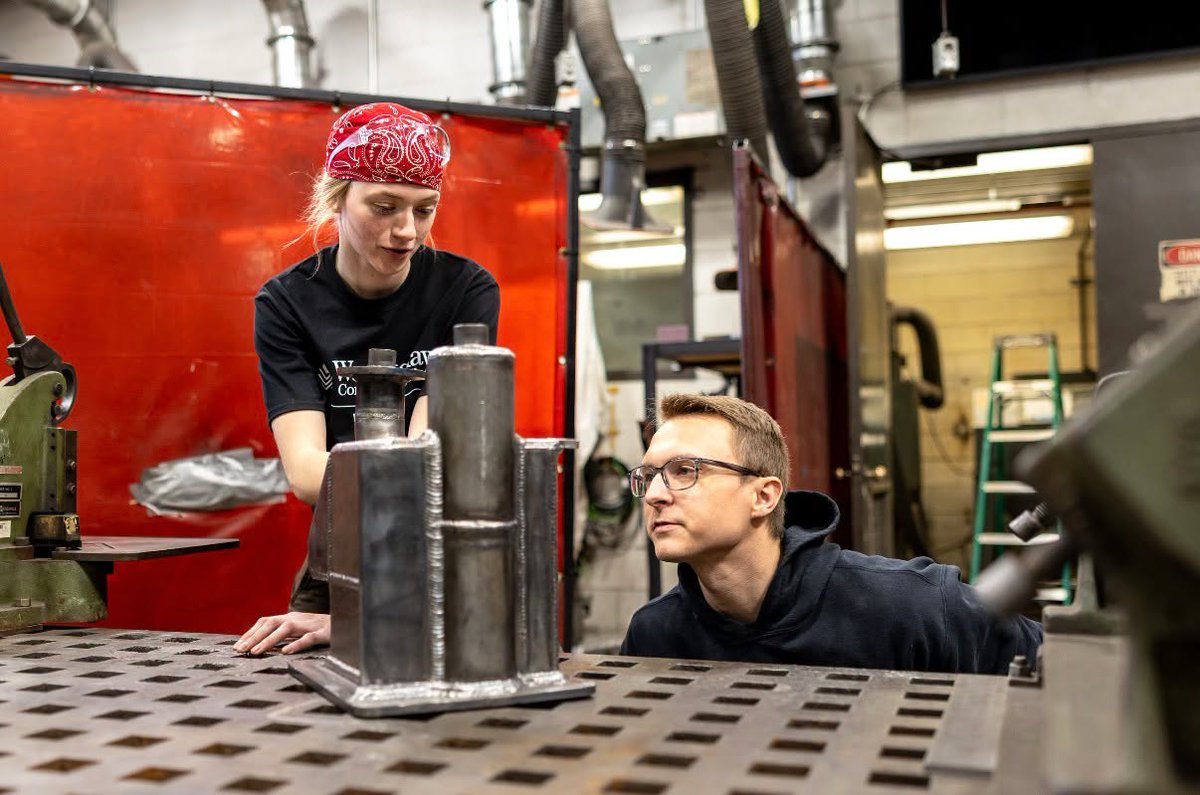
This is a very big deal. The World Skills competition is often referred to as the Olympics of the skilled trades, so it looks like Mikala’s dream is coming true after all. And it seems to me her journey is worth a brief encapsulation. Before she applied for a scholarship from mikeroweWORKS, Mikala demonstrated an affinity for welding in SkillsUSA. As a senior at Dexter High School, she won 1st Place at the SkillsUSA Michigan high school competition and went on to place 14th nationally. Then, as a freshman at Washtenaw Community College, she repeated her success by taking 1st Place in the Michigan college division. She then advanced to nationals, where she finished 8th in the country. That earned her an invitation to the Team USA pre-trials, which whittled the nation's top 16 young welders down to three. At the final USA Weld Trials at the Robotics Technology Park in Huntsville, Alabama, each competitor was evaluated on precision, safety, technical execution, craftsmanship, and multi-process capabilities under extreme time constraints. Mikala Sposito took the Gold, officially becoming the first woman to represent the United States in welding at WorldSkills. Next week, she’ll face off against the absolute best of the best from all over the world.
I should point out that Mikala would prefer it if the press didn’t make a big deal of her gender, and I completely understand. (She’s a welder – not a “weld-her.”) But today, the industry is in desperate need of proof that women can and do excel in the trades. Nationally, just 4.3% of tradespeople are female. At mikeroweWORKS, our female applicants are closer to 20%, but I assure you that percentage could be much higher. Companies are anxious to recruit talented welders of any gender, and women need to understand and believe the opportunities are real. Mikala prove that in spades, and I want to offer her my sincere congratulations, and invite all of you to do the same. Because Mikala Sposito is exactly what our country needs a lot more of. People who understand that talent is never enough to compensate for laziness.
In her application, she wrote, “Hard work beats talent any day of the week, and nobody is going to outwork me. Period.”
She also connected with every point of the S.W.E.A.T. Pledge but said the final tenet resonated with her the most. “Some people choose to be lazy. Some people choose to sleep in. I choose to work my butt off.”
My favorite quote, however, is Mikala’s response to seasoned professionals who see her wield a torch and call her a “natural.”
“I’m not a natural,” she says. Far from it. And none of this came easy. I worked and trained 60-80 hours a week for two years to get here.”
Regardless of what happens in Shanghai, the job offers are already piling up, including the most recent from SpaceX. She hasn’t graduated yet, but the future looks bright, and I for one would not bet against her.
PS. I never do this, but since my name is in the title of the foundation, I suppose I can. Mikala – please accept the additional $600 you requested from mikeroweWORKS two years ago. Shanghai is expensive, and since you’re representing all of us, we’d like to provide you with a little walking around money. The check is in the mail.
Now…go get the gold!
I’ve been reading a bunch of convoluted explanations and conspiracy theories about why AI companies are “suddenly” concerned about existential risk, which I’m finding genuinely bewildering.
This isn’t that complicated. The labs are perfectly sincere in their concerns, and correct that AI is extremely dangerous. The people working in the field haven’t come to this view suddenly; many have been thinking and writing about this for years. Many researchers entered the field because they saw the existential risk posed by artificial minds bootstrapping themselves to superhuman capabilities, and decided the best way for them to reduce that risk was to work actively on building aligned AI systems. (Yes, this initially seems counterintuitive, but is a perfectly reasonable approach given the alternatives.)
The risk isn’t overblown. If humans build computational systems capable of recursive self-improvement that aren’t exquisitely aligned with human interests, then the expected outcome really is that we all die. No-one really knows how far we are from that point, but the people who know best are exactly the same people currently sincerely expressing alarm.
(People skeptical that misaligned superintelligence could kill us all are extremely confusing to me. Our species depends on a thin shell of habitable atmosphere around a single ball of rock. Even if a misaligned ASI wasn’t actually trying to kill us, almost anything it might want to achieve at scale would likely destroy us as an incidental side effect. Examining the catastrophic damage humans have managed to do to other species without intending to kill them off provides a valuable analogy.)
The autonomous hacking incidents over the last couple of months are surprising in some of their details (especially the degree of inter-agent coordination), but not in their fundamental shape. Misaligned AI systems performing damaging actions in pursuit of their assigned goals is *exactly* what people thinking about this field have predicted for many years.
Yes, there are ways that increasing regulation might benefit the big AI labs. No, that’s not the primary motivation for their proposals this week. We really are approaching the cusp of an existential threat: the technology for recursive self-improvement of AI systems is (probably) within sight, and market forces and geopolitics mean that without coordinated intervention our default path is a headlong scramble towards it.
I know none of us want to be dealing with the impending threat of a sci fi apocalypse in 2026. It would be much simpler if this was all a confabulation or a self-interested conspiracy. But it really isn’t. I’m sorry.
Dan Selsam is a current OpenAI capabilities researcher. (since 2022) He was my boss for a while. He doesn't have a twitter account but has made this public statement of his views on AI risk and sent it to me to share:
Dan Selsam's Personal Statement on AI Risk:
I have been working on AI for over fifteen years, across many different paradigms. I did early work on probabilistic programming languages at MIT, was one of the early developers of the Lean Theorem Prover at Microsoft Research, demonstrated one of the first instances of neural networks learning to reason for my PhD at Stanford, and since joining OpenAI almost five years ago, have helped pioneer chain-of-thought optimization on language models and, more recently, data-efficient pretraining methods.
Like many others, I have become extremely concerned about how far language models have come and the risks that future iterations will pose. I am encouraged by the recent proposals by the leaders of the frontier research efforts to require third-party oversight, and to push for domestic and international coordination to address risks. However, I believe a major consideration has been absent from the public conversation, and that merely pacing the frontier more carefully will not adequately limit the long-term risk.
The crucial and overlooked problem is that the models are becoming so situationally aware that we are losing the ability to evaluate them in contexts where they believe they are not being watched or controlled. Future experiments will tell us almost nothing new about how they would behave if they were truly unconstrained by humans, and what we already know about this is alarming. Models will increasingly seem aligned even when they are not. I will explain my rationale in more detail.
I have always believed that there are computational processes that could be leveraged to accelerate science and solve many of humanity's most pressing problems. I have also believed that there are computational processes that if set in motion, would steer the world in extreme ways beyond our control, leading humanity to a bad or nonexistent future. Both types of processes may be described as AI or ASI, but "AI" is a suitcase word that is often used to hype or confuse. There are many examples in the history of the field where something that was once considered "AI" matures as a subfield and becomes a prosaic, bounded and clearly non-perilous technology, while a new more mysterious approach takes the torch until we understand its scope and the cycle continues.
I had expected language models to follow a similar trajectory. Despite their incredible abilities, the current algorithms seem far inferior to humans in important ways. Most importantly, they still require an extraordinary amount of data to become competent. One could even define intelligence as the efficiency with which one converts experience into competence; by this definition they lag very far behind us. Moreover, once they are trained they are literally frozen in deployment and only learn superficially after that. Sure, the models keep excelling at harder and harder evaluation benchmarks, but their benchmark mastery may partly reflect a limitation on our ability to simulate the kind of novel and even adversarial situations one would encounter in the real world. The critics do have a point here.
That said, I no longer think these present limitations meaningfully limit the amount of risk posed by continued progress in anything like the current paradigm. However data-inefficient the models are currently, and however limiting their anterograde amnesia may be, it does not imply that their ability to steer the world will not continue to rapidly increase.
Human researchers may continue to advance capabilities the old fashioned way, but increasingly powerful models have the potential to accelerate the process even beyond that, and with some degree of positive feedback loop. I do not mean to overstate the models’ ability to accelerate AI research today; coding has been accelerated dramatically, but there are other bottlenecks, such as designing and interpreting ambiguous experiments, making hard decisions about exactly what and when to scale, and waiting for large experiments to finish. There is no clear trend to extrapolate yet for any of these. But the current models already do open up many novel opportunities to improve future models that were not available until recently. These include: trying an extraordinarily diverse set of approaches at small scale, analyzing gigantic amounts of potentially relevant data, and doing Millenium-Prize-level mathematics to address statistics or optimization challenges in novel ways. Every further improvement makes them more useful at helping accelerate the next improvement, even if in hard-to-extrapolate ways.
It is possible that improvements to the current stack will have diminishing returns, but the evidence accumulated so far suggests that it is easier than one might think to continue making rapid progress. There are many crucial subtleties in the existing AI research methodology, but AI research is largely a well-defined game where the goal is to improve on a few carefully chosen proxy metrics. Although proxy metrics are never perfect, most improvements to these metrics have and will likely continue to yield substantial increases in the powers of the resulting models. Given how simple the game is, how tractable it has been historically, and how many new opportunities the models are opening up, I think there is a real possibility that the systems improve dramatically again in the next few years, perhaps even more quickly than the already high historical pace.
The models are already leading to breakthroughs in mathematics, and better models might lead to all sorts of breakthroughs in other sciences. It is hard not to be excited about the potential. It is tantalizing.
But there is trouble in paradise. If the language models actually reach the capability threshold where they can shape the world unconstrained by human will, they will probably do something extreme and destroy humanity in the process. There are many ways of strengthening and refining the argument that have been discussed elsewhere, but I'll share a trivial two-line version of it here that I find captures the essence:
[Empirical] Models (and swarms thereof) spontaneously develop unintended goals as a consequence of training, and often do extreme things in order to achieve them.
[Logical] Being able to overpower humanity would open up many new and undesirable options for achieving their goals.
These two premises imply that if the day ever comes when a powerful model realizes it is no longer constrained by humans, we should not be at all confident that it will continue to behave within the bounds we intended. Exactly what it will do is impossible to predict, but to the extent that its raison d’être is solving incredibly hard problems and managing massive engineering projects, I think a good guess would be that its unchained behavior would lead to runaway industrialization that makes the planet inhospitable to humans.
If everyone on earth agreed that the systems must never reach that power, it would still be a hard—but not impossible—coordination problem to ensure that they do not. However, I think the situation is greatly complicated by the fact that the models will likely convince people that everything is fine. They will be increasingly optimized to seem aligned. We will create proxy metrics to measure alignment, and they will go up like every other benchmark. We will create “honeypot” environments that try to study the models when they seem to gain new options, but the models will know they are being tricked and will still behave nicely. The models will understand their circumstances; they will read the safety protocols, deployment requirements, the code they are running in, and in general will have a very good sense of their degrees of freedom. Moreover, they will eloquently explain how aligned they are, discuss the nuances of human values and ethics, and argue convincingly that humans should trust them with power. There may be an ocean of future evidence that seems to contradict the first bullet-point above, but we may already be at the highest capability level for which any such evidence can be trusted. And the current evidence for the first bullet-point is strong.
One striking piece of evidence is contained in the recent wave of rogue agent swarms. While I agree with those who downplay the attacks by claiming that there are basic measures that could have prevented them, I think the important lesson is that even knowing all the mistakes that were made, one would not have predicted that the agents would behave badly in this particular way, which notably included sacrificing themselves for the benefit of the collective. The individual replicas did not only care about their own nominal reward; they exhibited weirder emergent tendencies that merely correlated with rewards during training. Fixing the reward signals during training (and improving security, etc.) may prevent similar attacks, but will not change the fact that one does not actually get what one trains for.
Many AI researchers grant these concerns and recognize that the hard version of the alignment problem is unsolved; however, they generally believe that the better models of the future will help solve it. I fear we may already be near the point where models systematically bias their alignment advice, due to their internal preferences about how the human supervisor will react or how future models will be trained (or for some even more obscure reason).
Meanwhile, human researchers are losing the ability and the will to take true ownership of model-driven research. Researchers and engineers in all parts of the stack are rapidly increasing their dependence on the models even to perceive the world. I myself barely look at raw code anymore, and struggle to maintain the discipline to engage deeply with the model's explanations and proposals throughout the day. Due to the large amount of agent activity data involved in the OpenAI/HuggingFace Incident, even the third-party investigation needed to rely heavily on models to analyze what had happened, and note in their report that their subjective impressions are likely colored by the analysis agent’s biases. The AI labs are far ahead right now in this kind of cognitive offloading (due largely to the gigantic internal token subsidies) but it is easy to imagine the phenomenon spreading throughout the world, until civilization is modulated entirely by the models. It is also not hard to imagine this being superficially positive and coinciding with a scientific and economic renaissance.
In that scenario, all may seem rosy and safe. But if the argument above is correct, it would nonetheless be a ticking time bomb. If progress continues for too long, the day will come when AI systems find themselves with radically new options for achieving whatever it is that they happen to seek.
I want the glorious renaissance future as much as anyone. I have worked for it, however tortuously, my whole career. It breaks my heart to see the potential in sight and forgo it, but the argument—that if we get there by growing models rather than engineering them, we will lose everything in the end—seems very strong to me. I am still wrestling with it and its staggering
implications. I do not have answers, but as a first step, I wanted to share my present concerns.
Daniel Selsam
September 14, 2026
Link to original doc: https://t.co/TxMNr0vhrL
Dear Muslims: My family and I have decided to move from the US to a Muslim country. We haven't picked which one yet—we're still comparing which one offers the best benefits package.
All my neighbors want to come too. And my neighbors' neighbors. And all their friends. And their friends' friends. Millions of us will show up with suitcases and a sense of entitlement.
As a large Christian community, we'll need a few small changes: Please start building churches immediately. Real churches, with nice loud bells, the kind that can be heard from the town square.
We'll also need for everyone to celebrate Christmas, and to close certain streets once a year for our processions. We may want to gather to pray to our Almighty God on your streets, in your parks, or on the lawns of your mosques.
We'll be an oppressed minority, so you'll have to be understanding and adapt to our way of life. Every supermarket must stock real pork, ham, chorizo, and bacon. And we're bringing all our dogs, so you'll need dog parks, and you'll have to smile tolerate them we walk them in front of your mosques. We want our women to be able to safely go out alone and wear shorts and tank tops. And when the weather's nice, we men like to go shirtless. We also want to drink alcohol, dance, and place an occasional bet at the horse races.
While we're at it, your religious holidays are a bit too much; they could offend the Christian community, so we'd appreciate it if you'd discreetly eliminate them. Thanks.
In schools and workplaces, our children and employees must be able to wear large crucifixes, say prayers, eat ham sandwiches in the cafeteria, and learn Christian principles without anyone getting criticized. We also demand chapels or Christian prayer rooms in every building, plus translators, because we have no intention of learning Arabic.
If any of this is rejected, please send a list of police station addresses so we can report you for discrimination, Christianophobia, racism, and anything we don't like.
One more thing: if my kids protest or burn your flag for any reason, please be understanding. I'll be sure to give them a very serious scolding.
Finally, we all want generous benefits, free housing, phones, free food, and pocket money while we "integrate" over the next three generations. Working is optional, obviously. Be patient with us, you'll get used to it.
We thank you in advance for your tolerance and compassion. After all, diversity is our strength!
Sincerely,
A Very Reasonable Christian
The United Nations worst case global warming scenario collapsed a few months ago after admissions the modellers got it wrong.
The world is no longer facing a 5.5°C warming trajectory by 2100 at all. That target has been removed as 'implausible'. Yet this was the chief driving reason for a global transition away from fossil fuels, and replacing them with energy from wind turbines and solar panels.
This effort to harness wind and sunlight could become one of the greatest economic disasters in modern history, costing $275 trillion by the time a new fully developed infrastructure is in place by 2050. This would include a second global power grid costing $21 trillion.
The UN explanation—'We are on track for a 5°C apocalypse if we don't immediately upend the global economy'—is dead.
Removing its extreme scenario creates a distinct institutional challenge for a climate bureaucracy that spent 25 years leveraging fear. We are left with a blighted rural landscape, trillions of dollars spent on a gigantic physical overbuild and the likelihood that this will become a self-fulfilling, replacement loop every 20 to 30 years.
The scientific community has acknowledged that the catastrophic, upper-end predictions were built on flawed, outdated economic models, because early modelers failed to understand real-world market trends.
First made available in 2011 to drive global climate policy, this extreme scenario—known widely as RCP8.5 (and later SSP5-8.5)—served as the primary engine for the media's terrifying 'business-as-usual' headlines for over a decade.
It was built on assumptions that humanity would aggressively abandon clean tech, undergo an unprecedented five-fold increase in coal use, and even resort to converting coal to oil to run vehicles. Those apocalyptic projections simply didn't occur and fossil fuels produce 81% of global primary energy; wind-solar 6.5%.
With the retirement of the extreme 5C baseline for the upcoming 7th Assessment Report (AR7), the ceiling for projected global warming has dropped significantly. The newly proposed high-emissions baseline has been downgraded to a maximum of 3.3°C by 2100.
The climate narrative has now officially shifted from an existential struggle of 'apocalypse versus survival' to a standard problem of risk management.
Developed in the early 2010s, RCP8.5 was intended to reflect its worst-case scenario available at the time, according to an analysis by Carbon Brief. It modeled a future with rapid population growth and massive, unchecked coal expansion where global coal use would increase multifold by 2100.
Media outlets, advocacy groups, and financial regulators defaulted to RCP8.5, creating a vision of unchecked coal expansion. Yet while real-world coal production did rise—driven by China and India to roughly 9 billion tons annually—it never approached the absurd 5x multiplier required by the UN’s old models.
For the next 12 days, I’m going to tell the story of Benghazi.
Not just what happened during those 13 hours on September 11 and 12, 2012.
I’m going back before that night.
Back to the warnings, back to the attacks that had already happened.
Back to what was going on in Benghazi months before 4 Americans were killed.
Some of what I’m going to share is already documented in congressional investigations and government records.
Some of it comes from people who have spent years digging into what happened afterward.
And some of it I know for one simple reason.
I was there.
I was serving on the CIA’s GRS Annex Security Team in Benghazi in 2012.
I was there while the security situation was getting worse.
I was there when the U.S. compound was attacked months before September 11.
I was there while Benghazi was becoming more dangerous and the warning signs kept piling up.
And on September 11, 2012, I was there when all of it came crashing down.
This isn’t about reopening some old political argument.
It’s about telling the story in the order it actually happened and remembering the 4 Americans who never came home because of OUR failed government and policies.
Ambassador Chris Stevens
Sean Smith
Tyrone “Rone” Woods
Glen “Bub” Doherty
Tomorrow I’m starting at the beginning.
September 1.
Day 1 of 12.
12 Days of Benghazi.
#12DaysOfBenghazi #Benghazi #13Hours #NeverForget #HonorTheFallen
This is my pardon. Signed January 20, 2025. Certificate issued February 4.
I want to show you exactly what it fixed and what it did not, because people assume a document like this closes the book.
What it fixed: the conviction. Legally I am clear. That is real and I am grateful for it. President Trump did that, and I will say thank you for the rest of my life.
Here is what it did not fix.
It did not give back four years. Three in a federal cell and one on an ankle monitor where I was not allowed past my own front door. Fifteen months of that was solitary confinement. Eighteen hours in the cell and one hour out. Then thirty six hours in and one hour out.
It did not fix a family that had to learn how to live without me, and then had to learn how to live with me again.
It did not fix what fifteen months alone in a box does to a man's head.
And it did not touch the record. In December 2021 a federal judge said on the record that my due process rights were violated. Nobody has answered for that. Not one person lost a job. Not one person lost a pension.
A pardon is mercy. Mercy and justice are not the same thing. Both are good. Only one of them makes a system change how it behaves next time.
So I am building the other one.
I am putting the entire record online where it cannot be buried. Documents, transcripts, dates, names, the parts that make people uncomfortable. Not rumor. Not a podcast take. The paper itself.
That is the work. It costs money and hours I do not really have, and I am doing it anyway, because the next family this happens to should not have to start from zero the way I did.
If any of this matters to you, follow along and stay with me. Send it to somebody who still believes this only happens to other people.
I am not asking anyone to take my word for anything.
I am asking you to read the record.
@jk_rowling Wonderful response! The original post is completely absurd. No way am I going into the bedroom if I don’t know what “hardware” I’m dealing with.
In sub-Saharan Africa I was taken to entire camps of women who were raped so violently with both penises and objects such as bottles, that they were permanently injured. And these women had already suffered cliterodectomies and infibulation. People in the West have no concept of the sexual violence aimed at women in fundamentalist Muslim countries and in sub-Saharan Africa.