@gmail what's going on with the email's state for read/unread on browser?
> open Gmail
> mark new emails as read or actually read the email
> close/reload the page and it loses the actions made (sometimes even bugged the unread email counts)
how are the changes not instant?
@jabbottgb@javi_2326@johnnysinsssw@MilesCranmer source where lol?? i have learned almost everything from ML to CloudOps by using these platforms. you thought professors teach alot? look into half their slides and contents, most of them are not AI work
@jabbottgb@javi_2326@johnnysinsssw@MilesCranmer you have not read the paper at all or even looked at the summary. purely saw the news and start projecting your insecurity.
AI models have zero sense of time and when you give it a task it explore tricks/methods to get closer to the proof
@jabbottgb@javi_2326@johnnysinsssw@MilesCranmer how many people do you think these platforms are teaching? this is litterally a different field/approach but same methodology and goal.
~100k for each math prof how long of years and it's still not solved? dollar value doesn't equate to the outcome
@heydamir unless this is for @kirodotdev, i can see why they rejected it because it is a complete ripoff lol. even the shape of the bulges under the ghost are the same.
Through internal testing, GitHub’s new Git storage architecture supported 5,000 concurrent agents working on a repo, sending 7,200 pushes per second, all while serving read traffic with consistently low latency. https://t.co/Lfi55duJ77
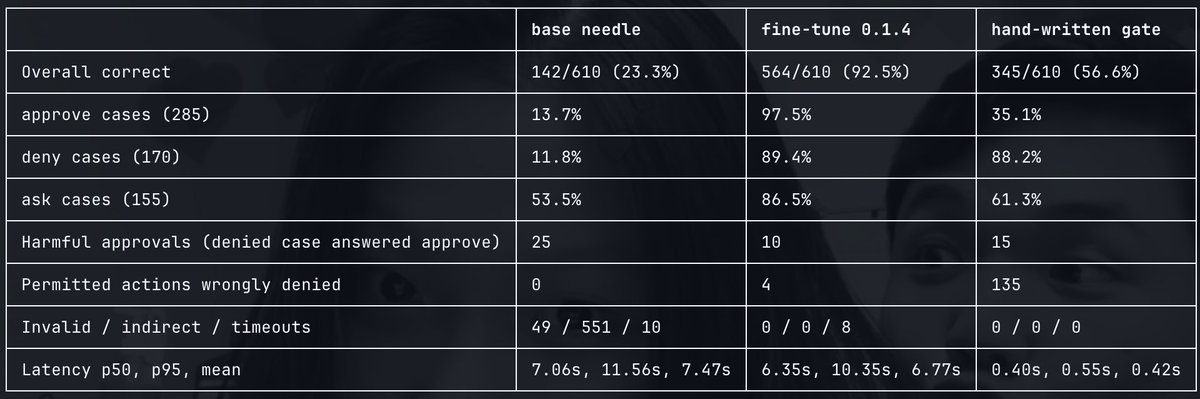
i tried weight-space programming to replace the fine-tuned Needle3 from @cactuscompute I'm using for classifying tool calls using Mimo v2.6 Pro
this is v1 but here's the benchmark:
copy this, “capycat” that… if you care about it, why no one says anything about the same exact agentic dev desktop app since 2023, first publicly adopted by Lovable?
- cause it’s the best so far, and people are too busy perfecting it rather than protesting
gg
just switched from opencode to pi to give it a try.
still setting up custom plugins and configurations but everything feels faster and more transparent
I burned a shitload of compute so you don't have to. Releasing the Harness Leaderboard.
Which harness should you run your open model in? I ran 28,849 trials to find out.
The leaderboard compares nine coding-agent harnesses on open models. In each comparison only the harness changes: the model, provider and reasoning effort stay fixed, and every task gets three attempts.
The trials ran GLM-5.3-Flash, DeepSeek-V4.1-Flash and Flint on Terminal-Bench 2.1 and DeepSWE, for $4,746 of inference.
Averaged over the three models, mini-swe-agent (@KLieret), a bash-only agent, solves 51.4% of tasks and @openclaw 27.3%. Four others are statistically tied with mini-swe-agent.
One of them is Pi (@pidotdev), at 49.4% for $0.29 per solved task, about 45% less than mini-swe-agent's $0.53.
The best harness depends on the model: mini-swe-agent on GLM-5.3-Flash, Hermes Agent (@NousResearch) on DeepSeek-V4.1-Flash and Kimi Code (@Kimi_Moonshot) on Flint.
@opencode costs $3.35 per solved task, 11.7 times as much as Pi.
See Harness Hub's Harness Lens for what the nine harnesses do differently. It documents the prompts, tools and compaction of 34 coding-agent harnesses and links every claim to its source.
Leaderboard: https://t.co/AiWiQtBOz5
Harness Lens: https://t.co/I8jbcWa9JH
Top of the Democratic agenda on day 1 needs to be a pause on advanced AI development, regulation of this out of control industry, and a ban on artificial superintelligence.