@perplexity_ai Perplexity Computer could’ve won over this AI assistant race. Where did they go wrong?
1) perplexity mobile contains hidden automation feature, with less delightful UX. “Tasks” and “notifications” should be embedded in chat experience.
2) Shopping launched too early. Embedding it into the pro subscription also led to lack of early adoption and user feedback on use cases.
3) lack of focus between enterprise and consumer positioning. Perplexity was landing enterprise deals, but knowledge search has lower ROI than automating workflows for employees.
It’s kinda crazy how much Muse can learn about you and remind you about with only email data. I just got a notification from Muse reminding me to leave for my yoga class.
The amount of personalized context building that’s going on here…wow
This metric may tell us more about the business model of consumer AI than the state of AI. AI for consumers almost inevitably will be subsidized and monetized via commerce, ads, or purchases of devices and other services. This metric may level off lower than we think.
@andruyeung What if we use these new ai assistants like muse or instinct to create learning plans for us and notify with fun facts or knowledge stories every day. Our brain muscles don’t need to atrophy if we don’t let it
@defyneric Another consideration: generative engine optimization (GEO). Merchant will pay agent platforms to jump up in results rankings so that they have higher cart conversation
@defyneric Overall support this hypothesis with one caveat - merchants and banks will never agree to pay additional interchange fees for agent initiated transactions. In order for this to succeed, agents will need to work with and have trusted identities with Visa and Mastercard
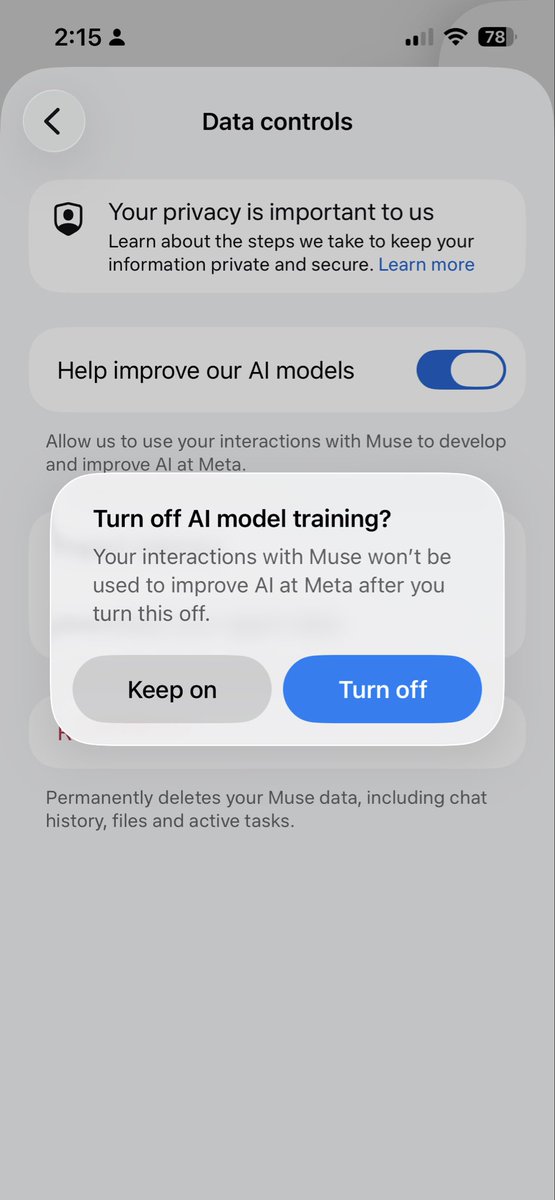
FYI @alexandr_wang , as someone who works in Agentic Commerce and aiming to solve the trust gap…I too feel hesitant to share my data with Muse. Would recommend building that relationship with users more explicitly. Can’t imagine how much fear the non tech saavy must have on this
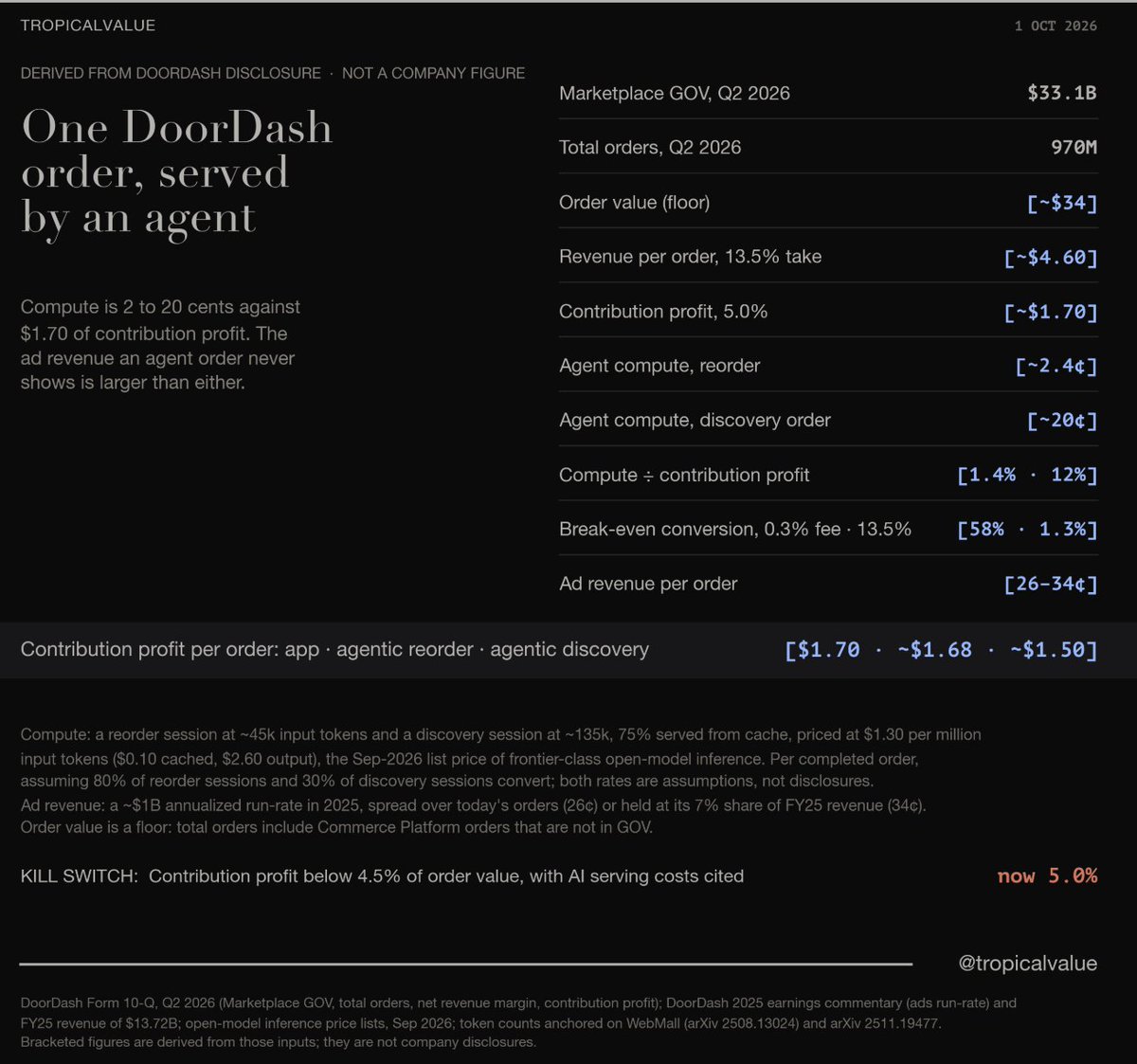
Serving a $DASH order through an AI agent costs $0.02 to $0.20 cents of compute, against $1.70 of contribution profit per order. The napkin math:
Unit economics, from the Q2-26 10-Q:
• Average order: ~$34
• Revenue: ~$4.60 (13.5% take)
• Contribution profit: ~$1.70 (5.0% of order value)
• Adj. EBITDA: ~$0.95 (2.8%)
Everything below is measured against that $1.70 contribution profit.
Moving forward, an agent doesn't make one call. It browses, compares and checks out, and every step re-reads its context. At market prices for frontier-class open models (~$1.30 per million input tokens, ~$0.10 cached), a session costs (est.):
• Reorder "my usual", ~45k tokens: ~$0.02
• New discovery order, ~135k tokens: ~$0.06
That is 40x to 120x the compute behind a Google search.
$GOOGL earns ~4¢ per search and spends ~0.05¢ of compute on it (est.), and its largest variable cost is the ~0.7¢ of traffic acquisition it pays Apple, Samsung and others. Advertisers pay per click, so they carry the searches that don't convert. An agent paid on a take rate carries a different equation.
For DoorDash that means the failed sessions land on the completed orders. If 80% of reorder sessions convert, compute is ~2.4¢ per completed order, and if 30% of discovery sessions convert, it is ~20¢. Both conversion rates are my assumptions, not disclosures.
Contribution profit per order:
• App order: $1.70
• Agentic reorder: ~$1.68
• Agentic discovery: ~$1.50
Compute takes 1.4% of the margin on a reorder and 12% on discovery.
Those two ratios are also the break-even. An agent order that would have happened in the app anyway carries the compute as pure added cost, so the agent pays for itself once 1.4% of its reorders, or 12% of its discovery orders, are orders DoorDash would not otherwise have had.
What absorbs the compute is the take rate. The same $34 discovery order on a payments-style 0.3% fee would need 58% of sessions to convert to cover it, and at DoorDash's 13.5% it needs 1.3%. Merchants of record on marketplace takes ($DASH, $BKNG, $EXPE, $AMZN) can add an agent for cents per order, while a third-party agent on a thin fee is confined to repeat and big-ticket purchases until merchants can no longer refuse it.
So the exposure sits on the revenue line. Ads reached a ~$1B annualized run-rate in 2025, about 7% of DoorDash's $13.7B of revenue, which is 26¢ to 33¢ of the $4.60 it earns per order (est.). They are sold in the app feed, and an agent order never opens the feed. The agent's costliest order burns 20¢ of compute, and the average order carries ~30¢ of ad revenue it doesn't show. But there's a scenario Doordash put sponsored options for the agents, ensuring those ads were read by the agent, delivering better ROAS for advertisers.
The line to watch as agent orders scale is net revenue margin, 13.5% in Q2-26, since that is where displaced ads would show. I'm wrong on compute if contribution profit falls below 4.5% of order value with management citing AI serving costs.