The best part of the conference was meeting all like-minded people @Dhan_instem your PhD journey was inspirational. Kudos to Anupam Mittal and team for organising ACMR2023.
Many congratulations to Abishek Bharadwaj and @ppant95 for the 1st & 3rd prizes in oral ppts under Basic Res at the Advances in Cardiovascular Medicine & Research-2023 organized by Intl Academy of Cardiovascular Sciences & Intl Soc for Heart Research-Indian at PGIMER, Chandigarh.
BIG ANNOUNCEMENT📣: I haven’t been this excited to be part of something new in 15 years… Thrilled to reveal the passion project I’ve been working on for the past year and a half!🙀🥳 It started from my frustration with the depressing effect that the current publishing system has on the well-being of myself, my team, and pretty much every scientist I know (maybe you’ve noticed from my stupid jokes… :) I was exhausted of dealing with the huge delays, reviewers that can be abusive, and how arbitrary it all is. Unfortunately, the most important factors are often WHO your reviewers are and who YOU are... It’s clear we need alternatives or at least ways to improve the situation. So, together with a really special and talented team we worked to develop this idea into “qed” a platform where you can get CONSTRUCTIVE feedback on your own work or CRITICALLY assess other people’s papers. It can be a real difference maker if many of you join us (thousands have tried it already, but today we release a NEW and much stronger version ;) Let’s harness qed to put the power back in the scientists’ hands, to do, to read & to publish science on our own terms. I’m dying for you to TRY IT, and it’s very simple - just drop a paper (the link to the website is in the replies👇) - it’s completely secure, private, and free, and you get results fast. Please show your support, SHARE, tell your friends, and let’s be the revolution 🫵!
Rubisco is (arguably) the most abundant protein on Earth. (LPP surely comes close, right?) It’s an enzyme that fixes CO₂ into sugars during photosynthesis.
Unfortunately, as most people learn in school, Rubisco is inefficient. Sometimes it confuses O₂ for CO₂ and wastes energy. Plants make up for this in raw concentration; up to half the soluble protein in a leaf is Rubisco.
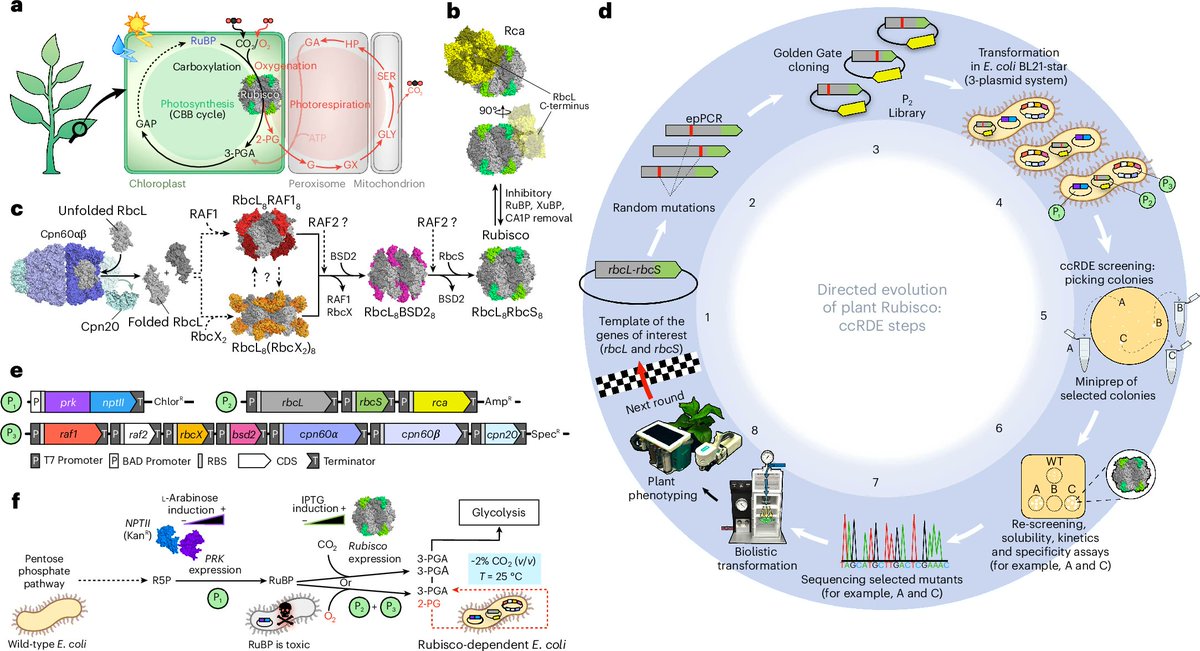
People have been trying to engineer better Rubiscos for many decades, but it's not easy because the proteins are big, do not fold easily (they need chaperone proteins to help out), are made from 16 subunits in land plants.
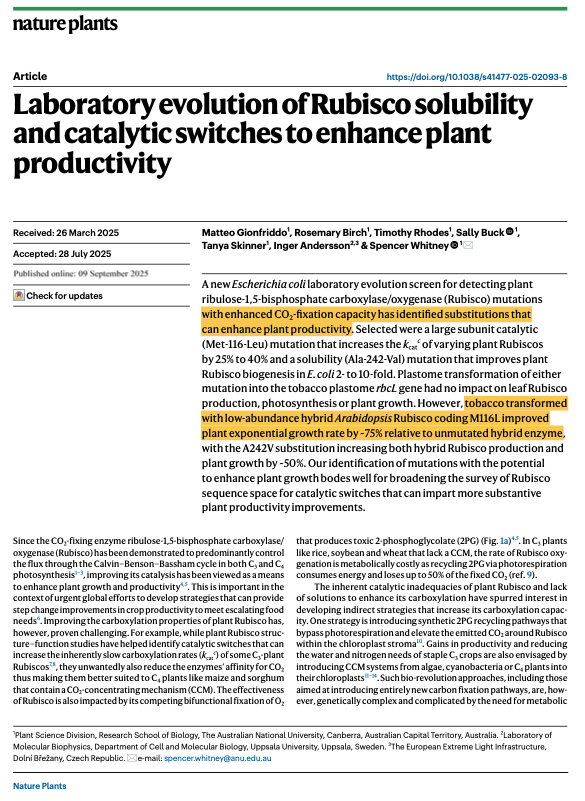
But there's a new paper in Nature Plants that looks really interesting. The TL;DR is that a group in Australia figured out how to express plant Rubiscos (and all SEVEN of their folding chaperones) using a set of 3 plasmids inside of E. coli cells. This enabled them to do "directed evolution" of Rubisco in bacterial cells, and quickly find Rubisco mutants that have higher enzymatic efficiency or that fold better.
In addition to the 3 plasmids, the researchers also coaxed E. coli to make ribulose-1,5-biphosphate, or RuBP, which is the 5-carbon sugar that Rubisco smashes into carbon dioxide to make molecules of 3-PGA for central metabolism.
Now, the clever bit is that you RANDOMLY MUTATE the three plasmids encoding the Rubisco to make millions of variants. Then, you transform those mutated plasmids into E. coli. If the E. coli do NOT make a functional Rubisco, RuBP levels build up and kill the cell; the molecule becomes toxic. But if the E. coli DO make a functional Rubisco, then they keep the RuBP levels in check and live just fine.
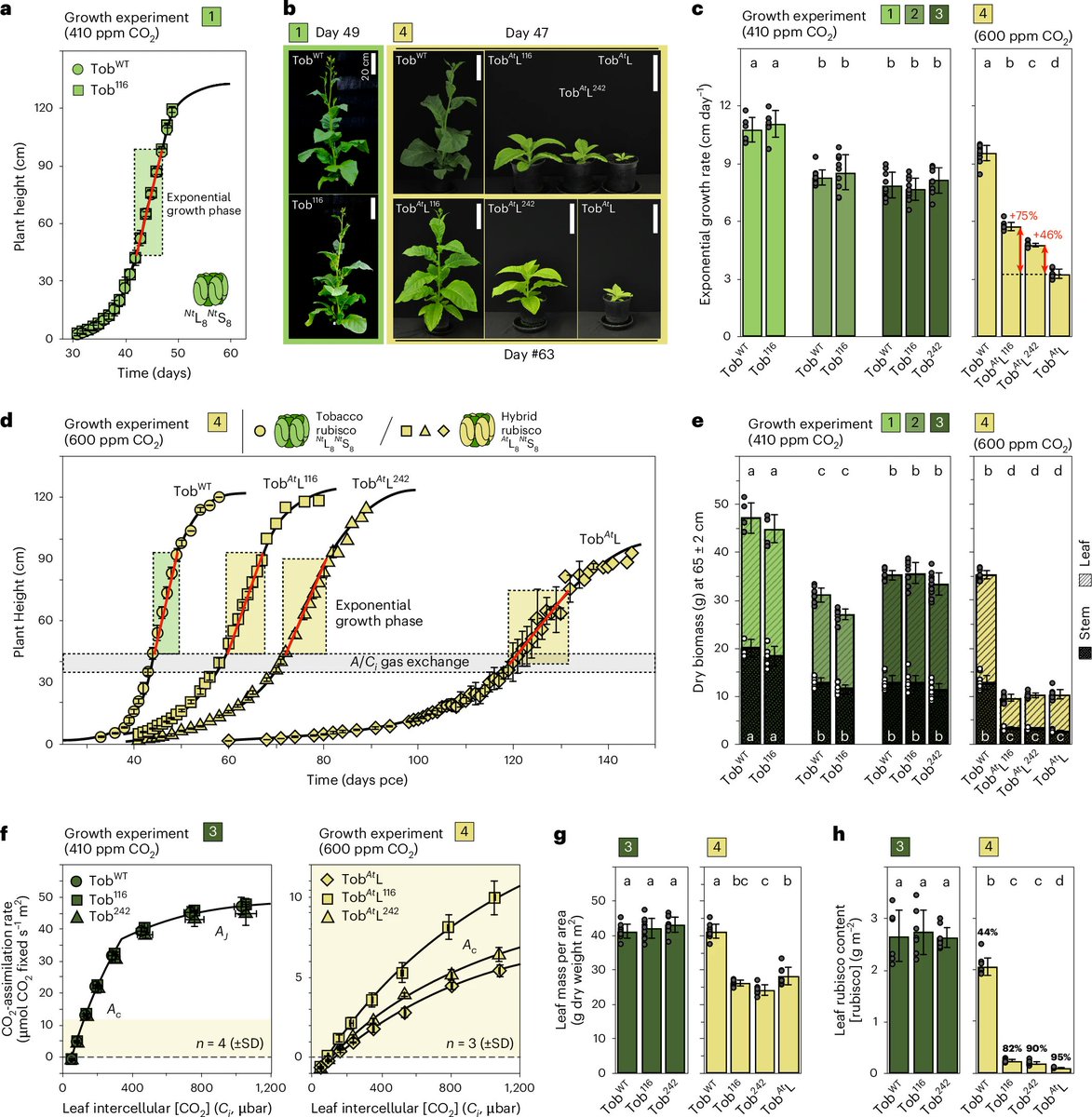
Using this "screening assay," the researchers found 46 fast-growing colonies of E. coli. Two of those colonies encoded really useful mutations. One mutation (M116L) makes Rubisco about 25–40% faster. The other (A242V) makes it fold and assemble much more efficiently.
They put this mutation into a "hybrid Arabidopsis–tobacco Rubisco," put that into tobacco plants, and measured growth. The plants with M116L grew 75% faster than wildtype.
No guarantees this will scale to more useful crops, like wheat and corn and soybeans etc. But it seems like a nice in vitro assay for faster prototyping!
🧬 BREAKING: Our CRISPR-GPT paper is out TODAY in Nature Biomedical Engineering @natBME !
🤯 We built an AI agent that turns ANYONE into a gene-editing expert in 1 DAY instead of months. An undergrad with ZERO experience achieved 90%+ editing efficiency on their FIRST attempt.
🧵 Here's how we're building expert AI agents for cutting-edge biotechnology:
🎯 The Problem: CRISPR is revolutionary but requires PhD-level expertise, it can take weeks to learn, adopt, and design, analyze a CRISPR experiment for R&D or making life-saving medicine. Even Pro scientists can make small mistakes (e.g. typos in guideRNA or cloning design) that cost months to find out, slowing us down.
💡 Our Solution: CRISPR-GPT - an AI co-pilot from @Stanford@Princeton@GoogleDeepMind that guides you through EVERY step via simple conversation
🔬 Real Results:
-Novice researcher: ~90% editing on 1st go
-Training time: Months → 1 day
-100% success rate in our trials
-Even experts save days/weeks on data analysis & troubleshooting
🤖 How it works: Our multi-agent system handles: CRISPR system and delivery method selection, guideRNA design, Protocol generation, Real-time troubleshooting, Data analysis, and beyond. All through natural language! No coding, no complex software.
📊 We benchmarked it extensively:
-288 evaluation scenarios/cases
-Outperformed GPT-4o on ALL gene editing tasks
-Trained on 11 years of expert discussions
-Covers knockout, base-editing, prime-editing & epigenetic editing
🌍 Why this matters:
-Every lab can now use CRISPR with an AI system distilling expert knowledge and skills.
-Every student can learn faster.
-Every researcher can tackle bigger challenges without worrying about small mistakes.
-Customized CRISPR design can be automated based on your need and the context of R&D workflow.
-Agentic AI ensure safety, privacy, and responsibility
-We're not just automating gene editing - we're using AI to power scientists to cure diseases.
🚀 Try it yourself! Beta access available at: https://t.co/CFQzrdVVPW
Paper: https://t.co/WOgmAjg1Ed
Code: https://t.co/UnPKrxyJuW
Benchmark (companion work, Genome-bench): https://t.co/LIooAXj2op
Co-first and key authors: @YuanhaoQ@KaixuanHuang1@MingYin_0312
PIs: @lecong@MengdiWang10
Key collaborators: @Rbaltman@denny_zhou
The future of biology and science is conversational. The future is now. @natBME@NaturePortfolio
#CRISPR #AI #GeneEditing #Biotech #Science #AISafety
@Ishwariya13 I think the issue is not just about the right time/age but the fact that a female is expected to uproot her whole life and career to either move to a new city or settle into the expectation of a new family.
It is sad that females have to either prioritize family or career.
Are mini proteins the new antibodies?
Mini proteins are highly stable, easy to manufacture, and very quick to design thanks to recent AI methods. Unlike mAbs, there is a large body of structural data to train machine learning models on to generate de novo mini protein binders. Of course, there are many apparent drawbacks to using mini proteins.
Thread 👇
Dive into our latest review, with @BailinW40848 and @ABeisaw, and explore the fascinating ways cell-cell interactions power heart regeneration!
https://t.co/kcl6Iboa74
Latest work in Imran Siddiqi's lab by @meiosiva and others found a gene - SHUKR in flowering plants, that might have helped these plants in rapid evolution, faster than in any other plant group. @SomdattaKarak explains the finding in @the_hindu:
https://t.co/gRuQbb5pbY
@CSIR_IND
Maarten van den Hoogenhof found a specific way to improve cardiac function in RBM20 cardiomyopathy. CAMK2 inhibition might become the first tailored therapy for a Dilated Cardiomyopathy (after mavacamten for Hypertrophic Cardiomyopathy): https://t.co/5x9YZibpX8
Butterfly! Butterfly!
Our study just published from #ImranLab@ccmb_csir in @NaturePlants can be explained with the help of a butterfly.
Worm > Cocoon > Butterfly – a transformation that has fascinated researchers, photographers, and poets for centuries. 1/n
1/ H3K27me3 mimicry has repeatedly emerged through evolution, but what's the physiological relevance?
We show that JARID2 and PALI1 mimic H3K27me3 to antagonise PRC2 in vivo and restrict the spread of Polycomb domains.
🧵
https://t.co/h5G9zTXNZz
Excited to be in this month’s SciArtist profile in @the_Node ! and I’m grateful for the opportunity to share my work with this amazing community.
SciArt profile: Harsh Kapoor https://t.co/LAMbpjS3aj
I genetically engineered the amazing Arabidopsis to mimic the striking patterns of my Tradescantia zebrina🧬🌱
From concept to creation, here's the story behind transforming this plant into a living work of art! (1/7) 🧵"
Is it acceptable to mention a grant on your CV even if you were not officially listed as the PI but was primary contributor for the grant and even helped with grant writing? #academictwitter#postdoc#investigatorsbook
🎉Excited to finally share that our new work (previously @biorxivpreprint) is now online at @Nature! A fantastic team effort with amazing collaborators. You can read the paper by using the following link: https://t.co/pBFuKIzxWq
A thread 🧵/1
https://t.co/LPB5TLE05z
We are hiring! The lab investigates possibly novel biological principles in Muscle repair and homeostasis mediated by known and unannotated proteins in flies. Much to be discovered! If your passion and skills fit with our lab, do apply! Post code 051024A https://t.co/IdQIJncHdp
Priyanka Pant (Registration No. 10BB19J03023) Ph.D. student of AcSIR will defend thesis entitled “Exploration of the regulatory functions of long non-coding RNAs in cardiac hypertrophy and failure” on September 30, 2024 at CSIR-Centre for Cellular & Molecular Biology, Hyderabad Ph.D work was completed under the supervision of Dr. Kumarswamy Regalla, AcSIR/CSIR-CCMB, Hyderabad @CSIR_IND@CCMB_CSIR