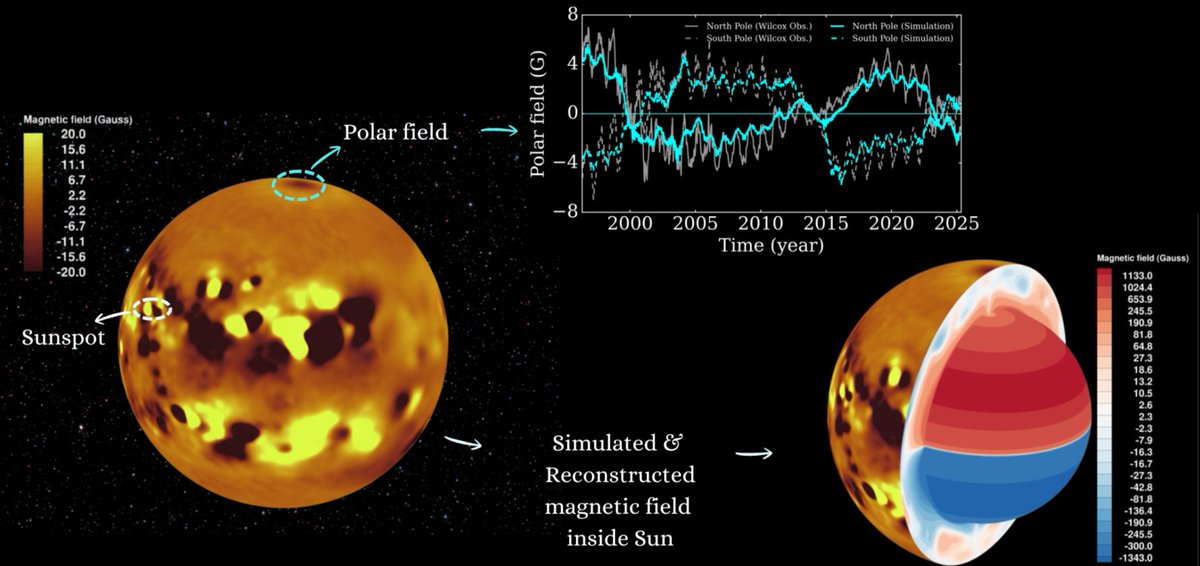
Decades of surface observations reveal our Sun’s mysterious magnetic interior
Researchers at IIT Kanpur have achieved a major scientific breakthrough by mapping the magnetic field inside the Sun for the first time. By assimilating 30 years of solar surface observations from space satellites into a 3D computational model, the study reveals the magnitude, structure, and evolution of the Sun’s internal magnetic fields over three decades.
Led by Soumyadeep Chatterjee, PhD student, under the guidance of Prof. Gopal Hazra (Department of Physics, IIT Kanpur), the research—published in The Astrophysical Journal Letters—offers critical insights into the solar dynamo, the mechanism that drives the Sun’s 11-year magnetic cycle, sunspots, and solar eruptions.
This data-driven model not only deepens our understanding of solar magnetic activity but also improves predictions of future solar cycles, helping safeguard satellites, power grids, navigation, and communication systems from space-weather disruptions.
Read the study: https://t.co/BaCt5hPpHx
#IITKanpur #SpaceWeather #Astrophysics #SolarMagnetism #SunScience #ScientificResearch
#DataDrivenScience #ComputationalModeling #SolarDynamo @IITKanpur@NASA@isro
Hello everyone,
We are delighted to announce an exoplanet workshop at IIT Kanpur from 4-6th April 2025. Please consider applying for the workshop.
Deadline: 27th Feb 2025
Apply here: https://t.co/ilMv6rxfge
@IITKanpur@asipoec@IUCAAScipop@IUCAAstro@IIABengaluru
First! direct imaging of a mature exoplanet using JWST, alongside the most sensitive mid-IR detection from the ground-based ESO/VLT telescope. Proud to be part of this groundbreaking discovery.
https://t.co/4ybim7disv
The Department of Space, Planetary & Astronomical Sciences & Engineering (SPASE) and the Department of Aerospace Engineering at IIT Kanpur are jointly hosting AntarikX'24 on August 24, 2024, to celebrate National Space Day, commemorating the successful Moon landing of the Chandrayaan 3 mission last year.
The theme for this year's event is “India’s Role in Space Science: Exploring Regional Growth Opportunities via Industry-Academia Participation.” The celebration will feature a keynote talk, a panel discussion, an exhibition of space-related companies, a popular science talk, a poster presentation session, and an evening of stargazing. The event is expected to attract around 450 attendees, including IITK students and researchers, school students, and students from nearby colleges.
The chief guest for the event is Dr. Subba Rao Pavuluri, President of SIA-India and Chairman & MD of Ananth Technologies Ltd. The keynote talk will be delivered by Smt. Nigar Shaji from URSC, Bengaluru, on the topic of “Indian Space Science Program.” The popular science talk will be presented by Prof. Sandeep Sahijpal from Panjab University, Chandigarh, on “ISRO Space Missions.” The panel discussion, including Prof. Ajit Kembhavi from IUCAA, Pune, Prof. M.C. Uttam from Pune University, and Dr. Amitesh Omar from the Department of SPASE, IITK, will focus on “India's Contribution to Advancements in Space Science.”
Additionally, there will be a poster presentation session for students and researchers to showcase their work of Space Science. The day will conclude with a Solar Observation session and an evening stargazing event open to the IITK campus community.
AntarikX'24 promises to be an eventful and insightful deep dive into India's space sector.
#NationalSpaceDay #space #Chandrayaan3 #spacemission #isro #IITKanpur #iitk
In a ground-breaking discovery, an international team of astronomers, including Dr. Prashant Pathak, Assistant Professor at the Dept. of Space, Planetary & Astronomical Sciences & Engineering (SPASE), IIT Kanpur, has discovered a giant planet orbiting a nearby star similar to our own Sun.
The planet, Epsilon Indi Ab, or Eps Ind Ab for short, is classified as a 'super-Jupiter' due to its mass, which exceeds that of Jupiter by at least six times, making it significantly larger than any planet in our solar system. Eps Ind Ab is the first-ever mature exoplanet (a planet beyond our solar system) to be discovered using direct imaging technique.
The details of the discovery and the research behind it has been published in the world's leading multidisciplinary science journal, Nature.
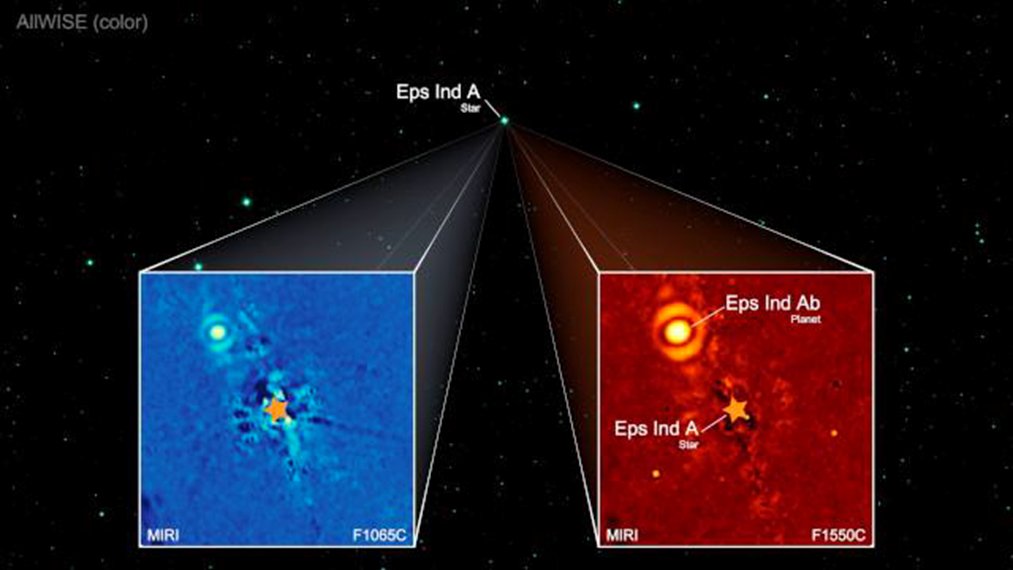
Using the James Webb Space Telescope's (JWSTs) Mid-InfraRed Instrument (MIRI), an international team of astronomers has directly imaged a new exoplanet orbiting the K5V-type star Epsilon Indi A (also known as HD 209100 or HIP 108870). Direct imaging of a nearby mature exoplanet marks a significant milestone in the realm of space exploration.
The newly discovered planet is located 12 light-years away from us. The planet is quite cold, with a temperature of about -1°C (30°F). Its orbit is also immense, circling its star at a distance 28 times greater than the distance between our Earth and the Sun.
Dr. Prashant Pathak, a key member of the research team , explained, "This discovery is exciting because it gives us a chance to learn more about planets that are very different from our own. The planet’s atmosphere appears to have an unusual composition that indicates a high metal content and a different carbon-to-oxygen ratio than we see on our own solar system planets. This opens up fascinating questions about its formation and evolution. By studying Eps Ind Ab and other nearby exoplanets, we hope to gain a deeper understanding of planetary formation, atmospheric composition, and the potential for life beyond our solar system.”
Image 1: Artist’s impression of a cold gas giant orbiting a red dwarf. Only a point of light is visible on the JWST/MIRI images.
Image 2: The image summarises the observations with JWST/MIRI that led to the rediscovery of Eps Ind Ab.
Photo Credit: T. Müller (MPIA/HdA)
#jupiter #space #spaceexploration #planetdiscovery #research #IITKanpur #iitk