🚗 Looking for an Embedded Engineer who loves working with STM32, CAN bus, and OBD-II.
We’re building real hardware + AI that keeps vehicles on the road.
Austin, TX, early founding team role with plenty of equity.
#IoT#AI#Startup#Embedded#techstars#austin
🚨 NOT THE SAME:
Elon Musk’s companies employ roughly 170,000 hardworking Americans.
AOC and her squad drove Amazon out of New York — killing 40,000 jobs.
One creates.
One destroys.
She’s not only constitutionally illiterate — she’s a full-blown economic moron.
Creators vs. Destroyers.
What do you think? 👇
#ElonMusk #AOC #Jobs #EconomicIdiots #AmericaFirst #BuildNotBurn
@SenWarren Oh, okay, I got it now. All these problems we have because we did not tax rich people enough. The government taxes its citizens $2.5T a year, but we still have all these problems because we just need to tax a little bit more and then everything will be solved.
@BernieSanders The failure of our political system is that it lacks a process to weed out the stupids. They live until they die by making people fear innovations and capitalism while they themselves get paid by taxpayers' money.
@garrytan 🤣 If you tell this to an early-stage investor, that will be a very short meeting. You can say all these smart-sounding things, but the reality is far from it.
I’ve always loved reading and typically go through a substantial number of books every year.
But lately I’ve been asking myself a deeper question:
If AI agents can read, synthesize, compress, and retrieve knowledge far more efficiently than I can, do I still need to spend hundreds of hours reading in the traditional sense?
When humans read, we are effectively constructing an abstract latent space in our minds, building temporary connections inside a biological knowledge graph, and later retrieving projections of that knowledge when needed.
Now AI agents can perform a similar process at vastly greater scale, speed, and fidelity.
So perhaps the future value of reading is no longer information acquisition itself, but something else entirely:
judgment, taste, intuition, wisdom, meaning, and the shaping of consciousness.
Maybe books will remain important, but for very different reasons than before.
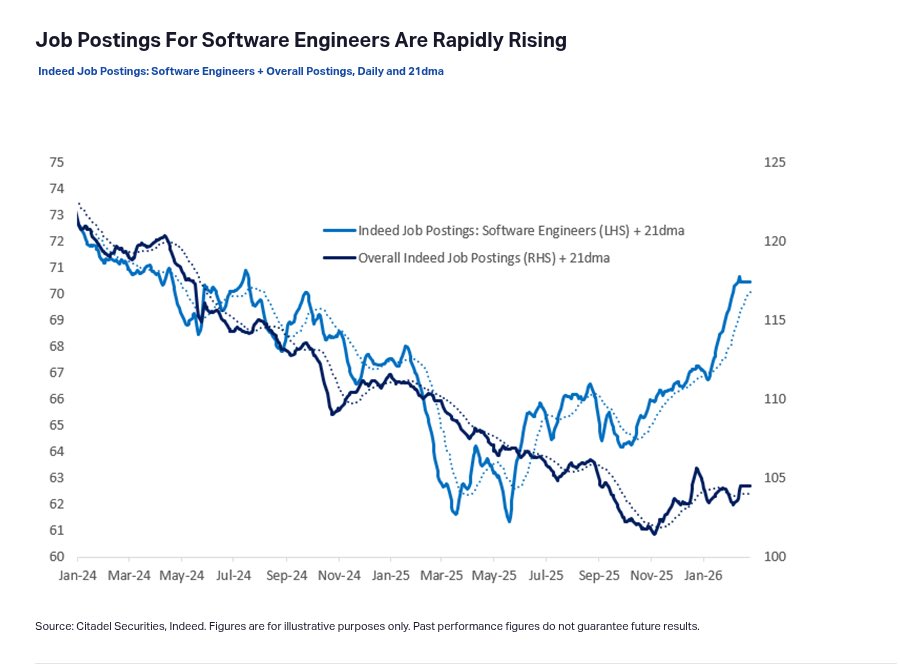
Q: How are job postings for software engineers rising rapidly despite AI agents automating coding?
A: Because there’s far more code to manage than ever before. We’re already seeing a 14x YoY increase in GitHub commits, and it’s accelerating.
AI has dramatically lowered the cost of writing code, so it’s now being used across far more businesses, applications, and use cases.
We’re at the beginning of a massive productivity boom driven by the proliferation of bespoke software throughout the entire economy.
Coding has been AI’s breakout use case this year. The fact that it’s increased demand for software engineers — rather than decreased it — should call into question the entire “AI will cause mass job loss” narrative.