Blog: Thank you message to WSO2
This is the final message I sent to the team on Sunday nite. I hope it inspires more people to do what WSO2 has shown can be done.
YOU can be they.
https://t.co/MaTZthCMG5
🚨 YOUR BODY EATS ITSELF TO STAY ALIVE
Scientists discovered a hidden survival process inside your cells called autophagy. During fasting, your body begins recycling old and damaged cell parts, turning them into energy and helping cells stay healthy.
Japanese biologist Yoshinori Ohsumi revealed this remarkable cellular cleanup system, a discovery so important that it earned him the 2016 Nobel Prize.
What seems like your body "eating itself" is actually one of nature's most fascinating repair mechanisms.
Source: Nobel Prize Outreach. The Nobel Prize in Physiology or Medicine 2016 – Yoshinori Ohsumi
Satellite and seismic data reveal that Earth emits a mysterious pulse every 26 seconds, often called its “heartbeat.” First noted in the 1960s, this rhythmic signal likely originates from ocean waves interacting with the seafloor near the Gulf of Guinea or volcanic activity nearby.
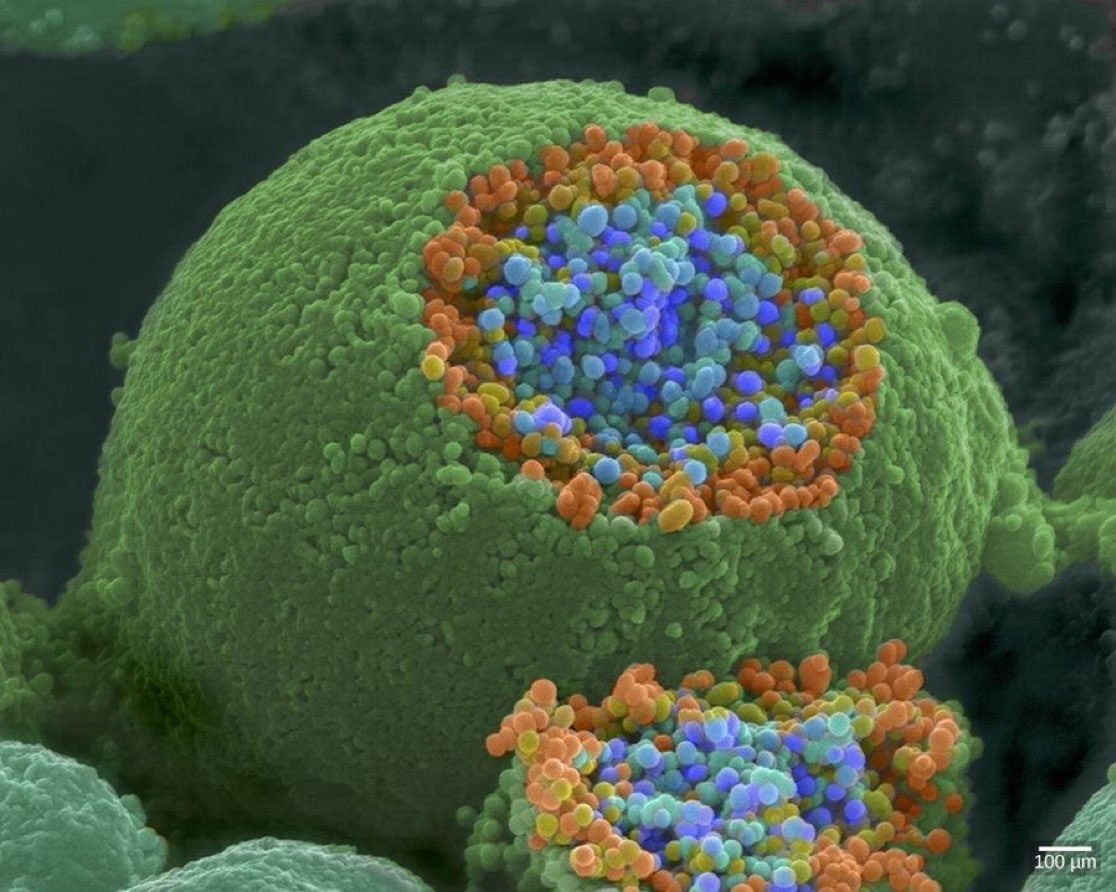
This is the appearance of a nerve ending.
It has been opened to reveal vesicles (shown in orange and blue) that contain the chemical messengers used to transmit signals within the nervous system.
After more than two decades of building, leading, and shaping WSO2 into a globally recognized technology company, today is Sanjiva Weerawarana's last day as CEO.
@sanjiva started WSO2 with a belief that world-class enterprise software could be built on the other side of the world and taken to the masses. What followed proved that belief right, many times over. He challenged assumptions about where great technology comes from, opened doors that didn't exist before, and built something that has genuinely changed how enterprises think about software development.
His impact goes well beyond WSO2. He helped define what's possible for the tech industry, and for the generations of engineers and leaders who came up through it.
Thank you, Sanjiva. It has been an extraordinary chapter.
Twenty years from now, someone will build something the world said was impossible. They'll be standing on your shoulders.
Albert Einstein kept a photo of Maxwell on his study wall, alongside pictures of Michael Faraday and Isaac Newton. He referred to Maxwell's work as the "most profound and the most fruitful that physics has experienced since the time of Newton."
Maxwell's equations were integral to the development of Einstein's theory of special relativity.
In the 7th century, negative numbers were used in calculations in India which was innovative because Europeans dismissed these numbers as absurd until the 17th century, when they gained widespread acceptance due to their practical use in accounting and bookkeeping.
Here's my conversation with Don Lincoln about some of the biggest open questions in physics, including dark energy, dark matter, the matter-antimatter imbalance, quantum vacuum, quantum foam, and the quest to unify the laws of physics.
Don is a particle physicist at Fermilab who has spent decades working at the frontiers of high energy physics. He is also a great teacher & writer. I highly recommend his courses & books. One of my favorite lecture series he has given is The Evidence for Modern Physics where he breaks down the experiments that validate some of the weird laws of physics we have, and what it would take to validate even the weirder ones.
It's not enough to come up with a beautiful theory. You also have to show through experiment that the theory is likely to be correct. This process often doesn't get the love it deserves, even though it's often the most important and difficult part of the scientific process.
I ❤️ physics.
The conversation is here on X in full and is up everywhere else (see comment).
Timestamps:
0:00 - Introduction
0:49 - Unifying the laws of nature
15:20 - General relativity
32:27 - Electroweak force
44:09 - How particle colliders work
1:02:12 - Higgs boson discovery
1:12:32 - Theory of everything
1:42:17 - Physics of empty space
1:49:41 - Antimatter
2:10:31 - Dark energy
2:14:20 - Dark matter
2:42:56 - Future of physics
@RhysSullivan The $2500 MacBook Pro I bought in 2012 that I used to write every single hashicorp 0.1 release. Arguably turned that $2500 plus some internet into like a billion dollars. Good trade.
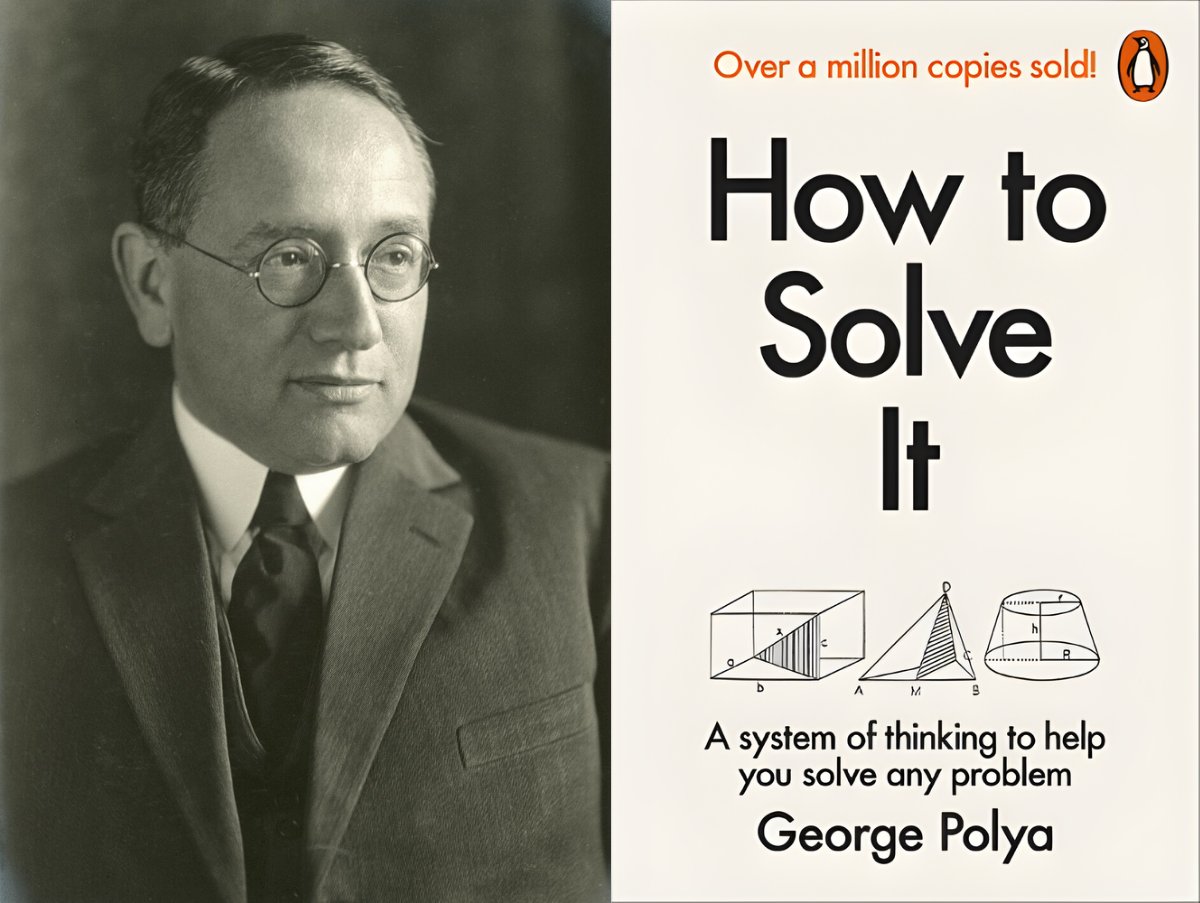
A Stanford mathematician spent 40 years watching brilliant students fail at hard problems.
Not because they were stupid.
Because nobody taught them what to do before they started solving.
His name is George Pólya, and his 1945 book has sold over a million copies and never gone out of print. Marvin Minsky, the man who built the first neural network machine at MIT, said publicly that everyone should read it. Most people have never heard of it.
The failure Pólya watched repeat itself for four decades was always the same. A problem appears. The student feels anxiety. They immediately start calculating. Not because calculating was the right move. Because it felt better than sitting with not knowing.
The calculation was almost always wrong. Not from lack of skill. From lack of understanding what was actually being asked.
He called it the most neglected step in all of problem solving.
Step one is to understand the problem. Not skim it. Not assume you've seen something similar. Actually understand it. His filter was one question. Can you restate the problem in your own words without looking at it? If you cannot, you have not understood it. You have only read it. Most people skip this and spend hours stuck on a problem they never actually understood in the first place.
Step two is to make a plan. Not execute. Plan.
The pattern Pólya saw in every successful problem solver was the same. When something feels impossible, find a simpler version and solve that first. Not because the simpler version is the goal. Because it gives you a method you can carry back. He phrased it once with precision. If you cannot solve the proposed problem, try to solve a related one. That single question is worth more than most problem-solving courses ever taught.
Step three is to execute. Everyone thinks this is the whole game. It is the third of four steps. Pólya spent the least time on it in the book because it is the most obvious. Once you understand the problem and have a plan, execution is mostly patience.
Step four is the one almost nobody does.
Look back.
Not to check the arithmetic. To ask whether you can verify the result with a different method. Whether you can use this approach somewhere else. What you would do differently next time.
This is where the real learning lives. Every expert Pólya studied had this habit. Every struggling student skipped from the answer to the next question, carrying nothing forward, starting from zero every single time. The expert built a library of methods over years. The struggling student built nothing, because every problem was disposed of the moment it was solved.
His deepest insight was not a technique. It was a diagnosis.
Intelligent people feel bad at problem solving because they confuse reading a problem with understanding it. They confuse starting to work with having a method. They confuse getting an answer with having learned anything. These are not the same things. They feel like the same thing in the moment, which is exactly why so many smart people spend their whole lives stuck in the gap between effort and progress without ever knowing what is wrong.
The students who get genuinely good at hard problems are not the ones who practice more. They are the ones who slow down at the two moments every instinct tells them to rush.
The beginning and the end.
The problem was almost never as hard as it looked.
They just hadn't understood it yet.
In 1947, Alan Turing publicly suggested that machines could learn from experience — years before the term “AI” even existed. In a London lecture, he described machines altering their own instructions, an early vision of machine learning.
There’s an ancient Babylonian clay tablet from 1800-1600 BC that contains the square root of two with 99.9999% precision.
How did they compute it?
Let me show you:
https://t.co/IRF35pBt5b
Thank this man for digital communication, data compression (ZIP, MP3), coding theory, and cryptography.
Claude Shannon’s biggest scientific contribution was the creation of information theory in his 1948 paper “A Mathematical Theory of Communication.”
He defined “information” mathematically, introducing the concept of bits (binary digits) as the fundamental unit. He borrowed the term from thermodynamics to describe the uncertainty or information content in a message. Shannon entropy became the foundation of data compression and coding. He proved the Shannon limit (channel capacity theorem): there is a maximum rate (capacity) at which data can be transmitted over a noisy channel with arbitrarily low error, using proper encoding. His framework underlies digital communication, data compression (ZIP, MP3), coding theory, cryptography, the internet, mobile phones, and AI.