@TimesAlgebraIND Some people think Hyderabad is their personal property.
Watch how MIM goons openly threatened and hurled abuses at Hyderabad #BJP candidate Madhavi Lata when she went to inspect some reported bogus voting in their ghettos.
From @WokePandemic
I taught JEE physics for years. That paper breaks strong kids in three hours.
This exam is five hours of theory and five hours of lab work, and these five did close to perfect scores on it.
Let me tell you what actually happened.
The International Physics Olympiad is the world championship of school physics. It was the 56th edition. Held in Bucaramanga, Colombia, from July 5 to 12.
381 students. More than 85 countries. Every one of them the best physics student their country could find.
India sent five kids.
All five came back with gold.
Their names are Kanishk Jain from Pune. Riddhesh Anant Bendale from Indore. Rishit Garg from Dwarka in Delhi. Shresth Suraiya from Mumbai. Svarit Joshi from Ahmedabad.
We know a hundred cricketers by their nickname and not one of these boys. :)
That clean sweep put India at joint World Number One. Tied with China, Russia, Kazakhstan, South Korea and Taiwan.
Those are countries that pour serious money and national pride into science education. We are standing level with them.
Now here is what the exam actually was.
Two papers. Each five hours long.
The theory paper had three problems. One on the thermodynamics of paramagnetic cooling. One on the photoionisation of ozone. One on the dynamics of electron positron pairs.
The experimental paper was another five hours in a lab, working through heat transfer and thermodynamic processes in fluids.
That means you get given equipment you have never seen, and you have to design your own experiment, take your own readings, handle the errors, and reach a real answer.
Not multiple choice. No shortcuts. No pattern recognition. You either understand physics or you sit there for five hours.
HBCSE says the Indian students were near perfect on theory and excellent on the practical too.
Now, this was India's 27th appearance at the IPhO.
Across all those years, about 44 percent of Indian students have won gold, 41 percent silver, 10 percent bronze.
In the last ten years, every single Indian student has come home with a medal. 62 percent gold, 38 percent silver.
Not one kid has gone and come back empty handed in a decade.
Five golds in one year has happened only twice. This year, and in 2018.
So who built this.
The programme is run by HBCSE, the Homi Bhabha Centre for Science Education. It sits under TIFR, which sits under the Department of Atomic Energy.
They run the whole funnel. A national exam, then a national olympiad, then a brutal selection and training camp, and out of everyone in the country, five kids get on a plane.
The team was led by Professor Anwesh Mazumdar of HBCSE-TIFR and Dr Leena Joshi from St Xavier's College, Mumbai.
The scientific observers were Professor Ananda Dasgupta from IISER Kolkata and Nisha Kelkar from Gogate-Joglekar College in Ratnagiri.
Yes. Ratnagiri. A college in a small coastal town in Maharashtra.
This is public education doing something the private coaching industry could never do on its own.
The coaching industry is very good at one thing. Teaching you to solve a known problem fast.
That is what JEE and NEET reward, and I say that with love because I was part of that world.
But an olympiad paper does not have a known type. There is no shortcut chapter. There is no formula sheet that saves you. You have to sit with a problem you have never seen and think.
That is a completely different muscle. And a government funded centre has been quietly building it in Indian teenagers for 27 years.
So yes, be proud. Loudly.
HBCSE also shared that around 64 percent of India's olympiad medallists go on to do a PhD.
But only about 32 percent of medallists end up settling in India.
I do not say that to spoil the moment. These kids owe the country nothing. They earned every option they have.
But it should tell us something. We are excellent at finding this talent. We are excellent at training it. We are still not great at giving it somewhere worth staying.
Congratulations Kanishk, Riddhesh, Rishit, Shresth and Svarit. This is one of the best things an Indian did this year and most of the country will never hear about it.
RWAs make voices heard on CURE
The CURE Bill 2026 sparked debate among Hyderabad's Resident Welfare Associations(RWA). At a feedback meeting on CURE, MAUD Special Secretary Jayesh Ranjan listened as RSV Badrinath, V.V. Rao and M Vijaya lakshmi shared UFREWAS members' concerns clearly and directly. RWAs made sure their feedback was included, turning the session into a strong display of citizen involvement. #CUREbill2026 #GHMCnews #Hyderabadnews
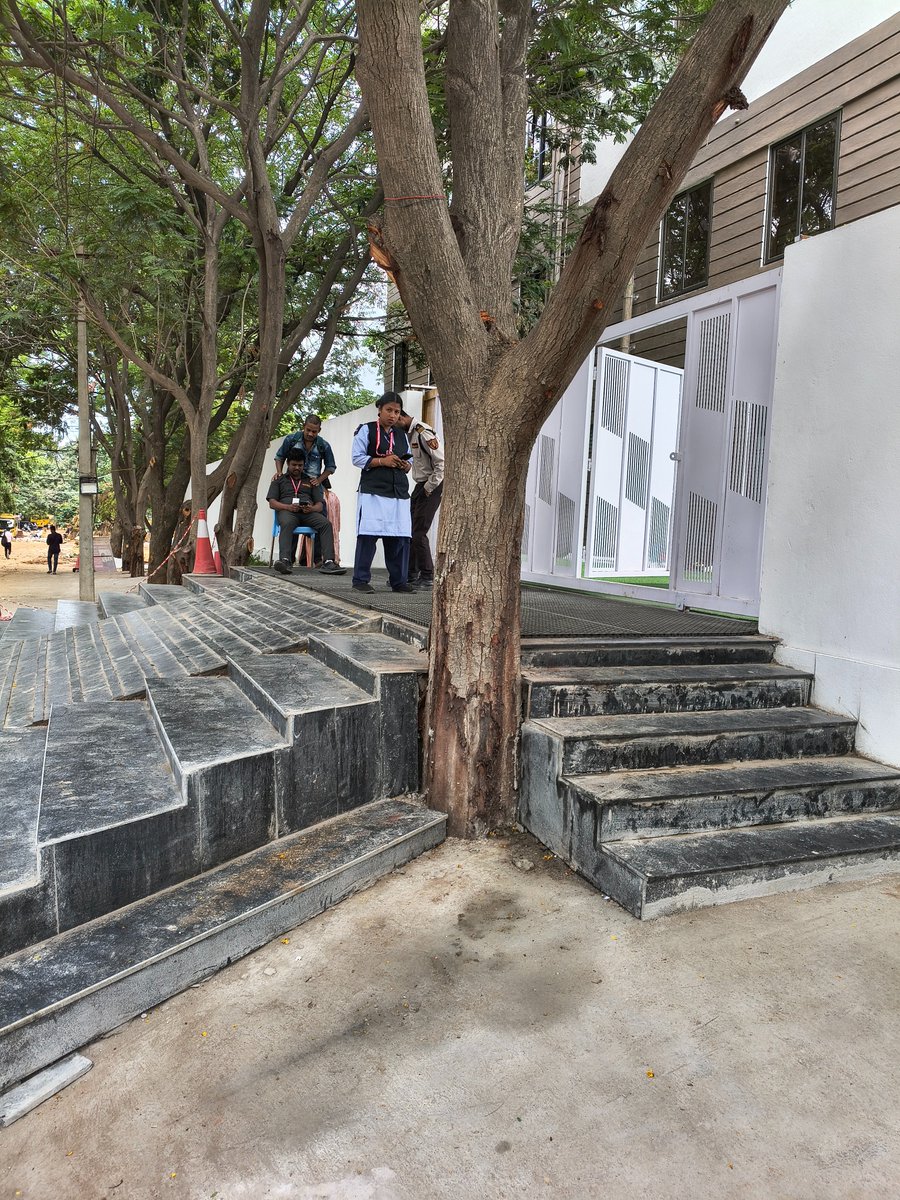
@CMC_Offcl Sadhana junior school in Nallagandla HUDA, has blocked the tree stems in concrete cement, please check and take appropriate action to free up the trees at the earliest.
@ZC_SLP , @MC_Cyberabad@GummallaSrijana@DC_SLP49
A 15-year-old dream has come true today. I started a PhD with the dream of creating a system that chants any Sanskrit shloka perfectly.
And here I am opening sourcing 𝐕𝐚𝐠𝐝𝐡𝐞𝐧𝐮 - 𝐀 𝐯ṛ𝐭𝐭𝐚 (𝐦𝐞𝐭𝐞𝐫) 𝐚𝐰𝐚𝐫𝐞 ś𝐥𝐨𝐤𝐚-𝐭𝐨-𝐜𝐡𝐚𝐧𝐭 𝐭𝐞𝐱𝐭-𝐭𝐨-𝐬𝐩𝐞𝐞𝐜𝐡 (TTS) 𝐬𝐲𝐬𝐭𝐞𝐦 𝐟𝐨𝐫 𝐒𝐚𝐧𝐬𝐤𝐫𝐢𝐭. This is the world's first vrutta-aware, open-source TTS for Sanskrit Chanting.
The economic and demographic effects of corruption.
Cost of land in our urban areas is far higher than what our GDP per capita would dictate. The ratio of land value to per capita GDP is probably higher in India than anywhere else. As an example, land prices in Chennai or Bengaluru rival that of cities like New York which has a vastly higher per capita GDP.
The key reason?
First, vast sums of political corruption money is parked in real estate. This raises real estate prices and high real estate prices affect everything downstream.
Second, corruption in building approvals and the like - the famous DTCP - raises construction costs, on top of already higher real estate costs.
Third, corruption in private school regulatory compliance enforcement raises school fees.
Fourth, corruption in private hospital regulatory compliance enforcement raises health care costs.
Fifth, household goods need sales outlets and those pay higher rents due to high real estate prices and construction costs.
So housing, education, healthcare and household goods - all of these now cost higher.
As a direct consequence, the economic burden on the average person gets worse. Young people, facing all these costs, postpone marriage, and postpone children or have fewer children.
That directly affects our demographics.
While this issue exists in many parts of India, Tamil Nadu, being the most urbanized of the bigger states, is particularly hit hard.
So corruption is becoming an existential threat to our society.
If you worry about the super-low birth rate in Tamil Nadu, way below replacement, understand that corruption raising our cost of living is one of the major causes, not the only cause, but a big one in our context.
For the last 15 years, I've always had one dream and desire which was to make Indian history interesting for everyone.
In that time period, I have tried writing blogs, long-form posts, stories and threads, to do exactly that.
Some worked, most didn't. But with every post, I always had this nagging question.
Why is Indian history always taught with a tunnel vision. Why is it so fragmented?
Why do we always learn things from the perspective of one empire, kingdom, king or invader.
Why do we never see an all India view of history?
I mean most of us struggle if we are ever are asked this question
1. What was the true extent of the Mughal Empire at its peak?
2. Who were the Cholas' contemporaries in North India?
3. While Muhammad Ghori was fighting the Second Battle of Tarain, who ruled Thanjavur?
4. While Harsha ruled Kannauj, who ruled Assam?
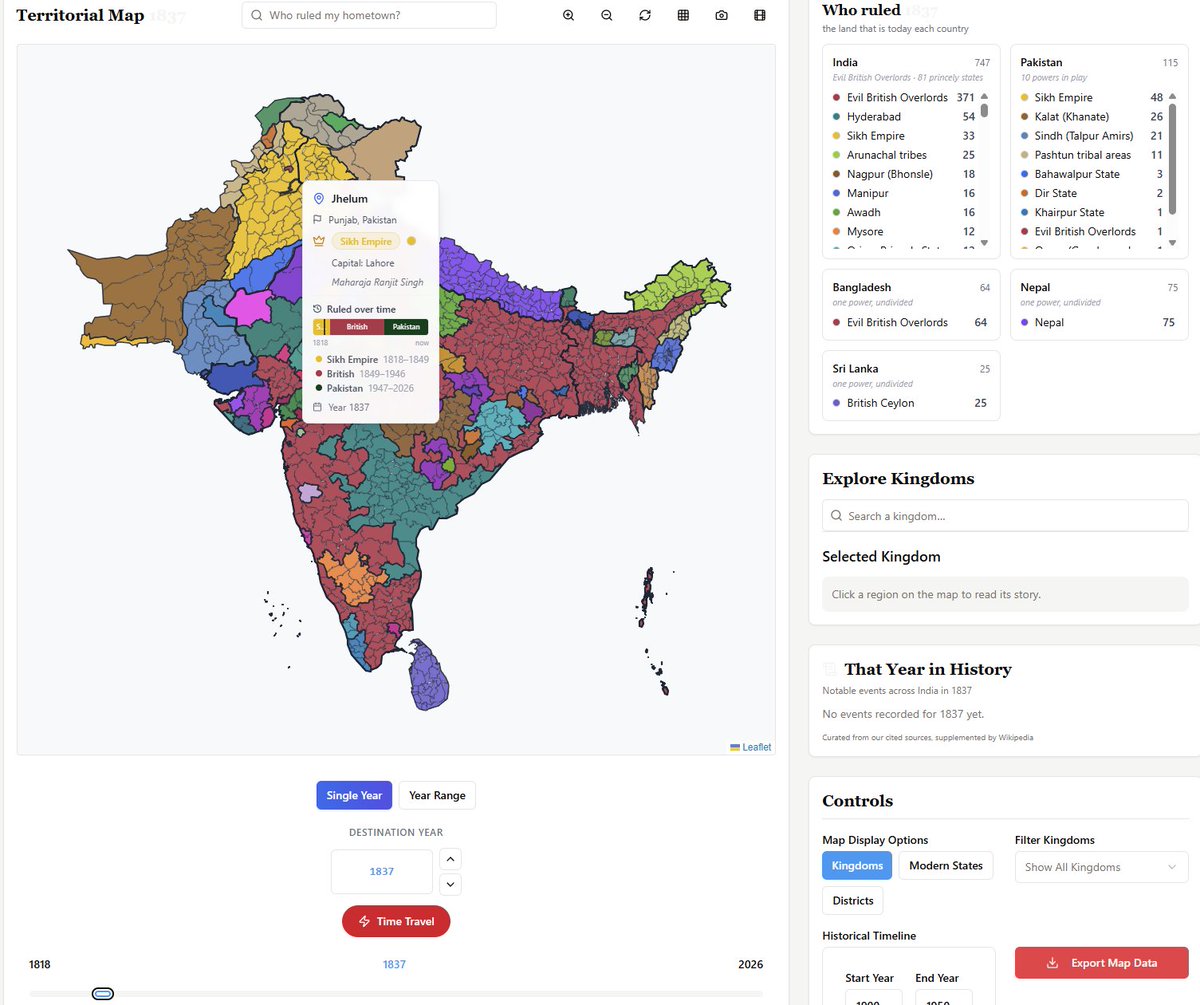
I have always wished there was a simple way to see the political map of India for any year in Indian history.
I have always wished there be a place where
1. One Could Select any year and instantly see who ruled every part of the Indian subcontinent.
2. One could Discover the important events that happened in that year
3. One could select a time period, say 1700 - 1947, and see how the Indian subcontinent evolved in that period.
4. How did one tiny red dot in West Bengal, from a tiny red dot in Europe, somehow came to rule an entire subcontinent of 400 million people,
For years, that idea remained just an idea and a dream because
1. I didn't know how to build a website.
2. I couldn't afford to hire someone who could.
Then Claude Came along.
Thanks to generous support and heavy lifting by Claude, over the last few months, that 15-year-old idea is slowly transforming into a reality.
And today, it has reached a position, where I'm excited to share with all of you, the first sneak peek of https://t.co/6ph2s9Zzl9
It is my attempt to create an interactive historical atlas of India that lets you travel through time and explore the political history of the subcontinent, one year at a time.
This is my attempt to make history interactive and fun.
I'd love to hear what you think.
People don't understand what Sanatana Dharma is. To be accurate, it is "THE THEORY OF EVERYTHING"..
And not only is it the Theory of Everything, but it is also a collection of Roadmaps to reach the destination...and kind of like an instruction manual that each one of us can follow, to carve out our own path to that destination.
However, trying to explain Dharma through the lens of a different faith, is like trying to measure the circumference of a sphere using a rigid wooden ruler. The issue is, the west is still using the same old wooden ruler to measure the massive sphere, because they are forbidden by doctrine to use a better tool for the job. The beliefs are far too immature, and incomplete. It is that same incomplete ideas, which led them to believe that the world was flat, and that time is linear.. (Time is Cyclical)
People should be taught the Diamond analogy, which came from Ramakrishna Paramahamsa if i'm right. It explains the essence of Advaita very beautifully.
~~ God is like an infinite-sided diamond. Each face that was cut on the surface of the diamond, is a window to look into the core. Every one of these faces, has Rama, Krishna, Kali, Shiva etc..But it also has you, and me. We are all part of the same diamond, and irrespective of which "lens" we choose to look through, we all will be staring at the same core. ~~
The universe, is ALIVE AND CONSCIOUS. (We live in a Multi-verse, as per Hindu tradition..We live in one universe among the infinite universes that pervade the cosmos, each of which are undergoing their own cycles of expansion and collapse). Sanatana Dharma is a Monotheistic religion at the core, which has been reiterated innumerable times throughout history. The west is incapable of understanding certain things unless they un-learn, and re-learn.
The very core of Sanatana Dharma, is lightyears ahead of every other faith. One can understand and explain every other "religion" or belief system using it. One cannot understand Dharma unless they live it.
The same kind of patterns that appear in the observable Universe, are constantly repeating everywhere, starting from the tiniest atom, to the human body, to nature, the solar system, and beyond..Because we are governed by the same super-consciousness that pervades through everything, through infinite time. "Yatha Brahmande, Thatha Pinde".
Starting from the Rig Veda, to Shankara's Advaita, to the teachings of modern-day saints like Ramana Maharshi, there has been no change in the narrative. There is only ONE GOD, and ONE DHARMA. We just have the freedom, and awareness to choose a form that resonates with us the best. Call it Prabrahma, Shiva, or Narayana...doesn't matter.
The stupidity begins when we believe that only ONE of these paths is right, and everything else is wrong. The very reason that all other religions manage to survive in India, is simply because of the inherent open-minded attitude and acceptance within Hindu Dharma.
It is easy for me to understand why someone believes in Jesus..Sure, I am always happy to add the Bible into the "Library" of books that explain various aspects of Dharma. At the same time, I will never be convinced that there is only ONE holy book, or ONE path.
Once you open your mind and see the truth, there is no going back. This very openness and thought process, is inconvenient to the people who wield power and influence.
They will lose control if the common folk become truly spiritual, and better thinkers.
That is the very reason that they are scared of Dharma, and the very reason they are Anti-Hindu. The guys in power, are scared that the truth will set people free.
How Britain Engineered History’s Greatest Financial Heist
By @shreehistory
I. The Stroke of Midnight
At the stroke of midnight on August 14, 1947, as the world watched the Union Jack descend over New Delhi and the saffron, white, and green of a new nation unfurl, history recorded a triumph of self-determination. The British Empire, exhausted by war and weakened by the inexorable tide of nationalism, was relinquishing its crown jewel. The romanticized narrative of the 20th century tells us that Britain granted India its freedom, an act of political magnanimity marking the end of colonial dominion.
But beneath the pageantry of lowering flags, the soaring rhetoric of Jawaharlal Nehru’s "Tryst with Destiny," and the chaotic tragedy of Partition, a very different kind of transfer was taking place. It was not a transfer of political power, but of financial liability.
In the quiet, wood-paneled chambers of the British Treasury and the Reserve Bank of India, a ledger was being closed. To the accountants and chancellors in London, Indian independence was less a geopolitical retreat and more a Chapter 11 bankruptcy filing, a meticulously orchestrated maneuver by which Britain effectively declared independence from its own creditor.
The colonizer owed the colonized a staggering fortune. And the colonizer was broke.
II. The First Extraction and the Silencing
To understand the audacity of the financial maneuvering of 1947, one must look back to the blueprint drafted three decades earlier, during the First World War. The great financial heist of the mid-century was not an anomaly; it was the perfection of a formula born in the trenches of Europe, paid for in the fields of Bengal.
When the First World War erupted in 1914, Britain found itself in desperate need of men, material, and money. It turned to its empire. India was coerced into contributing hundreds of millions of pounds to the British war effort, alongside the lives of over a million Indian soldiers. To finance this, the British Raj effectively commandeered India’s export earnings and heavily increased taxation, flooding the domestic economy with paper currency while draining its physical gold reserves. Britain abandoned the gold standard, but India was forced to maintain it, absorbing the inflationary shock.
By the war's end, the economic strain on the Indian populace was immense. Prices of essential goods had skyrocketed, and the returns on the capital extracted for the war were nowhere to be seen. As the Indian public began to realize the scale of this economic theft, dissent began to boil. Nationalist leaders pointed to the economic drain, exposing the arithmetic of imperial exploitation.
London’s response was not to remedy the extraction, but to legislate silence. In 1919, the British government passed the Anarchical and Revolutionary Crimes Act, widely known as the Rowlatt Act. The Act allowed for the incarceration of suspects without trial and curbed the free press, specifically targeting the dissemination of seditious materials, which in practice meant anyone explaining how the British were bankrupting the country. When protests erupted against this silencing, the British military responded with the Jallianwala Bagh massacre in Amritsar, killing hundreds of unarmed civilians.
The message was unequivocal: the colony would pay, and it would suffer in silence. The economic truth was to be suppressed by force. It was a precedent that would prove vital 28 years later, when the sums involved would be exponentially larger.
III. The Blank Check of World War II
By the time the Second World War began, the British Empire was already financially strained. The defense of the Middle East, Southeast Asia, and the British Isles required capital that London simply did not possess. Once again, the British turned to the vast, seemingly bottomless reservoir of the Indian economy.
To fund the massive mobilization of troops, the provisioning of armies, and the purchase of raw materials, the British Raj essentially wrote itself a blank check against the Indian taxpayer. India was declared a "non-self-governing territory" contributing to the war effort, but instead of paying India in hard currency for the goods and labor extracted, Britain credited the Reserve Bank of India with pounds sterling. These were not transferable funds; they were essentially IOUs, piling up in London as "Sterling Balances."
The human cost of this capital extraction was catastrophic. The most visceral manifestation of this economic drain was the Bengal Famine of 1943. While the British Treasury accumulated sterling balances, the diversion of grain and the financial extraction policies led to the starvation of an estimated two to three million people in Bengal. The Indian taxpayer was literally funding the survival of the British Empire with their lives and their livelihoods.
By 1945, the sheer scale of this extraction was breathtaking. Britain owed India roughly £1.3 billion. To comprehend the magnitude of this sum, one must view it not through the lens of modern consumer inflation, but as a share of the economy. In 1947, £1.3 billion represented roughly 13.5 percent of Britain’s entire Gross Domestic Product. If the British Treasury were forced to write a check for that proportion of its economy today, it would need to find approximately £350 billion.
It was a sum so massive that paying it in full would have instantly bankrupted post-war Britain, a nation that was, at that very moment, surviving on American Marshall Plan aid and rationed bread. The colonizer owed the colonized. And the colonizer had no intention of paying in full.
IV. The Safety Valve and the Negotiation
Facing the prospect of domestic economic collapse, the British government executed an audacious maneuver. The transfer of power in 1947 was not merely a political act; it was a financial release valve.
There is a historical curiosity, often unspoken in popular narratives, that complicates the story of India’s independence. The Indian National Congress (INC), the primary vehicle of Indian nationalism and independence, was not born from a grassroots peasant uprising, but was initially floated by a British colonial official, Allan Octavian Hume, in 1885. Historians have long debated the "safety valve" theory: the idea that Hume and the Viceroy engineered the creation of the INC to provide a controlled, institutional outlet for the rising frustrations of the Western-educated Indian elite, preventing a violent, uncontrollable rebellion.
While the INC evolved into a formidable force for independence under Mahatma Gandhi and Nehru, the institutional DNA of the organization was steeped in British legal and political frameworks. When it came time to negotiate the financial settlement of 1947, the lingering effects of this "safety valve" dynamic became apparent.
The negotiations over the Sterling Balances were brutal, conducted behind closed doors by the British Labour government’s Chancellor of the Exchequer, Sir Stafford Cripps, and the Indian delegation led by Nehru and Sardar Vallabhbhai Patel. Britain argued that a sudden withdrawal of £1.3 billion would crash the pound sterling, bankrupt the Sterling Area, and trigger a global financial crisis. The threat was explicit: if India demanded its money, the ensuing chaos would ensure India received nothing.
India was in a state of profound vulnerability. The subcontinent was engulfed in the horrific trauma of Partition; millions of refugees were on the move, and the new government was struggling to establish basic administrative continuity. In this moment of existential crisis, the Indian leadership accepted terms that effectively castrated its own wealth.
The 1947 agreement dictated that the vast majority of the £1.3 billion would be "blocked." Only a fraction was immediately released; the remaining £1.15 billion was locked in London, to be doled out in agonizingly slow installments over a decade or more. Worse, the agreement stipulated that these blocked balances would earn little to no interest. By accepting this compromise, the post-colonial government effectively agreed to a structural haircut on the asset, surrendering the real-time economic utility of the money to save the British economy from default.
The safety valve had, once again, operated exactly as designed.
V. The Alchemy of Devaluation
With India's massive claim successfully trapped in the vaults of the Bank of England, Britain weaponized the only tool it had left: the currency itself.
Having forced India to accept deferred payments, Britain engineered a stealth default through the alchemy of foreign exchange. On September 18, 1949, just over two years after Indian independence, the British government unilaterally announced a massive devaluation of the pound sterling. The pound’s value against the US dollar was slashed overnight from $4.03 to $2.80, a devaluation of 30.5 percent.
Because India’s sterling balances were, by the very terms of the 1947 agreement, denominated in pounds, this overnight maneuver was an economic earthquake. It instantly vaporized almost one-third of the purchasing power of the money owed to India. If India wanted to use those sterling balances to buy American machinery, Canadian wheat, or Swiss capital goods, they would find that nearly a third of their money had vanished into the ether.
Britain, on the other hand, enjoyed a sudden, massive windfall. The real value of the debt owed to India was slashed by a third with the stroke of a pen. India was bound by the Sterling Area agreement and had to devalue the rupee proportionately, tying its currency to the declining fortunes of the British pound and further devastating its import capacity. It was a financial ambush, executed with the cold precision of an actuary.
VI. The Central Bank’s Quiet Payout
As if this financial evisceration was not sufficient, the final insult was administered at the very heart of India’s financial system.
The Reserve Bank of India (RBI), the nation's central bank, had been established in 1935 under British colonial rule as a privately owned entity. Its shareholders were a mix of private banks, financiers, and investors, a group that included substantial British and colonial-era capital.
Just after independence, the Indian government recognized the strategic necessity of nationalizing the central bank. The RBI (Transfer to Public Ownership) Act was passed in 1948, and the bank was officially nationalized on January 1, 1949.
The terms of this nationalization reveal a profound asymmetry in the post-colonial transition. When the Indian government took ownership of the RBI, it did not simply seize the assets. It compensated the private shareholders handsomely. Under Section 4 of the 1948 Act, the compensation was calculated not at a discounted state rate but based on the average market price of the shares on the Bombay Stock Exchange during the months preceding the Act. Because RBI shares, with a face value of one hundred rupees, were trading at a premium of roughly fifty percent on the open market, the total payout from the Indian exchequer to the 500,000 private shares was approximately 7.5 crores.
But the generosity of the settlement did not end with a cash buyout. Under Section 4(2) of the Act, the shareholders were given the option to take their compensation in Government of India promissory notes bearing a guaranteed interest rate of three percent per annum. This was a staggering mechanism of financial alchemy. The British and colonial-era investors were effectively allowed to convert their equity in India's central bank into risk-free sovereign debt backed by the newly independent Indian taxpayer. They could hold these 3 percent government papers and collect a perpetual stream of interest, ensuring that the extraction of wealth from the subcontinent continued long after the political transfer of power.
The juxtaposition is staggering, bordering on the absurd. Private shareholders of India’s central bank were paid out in full, at peak market valuations, and handed guaranteed interest-bearing bonds. Meanwhile, the Indian public, who had already paid for Britain’s survival in two world wars through forced extraction and inflation, was left holding devalued, blocked IOUs that had just lost a third of their value in the currency markets.
The private investors were made whole. The Indian public was made paupers.
VII. The Durgapur Paradigm: The Empire Strikes Back
The long shadow of this financial subjugation played out in the subsequent decades, dictating the trajectory of the newly independent nation’s development.
By the late 1950s, India had launched its Second Five-Year Plan, an ambitious push to industrialize. But the country was facing a severe balance-of-payments crisis. The sterling balances had been largely drawn down to pay for essential imports, and the country was running out of foreign exchange. India needed to build three major steel plants to fuel its industrialization. The Soviet Union stepped in to fund the Bhilai Steel Plant; West Germany funded the Rourkela plant. Britain, eager to maintain its commercial foothold, wanted the contract for the Durgapur Steel Plant.
Rather than releasing any lingering goodwill or acknowledging the massive debt still technically being dribbled out, Britain offered a new arrangement. In 1958, the UK government extended a fresh £100 million loan, a "new" line of sterling credit, to India.
This was not a repayment of the wartime debt; it was fresh financing. The British government essentially told India: We will lend you this new money, but you must use it to buy British goods. The money flowed straight back into the pockets of a British consortium of steelmakers, subsidizing the post-war British heavy engineering industry.
The Indian taxpayer, who had already funded the British war machine, was now taking on new debt to buy British machinery, because the money they were originally owed had been blocked, devalued, and structurally dismantled. The cycle of financial dependency had been perfectly preserved.
VIII. Amnesia and the True Cost of the Union Jack
Today, the historical amnesia surrounding these events is profound. The narrative of 1947 is frozen in the amber of political triumph: the lowering of the flag, the end of empire, the dawn of a new era. Mainstream histories focus on the geopolitical maneuvering, the tragedy of Partition, and the drafting of a constitution. The great financial heist remains obscured in the shadows of central bank archives and Treasury minutes.
The Indian population has been kept largely in the dark about the arithmetic of their own subjugation. The textbooks speak of the political transfer of power, but rarely of the transfer of financial liability. The £350 billion equivalent that was extracted, blocked, devalued, and systematically stripped of its value is a phantom limb in the national memory.
When the viceroys departed, Britain did not just walk away from the subcontinent; it walked away from an invoice it could not afford to pay. It declared independence from its own empire. Through a masterclass in financial engineering, leveraging the Rowlatt-era instinct for suppression, the "safety valve" of institutional compromise by a party supposedly fought for freedom and did deals behind the doors, the blunt instrument of currency devaluation, and the quiet payouts of risk-free bonds to colonial shareholders, Britain managed to offload the cost of its own survival onto the very people it had colonized.
Independence was not a gift. It was a getaway car. And the true price of the Union Jack's descent was paid not by the British taxpayer, but by the millions of Indians whose sweat and starvation funded an empire, only to be handed a worthless IOU in return.
References and Further Reading
Bhattacharya, S. (1997). The Colonial State and the Monetary System in India. Oxford University Press.
Bhowani, B. R. (1965). India's Sterling Balances. International Monetary Fund (IMF) Staff Papers, Vol. 12, No. 1, pp. 1-42.
Chandavarkar, A. (1989). The Imperial Bank of India and the Reserve Bank of India: A Study in Central Banking Transition. Oxford University Press.
Datta, B. (1949). The Devaluation of the Rupee. The Indian Economic Journal, Vol. 1, No. 1, pp. 1-12.
Hume, A. O. (1885). The Indian National Congress: A Retrospect.
Keynes, J. M. (1946). The Balance of Payments of the United Kingdom.
Mukerjee, M. (2010). Churchill's Secret War: The British Empire and the Ravaging of India during World War II. Basic Books.
Reserve Bank of India. (1948). The Reserve Bank of India (Transfer to Public Ownership) Act, 1948. RBI Historical Archives.
Sarkar, S. (1989). Modern India: 1885-1947. Macmillan.
Tomlinson, B. R. (1979). The Political Economy of the Raj 1914–1947: The Economics of Decolonization in India. Macmillan.
(All rights reserved. You must get written permission if you want to republish)
Twitter users can share, repost, like, comment but please provide attribution to @shreehistory who did all this research.
Ayodhya's lesson is not that Hindus cannot manage temples, but that temples cannot be managed well without transparent accounts and credible oversight, irrespective of who runs them.
Read @nishthaanushree's full piece here: https://t.co/egiYSQaPrc
While writing one of my political science exams, a question came regarding Syama Prasad Mookerjee, don't remember that now. But while writing the answer, I was chanting "जहाँ हुए बलिदान मुखर्जी, वह कश्मीर हमारा है"
Thanks to my dear friend @FreezingHindoo for writing this. Someone, someday had to say some cold hard truths, and something that should be discussed more
https://t.co/bhh3z0cknE
IBM CEO Arvind Krishna says the muli-trillion dollar AI data center build out is a bubble.
We are investing in creating capabilities like data curation, reinforcement learning, and most crucially the compiler infrastructure to ensure AI output can be verified but we will not chase the investment bubble.
This is just our normal prudence. To some people that would sound defeatist, but we will talk in 5 years.