India pays a premium for the privilege of not learning anything :)
Every Indian car Tata, Mahindra, Maruti, all of them has a tiny computer inside called an ECU (Engine Control Unit)
This computer decides everything - how much fuel to inject, when to shift gears, how brakes work, how the battery behaves in an EV. Think of it as the car's brain.
India makes zero of these brains for passenger cars. All of them come from foreign companies, mainly Bosch (Germany).
If you don't control the brain, you don't really control the car. Indian OEMs can't even add a simple valve to their own engine without asking Bosch for permission.
They can't change a single line of code. They are selling cars with someone else engineering inside.
This isn't really about technology being too hard. It's a business model designed to keep you dependent.
Three layers lock you in :)
First, every new car programme needs Bosch to do setup work (Rs 10-30 crore). Second, you pay full price for software Bosch already developed for Volkswagen so Bosch gets paid twice for the same work.
Third and this is the killer every time you want to change anything in the software, even something tiny, it costs around $500,000. So Indian OEMs simply stop trying to innovate. They accept whatever Bosch gives them.
The calibration trap means tuning the car's brain for Indian conditions, how should the engine behave in Ladakh cold vs Chennai heat?
Indian OEMs outsource even this to AVL in Austria. AVL reuses work they already did for European cars, charges India full price, and transfers zero knowledge. So Indian engineers never even learn how their own cars work from the inside.
What Korea did is Hyundai faced the exact same situation in 1987. They set up Kefico as a joint venture with Bosch, learned everything from the inside, and by 2015 they owned the full technology themselves.
The sequence was simple - first learn calibration (tuning) → then write your own software → then build your own hardware. It's a ladder. India never climbed the first rung.
Why India didn't do this - It's not a talent problem Indian engineers design ECUs at Bosch offices worldwide.
It's a combination of things like Indian OEMs won't fund Indian startups to develop alternatives. They demand that Indian suppliers first prove themselves in Europe before getting a chance at home (while European companies protect their own).
Middle managers won't risk their careers backing a Pune startup when they can safely pick Bosch. India spends 0.64% of GDP on R&D vs Korea's 4.9%. Private sector funds only 36% of India's R&D, in Korea it's 79%.
SEDEMAC - the one exception - One Indian company (IIT Bombay founders, Pune-based) actually makes ECUs for two-wheelers and generators. They have real IP, real patents, millions of units shipped.
But even they couldn't break into passenger cars. Tata Motors is literally in the same city and doesn't use them.
EVs are simpler to control than petrol/diesel engines. This should have been India's fresh start. Instead, Mahindra's new EV platform has Bosch (Germany), Valeo (France), BYD (China), Mobileye (Israel), Continental (Germany) - zero Indian ECUs.
The dependency just migrated from ICE to EV with different foreign names.
https://t.co/WWAQF0P5uR
🚨BREAKING: Someone turned Naval Ravikant's mental models into AI prompts and the results are insane.
It's the closest thing to having the AngelList founder rebuild your career from scratch.
Here are the 10 prompts that completely changed my life:
Voice mode is rolling out now in Claude Code. It’s live for ~5% of users today, and will be ramping through the coming weeks.
You'll see a note on the welcome screen once you have access. /voice to toggle it on!
Claude Code just dropped agent teams.
And it's like hiring an entire dev team for free.
Multiple AI agents working together. One agent handles front-end. Another debugs back-end. A third reviews security.
All at the same time. All coordinated.
Here's exactly how it works →
→ Lead agent manages everything.
→ Spawns teammates automatically.
→ Assigns tasks based on dependencies.
→ Agents message each other directly.
→ Real-time collaboration like Slack.
Build a landing page? One agent does conversion. Another handles design. A third writes copy. Fourth checks mobile.
Debug a complex issue? One agent checks data flow. Another reviews APIs. Third examines error logs.
They find solutions 3x faster.
This is experimental. It uses more tokens. Setup takes work.
But for complex projects? Game over.
Want the full breakdown? Link in bio. 💬
Two 23 year old Indians just dropped the #2 open-weight AI voice model in the world, trained purely on free credits!
Maya1 is #20 globally, better than even Google's best. 3B params, runs on one GPU and does 20+ emotions with < 100ms latency
You can just do things.
Andrew Ng (@AndrewYNg) on how startups can build faster with AI.
At AI Startup School in San Francisco.
00:31 - The Importance of Speed in Startups
01:13 - Opportunities in the AI Stack
02:06 - The Rise of Agent AI
04:52 - Concrete Ideas for Faster Execution
08:56 - Rapid Prototyping and Engineering
17:06 - The Role of Product Management
21:23 - The Value of Understanding AI
22:33 - Technical Decisions in AI Development
23:26 - Leveraging Gen AI Tools for Startups
24:05 - Building with AI Building Blocks
25:26 - The Importance of Speed in Startups
26:41 - Addressing AI Hype and Misconceptions
37:35 - AI in Education: Current Trends and Future Directions
39:33 - Balancing AI Innovation with Ethical Considerations
41:27 - Protecting Open Source and the Future of AI
🚨 BREAKING: Google just turned Gemini into an AI operating system.
At I/O 2025, they launched a full suite of tools that go way beyond chat.
Here’s what just dropped and it’s wild: 🧵👇
Naval Ravikant's latest podcast with Chris Williamson is mind-blowing.
He revealed:
• Why he deleted his calendar
• Three decisions that determine 90% of your life's outcome
• Why most anxiety comes from a problem few understand
10 insights that'll transform your life:
4/5
There’s only one logical move left:
✨Rebrand as a wellness startup.✨
Yoga mats out. Guided meditations in.
If you can’t beat the AI… let it center you.
#WellnessTech#SiliconSatire#ComicSeries#TechDetox
What’s the best AI agent you’ve used so far that executed actions reliably for you end to end or at least gave you fallbacks to figure it out yourself when it knew it couldn’t fulfill the task?
It was a huge week of AI and robotics news.
So I summarized everything announced by Meta, Harvard, Engineered Arts, Tesla, Leju Robotics, OpenAI, Zoom, Agility Robotics, and Amazon.
Here's everything you need to know and how to make sense out of it:
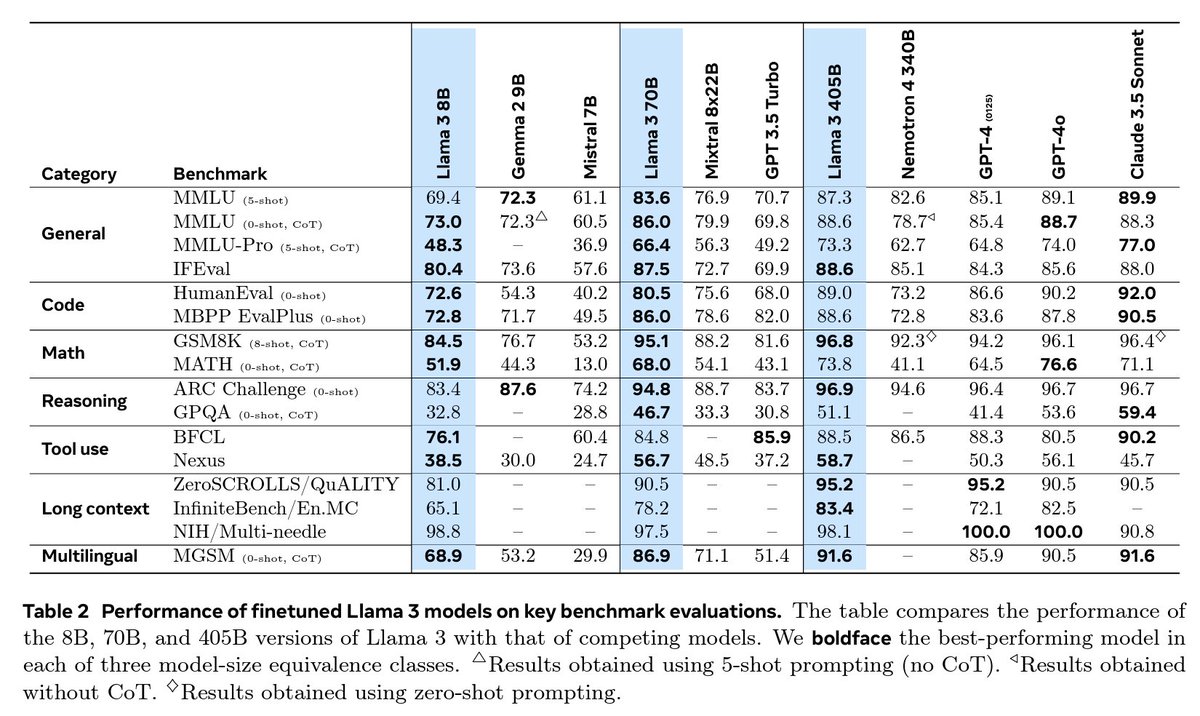
Among the most impressive aspect of the Llama 3.1 release is the accompanying research paper! Close to 100 pages of deep knowledge-sharing on LLMs like we havn't seen very often recently
What a treat!
It covers everything, pretrainining data, filtering, annealing, synthetic data, scaling laws, infrastructures, parallelism, training recipees, post-training adaptation, tool-use, benchmarking, inference strategies, quantization, vision, speech, videos...
Mind-blown! Maybe the single paper you can read today to join the field of LLM from zero right to the frontier
Read it here and feel the open-science https://t.co/nANpZtiP0s
Vector Database by Hand ✍️
Vector databases are revolutionizing how we search and analyze complex data. They have become the backbone of Retrieval Augmented Generation (#RAG).
How do vector databases work?
[1] Given
↳ A dataset of three sentences, each has 3 words (or tokens)
↳ In practice, a dataset may contain millions or billions of sentences. The max number of tokens may be tens of thousands (e.g., 32,768 mistral-7b).
Process "how are you"
[2] 🟨 Word Embeddings
↳ For each word, look up corresponding word embedding vector from a table of 22 vectors, where 22 is the vocabulary size.
↳ In practice, the vocabulary size can be tens of thousands. The word embedding dimensions are in the thousands (e.g., 1024, 4096)
[3] 🟩 Encoding
↳ Feed the sequence of word embeddings to an encoder to obtain a sequence of feature vectors, one per word.
↳ Here, the encoder is a simple one layer perceptron (linear layer + ReLU)
↳ In practice, the encoder is a transformer or one of its many variants.
[4] 🟩 Mean Pooling
↳ Merge the sequence of feature vectors into a single vector using "mean pooling" which is to average across the columns.
↳ The result is a single vector. We often call it "text embeddings" or "sentence embeddings."
↳ Other pooling techniques are possible, such as CLS. But mean pooling is the most common.
[5] 🟦 Indexing
↳ Reduce the dimensions of the text embedding vector by a projection matrix. The reduction rate is 50% (4->2).
↳ In practice, the values in this projection matrix is much more random.
↳ The purpose is similar to that of hashing, which is to obtain a short representation to allow faster comparison and retrieval.
↳ The resulting dimension-reduced index vector is saved in the vector storage.
[6] Process "who are you"
↳ Repeat [2]-[5]
[7] Process "who am I"
↳ Repeat [2]-[5]
Now we have indexed our dataset in the vector database.
[8] 🟥 Query: "am I you"
↳ Repeat [2]-[5]
↳ The result is a 2-d query vector.
[9] 🟥 Dot Products
↳ Take dot product between the query vector and database vectors. They are all 2-d.
↳ The purpose is to use dot product to estimate similarity.
↳ By transposing the query vector, this step becomes a matrix multiplication.
[10] 🟥 Nearest Neighbor
↳ Find the largest dot product by linear scan.
↳ The sentence with the highest dot product is "who am I"
↳ In practice, because scanning billions of vectors is slow, we use an Approximate Nearest Neighbor (ANN) algorithm like the Hierarchical Navigable Small Worlds (HNSW).
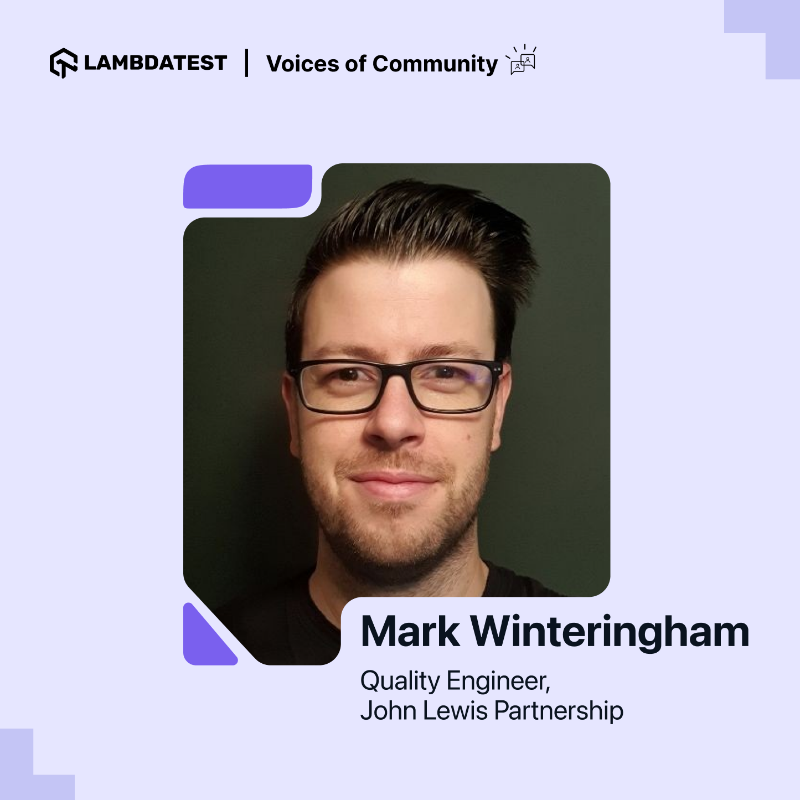
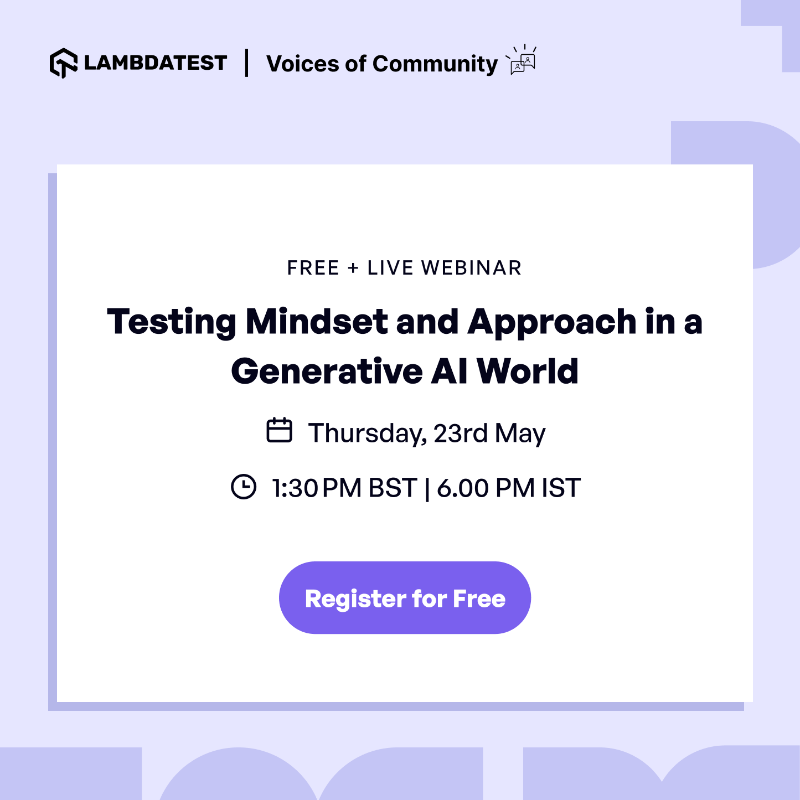
Is your testing mindset ready for the AI revolution?🌐🤖
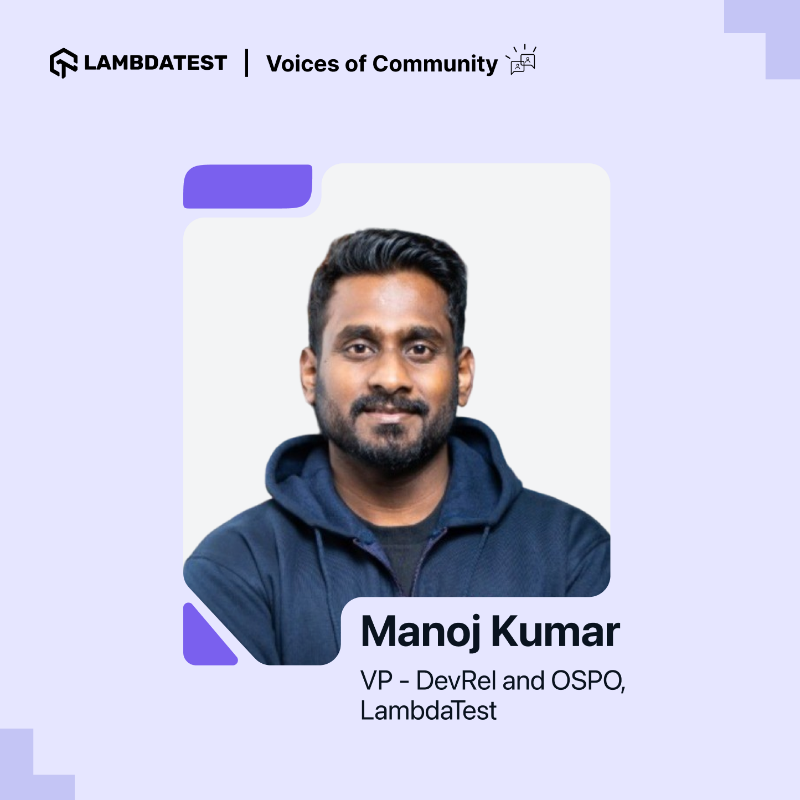
Join our upcoming #VoicsesOfCommunity webinar🔗https://t.co/gEAzugIFqi to decode this crucial question! Hear @2bittester, Quality Engineer, @jlpartnership, and @manoj9788, VP - DevRel & OSPO, LambdaTest.
#AIs your testing mindset ready for the AI revolution?🌐🤖
Join our upcoming #VoicsesOfCommunity webinar🔗https://t.co/gEAzugIFqi to decode this crucial question! Hear @2bittester, Quality Engineer, @jlpartnership, and @manoj9788, VP - DevRel & OSPO, LambdaTest.
#AIs your testing mindset ready for the AI revolution?🌐🤖
Join our upcoming #VoicsesOfCommunity webinar🔗https://t.co/gEAzugIFqi to decode this crucial question! Hear @2bittester, Quality Engineer, @jlpartnership, and @manoj9788, VP - DevRel & OSPO, LambdaTest.
#AIs your testing mindset ready for the AI revolution?🌐🤖
Join our upcoming #VoicsesOfCommunity webinar🔗https://t.co/gEAzugIFqi to decode this crucial question! Hear @2bittester, Quality Engineer, @jlpartnership, and @manoj9788, VP - DevRel & OSPO, LambdaTest.
#AI