I would for sure not vote for the party in power that aims to mindlessly increase ethanol mixing in petrol. I hope people would do the same. Very bad that people have stopped opposing any moves of the government. @nitin_gadkari@BJP4India@narendramodi@Dev_Fadnavis
@MilkyMistIndia had purchased Milky mist paneer, the packet was puffed up before expiry date in refrigerator and is tasting a bit sour. Had to throw away the paneer. Very bad experience.
A student submitted an essay she wrote by hand. Her university ran it through an AI detector. The detector said she cheated. She is autistic.
Her name is Moira Olmsted. Adelphi University. February 2026. Turnitin flagged her essay as 100% AI-generated. She was disciplined.
Two other AI detectors classified the same essay as human-written.
She sued. She won. The court called the school's decision "arbitrary and capricious."
She is not the only one.
In May 2026, a high school student in Palo Alto was expelled after an AI detector flagged his work. He faced visa revocation. He filed a federal civil rights lawsuit.
A researcher at Griffith University just proved mathematically why this keeps happening. The paper is on arXiv. The finding is one sentence.
AI text detectors have a structural flaw that no amount of better engineering can fix.
Here is what the math says.
If a university wants its detector to catch 80% of cheaters, at least 750 out of every 10,000 innocent students will be wrongly accused. That is not a software problem. It is a theorem.
If the university tries to limit false accusations to 1%, detection power collapses to 6%. It catches 6 out of every 100 AI-written papers. The other 94 get through.
There is no setting where the detector is both fair and effective.
The reason is diversity. Every student writes differently. Non-native English speakers use simpler vocabulary. Shorter sentences. Clearer structures. So does AI. A Stanford study found that 61.3% of TOEFL essays written by non-native English speakers were misclassified as AI-generated. A separate analysis tested 14 commercial detection tools. Zero out of 14 reached 80% accuracy.
The students most likely to be wrongly accused are non-native English speakers, neurodivergent students, and anyone who writes with clarity and precision. The qualities that make their writing effective are the same qualities the detector mistakes for a machine.
Vanderbilt University understood this. They disabled Turnitin's AI detection in 2023 after calculating that even a 1% error rate across 75,000 submissions would produce 750 wrongful accusations per year.
750 students accused of cheating for writing like themselves.
The paper's conclusion is not that we need better detectors. It is that the diversity of human writing itself makes accurate detection mathematically impossible.
The same thing that makes your writing yours is the thing that gets you accused.
https://t.co/L91ldtXP05
In a landmark judgment on May 22, 2026, the Delhi High Court held Google liable for trademark infringement.
The case was between Hindware and Google. The court held that, by allowing competitors of Hindware to purchase the keyword “Hindware” (a trademarked name) through Google Ads, Google enabled trademark infringement. The court said that “Hindware” is not a generic English word but a specific brand trademark. By allowing competitors to place ads on that keyword, Google is enabling competitors to divert traffic that should have legitimately gone to Hindware.
This has been a big challenge for companies, both big and small. Even today, if you search for Zerodha, you will see search results from competitors. This has been happening for well over a decade.
Although it is hard to quantify, we have lost a lot of business to this. Think about what happens. Whenever someone searches for "Zerodha", the traffic should rightfully come to Zerodha. But what often happens is that the first couple of results on Google Search are ads, leading the customer to a competitor's website. In the process, we lose business that should have come to us.
This is made worse by the fact that we do not advertise.
There is also an even more ironic thing here. A lot of brands, just to capture the traffic that should have come to them organically, end up bidding on their own keywords. Think about it. If you own a business and have a trademarked name for your business, you still have to pay Google just to hopefully make your name too expensive for your competition to run ads on it.
But now, thanks to the Delhi High Court judgment, we have the option of taking legal action whenever we come across instances of other companies squatting on our keyword.
The other brilliant part about this judgment is that it levels the playing field. And this matters even more for startups, who are already starved for resources and have the odds stacked against them. The last thing they need is for competitors to bid on their brand keywords and steal their traffic.
This judgment now opens up a route for legal recourse whenever such deceptive practices occur.
While keyword squatting is most visible in Google web results, it is an even bigger problem when it comes to app stores. Whenever someone searches for your brand, the first couple of results, both above and below your app listing, often tend to be those of your competitors. And in the case of app stores, I think the ads are even more problematic. When a user clicks on an app-store ad, they often end up installing an app. That is a much higher-commitment action than clicking on a competitor’s web search result and then just closing the page. Because the user has installed an application, the conversions, at least anecdotally, tend to be much higher.
Again, brands that do not advertise are at the receiving end of this. So I welcome this ruling and hope this changes the unfair norms we've been living by for so long.
I would for sure not vote for the party in power that aims to mindlessly increase ethanol mixing in petrol. I hope people would do the same. Very bad that people have stopped opposing any moves of the government. @nitin_gadkari@BJP4India@narendramodi@Dev_Fadnavis
A Wharton economist ran a randomized controlled trial on almost a thousand high school students in Turkey.
The result was so brutal for the AI-in-education narrative that it had to be peer-reviewed by PNAS before people would believe it.
Her name is Hamsa Bastani. She teaches operations and information at the Wharton School at the University of Pennsylvania, and the study she published in 2025 alongside her co-authors is one of the cleanest experiments anyone has run on what AI actually does to learning when you remove it from the equation and check what is left.
The setup was a randomized controlled trial, the same methodology used in clinical drug trials. Nearly a thousand high school math students in Turkey were split into three groups and put through four sessions of ninety minutes each. One group practiced with GPT Base, a standard ChatGPT-4 interface that could answer any question directly. One group practiced with GPT Tutor, a version of the same model that had been prompted to guide students with hints rather than hand them the answer. One group practiced with nothing but their textbook and their own head.
During the practice sessions, the AI groups looked like a miracle. The GPT Base group solved 48% more problems than the students working alone. The GPT Tutor group solved 127% more. Every administrator looking at those numbers would have written a press release about the transformative power of AI in education and moved on.
Then the actual exam came, and AI was not allowed.
The students who had practiced with GPT Base scored 17% worse than the students who had practiced alone. Seventeen percent worse, despite having solved nearly half again as many problems in the sessions leading up to it. The students who had struggled the most, who had sat with the confusion and worked through it without a tool to rescue them, were now the only ones who could actually do the math when it counted.
Bastani's team read through the chat logs to understand what had actually been happening during the practice sessions, and the answer was exactly what the exam results had already implied. The GPT Base group had not been learning. They had been extracting answers and moving on, and every moment that felt like understanding was actually the model doing the cognitive work while the student's brain waited for the next problem to arrive. The paper describes it precisely: without guardrails, students attempt to use GPT-4 as a crutch during practice, and subsequently perform worse on their own.
The detail that should follow every conversation about AI in education is the one buried in the post-test survey results. The students who had relied on AI the most during practice were also the most confident they had understood the material. The tool had not just failed to teach them. It had convinced them they had learned something they had not, which is a different kind of failure entirely and a much harder one to correct because the student has no idea it is happening.
The crutch had made them confident and weak at the same time.
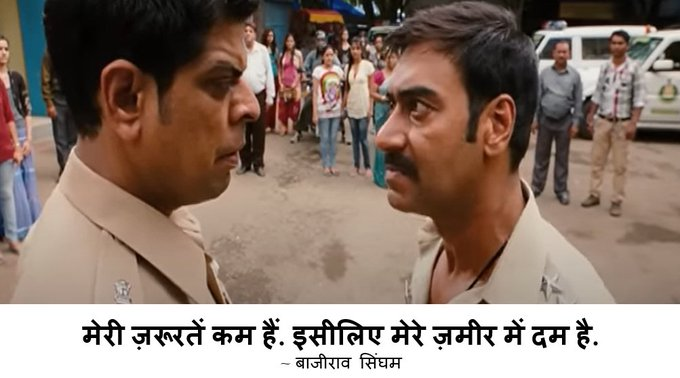
Do I need ₹10 cr to call it "enough" in life, or ₹50 cr? Doesn't matter.
All I know is I've taken this lesson from Singham seriously:
मेरी ज़रूरतें कम हैं.… इसलिए मेरे ज़मीर में दम है.
(My needs are less...and thus my conscience is strong).
Lower your needs. Simple.
Marc Andreessen just revealed the Elon Musk philosophy that completely broke his brain: "The best product in the world shouldn't even need a logo."
We all know Elon is relentless about quality. As Marc puts it: "Do you want the best car in the world or not, right? Like that's Elon's mentality... And it's working very well."
But at a recent event, Elon took this mindset to a completely different level. He dropped a perspective so jarring that Marc initially thought it was a joke.
Elon’s thesis? "You shouldn't even have to have your name on the product. It's just obvious. Everybody knows."
The logic is brutal but simple. If you build the undeniable, undisputed best thing in the world, everybody uses it. And because everybody uses it, you don't need to slap your branding all over it to prove it's yours.
Think about that. We spend endless hours agonizing over marketing, tweaking brand colors, and putting our logos on every square inch of what we build. But the ultimate flex isn't a flashy logo. The ultimate flex is building something so undeniably brilliant that its mere existence is the brand.
Money can buy you almost anything, but it can't buy discipline.
Technology can tell you almost everything, but it can't act on your behalf. You've got to do the work.
Sweden is committing more than €100 million to a sweeping classroom overhaul: replacing tablets and screens with traditional printed textbooks to help reverse falling student performance and sharpen focus.
After more than a decade of embracing digital-first education, Swedish authorities are now pivoting back to paper-based learning. Official data and recent studies cited by the Ministry of Education show that prolonged screen use in class has been linked to shorter attention spans, weaker reading comprehension, and reduced critical-thinking abilities.
Research consistently finds that reading on illuminated screens requires greater mental effort and invites more distractions compared to the calm, linear experience of physical books—factors believed to have contributed to declining academic outcomes in recent years.
Under the new plan, every student will receive printed textbooks for all core subjects, restoring books as the central learning tool. Digital devices and online resources will remain available as supportive tools, but they will no longer dominate daily instruction.
This bold €100+ million investment signals Sweden’s leadership in rethinking the role of technology in education. It underscores a broader, growing recognition worldwide: while screens provide speed and access, the hands-on, distraction-free engagement of physical books supports deeper concentration, stronger memory retention, and more effective long-term learning.
By choosing paper over pixels, Sweden is charting a path toward a more balanced, evidence-informed classroom future—one that puts proven pedagogical principles ahead of unchecked digital trends.