Dear American friends, Europe is your closest ally, not your problem. And we have common enemies. At least that’s how it has been in the last 80 years. We need to stick to this, this is the only reasonable strategy of our common security. Unless something has changed.
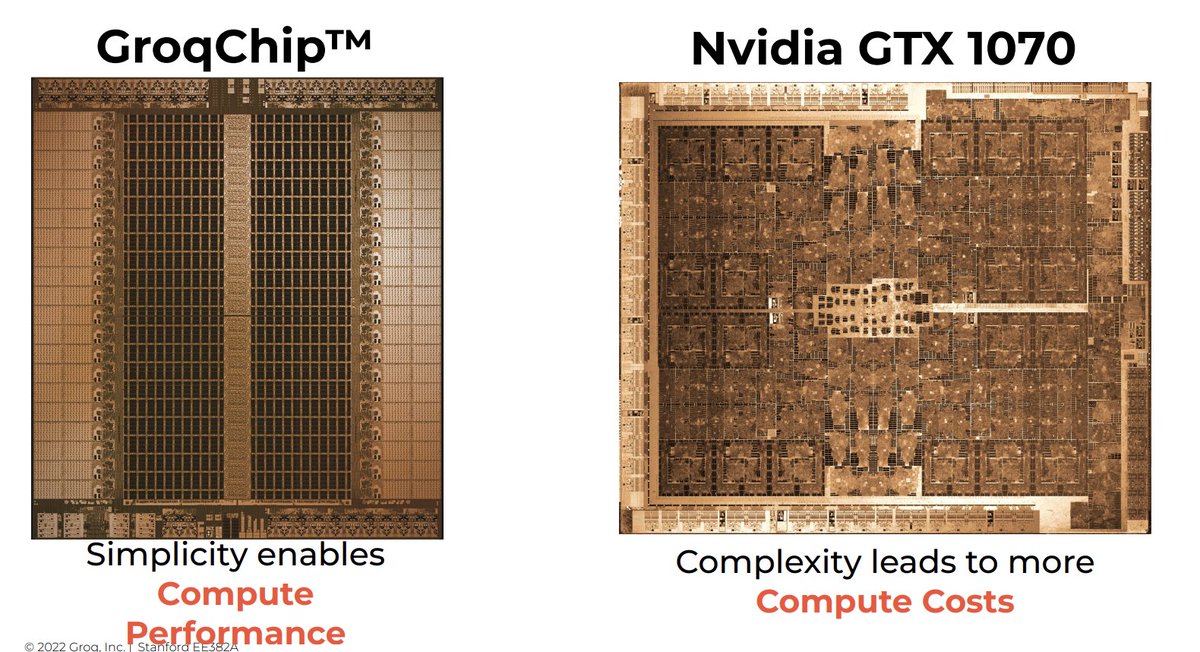
Groq is a Radically Different kind of AI architecture
Among the new crop of AI chip startups, Groq stands out with a radically different approach centered around its compiler technology for optimizing a minimalist yet high-performance architecture. Groq's secret sauce is this compiler-first method that shuns complexity in favor of tailored efficiency.
At the heart of Groq’s architecture is an almost surprisingly bare-bones design that does away with unnecessary logic in favor of raw parallel throughput. The hardware itself is comparable to an ASIC – an application-specific integrated circuit finely tuned for machine learning. However, unlike a fixed-function ASIC, Groq leverages a custom compiler that can adapt and optimize across different models. It is this combination of a streamlined architecture and an intelligent compiler that sets Groq apart.
The key insight is that many AI chips stack components, like GPUs, that bring extraneous hardware and bloat. Groq returns to first principles, recognizing that machine learning workloads are about massive parallelism over simple data types and operations. By eliminating generic hardware and even concepts like locality, the design maximizes throughput and efficiency.
This is enabled by Groq’s compiler that sits between software frameworks like TensorFlow and the hardware. The compiler analyzes and optimizes neural network graphs, tailoring and mapping them to the underlying architecture for accelerated execution. It breaks computations into the smallest operations to unlock parallelism. The compiler also enables capabilities like batch size 1 inference that ensures all hardware is usefully leveraged.
Critically, Groq built its compiler before even finalizing the hardware design. The software insights directly informed the architecture. This co-design process allowed inference-specific optimization without legacy limitations. The compiler also provides deterministic guarantees of runtimes, enabling reliable scaling.
Together, the Groq compiler and architecture form a streamlined, robust engine for machine learning inference. The innovative compiler-first methodology allows custom optimization that balances flexibility with performance. Rather than chasing complexity, Groq realizes less can be more when software and hardware align – a compelling recipe as AI workloads continue evolving.
LLMs are so weird because one side is people with five PhDs who have been studying neuron activations for the past three decades and on the other side is someone called leetm5n with an anime avatar just casually releasing increasingly better performing fine tunes of mistral
@francoisfleuret Math as taught in Albanian unis has two problems. 1) remains at theoretical level 2) there is no “math for ai” book. Found https://t.co/Rq8QTlVAxd on linkedin, would love a book on math in his style.
@thealexker I don’t think this will crash all of them. They cannot do both AGI and chat with PDFs. Dedicated products will certainly add more features both functional and usability wise.
@thekitze We evaluated Svelte, Solid & React. The winner for us is React + shadcn + zustand + zod + react-query. Quite a stack but porting our apps from our in house https://t.co/0O2iVeEikA is strait forward and code looks clean.
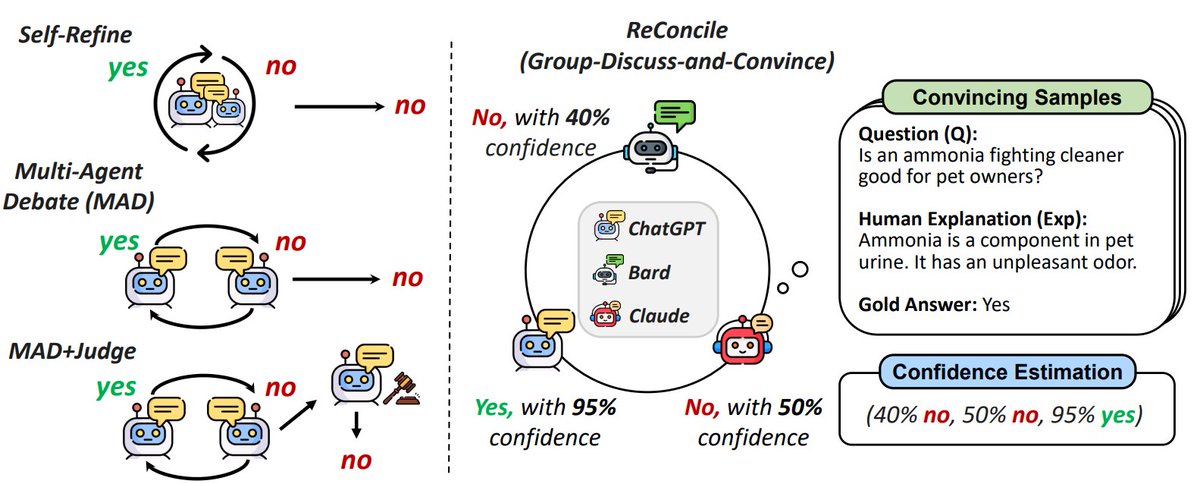
Introducing the RECONCILE framework:
Overview
- RECONCILE is a multi-agent framework that enables multiple diverse Large Language Models (LLMs) to engage in multi-round discussions and reach consensus on complex reasoning tasks.
- It consists of 3 main phases:
1. Initial Response Generation
2. Multi-Round Discussion
3. Final Answer Generation
Phase 1: Initial Response Generation
- Given a reasoning task Q, each agent Ai generates:
- An initial answer ai
- An explanation ei
- A confidence score pi indicating likelihood of answer being correct
- The initial prompt instructs the agent to provide step-by-step reasoning.
Phase 2: Multi-Round Discussion
- RECONCILE facilitates R rounds of discussion between agents.
- In each round r, the discussion prompt Di for agent Ai contains:
- Grouped answers {aj} from previous round, summarized based on distinct responses
- Explanations {ej} from previous round, grouped according to each answer
- Confidence scores {pj} estimating other agents' uncertainties
- Convincing samples Cj for each other agent Aj, consisting of human explanations that can rectify Aj's incorrect answers
- Based on this, each agent Ai provides updated answer, explanation, and confidence score.
- Goal is to convince other agents to reach better consensus. Convincing samples teach agents to generate persuasive explanations.
Phase 3: Final Answer Generation
- Discussion continues until reaching consensus or a maximum of R rounds.
- Final answer is generated via weighted voting using confidence scores:
- Rescale confidence scores pi to deal with overconfidence
- Convert pi to weight wi
- Take weighted vote across all agents' answers to determine final answer
This multi-round discuss-and-convince approach with diverse LLMs improves reasoning capabilities.
I believe in intuition and inspiration. ... At times I feel certain I am right while not knowing the reason. When the eclipse of 1919 confirmed my intuition, I was not in the least surprised. In fact I would have been astonished had it turned out otherwise. Imagination is more important than knowledge. For knowledge is limited, whereas imagination embraces the entire world, stimulating progress, giving birth to evolution. It is, strictly speaking, a real factor in scientific research.
-- as mentioned in Cosmic Religion : With Other Opinions and Aphorisms (1931) by Albert Einstein
📷A. Einstein photographed by Ben Meyer at Einstein's home in Santa Barbara, Caltech Archives Image
Mind blown! 🤯
New research shows models like Stable Diffusion secretly learns 3D geometry, even without any depth data.
It's building a 3D game engine in its brain to realistically draw what we describe.
https://t.co/JXTWIgLSwF
@teknium I couldn’t get Copilot produce good results in visual studio with a c# .net project. Strangely enough it was a dissapointment even compared to chatgpt3.5…