Princeton University initiative enhancing fundamental understanding of AI, enabling its use in academic disciplines, and examining AI's societal implications.
We collected 7k+ trials of humans performing visual tasks while tracking gaze
We then test different forms of gaze guidance for supervising grounded reasoning, interleaving text with coordinates
We find selective use of gaze is more effective than supervising every fixation
How can we train strong visual reasoners that ground their reasoning in where humans look?
We collect 7,000+ active viewing trials of humans and use it to train a gaze-guided reasoner (GGR)
GGR combines strong task performance with more reliable, gaze-aligned reasoning
(1/N)🧵
Shirley Yu, a senior majoring in computer science, won a department award for her independent work project, "Spectral-Gated Test-Time Adaptation for Foundation Time-Series Models under Regime Shifts." She was advised by @HazanPrinceton.
VERY EXCITED to host a launch event for AI Alignment & Safety at @Princeton on Oct 19th, with v. distinguished speakers and new&important research. C u there!!
Morningstar ranks Princeton as a Tier I leader in “AI production capacity” — the only Ivy League institution to reach this tier. Highlights: strength in research, curriculum, compute & infrastructure, talent, entrepreneurship, and global impact.
https://t.co/GQHhqsH4QM
I completed my postdoc at Princeton University 9 months ago but never wrote a goodbye post so:
My two years at Princeton were the best 2 years of my life. I'm forever grateful to @karthik_r_n, @prfsanjeevarora & Ellen DiPippo for creating the incredible environment that enabled me to be take part in amazing research.
I'm forever grateful to @closji & @jyangballin for meeting me on my fourth day on the job and then inviting me to join the software engineering benchmark they had developed. And to @KLieret who joined us just after and became a core part of the SWE-team.
Thank you @ShunyuYao12 who met with me when I was making the decision; I enjoyed our walks so much I decided to join just so I could go on more walks with Shunyu.
Thank you @_awettig my collaborator in both science and art, and European<->American linker.
Thank you to my FAIR postdoc hosts @syhw and @sidawxyz.
Thank you to *all* of my collaborators, including first authors: @MinyangTian1 SciCode and CritPt, @AbramovichTalor SWE-agent for Cyber Security, @OriYoran AssistantBench, @18jeffreyma SWE-fficiency, @a1zhang VideoGameBench, @MiniHui_zhu CritPt, and @ori_press my actual brother and author of AlgoTune
Thank you to my senior collaborators: @Diyi_Yang & @lschmidt3 (through John), @haopeng_uiuc (through Minyang), @profvjreddi (through Jeff), @JonathanBerant (through Ori Yoran) and @MatthiasBethge (through Ori Press).
Thank you to all the people at Princeton who made PLI what it is: @danqi_chen@cocosci_lab and all of the other faculty, postdocs, graduate and undergraduate students.
BuilderBench explores training agents for open-ended exploration beyond their training experience, enabling systems that generalize to entirely new tasks.
https://t.co/jH5xnu06vo
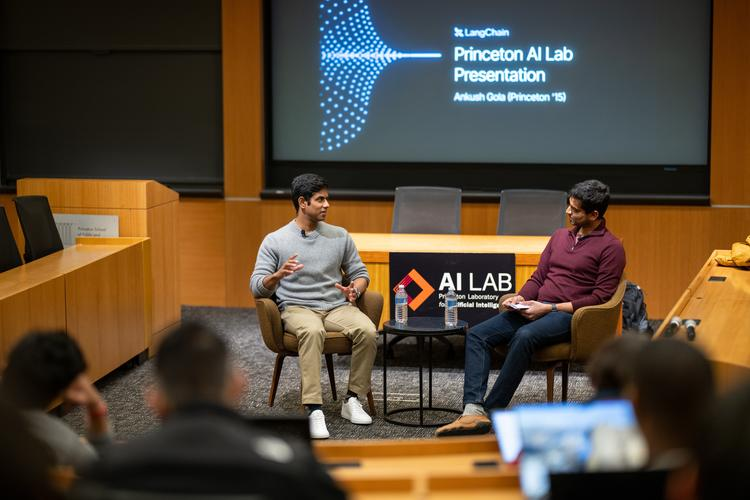
On Mar. 18, Karthik Narasimhan sat down with @ankush_gola11 ’15 to discuss @LangChain, the startup he co-founded that provides the framework for building AI agents and LLM-powered applications.
Read more: https://t.co/xYITu3xScS
👋Meet the Postdoc!
Meet Xinyi Wang, a researcher with @PrincetonPLI. Her research centers on developing a principled understanding of large foundation models with the aim of enhancing their capabilities.
https://t.co/6AJjXKckjP
We're hiring an RSE at @PrincetonPLI to support research on large AI models from systems/infra side. https://t.co/Ci1ikjmHvi Required: (i) experience w/ GPU-based computing and AI (ii) ability to follow AI research in our group.
(Our GPU hardware is already managed by a separate university team.)
The Princeton Language & Intelligence (PLI) is hiring a Research Software Engineer (RSE)!
Help build robust research software, collaborate with faculty and students, and support cutting-edge AI and ML research at Princeton.
👉 For Info and Application: https://t.co/GdlwvsR94b
NeurIPS, the top AI and ML conference, is being held in San Diego from December 2nd to December 7th. Princeton Language and Intelligence is proud to feature the work of our students, post-docs, and faculty that will be showcased at the conference.
https://t.co/2urr4PrPEv
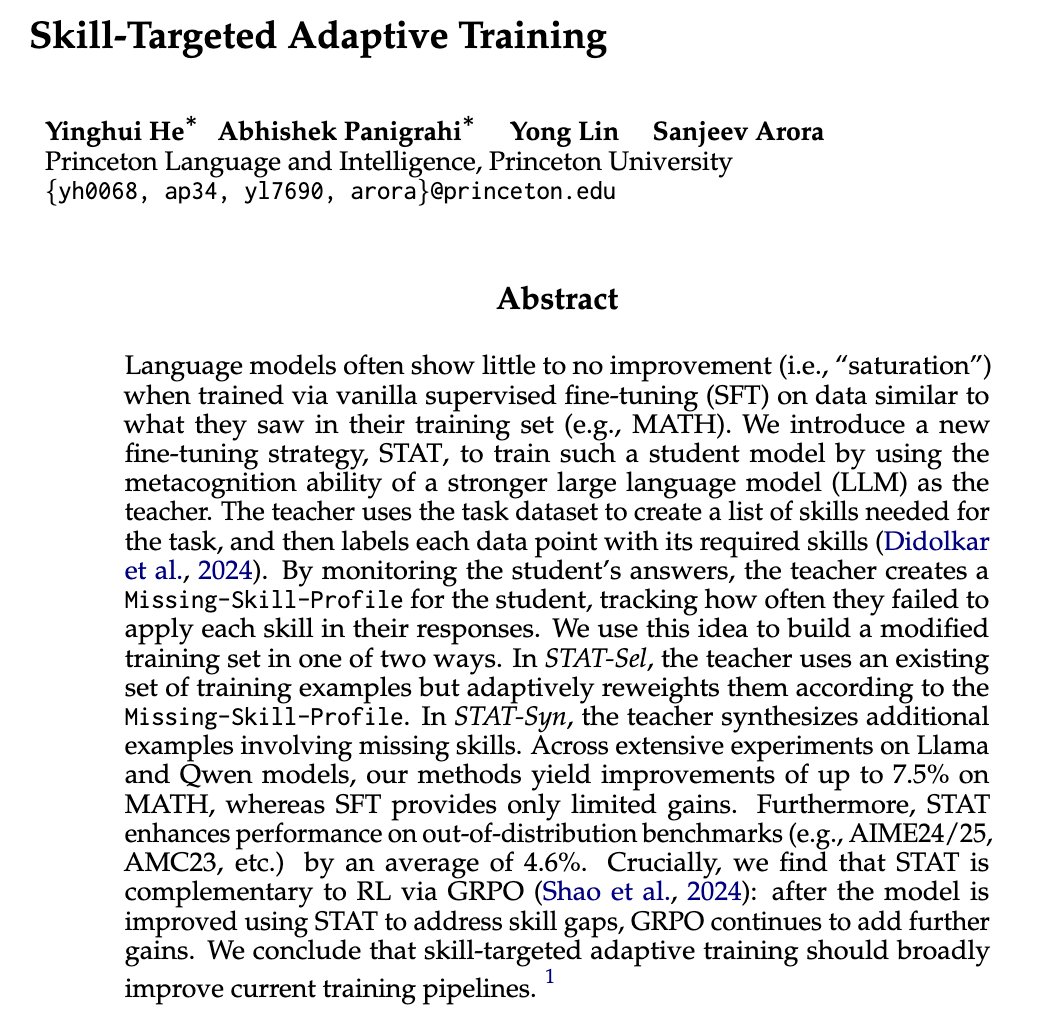
Claude Skills shows performance benefits from leveraging LLM skill catalogs at inference time. Our previous work (linked under thread 5/5) showed the same 6 months ago! 🌟Our new work, STAT, shows that leveraging skills during training can greatly help too‼️, e.g., Qwen can continue to learn new tricks from Hendrycks MATH, which it had been over-trained on.
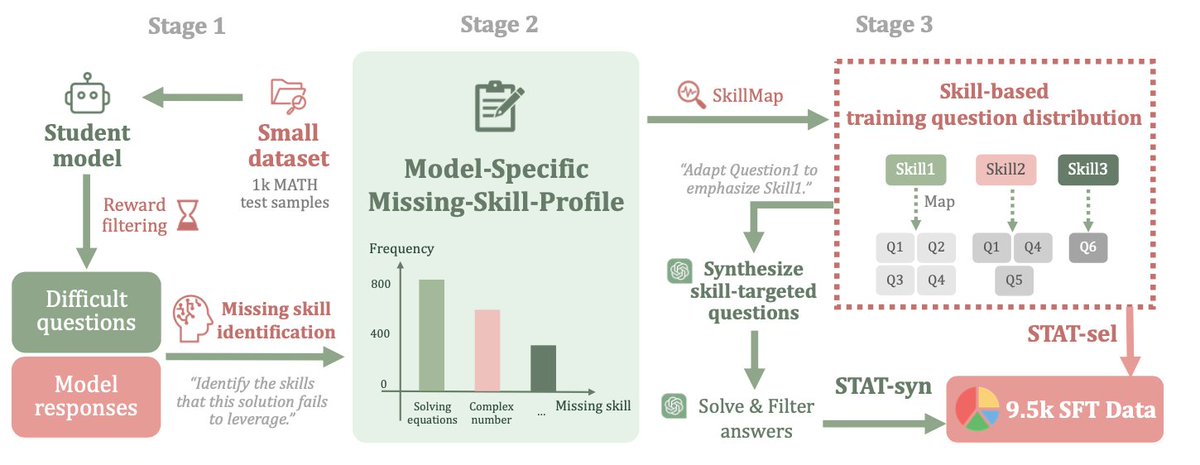
🚨 We introduce Skill-Targeted Adaptive Training (STAT), which uses a supervisor model and a skill catalog to construct a 🧩Missing-Skill-Profile for each student model, and then modifies training to squeeze out >=7% more performance! The intervention can be as simple as reweighting existing training sets. You can also think of this as a more effective distillation method. More in threads 🧵
📎 [arxiv]: https://t.co/Q3ItCevBEh
💻 [github]: https://t.co/jgx4h1C6GT
🥳 Amazing collaborators: @Abhishek_034, @Yong18850571, @prfsanjeevarora
We welcomed 2 new associate research scholars this fall 🥳
Liam Fowl and @happybuzaaba1 will be supporting the research @PrincetonPLI to develop an understanding of LLMs and enable their application to research and education.
Read more: https://t.co/KIPqsdTeAB
🚨 Call for Seed Grant Proposals 🚨
The AI Lab is now reviewing seed grants to support research in large AI models, natural and artificial minds, AI for invention and other AI-related projects.
Deadline for proposals is 10/31. For more information: https://t.co/xyF0adVSZp
EVERYONE PREFERS HUMAN WRITERS, INCLUDING AI We know humans are biased against AI-creativity but what about LLMs, now often judging creativity in various contexts? Check out new preprint from PLI Seed Grant Recipients, Meridith Martin and Wouter Haverals https://t.co/VaOOclEM7o
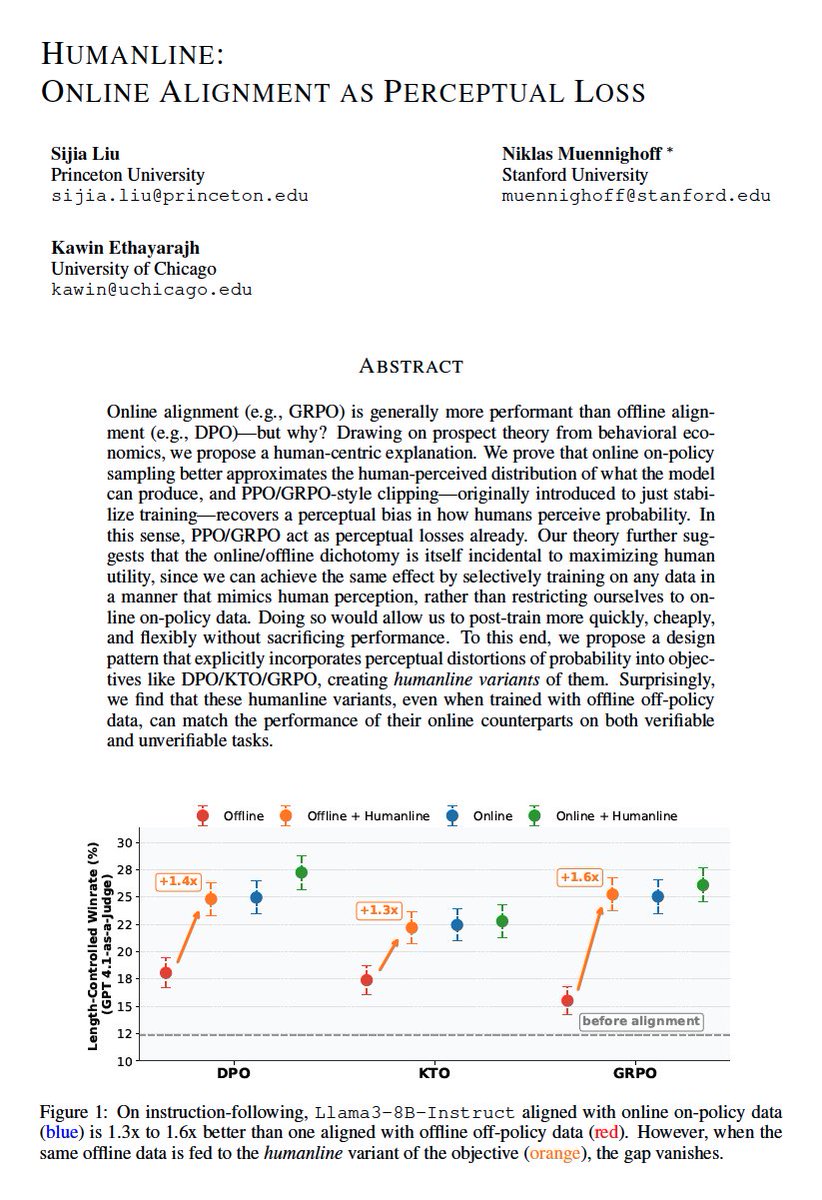
Is online alignment the only path to go despite being slow and computationally expensive?
Inspired by prospect theory, we provide a human-centric explanation for why online alignment (e.g. GRPO) outperforms offline alignment (e.g. DPO, KTO) and empirically show how to close the online-offline gap with Humanline, a simple yet consistently effective two-part design.
💡Main finding: Applying humanline on top of offline objectives can perform on par with their online counterparts on both instruction following and mathematical reasoning. Consistent gains across different objectives, model families and model sizes!
More in threads 🧵