INTRODUCING HARDLIST V2 🇪🇺
I spent hundreds of hours researching European startups that work on the frontiers of energy, mining, compute, AI, defense, transport, robotics, agriculture, biotechnology, health, construction and space.
Together with @rickbossenbroek I turned this into a website we modestly refer to as "the definite index of ambitious hardware startups". I really believe that the 75+ startups on the list are building a new industrial layer that secures European prosperity and relevance in the world.
My goal with HARDLIST is pointing the right talent to the hardest problems that are being tackled by the most ambitious founders.
I've come to believe that the ultimate rate limiting factor to a great European future is the amount of "all-or-nothing" founders we can cultivate at home or attract from abroad. People like @torstenreil or @helenehuby or @salar move aggressively to build vertically integrated companies from first principles.
That's it. If we can grow the number of these founders, we win. If we don't, we lose.
It is not regulation, bureaucracy, lack of venture capital. No my friends, these are NOT the fundamental constraint for European progress and prosperity. We are only limited by formidable founders.
In fact, Europe is an underrated place to build. Think about it: thriving universities & scientific output, a huge industrial base and a massive pool of talented engineers that (still) request modest salaries. And Europe is the nicest place to live on earth.
What is a philosopher-builder?
A philosopher-builder is someone who starts from a thesis about human flourishing.
Rather than simply looking for a gap in the market, they start out with a vision of the human capacities that are worth developing, what constrains them, and how we can expand them.
They reason from first principles about human potential and translate those insights into products or institutions.
To understand what a philosopher-builder is, it’s important to grasp what they are not:
1. They are not philosopher-kings. They do not have a blueprint for a society or a theory about how everyone out to live. Some of our most importance capacities are independent judgment, creativity, and the pursuit of knowledge. They seek to expand these capabilities, not prescribe outcomes
2. Open to disconfirming evidence. A strong philosophical starting point is open to rational criticism and has to be tested against reality. Their hypothesis is open to challenge and evidence should not only inform how they build their product, but potentially cause them to revise their underlying thesis. Philosophical seriousness demands intellectual humility.
3. Not a nihilistic iterator. “Make something people want” is a powerful entrepreneurial discipline, but by itself, it cannot establish whether satisfying people’s immediate wants advances human flourishing. You cannot outsource your belief in which ends are worth pursuing to market feedback.
The philosopher-builder is someone who combines philosophical conviction with empirical discipline. They have a vision, ambition, and an openness to revision.
We believe that AI isn’t a normal technology like the internet or the smartphone that society will simply absorb. Instead, it will create the biggest opening for institution-building since the American founding and philosopher-builders will be more important than ever.
If this vision of how to build resonates with you, we want to hear from you.
A San Francisco startup says it just turned mercury into real gold, and their own math says gold is one of the cheapest things their machine can make. Aim it at a different metal and it makes a cancer drug ingredient worth tens of billions of dollars a gram.
Here's how it works. When you fuse two kinds of hydrogen, deuterium and tritium, every single reaction kicks out a neutron moving at 14.1 MeV, which is absurdly fast. Fire one into mercury-198 and it knocks another neutron loose on the way through, so two come out and you're left with mercury-197. Give that a few days and it decays into gold-197, the only stable kind of gold there is. The whole trick needs neutrons above about 6 MeV, and regular nuclear reactors barely make those, while fusion makes one every time it fires.
Now swap the mercury for radium-226. Same reaction, one neutron in and two out, and you end up with radium-225, which decays into actinium-225. Novartis is building its next prostate cancer drug around actinium-225, and it's so scarce it sells by the millicurie, roughly $1,200 to $2,500 apiece. Price it by the gram and you're into the tens of billions of dollars, for a material so radioactive nobody could safely hold a gram of it anyway.
Marathon's team actually put a dollar value on a single fusion neutron in a paper this year. Use it to make electricity and it's worth about $3 × 10⁻²⁰. Gold comes in at $2.6 × 10⁻²⁰, basically a wash. Molybdenum-99, which goes into about 80% of nuclear medicine scans, is worth $2.6 × 10⁻¹⁷ a neutron. Actinium-225 is worth about $10⁻¹⁰, around 3 billion times what the electricity's worth.
That's why fusion people should care. Every fusion company you've heard of is chasing electricity, and selling electricity only pays once the plasma puts out something like 10 to 22 times the energy you pump in to heat it. The best result so far, at JET in England, was about a third. Add gold on the side and Marathon's math says you break even around 3x. For molybdenum-99, the number is 0.001x.
So a machine that gives back one-thousandth of the energy you feed it can still make money, as long as the neutrons hit the right metal.
By their numbers, a 3 megawatt machine running way below breakeven could cover the whole world's supply of molybdenum-99, which today comes from splitting uranium in a handful of research reactors. Today's experimental fusion machines already beat the gain that job needs.
Their second post basically says this out loud. Marathon now describes itself as an isotope company for radiopharma. Their chart shows roughly 390 targeted radiotherapy trials. Pluvicto, the prostate cancer drug Novartis launched at $42,500 a dose, did $1.9 billion in sales last year.
Gold still matters to them, just later. It's about a $700 billion a year market, and Marathon's paper figures it could soak up around 2 terawatts of fusion capacity, which is roughly the scale where fusion actually moves the grid. So the plan is to sell cancer isotopes out of small machines now and use gold to pay for the giant ones, years before electricity can pay for itself.
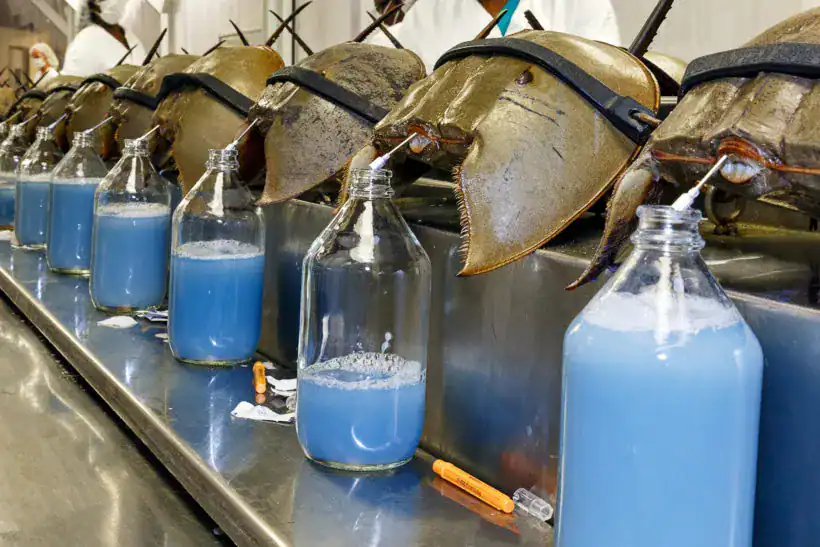
If you think the fact that antivenom is still made by injecting horses with scorpion venom, costs $39M a gallon, about $500 a drop, and scorpions sting 1M+ people a year and kill 3,000+ is crazy... wait until you learn that ALL vaccines are still tested for bacterial toxins using horseshoe crabs’ blue blood, processed into a reagent valued at $60K a gallon. Over 1M horseshoe crabs were bled in the U.S. in 2024, with an estimated 185,000 dying from the process.
Reducing this animal suffering is moral imperative.
Today, Pioneer Labs is announcing our first step towards terraforming Mars. 🚀🌼
With equipment that fits in just a single rocket launch, we can convert Martian dirt, water, and air into enough building materials to construct a small city on Mars.
To do it, we made the first microbe for Mars. We found the best microbe on Earth and used evolution to teach it how to source all of its nutrients directly from Martian materials.
The first astronauts will be greeted with safe shelter already filled with water, oxygen, and rocket fuel for the return journey.
This is the first step toward using biology to make Mars a friendly place for life. It lets us live off the land and helps us build the next great frontier.
It's the first of five organisms we need to green Mars ⬇️
Abundance usually gets explained as a list of problems: zoning, permits, licensing, slow approvals.
Here’s what we'd actually get if we fixed them:
Lunch costs $4, like it does in Japan and Singapore. Most US cities require three or four separate sinks, which makes a kitchen under 200 square feet nearly impossible.
Anyone can open an owl cafe or a vegan lesbian bookstore. Japan is full of tiny, oddly specific businesses run by one or two people. They survive because small spaces are cheap and enough people live close enough to walk in.
A room in a big city for $400 a month. These buildings housed millions of low-income and older Americans until cities banned most of them by the 1980s.
A three-bedroom apartment you can stay in after you have a kid. US codes require two staircases in buildings over three stories, so family-sized units only fit on the corners. Most of the world allows one staircase.
A new electric car for about $10,000. China sells these globally. Americans can't buy it.
A government so dependable it's boring. When a loved one dies, you report it once instead of to every agency.
We can decide to make it happen here.
The full list has 16 things, from taco trucks on every corner to no more pandemics. I wrote this to also announce that today is DC Abundance's official launch!
If you’re in DC, come celebrate and see the G.O.A.T. Derek Thompson speak!
150 GW of new production brought online over 20 years, or 7.5 GW per year. Most of it would be wind power.
Offshore turbines currently generate about 25 MW, so they would have re-industrialized Glasgow's dockyards to produce about one per day.
This is about the same rate that the Kaiser shipyards produced finished liberty ships, which are substantially more complex.
One turbine per day doesn't sound like all that much, but do it for a decade and Britain doubles its power production capacity.
Or stay poor forever.
The brilliant communication insight of @bryan_johnson is that LONGEVITY suddenly legitimates a lot of things that are "not done" by society because they're seen as weak or weird: being vain, using psychedelics, going to bed early, etc
A high status member of society signaling that health is the premium status symbol.
"I encourage people to compete on health, not wealth rankings or lambos."
The critical threshold for mass adoption will happen at around 75,000 similarly powerful people saying the same thing