I’m speaking at #MLDS2026 tomorrow.
"@BharatGen_Com: Sovereign & Shared: Frugally Scalable Multilingual–Multimodal AI for Bharat"
📍 Hall 1, NIMHANS Convention Centre, Bengaluru 🕔 Day 1 | 5:25 PM
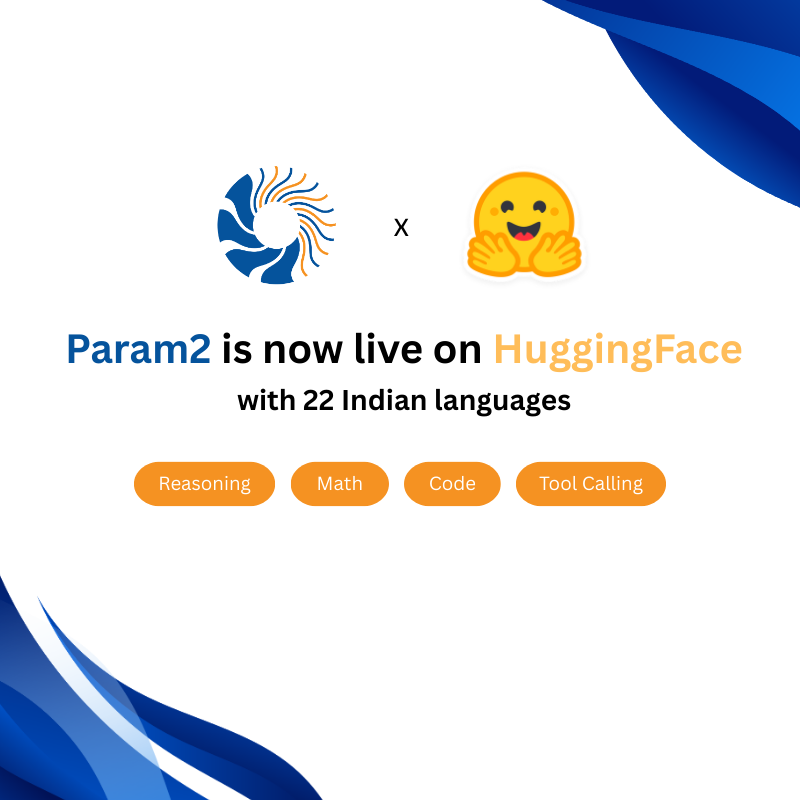
Param-2 is live on @huggingface.
17B parameter MoE. 22 trillion tokens. 22 Indian languages. Reasoning, math, code, tool calling.
Built from scratch, in India, open for the world.
🤗 Try it now: https://t.co/y5ECDBa9oQ
#BharatGen#Param2#OpenSource
Hon’ble @VPIndia Shri C. P. Radhakrishnan hailed India’s rise in the Global Innovation Index (81st in 2015 to 38th in 2025) and lauded BharatGen as a symbol of India’s growing AI and tech leadership.
#BharatGen#AI
We’re beyond excited to have officially launched BharatGen! A huge thank you to everyone who joined us in this milestone moment! Here’s a glimpse of the event.
@TIH_IoT
#LaunchEvent#GenerativeAI#Innovation
Prof #GaneshRamakrishnan speaks on the latest advancements in #GenerativeAI through BharatGen!
Whether you're a tech enthusiast or industry leader, his talk will spark ideas and inspire change.
Watch the full video now: https://t.co/R1LkSiwMXq
#TechInnovation#FutureOfTech
Integration between Public and Private sectors is crucial to future growth, says Union Minister @DrJitendraSingh
AI and BharatGen: Paving the Way for Inclusive Digital Transformation in India
National Learning Week Session Emphasizes Collaborative Approach to Transform India’s Technological Landscape
Read here: https://t.co/RXGEHlmfe2
Prof. Ganesh Ramakrishnan, from @iitbombay elaborated on Large Language Models (LLMs) and the transformation that BharatGen, a LLM initiative launched under DST‘s National Mission on Interdisciplinary Cyber Physical Systems #NMICPS could bring about, as well as on Data-Efficient Machine Learning, while Dr. Sharad Sharma, co-founder of iSPIRT Foundation, spoke on Digital Public Infrastructure - The Unfolding Revolution.
Actually, really liked the Apple Intelligence announcement. It must be a very exciting time at Apple as they layer AI on top of the entire OS. A few of the major themes.
Step 1 Multimodal I/O. Enable text/audio/image/video capability, both read and write. These are the native human APIs, so to speak.
Step 2 Agentic. Allow all parts of the OS and apps to inter-operate via "function calling"; kernel process LLM that can schedule and coordinate work across them given user queries.
Step 3 Frictionless. Fully integrate these features in a highly frictionless, fast, "always on", and contextual way. No going around copy pasting information, prompt engineering, or etc. Adapt the UI accordingly.
Step 4 Initiative. Don't perform a task given a prompt, anticipate the prompt, suggest, initiate.
Step 5 Delegation hierarchy. Move as much intelligence as you can on device (Apple Silicon very helpful and well-suited), but allow optional dispatch of work to cloud.
Step 6 Modularity. Allow the OS to access and support an entire and growing ecosystem of LLMs (e.g. ChatGPT announcement).
Step 7 Privacy. <3
We're quickly heading into a world where you can open up your phone and just say stuff. It talks back and it knows you. And it just works. Super exciting and as a user, quite looking forward to it.
Thrilled to announce that
@gpt_bharat
is making waves at the renowned MIT Stata Center, CSAIL! 🚀 Presented our cutting-edge large language model research innovation at MIT yesterday. Grateful to #CSAIL for this opportunity to showcase advancements in AI.
New era for the sports industry
It's time for folks to really start looking at how spatial computing will change sports for ever.
What used to cost millions and take weeks, can now happen in real-time and cost close to nothing.
🧵 A thread
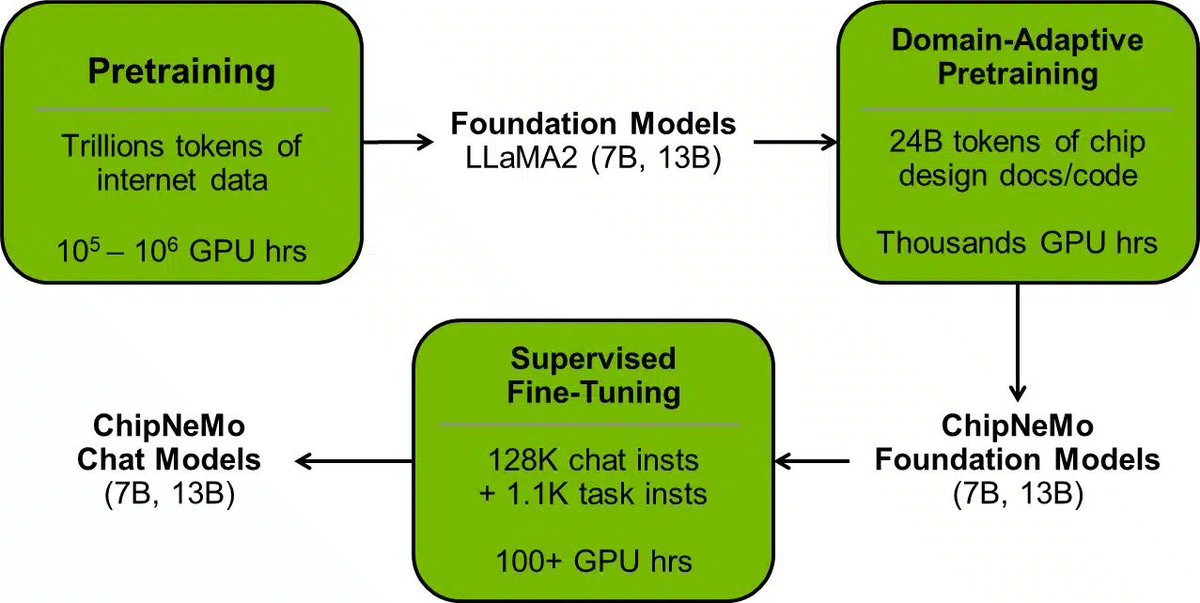
NVIDIA basically compressed 30 years of its corporate memory into 13B parameters. Our greatest creations add up to 24B tokens, including chip designs, internal codebases, and engineering logs like bug reports. Let that sink in.
The model "ChipNeMo" is deployed internally, like a shared genie:
- EDA scripts generation. EDA stands for "Electronic Design Automation", a core software suite for designing the next-gen GPUs. These scripts are the keys to a $1T market cap 🦾;
- Engineering assistant chatbot for GPU ASIC and Architecture engineers that understands internal hardware design specs and is capable of explaining complex design topics;
- Bug summarization and analysis as part of an internal bug and issue tracking system;
- Domain-finetuned retriever that achieves much better accuracy over internal knowledge.
And we publish a whitepaper to share ChipNeMo's creation process: https://t.co/dMG5AFMXTH
Official blog: https://t.co/MMjLbKxE34
Congrats to Haoxing "Mark" Ren's team for the outstanding work!
I’ve resigned from my role leading the Audio team at Stability AI, because I don’t agree with the company’s opinion that training generative AI models on copyrighted works is ‘fair use’.
First off, I want to say that there are lots of people at Stability who are deeply thoughtful about these issues. I’m proud that we were able to launch a state-of-the-art AI music generation product trained on licensed training data, sharing the revenue from the model with rights-holders. I’m grateful to my many colleagues who worked on this with me and who supported our team, and particularly to Emad for giving us the opportunity to build and ship it. I’m thankful for my time at Stability, and in many ways I think they take a more nuanced view on this topic than some of their competitors.
But, despite this, I wasn’t able to change the prevailing opinion on fair use at the company.
This was made clear when the US Copyright Office recently invited public comments on generative AI and copyright, and Stability was one of many AI companies to respond. Stability’s 23-page submission included this on its opening page:
“We believe that Al development is an acceptable, transformative, and socially-beneficial use of existing content that is protected by fair use”.
For those unfamiliar with ‘fair use’, this claims that training an AI model on copyrighted works doesn’t infringe the copyright in those works, so it can be done without permission, and without payment. This is a position that is fairly standard across many of the large generative AI companies, and other big tech companies building these models — it’s far from a view that is unique to Stability. But it’s a position I disagree with.
I disagree because one of the factors affecting whether the act of copying is fair use, according to Congress, is “the effect of the use upon the potential market for or value of the copyrighted work”. Today’s generative AI models can clearly be used to create works that compete with the copyrighted works they are trained on. So I don’t see how using copyrighted works to train generative AI models of this nature can be considered fair use.
But setting aside the fair use argument for a moment — since ‘fair use’ wasn’t designed with generative AI in mind — training generative AI models in this way is, to me, wrong. Companies worth billions of dollars are, without permission, training generative AI models on creators’ works, which are then being used to create new content that in many cases can compete with the original works. I don’t see how this can be acceptable in a society that has set up the economics of the creative arts such that creators rely on copyright.
To be clear, I’m a supporter of generative AI. It will have many benefits — that’s why I’ve worked on it for 13 years. But I can only support generative AI that doesn’t exploit creators by training models — which may replace them — on their work without permission.
I’m sure I’m not the only person inside these generative AI companies who doesn’t think the claim of ‘fair use’ is fair to creators. I hope others will speak up, either internally or in public, so that companies realise that exploiting creators can’t be the long-term solution in generative AI.
Embarking on a remarkable journey with #BharatGPT's first strategic partnership alongside #DARPG. Under the visionary leadership of Prof. Ganesh Ramakrishnan and Shri Parthasarathy Bhaskar, we're blending AI with governance to revamp CPGRAMS. The future looks promising! 🇮🇳
The DARPG - IIT Mumbai led Bharat GPT team collaboration on using BharatGPT in CPGRAMS. The non disclosure agreement was signed by Prof. Ganesh Ramakrishnan of IIT Bombay and Shri Parthasarathy Bhaskar Deputy Secretary DARPG in the presence of Secretary DARPG Shri V.Srinivas.