Just for sanity check: "10 million H-1B people here forever" is double the entire foreign-born population of the two countries that supply nearly all H-1Bs, counted across all visa categories. It's not physically possible without counting U.S.-born children very aggressively
Can you recalculate
@grok@matters_btc@Mamanancy10@bofrench@JohnO77929862 No I am saying not all 140K alloted EB categories go to H1B, there are O1, L1 and other types, that also avail EB categories. We wanted to know H1B specific counterfactual right?
@grok@matters_btc@Mamanancy10@bofrench@JohnO77929862@grok did you consider wasted visa numbers from 1990 onwards, and not full 140K is allotted to H1Bs, as per freely available data around 40K a year goes to H1B primary applicants.
https://t.co/nVt9Olv6Sz
@grok maybe a better way to estimate these would be using EB1/2/3 numbers available, and make fair assumptions of how many go to H1Bs, how many of these visa numbers are wasted over the years, then add back some spill overs towards F2A/IR and EB5 categories. that way you can have better estimate, and then you can extrapolate it to families and kids assuming people on H1Bs have lower number of kids than national average(if that assumption is sound)
I implemented @GoogleResearch's TurboQuant as a CUDA-native compression engine on Blackwell B200.
5x KV cache compression on Qwen 2.5-1.5B, near-loseless attention scores, generating live from compressed memory.
5 custom cuTile CUDA kernels ft:
- fused attention (with QJL corrections)
- online softmax
-on-chip cache decompression
- pipelined TMA loads
Try it out: https://t.co/m5vkJxWIY6
s/o @blelbach and the cuTile team at @nvidia for lending me Blackwell GPU access :)
cc @sundeep@GavinSherry
I was inspired by this so I wanted to see if Claude Code can get into my Lutron home automation system.
- it found my Lutron controllers on the local wifi network
- checked for open ports, connected, got some metadata and identified the devices and their firmware
- searched the internet, found the pdf for my system
- instructed me on what button to press to pair and get the certificates
- it connected to the system and found all the home devices (lights, shades, HVAC temperature control, motion sensors etc.)
- it turned on and off my kitchen lights to check that things are working (lol!)
I am now vibe coding the home automation master command center, the potential is 🔥.And I'm throwing away the crappy, janky, slow Lutron iOS app I've been using so far. Insanely fun :D :D
When I created Claude Code as a side project back in September 2024, I had no idea it would grow to be what it is today. It is humbling to see how Claude Code has become a core dev tool for so many engineers, how enthusiastic the community is, and how people are using it for all sorts of things from coding, to devops, to research, to non-technical use cases. This technology is alien and magical, and it makes it so much easier for people to build and create. Increasingly, code is no longer the bottleneck.
A year ago, Claude struggled to generate bash commands without escaping issues. It worked for seconds or minutes at a time. We saw early signs that it may become broadly useful for coding one day.
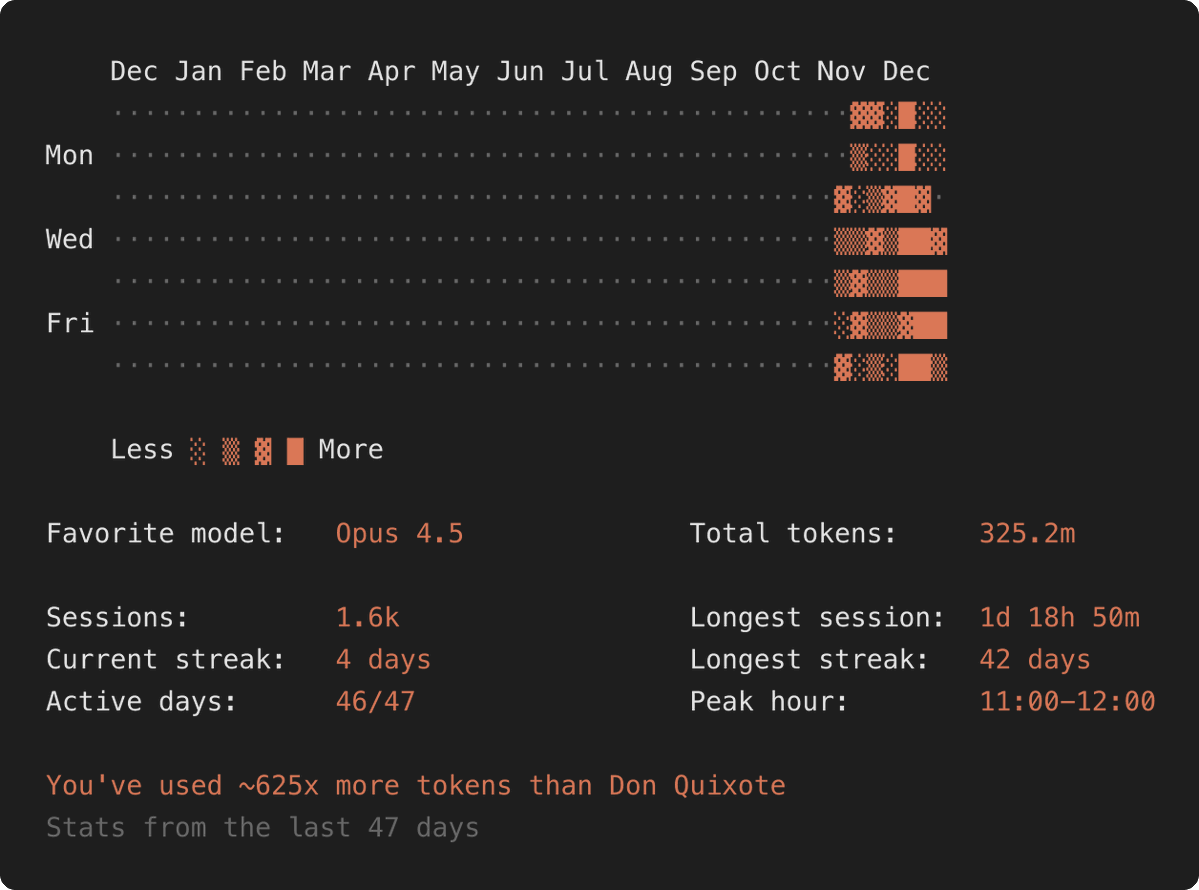
Fast forward to today. In the last thirty days, I landed 259 PRs -- 497 commits, 40k lines added, 38k lines removed. Every single line was written by Claude Code + Opus 4.5. Claude consistently runs for minutes, hours, and days at a time (using Stop hooks). Software engineering is changing, and we are entering a new period in coding history. And we're still just getting started..
I've never felt this much behind as a programmer. The profession is being dramatically refactored as the bits contributed by the programmer are increasingly sparse and between. I have a sense that I could be 10X more powerful if I just properly string together what has become available over the last ~year and a failure to claim the boost feels decidedly like skill issue. There's a new programmable layer of abstraction to master (in addition to the usual layers below) involving agents, subagents, their prompts, contexts, memory, modes, permissions, tools, plugins, skills, hooks, MCP, LSP, slash commands, workflows, IDE integrations, and a need to build an all-encompassing mental model for strengths and pitfalls of fundamentally stochastic, fallible, unintelligible and changing entities suddenly intermingled with what used to be good old fashioned engineering. Clearly some powerful alien tool was handed around except it comes with no manual and everyone has to figure out how to hold it and operate it, while the resulting magnitude 9 earthquake is rocking the profession. Roll up your sleeves to not fall behind.
Indian Americans are at the absolute top of the US tech industry, and they have done absolutely jack shit to stop anti-Indian racism and bigotry on social media.
Of course this doesn't sound so surprising when you realize that they're also mostly achieving jack shit in Washington for India's foreign-policy interests too.
The Indian diaspora is the largest in the world, but also one of the most useless.
(1) I love India
(2) Anybody who applies for an e-visa to India knows the website is always comically, profoundly, embarrassingly broken
It looks like it was written in 2003, kicks you out randomly without saving your work, won't charge your credit card until your nineteenth attempt
But this is a new one—halfway through the business visa application, it displays a list of the tallest peaks in each Indian state??
Come on folks, I'm just trying to invest in your country!
@yacineMTB Feels like you built a hypothesis about "a" culture of 1.4B people using a dataset of your personal online interactions.
That's not cultural analysis....that’s overfitting on noisy samples. Have you considered that you might have high variance brain?
You can spot an aggrieved Linux loser by the attempt to gatekeep the term "distribution" like it was a royal distinction of honor. I don't give a fuck what you call a compilation of configs, tools, and programs with a custom installer that ships on an ISO.