This deal between SpaceX and Google isn't just another buzzword about AI.
Word is, Google is paying SpaceX $920M a month for AI compute through 2029.
That works out to about 110,000 NVIDIA GPUs sitting in SpaceX's data centers.
Here's what that tells me:
Even Google doesn't have enough compute power.
The real race in AI isn't about chatbots or models anymore.
It's about who controls:
GPUs
Data centers
Cloud capacity
Power
Infrastructure
SpaceX was always about rockets and satellites.
Now they're turning AI compute into a cash machine.
With the Anthropic deal, SpaceX's AI compute contracts could bring in around $26B in yearly revenue.
That's wild.
Stocks I'm keeping an eye on from this trend:
$GOOG
$NVDA
$AMD
$AVGO
$MSFT
$AMZN
$ORCL
$TSLA
$TSLA isn't directly SpaceX, but the Elon AI infrastructure story still matters.
My take is simple:
AI isn't just software anymore.
It's becoming an infrastructure arms race.
Don't chase the hype.
Follow the compute.
$META is way more than just a social media stock these days.
Current price: $593.00
Today: -$34.78
Market cap: ~$1.52T
P/E: ~21.6x.
People still think of Meta as just Facebook and Instagram ads.
But the real game is way bigger:
Family of Apps = cash flow machine
Instagram / Facebook / WhatsApp = global reach
AI ads = smarter targeting and more money
Reels / Threads = keeping eyes glued
Meta AI = product ecosystem
Reality Labs = future bet
Meta’s Q1 2026 revenue hit $56.31B, up 33% from last year. Family of Apps brought in $55.91B, but Reality Labs is still a drain with a $4.03B operating loss. Capital expenditures were $19.84B, showing just how hard Meta’s pushing into AI infrastructure.
My take:
$META is still one of the top AI ad platforms out there.
The potential is in AI boosting ads, engagement, recommendations, and business tools.
But there’s clear risk too:
AI spending is climbing fast.
Reality Labs keeps bleeding cash.
Regulation is a long-term cloud.
My plan:
Don’t chase.
Wait for dips.
Keep an eye on ad growth and AI monetization.
Only buy if the stock holds key support.
Watchlist:
$META / $GOOG / $MSFT / $AMZN / $NVDA / $AVGO
Not financial advice. 🚀
🚨 People forget $KLAC isn't your typical semiconductor equipment stock.
Price: $1,929.20
Drop: -$201.88 / -9.47% today
Market cap: ~$254B
P/E: ~54.6x.
Everyone talks about $NVDA, $TSM, $ASML, $MU.
But KLA's real job flies under the radar.
$KLAC is the boss of process control and yield management.
Simply put: it helps chipmakers spot defects, boost yield, and crank out advanced chips better.
That's huge because AI chips are getting tougher to make.
Tougher nodes.
Trickier wafers.
Fancier packaging.
More inspection and metrology needed.
Last quarter:
Revenue: $3.415B
Non-GAAP EPS: $9.40
Free cash flow: $622M
Q4 revenue outlook: $3.575B ± $200M.
How I see it:
$NVDA drives AI compute demand.
$TSM builds the advanced chips.
$ASML supplies EUV tools.
$KLAC ensures those chips can actually be produced with high yield.
So $KLAC isn't just another equipment maker.
But after a big run-up and lofty valuation, I'm not jumping in.
Watching for dips in:
$KLAC / $ASML / $TSM / $NVDA / $AVGO / $MU
Best play:
Wait for support.
Wait for fear.
Buy the firms that own the bottlenecks. 🚀
Not financial advice.
🚨 $TSLA isn't behaving like a typical car company.
Current price: $391.00
Today: -6.61%
Market cap: ~$1.38T
Everyone keeps debating Tesla’s car sales.
But that’s just one piece of the puzzle.
The real $TSLA bet is bigger:
EV production
Energy storage
FSD
Robotaxi
AI robots
Software systems
If Tesla is just an EV maker, the price looks steep.
But if it turns into an AI mobility platform, everything changes.
That’s why $TSLA is always high-risk, high-upside.
My take:
I like the long-term vision.
But I wouldn’t jump in after big gains.
I’m watching:
$TSLA — waiting for dips
$NVDA — AI computing
$GOOG / $MSFT — AI platforms
$AVGO / $TSM — AI hardware
Don’t chase hype.
Wait for support.
Buy only when the risk-reward works. 🚀
Not financial advice.
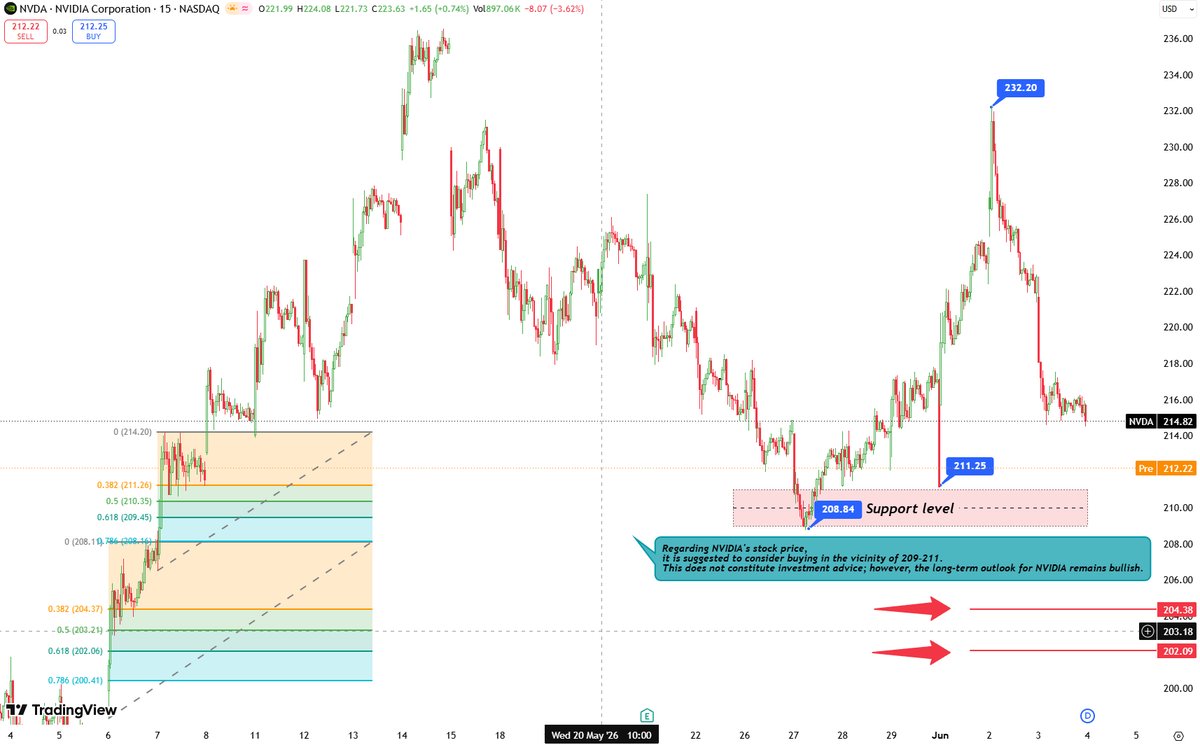
🚨 $NVDA volatility has expanded sharply over the past two trading days.
The stock rallied from around $211 all the way to nearly $232, showing very strong short-term momentum. However, after that sharp move, $NVDA pulled back quickly and is now trading near the $214 area. 📉
From a technical perspective, the most important support zone is now around $209–$211.
This area is not only where the previous move started, but also a key defensive zone that bulls must hold. 🎯
If $NVDA can stabilize around $209–$211 and buyers step back in, the bullish structure would still remain intact, and another rebound attempt could follow.
But if this support zone breaks, short-term sentiment may weaken further, and the stock could continue searching for lower support. Considering Nvidia’s massive market cap, every sharp pullback can also lead to a major loss in market value. ⚠️
This pullback is not only about $NVDA itself.
The broader U.S. market is also under pressure. Right now, $SPX, $NDX, and $QQQ are all facing pullback pressure, while tech stocks and semiconductors are moving lower together.
At the same time, $SMH is another key ETF to watch. If $SMH continues to weaken, it means capital is still cooling off in the semiconductor sector, which could put more pressure on $NVDA in the short term.
If $QQQ and $SMH can stabilize, $NVDA will have a better chance of attracting capital back into the stock. 📊
This decline may be related to several factors:
• Broader weakness in $SPX
• Pullback pressure in $NDX / $QQQ
• Short-term cooling in $SMH
• Profit-taking after a strong rally
• Valuation digestion in AI leaders
• Lower risk appetite across the market
However, from a long-term perspective, Nvidia’s core fundamentals have not changed. AI computing demand, data center expansion, GPU supply-demand strength, enterprise AI adoption, and semiconductor industry upgrades are still supporting the long-term story behind $NVDA. 🚀
My view is simple:
Do not blindly chase in the short term.
Watch the $209–$211 support zone closely.
Also monitor whether $SPX, $NDX, $QQQ, and $SMH can stabilize.
If support holds, a rebound is still possible.
If support breaks, short-term risk will continue to increase.
Long-term structure remains bullish, but short-term price action must respect the broader market pullback and sector pressure.
⚠️ This is market analysis only, not financial advice. Please do your own research.