Helping people in AI + Tech keep the public informed. Got information you're concerned about?
1) Save it in the Psst Safe
2) We'll help you take it from there
The federal government is making it harder for whistleblowers to speak up. OPM Director Scott Kupor, a former Andreessen Horowitz partner, is proposing NDAs for all federal workers. His words: "Government should run more like the private sector."
#AI#Whistleblowers
The federal government is making it harder for whistleblowers to speak up — borrowing the tools straight from the private sector.
https://t.co/TW3on7j3HI
To everyone caught in Meta's latest round of layoffs: we see you, and we're sorry.
Here's the one thing worth knowing right now: don't rush to sign anything.
We broke down exactly what US law says about severance agreements in our Substack 👇
https://t.co/wOBa0rdTPB
Illinois just passed SB 315, the nation's strongest check on major AI companies yet.
Beyond self-reported safety disclosures, it mandates independent third-party audits and whistleblower protections for employees raising concerns. A real step toward accountability.
#AI#SB315
Meta just laid off 10% of its workforce this morning — via email.
If you're affected, you’re not alone. Severance agreements can be tricky — make sure you know what you're signing before you do.
Free legal advice available.
In solidarity, Psst
#Meta#Metalayoffs
Why do insiders matter?
Because without them, you'd never see a leaked all-hands where Zuckerberg announces Meta's AI will be trained by its own employees.
#meta#AI
LEAKED AUDIO: In an all-hands meeting on April 30, Mark Zuckerberg tells employees that he's training AI on them ahead of mass layoffs.
"The AI models learn from watching really smart people do things... The average intelligence of the people who are at this company is significantly higher than the average set of people that you can get to do tasks.
So if we're trying to teach the models coding, for example, then having people internally build tools or solve tasks that help teach the model how to code, we think is going to dramatically increase our model's coding ability faster than what others in the industry have the capability to do, who don't have thousands and thousands of extremely strong engineers at their company."
LEAKED AUDIO: In an all-hands meeting on April 30, Mark Zuckerberg tells employees that he's training AI on them ahead of mass layoffs.
"The AI models learn from watching really smart people do things... The average intelligence of the people who are at this company is significantly higher than the average set of people that you can get to do tasks.
So if we're trying to teach the models coding, for example, then having people internally build tools or solve tasks that help teach the model how to code, we think is going to dramatically increase our model's coding ability faster than what others in the industry have the capability to do, who don't have thousands and thousands of extremely strong engineers at their company."
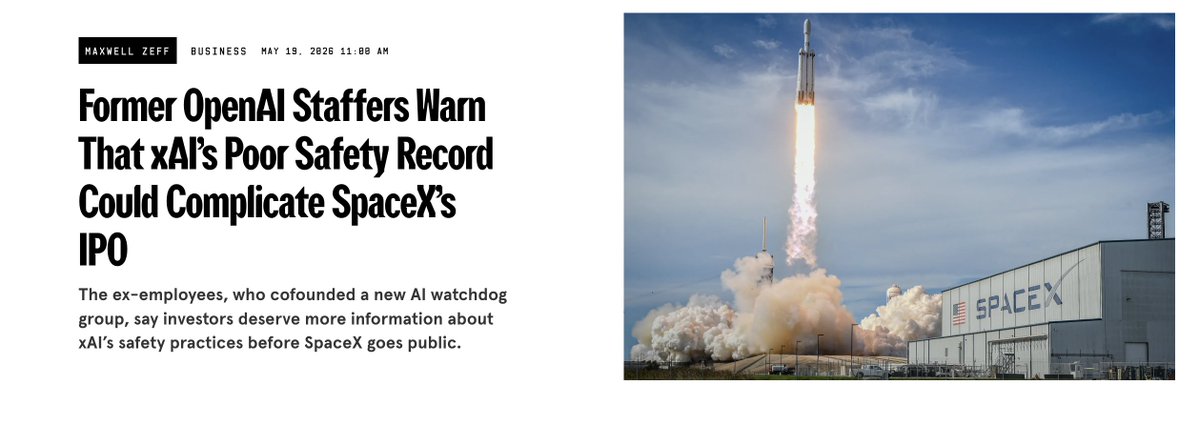
SpaceX is preparing to file what's expected to be the largest initial public offering in Wall Street history — and there are already red flags.
Ex-OpenAI researchers @sjgadler and @michaelhpage warn that xAI's poor safety record is a risk worth paying attention to.
#xai
New: Former OpenAI staffers and a group of nonprofits published a letter Tuesday warning that xAI could become a liability for the SpaceX IPO due to "unpriced risks" around safety.
They claim xAI's poor safety record could expose it to unique regulatory and litigation risks.
🚨 For the first time ever, workers at a frontier AI lab are unionizing.
Google DeepMind's UK staff announced a union today, following a deal with the US military announced last Friday. Over 600 Google employees had already signed an open letter to the CEO opposing the deal, but there had been no meaningful response from leadership.
Insiders at frontier AI labs are at the forefront of efforts to ensure the public is protected from unregulated AI development. That's why now more than ever, we need safe channels for workers to speak out collectively and without fear.
#AI #GoogleDeepmind #Techunion
https://t.co/whGxuICgqm
I fear we're in a shrinking window where staff voice inside AI companies is still very important.
As AI automation starts to displace human workers within the company, I unfortunately expect staff power to decrease
At 10 pm on a weeknight, a software engineer biked home through San Francisco and sent their boss a message that couldn't wait until morning.
It was about doing more community-focused work, specifically AI evaluations for communities that never get a seat at the table where these systems are built. The boss was encouraging. Within months, they'd landed nonprofit contracts to do exactly that work.
That was then.
In our latest Substack piece, an anonymous startup engineer talks about what happened next — how idealism to do social good quietly erodes within a structure that was never designed to support it, why startup workers are often harder to organize than their big tech counterparts, and what it would actually take to change things from the inside.
If you want to understand what's actually being built in San Francisco right now, this one's for you.
🔗:https://t.co/F9UdMDlgtF
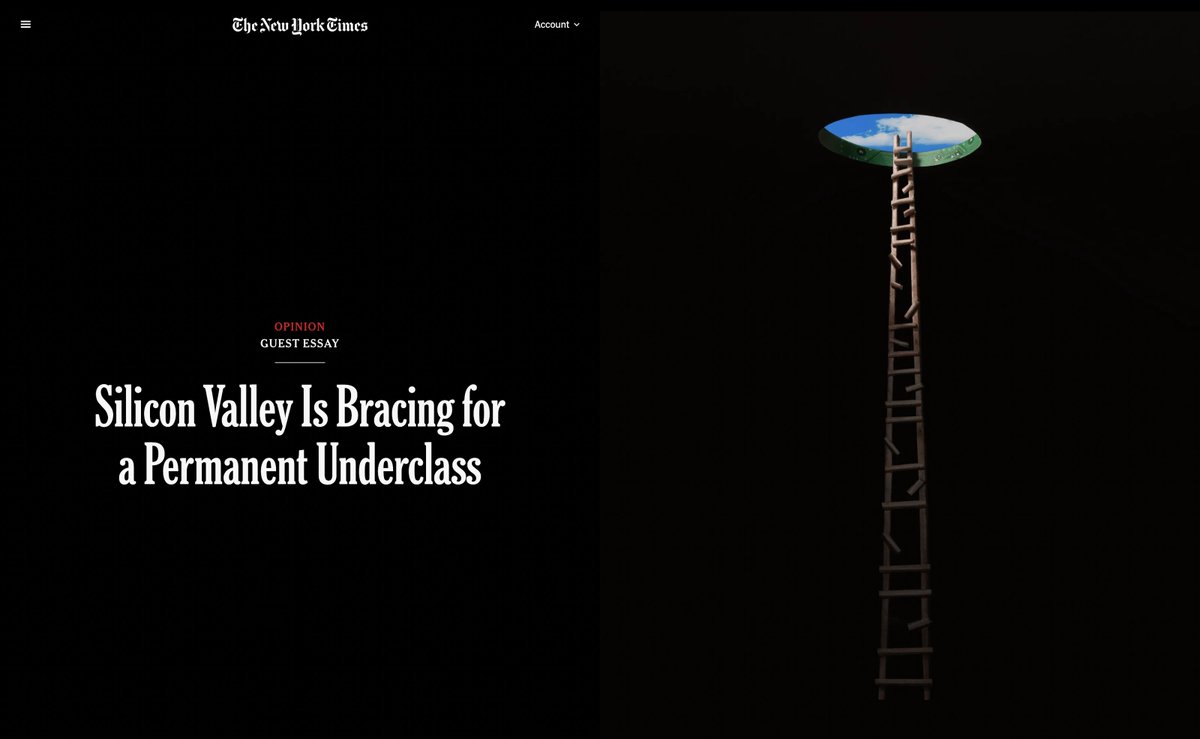
Most people I know in AI think the median person is screwed, and they have no idea what to do about it.
I spent the last 3 months talking to dozens of researchers, economists, and policy experts about AI's impact on work; including reps from every frontier lab and several Congressional offices. Unfortunately, I was not reassured.
The AI industry is raising the alarm, but can't change course. These companies' core business model relies on the disruption they are warning about: their faith in full automation only makes them go faster.
Policymakers are waking up, but still paralyzed by data and debates. Econ wonks disagree on plenty, but even the limited scenario looks like a "painful transition" that will disempower millions of workers.
But an "underclass" is not inevitable, but rather a societal choice — and one we can and should stop. Instead of waiting for impact, we should start planning now to support workers through AI disruption. Whether policymakers can assuage concerns about economic security may determine if we get to reap AI's gains at all.
New from me for @NYTOpinion. I put a ton into researching what I think may be the biggest topic of the year, so hope you read it (gift link here!) https://t.co/NiGJpjyjzH
OpenAI is lobbying for a bill that would shield them from liability if their AI kills.
A bill in Illinois — SB 3444 — would protect AI companies from lawsuits even when their technology is used to cause mass casualties. We're talking 100 or more deaths, or a billion dollars in damage.
And what would they have to do to keep that protection? Simply prove they didn't mean for it to happen — and post their own safety framework on their own website. No third-party audits. No external oversight. Just their word.
This isn't new behavior, though. OpenAI previously fought California's SB 53 and SB 1047 — two bills that would have held AI labs directly accountable for catastrophic harm.
Even Anthropic has come out against SB 3444, calling it a get-out-of-jail-free card — and drawing a new fault line in the industry over who should actually be held responsible when AI causes serious harm.
Because that's the real question underneath all of this:
If an AI system is used to kill people — who's on the hook?
Right now, OpenAI's answer seems to be: not them.
If you work in AI and see something concerning...
Go to https://t.co/Ponr6MhgBm.
#OpenAI #AI
Google employees are stepping up.
Hundreds signed a letter to their CEO refusing a classified AI deal with the Pentagon — demanding their work not be used in "inhumane or extremely harmful ways."
AI workers are increasingly carrying the ethical weight their companies won't.
But classified deals will only silence them further. We need safe, secure channels for employees to get vital information to the public — before it's too late.
https://t.co/ol6lqFGVs4
More than four million people have canceled their ChatGPT subscriptions.
College students are ditching ChatGPT for the dancefloor, millions are canceling their subscriptions, and some are taking to the streets — we spoke to the folks behind the QuitGPT movement, convincing them to do it all.
@quitchatgpt is what happens when enough people feel deep unease about who is building AI and why, and lose faith that the usual channels for holding powerful companies accountable are working.
We spoke to the organizers to find out how it started, what it's achieved, and what it would take for them to stop.
The piece is live now on our new Substack.
🔗: https://t.co/yulOh1Z9Wq
Meta's new "Model Capability Initiative" plans to record every click and keystroke on employee computers to train autonomous AI agents.
Meta says the data won't be used for performance assessments or to collect sensitive information, but for a company with a well-documented history of whistleblowers, that promise warrants skepticism.
If every action is tracked, where does that leave the space to act outside the corporate gaze — whether that means raising concerns internally or sharing information in the public interest?
There's also a hard irony here: employees may be monitored while training the very AI agents that could one day replace them.
The U.S. still lacks meaningful federal limits on worker surveillance. Without them, the race to build AI workforces may come at the cost of the safe channels employees need to speak up.
#AI #Meta
📎: https://t.co/RMpXXVW6lk