50 active users on TruestEdge today. small milestone but every single one is a real polymarket or kalshi trader actually using the tool. thanks to everyone who's been testing and sending feedback. on to the next one.
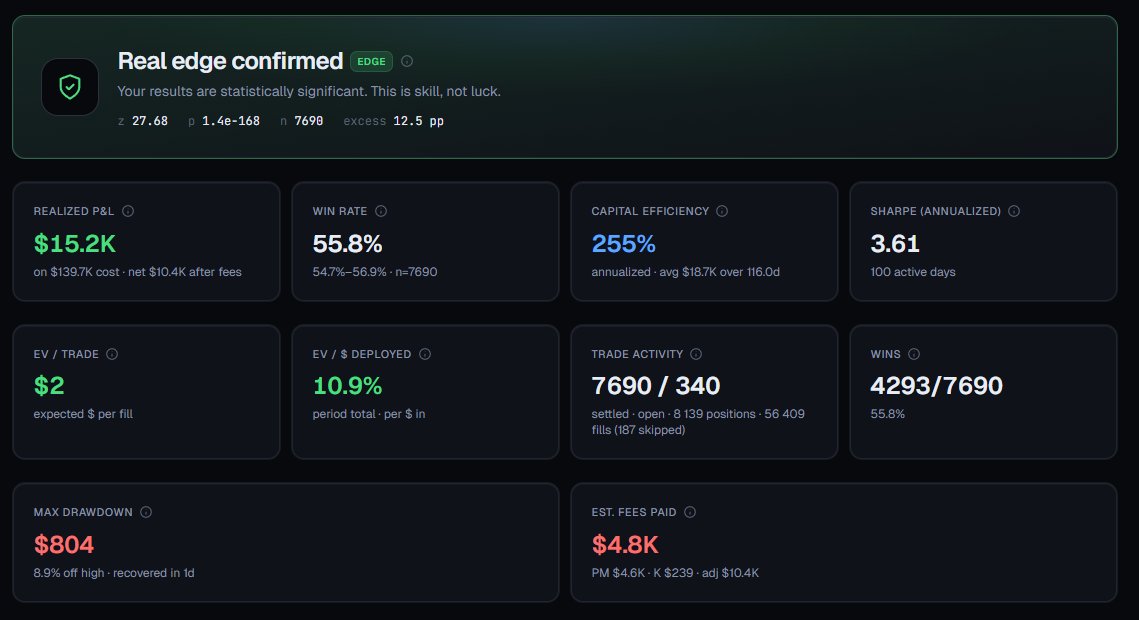
I analyzed a Polymarket weather trader.
The numbers are unreal:
6,967 bets · 56% win rate · +$15.2K P&L
z-score = 27.68. p < 1e-168.
This isn't luck. Here's how he does it 🧵
Just unlocked my Gas ID via ETHGas 🪪
I'm a Teen Jack with 0.4098 ETH spent on gas since Beacon Chain - now fueling my climb to the Gasless Future and earned 120 Beans already.
Reveal yours at https://t.co/NVBycSDVEf
Just unlocked my Gas ID via ETHGas 🪪
I'm a Teen Jack with 0.4098 ETH spent on gas since Beacon Chain - now fueling my climb to the Gasless Future and earned 120 Beans already.
Reveal yours at https://t.co/NVBycSEttN
ADL is a relic of isolated margin systems copied from @BitMEX. It doesn’t work for options, and at best is a terrible experience for cross-margin users.
Paradex deliberately chose not to implement ADL.
It breaks cross-platform hedges, adds a lot of unpredictability to users’ risk management, and fails for complex assets and portfolio-margin setups. There’s also no guarantee of finding profitable ADL counterparties under cross margin, without further amplifying liquidations. @DeribitOfficial also operates without ADL.
Socialized loss (SL) is a far better experience for users and scales easily to more complex assets and margin types 👇
Portfolio-Level Integrity
ADL operates at the single-market level, without considering the user’s overall account exposure. The trader who is high on the ADL queue due to a highly profitable/leveraged position on one market isn't necessarily profitable on an account level.
Example:
BTC = $100,000, ETH = $4,000
Insurance Fund (IF) = $100,000 collateral + short 40 BTC perps.
Alice has a $4M BTC-ETH spread on, i.e. +40 BTC perps (long) and –1,000 ETH perps (short)
→ Both BTC and ETH rally +5%
→ BTC to $105,000, ETH to $4,200.
Under a normal scenario, Alice’s BTC and ETH positions offset, leaving her with flat PnL. But the insurance fund’s bankruptcy price is $102,500. To protect the fund, ADL is triggered and forces Alice’s BTC leg to be closed at $102,500 as it cannot afford a loss that is higher than $100,000. Alice realizes BTC profits based on a 2.5% move while her ETH short continues to lose 5%, leaving her with a $100,000 loss. This can, in theory, lead to an unfair liquidation of Alice's account.
"Ethena" Risk
The same is true for a trader that could be holding the opposite position on a different exchange. If the position is subject to ADL, it closes the profitable leg, leaving the user with a naked losing leg. This destroys the intended hedge and amplifies risk exposure. @ethena smartly negotiated this provision away for it's trading on CEXs but that now means the risk of ADL is being unfairly borne by the exchange's other users. Smart for Ethena but not scalable for the exchange.
Given the potential market exposure imposed on affected accounts, ADL often triggers a forced unwind of positions, leading to fire-sale behavior that further amplifies market volatility and erodes liquidity.
This mechanism is particularly unsuitable for exchanges with options, where users frequently hold multiple correlated instruments on the same underlying asset for hedging or risk-neutral strategies. In such environments, forcibly closing a single profitable leg through ADL can break portfolio hedges, destabilize the portfolio and, by extension, the market.
To our knowledge, NO EXCHANGE discloses how cross-instrument exposures are handled under ADL.
Conditional + Reversible
Under a SL mechanism, losses are conditional, deferred (not immediately realized) and give users a choice. They are applied only upon withdrawal, and only if the platform is still experiencing a solvency deficit at that time.
If the market rebounds, or if the insurance fund grows (either through profitable liquidations or additional allocations) and covers the deficit, the shortfall is erased and no SL is applied.
By contrast, ADL crystallizes losses instantly and doesn’t give the user a choice. If a sudden market move causes insurance fund depletion, the system immediately closes profitable positions via deleveraging. Those users now permanently lose their realized profits.
SL introduces time, and recovery potential into the loss-allocation process while giving users a choice. It penalizes only those who exit during insolvency, while long-term users benefit if solvency is later restored.
Fair + Predictable Risk Distribution
ADL targets specific traders (often highly leveraged and profitable ones), forcibly closing their positions to cover the platform shortfall. It penalizes traders for system-level insolvencies outside their control.
SL by comparison avoids arbitrary targeting and maintains fairness. All users share the risk evenly and only when a persistent shortfall exists.
Transparency
ADL is a complex, queue-based mechanism that is very hard to anticipate for users. In contrast, a SL adjustment is a simple, transparent function of the insurance fund shortfall relative to the platform’s TVL. As it affects users only when they withdraw, it ensures predictability and transparency in the loss allocation.
Compute Efficient = "Chain Friendly"
SL simplicity makes it straightforward to implement on-chain in a trustless manner. There is less compute complexity which means cost and throughput constraints are alleviated. ADL’s dynamic queue logic is computationally heavy as it requires scanning all accounts on the platform, making it very expensive and error-prone. It also adds congestion to a system that is likely to already be congested when ADL is triggered.
October 10 = Wake Up Call
If your CEX can’t guarantee portfolio integrity under stress, it’s the architecture that’s broken. Switch to DEXs with intelligent loss-allocation that protects hedges, distributes risk fairly while staying conditional and predictable.
Paradexio
I will never turn my back on @Lighter_xyz
I see all this hate on X - it was already there from with .hl guys, and now they’ve got another reason to amplify it
But I’m glad that the people with 🕯️ remain loyal, because a true friend is tested in hard times
Love you fam!