It's been interesting and puzzling to witness the problems with accuracy in UK economic statistics over the past few years. (See the links in the next tweet for more.) It seems that the Office for National Statistics, ONS, now struggles to effectively measure basic figures such as employment, trade, and inflation. This resulted in a quite scathing government report published last summer, where Robert Devereux, a former permanent secretary, concluded that "most of the well-publicised problems with core economic statistics are the consequence of ONS’s own performance."
There's a lot of discussion about the travails facing the UK these days (including this big piece in The Atlantic a few weeks ago[1]), and the problems with the ONS feel like an unsettling microcosm of diffuse decline in broader institutional competence.
Anyhow: at Stripe, we became curious about the UK's published entrepreneurship data. While we observe a boom in many parts of the world, official figures don't show a similar increase in the UK. In the latest Stripe Economics post, we dug into the data, and, as far as we can tell, the official figures are probably misleading. The good and the bad news (mostly good, I think!) is that the UK is almost certainly witnessing an unmeasured boom in entrepreneurship: https://t.co/R7oTZNmxc6
UK-specific issues aside, I suspect that this measurement question is illustrative of forthcoming econometric challenges. Keeping the world's macro indicators up-to-date in response to the faster-than-usual changes wrought by AI will be both increasingly difficult and increasingly important in the coming years.
[1] https://t.co/OAnwRmpyON
There's a fascinating essay on what film does to the picture by @steveyedlin https://t.co/nP47N0ZpmS
The reason for scanning the film therefore would be not to bypass CCD, but rather to introduce film at some point instead of correcting precise camera's CCD data later on
@BestMovieMom I'll be impressed when they edit on film. All this changes is the time the CCD is not used, not IF it is used. It's still scanned to digital before editing...
@PhilipGreenspun Here in London often seems that drivers are too tired and driving slower allows to pay less attention to the road, possibly allowing to work more hours
@FireSourcery I think authors have real experience, but the ones I read tend to give patterns and don’t really teach how to reason about which are appropriate in any specific case
@RossLydall Where I’ve personally seen the RBKC enforcement officers at work this was very sensibly applied (like stopping cyclists accelerating to 30mph+ when going downhill on a narrow pavement of the West Cromwell rd bridge).
Fascinating story of how power supplies got small and light in the 80s when MOSFETs were invented and how GaN made them smaller 3x in the last few years https://t.co/Gv1t2zOpPA
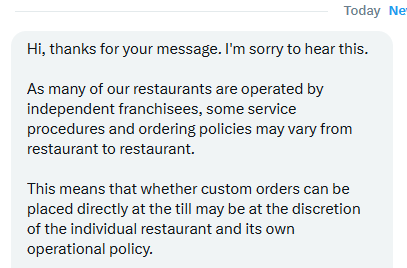
Been told in a McDonalds today that the legendary customization policy (still advertised on the website https://t.co/TknuutShx1) was quietly phased out as a company-wide policy - confirmed by @McDonaldsUK
End of an era
Ray Kroc used to drive around unannoced to McDonalds stores and ate few burgers a day (while counting burger wrappers in competitors trash to gauge their sales).
Current McDonald’s CEO Chris Kempczinski looks like he gonna hurl after eating new Big Arch.
Built my own claw in a day 🦞
- runs isolated in Docker, so I can safely run it on my machine - no need for a Mac Mini
- has access to mounted folders with my mac so it can still edit docs, write code, etc but can't run anything malicious unlike openclaw
- 1200 lines of typescript: it can easily understand and extend itself via claude code
@nick_tikhonov I added voice message recognition and remote HTTP MCP support (the bundled seemed to be STDIO only?). Would sharing the fork be useful? Sounds like the whole idea is to keep it minimal
@anthonyrose They’re very thin and I imagine having air conditioning fed by the turbine fan/compressor doesn’t help. Having said that, 90db is still much more that I would’ve expected
Alright, so this blew up.
Correct answer: Left one.
The majority of folks got it wrong
It also got us:
- 3% higher conversion to paid
- 17% higher ARPU
- 33% higher MRR
What a surreal read: Wikipedia founders @jimmy_wales and @lsanger are being told by the editors that the neutrality policy they themselves wrote doesn't mean what it says https://t.co/s1k9DMjJJ2
2. Enable competing articles.
Since true neutrality is impossible under the current editorial monopoly, Wikipedia should allow multiple competing articles written from different declared perspectives, each striving for neutrality within its framework. Let people write alternative articles.
Wikipedia: https://t.co/hopC9aV5Js.
https://t.co/Rb0Z47Y1li:
https://t.co/0c3QVZax4p
Had the 'Grokipedia' idea two years ago once LLMs became better at summarising sources than most Wikipedia editors. The tricky issue was that a better mechanism to select and weigh sources would be required. It's not clear how one gets to truthful representation of the world.
Join @xAI and help build Grokipedia, an open source knowledge repository that is vastly better than Wikipedia!
This will be available to the public with no limits on use.





![patrickc's tweet photo. It's been interesting and puzzling to witness the problems with accuracy in UK economic statistics over the past few years. (See the links in the next tweet for more.) It seems that the Office for National Statistics, ONS, now struggles to effectively measure basic figures such as employment, trade, and inflation. This resulted in a quite scathing government report published last summer, where Robert Devereux, a former permanent secretary, concluded that "most of the well-publicised problems with core economic statistics are the consequence of ONS’s own performance."
There's a lot of discussion about the travails facing the UK these days (including this big piece in The Atlantic a few weeks ago[1]), and the problems with the ONS feel like an unsettling microcosm of diffuse decline in broader institutional competence.
Anyhow: at Stripe, we became curious about the UK's published entrepreneurship data. While we observe a boom in many parts of the world, official figures don't show a similar increase in the UK. In the latest Stripe Economics post, we dug into the data, and, as far as we can tell, the official figures are probably misleading. The good and the bad news (mostly good, I think!) is that the UK is almost certainly witnessing an unmeasured boom in entrepreneurship: https://t.co/R7oTZNmxc6
UK-specific issues aside, I suspect that this measurement question is illustrative of forthcoming econometric challenges. Keeping the world's macro indicators up-to-date in response to the faster-than-usual changes wrought by AI will be both increasingly difficult and increasingly important in the coming years.
[1] https://t.co/OAnwRmpyON](https://pbs.twimg.com/media/HNMWtDsbwAEG7Lo.jpg)