New paper from the lab. Using AI-guided modeling and experiments, we identified a hidden allosteric pocket in the cancer kinase PKMYT1. Led by @NHerrington24 in collaboration with @LazarusLab https://t.co/TOVfd0tesd
Excited to share our work on ErbB receptors published today @CellCellPress! Using multicolor, photostable UCNPs, we perform long-term (>15 min) single-particle tracking of EGFR, HER2, and HER3, enabling direct visualization of dimerization in live cells. https://t.co/BZdJHyctl2
Join us Wed. 2/25 (after the blizzard 🌨️) for our Cancer Research Institute seminar series w/ Sara Buhrlage, PhD @DanaFarber. Her lab specializes in deubiquitinase (DUB) biology, building a chemical biology platform to discover and validate DUB inhibitors as therapeutic targets.
#CancerResearch #CancerBiology
RESEARCH | @thebioKIMist@JasonRCantor et al. (@Morgridge_Inst):
Differential localization of the hexokinase HK1 isoform compared to the HK2 isoform, explains the conditional essentiality of HK2 in cancer cells cultured in physiologic media.
https://t.co/9DluG7FUQZ
(1/8) Still wondering how low complexity intrinsically disordered regions (IDRs) guide transcription factors (TFs) to bind in genomes? Previous studies on sequence grammars; our new @MolCell paper takes the next step: de novo design of functional TF IDRs!
https://t.co/qJugw2V3qE
An excellent review of our recent paper on mitochondrial control of fuel switching – thank you!! The bottleneck of fat burning | Science https://t.co/Bi90o098nm
For nearly a century, we’ve asked: why do proliferating cells ferment glucose even when O2 is around? I’m thrilled to share our latest work @NatMetabolism, led by @thebioKIMist! Leveraging conditional essentiality in HPLM, we propose a provocative new answer to this classic Q 🧵
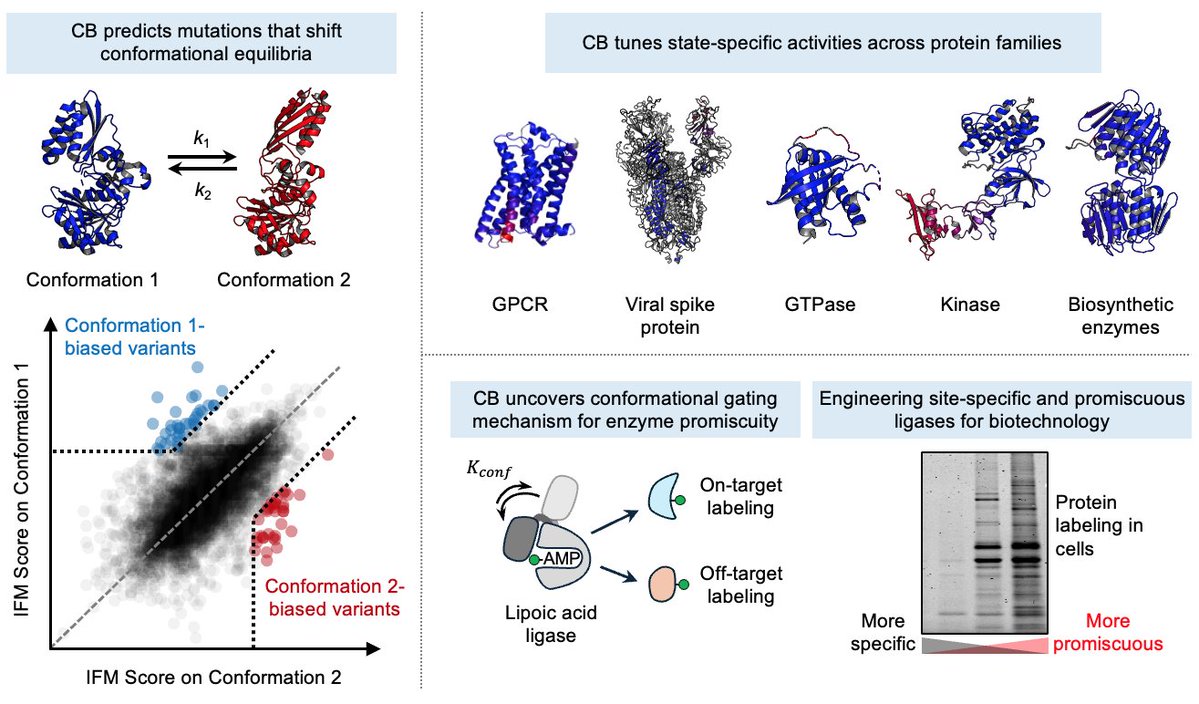
Can we design mutations that predictably bias proteins towards desired conformational states?
Today in @ScienceMagazine, we introduce Conformational Biasing (CB), a simple and scalable computational method that uses contrastive scoring by inverse folding models to identify conformation-biasing mutations.
https://t.co/lbWzHNdMRJ
I love this concept. Although framed around #aging research, I think it can extend beyond that. We can use a synthetic approach, to study basic principles of cell biology and potentially mitigate human disease by engineering unique bacterial enzymes. https://t.co/6RTAhFbElS
@VFCracan Agree ! We do the same for our favorite metabolic pathways . But hard to conceptualize how this could be streamlined as some enzymes need specific adaptation in human cells , and the readout for “screening” is not trivial . But definitely this is the way moving forward 🤓
New preprint out!
Deep Mutational Scanning of FDX1 Identifies Key Structural Determinants of Lipoylation and Cuproptosis
A quick twitorial 🧵https://t.co/lbHcRWG8Ir
➡️Join our upcoming BCDI discussions on the role of ferroptosis in autism led by Sundari Chetty @harvardstemcell and targeting apoptosis to overcome cancer chemoresistance led by Xingping Qin @HarvardChanSPH
Monday December 1st at 3PM @harvardmed Quad. https://t.co/uOJiL148QG
Exciting work from @LevKats and team showing a direct link between heme homeostasis and #cuproptosis and how heme depletion can naturally induce cuproptosis, highlighting a targetable vulnerability in AML. Well done 👏👏.
Inspiring talk by @KivancBirsoy today - great example of how functional genomics can uncover fundamental principles of cell metabolism, with a fascinating look at still-unresolved questions in mitochondrial redox regulation and the possible involvement of metals.
Live from our #CancerResearch seminar series, @KivancBirsoy@RockefellerUniv speaks about understanding the role of compartmentalized metabolism in physiology and cancer. There’s a lot of interest in this subject, thanks to everyone who came, there isn’t a free seat left!