Iran is on my mind:
My focus is on blockchain, ZK, cryptography and math. But some things are way bigger. Like what's going on in Iran.
After decades of oppression by a brutal and powerful autocratic regime, in which hangings, torture, lies and immense funding of Evil stuff all around the world, the brave Persian nation is standing up and saying NO.
They are doing so while risking their lives. And while they're doing this because they want a better life, if they succeed everyone in the region will benefit.
Persia is one of the most ancient and proud and important nations in History. And Cyrus the Great is widely recognized as the first proponent of Human Rights in History.
May the proud Persian Nation win in this, the most important battle of the 21st century.
I'm a hacker and AI researcher who has reported vulnerabilities to OpenAI, Google, and others. I wrote this guide as a reference of all of the ways that you can hack AI.
It has saved me hours. Bookmark this if you need a reference for what all to try (AND includes mitigations).
🎂 It's official: Bell Labs is one hundred!
It's hard to imagine what the world would be like without Bell Labs. Join us this year as we celebrate a hundred years of Bell Labs and look forward to the next century of innovation...
Discover more ➡️ https://t.co/kqGP65j7jx
Okay. Thanks for the nerd snipe guys. I spent the day learning exactly how DeepSeek trained at 1/30 the price, instead of working on my pitch deck. The tl;dr to everything, according to their papers:
An excellent update on folding schemes, including the full walkthrough of HyperNova by @0xAlbertG and @nico_mnbl!
HyperNova is an "early stopping" Spartan containing a single sum-check. The more recent NeutronNova stops even earlier requiring only a single round of sum-check!
the best way to get good at something is usually to just practice actually doing the thing in question.
a lot of very capable people outsmart themselves with complex plans that involve working a lot on fake prerequisites.
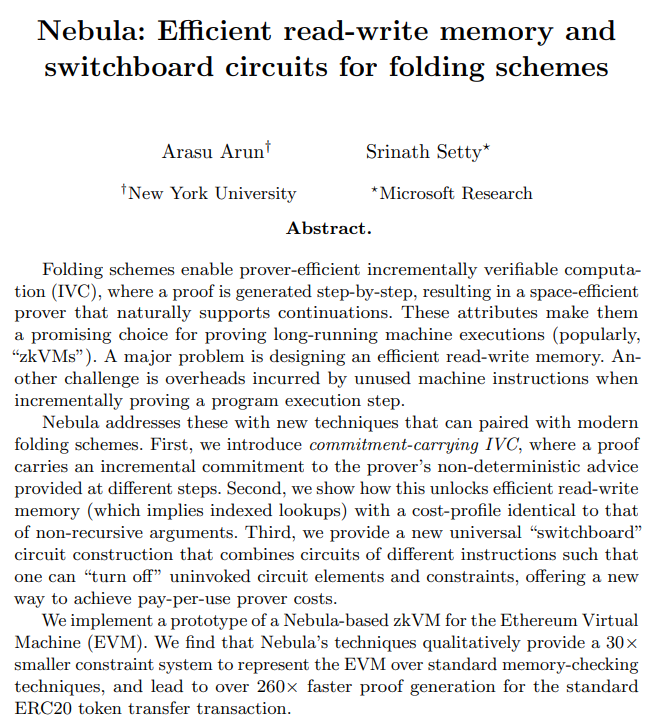
Complementary to NeutronNova, we wrote another paper, called Nebula. A core result is an efficient read-write memory primitive in folding schemes. We also provide a new way to acheive "pay-per-use" universal circuits, which "turn off" unused constraints in R1CS.
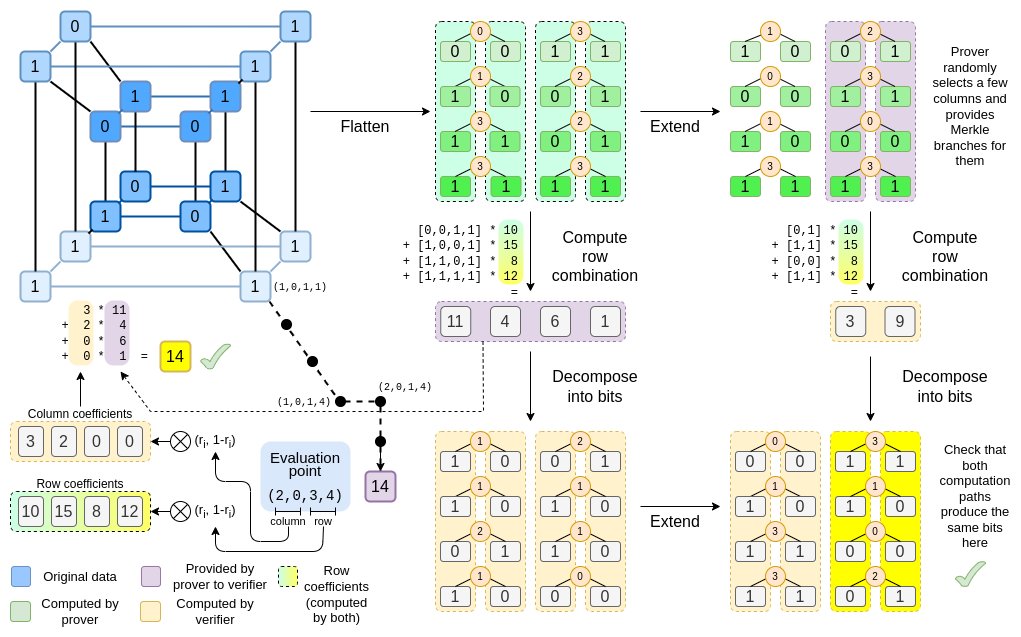
WHIR 🌪️: a IOP of proximity and multilinear polynomial commitment scheme with exceptionally fast verification time.
Joint work with @GalArnon42, Alessandro Chiesa and Eylon Yogev.
📚: https://t.co/fABAMldmOY
📄: https://t.co/PPUAwmqqBi
🧑🏻💻: https://t.co/9qwHbPWRgd
We verified a Nova+CycleFold proof onchain!, we're very happy ^^
These past months we've been implementing Sonobe in a joint effort by @0xPARC and @PrivacyScaling.
https://t.co/D1A2Qb2ufy
Verifying Nova proofs onchain in Ethereum is now a reality!
Our zk research team has been working on something super cool! It has potential to become the most performant zk[E]VM targeting at real time proving.
It combined the best parts of proving system, field choice and VM flow:
GKR parallelization +
Smaller field arithmetic +
Pay what you need at opcode level
It’s still an early draft describing the architecture, lots of work need to be done, benchmark is coming out soon. DM me if you are excited about GKR based proving system and want to contribute!
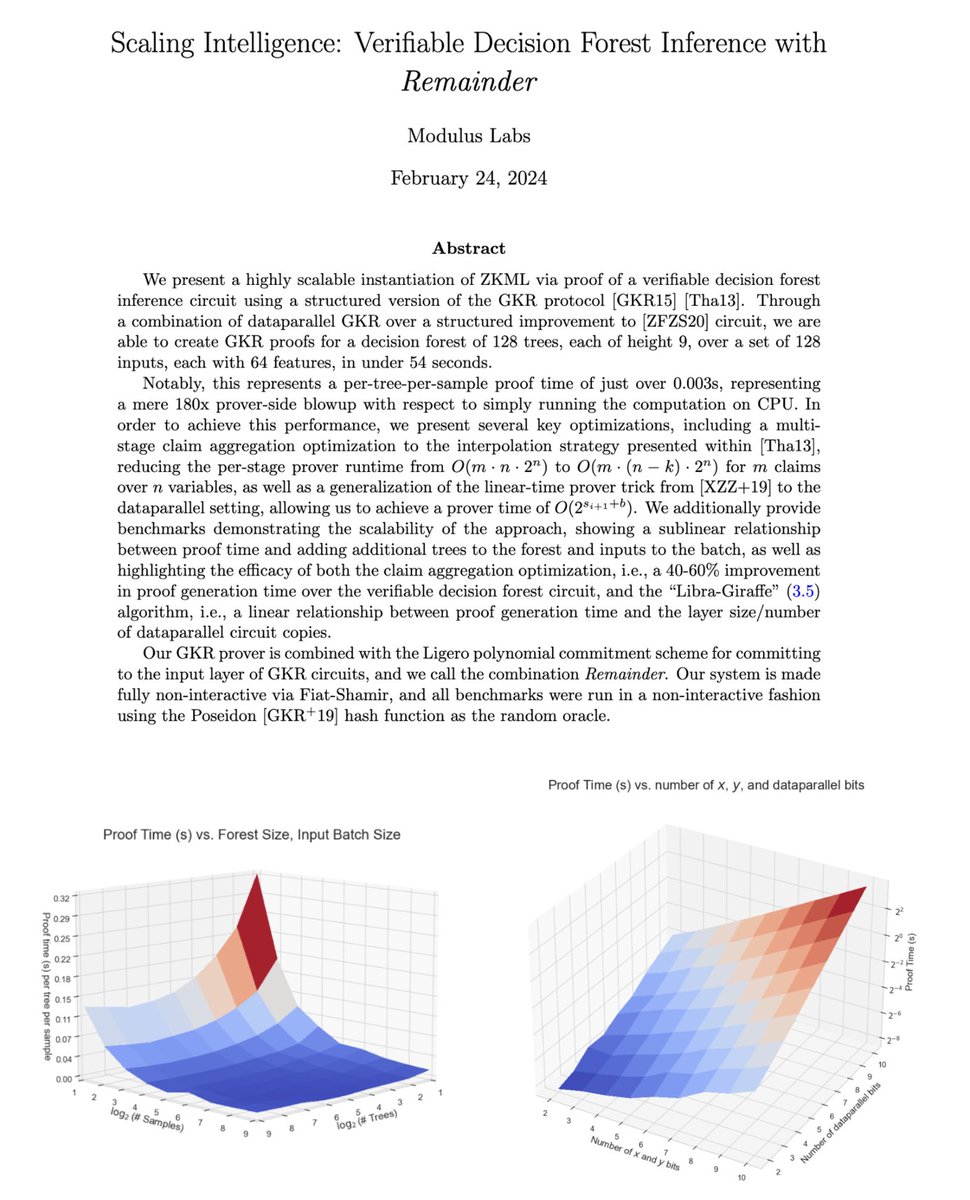
We're excited to unveil 𝑅𝑒𝑚𝑎𝑖𝑛𝑑𝑒𝑟—the world's most powerful ZKML prover
Our first implementation achieved a mere 180x proof generation overhead vs. the same (non-verifiable) computation on an M2 Mac.
Highlights below, read all about it here: https://t.co/nPqvYQ3UNQ 🚀
I'm back, did you miss me? I have some huge news!
Over the last year and a half, I've been working on something big in secret with the rest of the crypto security community. Today, we're finally ready to reveal ourselves to the world. We are @_SEAL_Org
1/ We are excited to announce Succinct Processor 1 (SP1), our first generation, 100% open-source zkVM that proves arbitrary Rust programs.
SP1 targets an order of magnitude performance improvement vs. existing zkVMs, and is already up to 28x faster for certain programs.
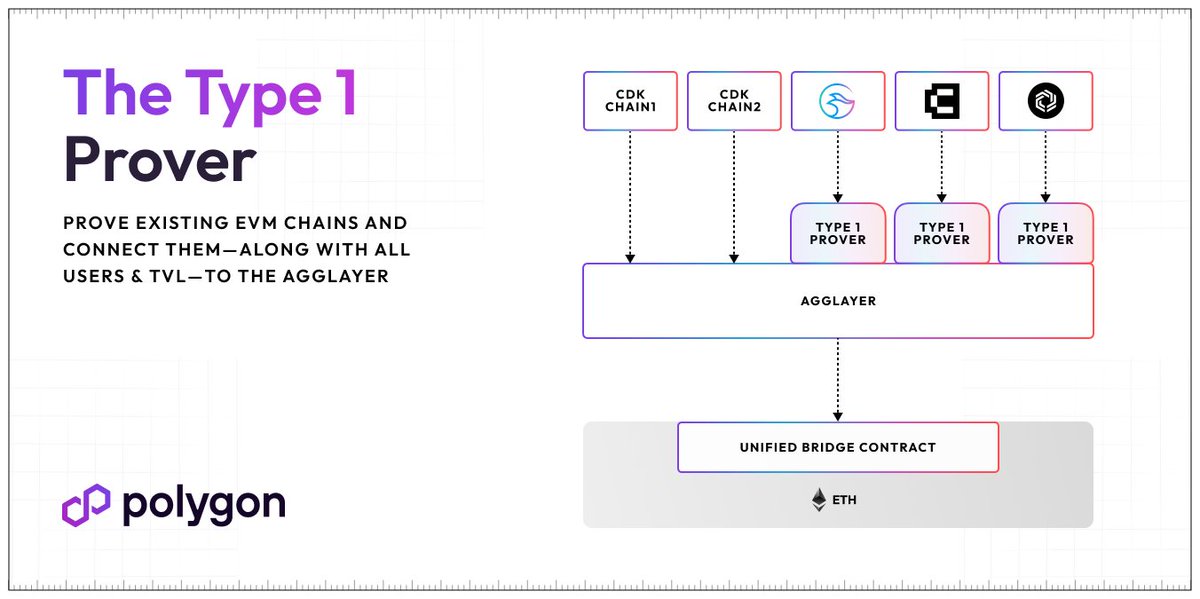
Releasing the Type-1 upgrade to the zkEVM prover, the next generation of Polygon’s proving tech. It can generate proofs for any EVM chain—sidechain, optimistic rollup, even Ethereum itself.
When proving Ethereum mainnet blocks, avg per-transaction costs are $0.002 - $0.003.
Developed with @Toposware, the Type 1 is open source and available today.
Together with the AggLayer, the Type 1 prover will allow EVM chains to upgrade to ZK and access the shared state, liquidity, and user-base of the Polygon ecosystem.
What makes it a Type 1? Ethereum equivalence. The Type 1 prover preserves all of Ethereum’s execution logic. In practice, this means that any EVM chain can become a ZK Layer 2, without having to fork or make modifications.
The Type 1 zkEVM prover will be another config available to projects building with Polygon CDK, the modular toolkit for spinning up ZK L2s. All chains building with the modular toolkit can leverage the Type 1 to connect to the AggLayer, while taking advantage of lower costs, lower latency, and better UX. Projects like @Immutable zkEVM, @MantaNetwork, and @CantoPublic are planning to do exactly this.
There are more performance optimizations and a Type 2 mode coming. Right now, the Type 1 can prove existing Ethereum blocks at an average per-tx cost of $0.002 to $0.003. With Plonky3 and additional zkEVM improvements, there will be a 30 to 50X reduction in cost over the next year.
Read on for use cases and in-depth performance benchmarks: https://t.co/jBiQZEC6FK