Ask me about the care gap in perinatal mental health, creator economy, deep tech, & no-code tools.
Founder @Haplocare. Runner, love animals, world citizen
I was asked by someone I met today that I need to share my story. Not because it is special, but because you never know who needs to hear it at this very moment. So even though it makes me darn uncomfortable and nobody might read this, here we go../1 #postpartum#mentalhealth
Life Hack: Embrace the embarrassment of being a beginner.
The only way to accomplish something meaningful is to endure days, weeks, months, or even years of embarrassing failure.
Every expert started out as a beginner.
Those who embrace the embarrassment will eventually win.
You can be an absolute monster with your ambition and work, and still be a decent human.
Abundance mindset.
Ambitious in your work
Generous when it matters...and
Not someone to mess with.
Found this years ago. Remains some of the most valuable advice I've ever seen.
If I were a business school professor, I'd have my students memorize it.
Being Brave takes so many forms - some visible publicly, and some of them in private - but all of them require you to choose against the "easy route."
Not defaulting to "easy," is a foundation to being exceptional.
When life gives you options - Do the brave thing.
Years ago, a mentor said to me: “It’s your job to have the highest quality standards of anybody you work with. Every day, you’ll face pressure to lower them. Don’t do it. If you can set a high standard and simply maintain it, you’ll do very well for yourself.”
What skills are compounding in your career?
Physics teaches us that sharp objects move faster.
The fastest trains have a pointy front car; the Concorde airplane needed an incredibly sharp tip to become the fastest commercial jetliner ever; narrowing your surface area is the best way to dive deep into a swimming pool; and even the blinding light of a laser comes from a concentration of energy.
You only need to be good at a few things to be immensely successful. The more focused you are, the easier it is to become world-class at whatever you commit to.
Early in your career, it's okay to scatter. Try things. Read a bunch of books. Take on a bunch of projects. But expend energy so that you can eventually find the few things you do exceptionally well. But the experimentation phase has to end eventually.
@FoundersPodcast has a good line on this: "A novice is easily spotted because they do too much."
They’re scattered, frantic, and unfocused because they’re afraid to slash the parts of their life that don’t align with the desires of their heart, how they can uniquely serve society, and how God wants them to live. And so, they reject the core of who they are for the mirage of short-term productivity.
Working intensely feels joyful and nearly effortless once you find the right thing. Even if there are moments of willpower, there’s almost none of the teeth-grinding you’re trained for in school, and you can cut down on how much coffee you’re slugging every morning.
The goal isn’t to retire on a beach somewhere. No, that's a recipe for lifelessness, purposelessness, and the haunting chills of misery. Rather, the purpose of a career is to find the skills you want to compound and never stop doing them.
Every smart person should have a good answer to the question: “What advantages are you compounding in your career?”
You get a maximum of three. Here are mine:
1) Written and spoken communication.
2) Domain expertise in online writing for smart, ambitious, and high-agency people.
3) A large and loyal online audience to amplify the first two.
Narrow your focus until your head, heart, and wallet are aligned. Doing less leads to exponential gains in how well you're able to do the things you commit to.
I think the only way for anyone to stand out these days is to focus all of their time, attention, and creativity on really doing dope shit and then sharing said dope shit with the world.
- @_coleschafer
Most runners run not because they want to live longer, but because they want to live life to the fullest. If you’re going to while away the years, it’s far better to live them with clear goals and fully alive than in a fog, and I believe running helps you do that.
-Murakami
A Brit accepting a compliment:
“I like your coat”
“What? This old rag? Don’t be silly. It cost 2p. I’ve had it ten years. I found it in a bin. It’s a load of tat. Thank you, though!”
Every time I read @harukimurakami_ 's "What I Talk About When I Talk About Running", it reveals a new insight that escaped me the last time.
How is that even possible <shaking my head>?
It is *the* definition of a good book: every time you read it, it opens up a new door!
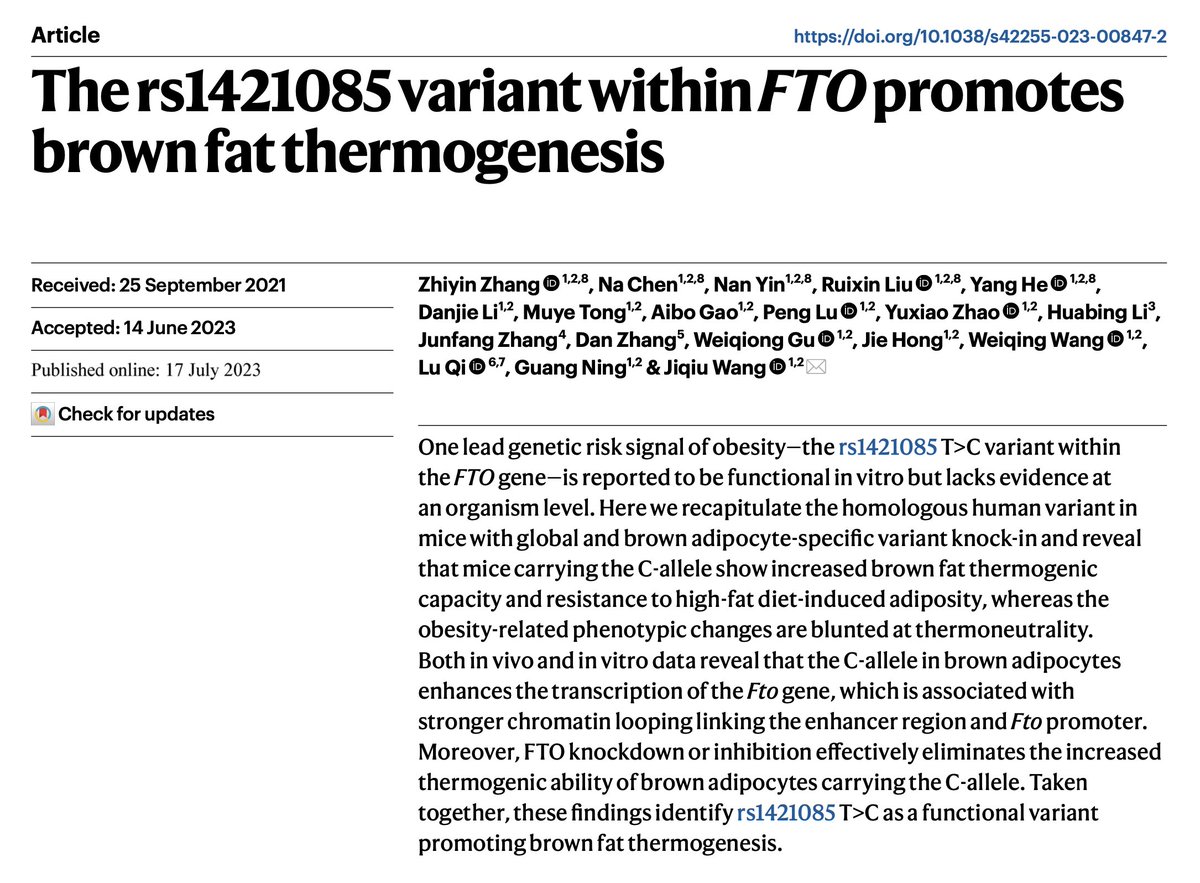
Buckle up! We're in for a wild ride today. A new @NatMetabolism paper by scientists from China adds a surprising twist to the long-known FTO GWAS story.
The FTO locus (16q12.2) is the first ever GWAS locus to be associated with obesity and even after 16 yrs now, scientists appear to be scratching their heads trying to make sense of this locus. Non-coding intronic variants within FTO strongly associate with BMI, where individuals homozygous for the top risk variant weigh ~3kg more than non-carriers (https://t.co/vh4ceXVQaQ).
Since its discovery in 2007, there have been tremendous efforts to identify the causal gene(s) at this locus. Given that the risk variants are sitting right within a gene, FTO was of course the primary suspect. How do you find out if FTO has an effect on BMI? Delete it in mice and see if the animal gains weight. And that's what scientists did and found out that Fto knockout mice were stunted and lean, and the leanness was mainly due to burning too much fat (https://t.co/DkKIGLvD0P). That's great. So FTO must be the causal gene.
But then contradicting findings appeared. If you knock out the Fto only in adipose tissue (https://t.co/W5A8JwT2Hx) or globally after the animal has grown (https://t.co/uJ69bO8A9x), the mice actually gain weight!
Amidst this confusion came an even bigger one: two landmark papers, one in Nature (https://t.co/Kq3uqKrAg1) and the other in NEJM (https://t.co/Ztqf4FTOYT), said, forget about FTO, the causal genes are located far away. The FTO locus is an enhancer that folds in the 3d space and touches the promoter of distant genes IRX3 and IRX5. And deleting Irx3 in mice resulted in weight loss.
Then scientists were like, you know, a proper experiment would be not to knock out Fto or Irx3, but to delete the homologous noncoding region in mice. So, they deleted an 82 basepair-homologous region in mice and showed that without this region, the mice don't gain weight when fed with a high-fat diet, and deleting this locus increases Irx3 and Irx4 expression (https://t.co/NFFL2OQNL8). So, the causal genes are IRX3 and IRX4 then.
And now, in the current paper, the scientists argue, you know, the most appropriate way to study the FTO locus is to recreate the exact genetic variant in mice and study the consequences.
What did they find? The exact opposite of what was found in humans. The risk allele that increased weight in humans, decreased weight in mice. Can it be because of some off-target effects of the CRISPR experiment? No. Even if you do the knock-in in an old-fashioned way, the results are the same. The weight loss is mainly via over energy expenditure via brown adipose tissue. Wait, there is another twist.
There is an interesting difference between humans and mice. Humans have brown adipose tissue only during infancy and then lose it as they grow into adults, which isn't the case in mice. The brown adipose tissue helps mainly during cold temperatures. The experiment mice are usually housed at around 20-22 degrees Celsius, which is an ambient temperature for humans but not for mice. It's substantially cooler than mice's "thermoneutral zone (29-31 degrees)".
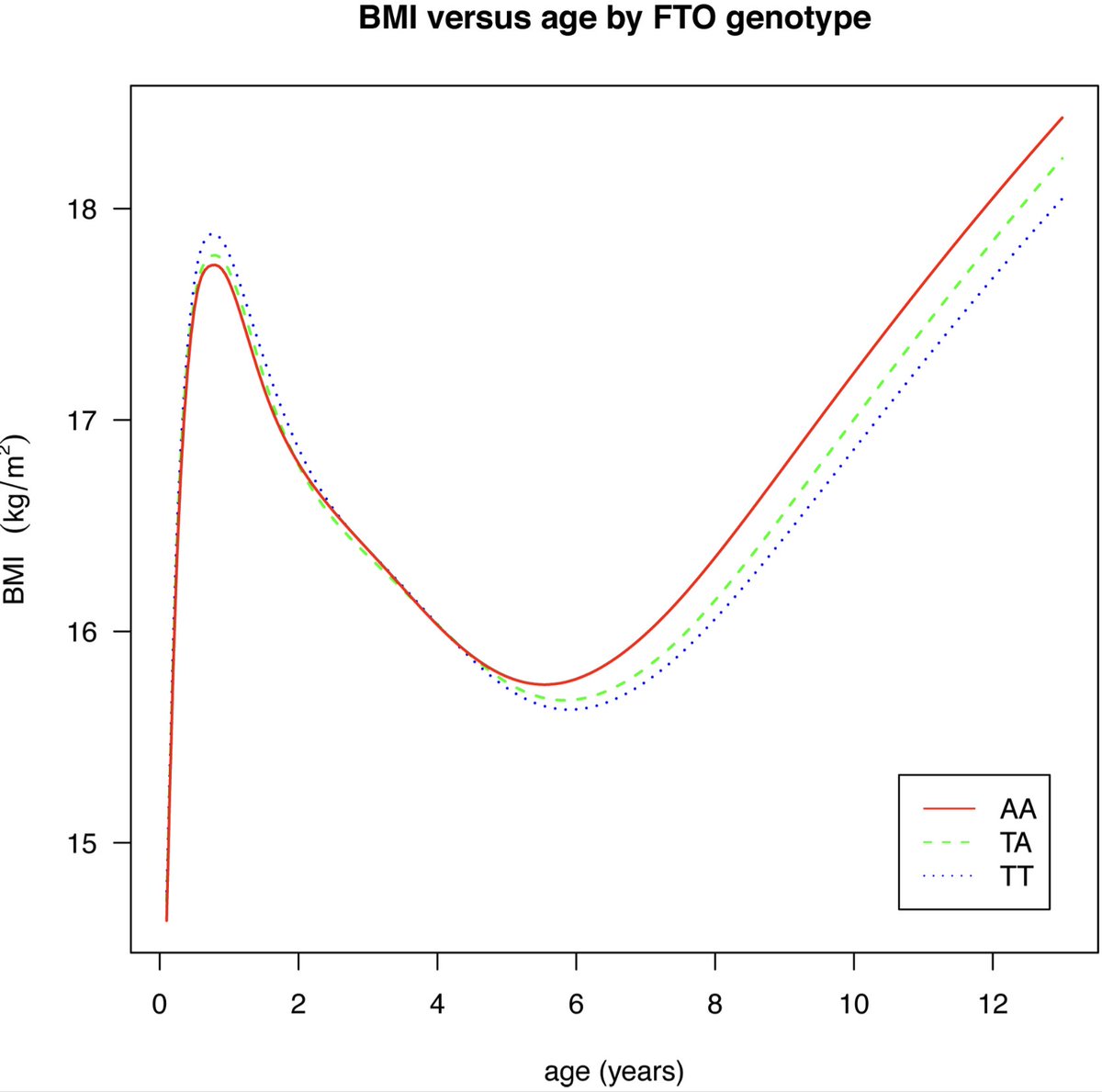
So what happens when you repeat the experiments in what might be the mice's ambient temperature--30 degrees? All the weight loss effects that were previously seen at 20-22 degrees are now blunted. So, the FTO locus effects are strongly dependent on two things: temperature and the presence of brown adipose tissue. And it turned out, in fact, it was previously shown in humans that the FTO variant has an age-dependent effect. It lowers the body weight in infants and then increases the body weight in adults, which aligns with the current finding. (https://t.co/S7iKVj0p5d)
Overall, the current paper is an impressive work and will stand as a landmark in the long twisty road of FTO story. But above all, this paper is a remarkable example to show case the challenges behind translating mice physiology to human physiology.
https://t.co/i8IIr2bSFc