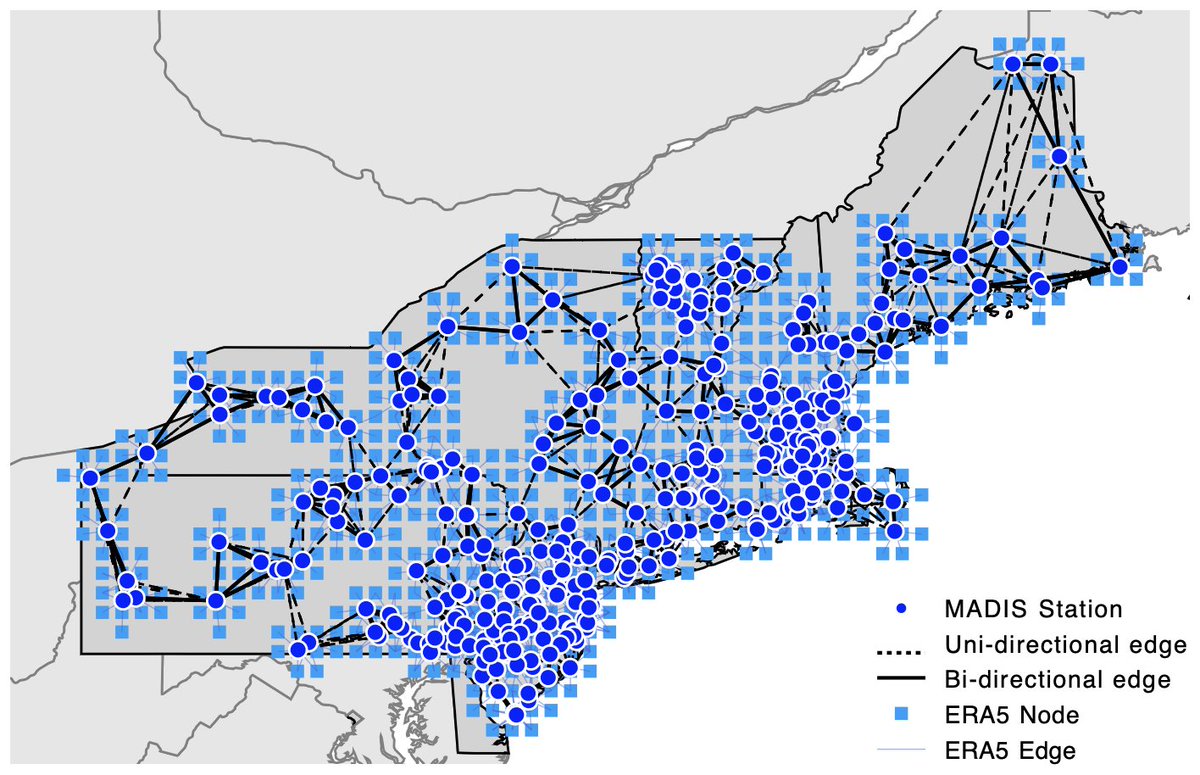
Thrilled to unveil our latest work: multi-modal machine learning to forecast localized weather! We construct a graph neural network to learn dynamics at point locations, where typical gridded forecasts miss significant variation.
Paper: https://t.co/bH8xLVd4hH
🧵
I'm excited to share that I will start as an assistant professor at the Université de Montréal @UMontrealDIRO and @Mila_Quebec in January 2025.
I'll keep doing machine learning research for climate and health applications: materials discovery, drug discovery and more!
Hiring 👇
Who is this climber?
And what was her great ICLR poster about?
Read our full review in the latest Computer Vision News:
https://t.co/1CtC8fCTwi
Meet the scientist behind the science!!!
#ICLR#MachineLearning#womeninSTEM
We have an ML engineering internship available in my group at @Mila_Quebec for our work on monitoring insect biodiversity! Details here: https://t.co/SulpnGhR41
Excited to be on my way to ICLR. Presenting 3 times
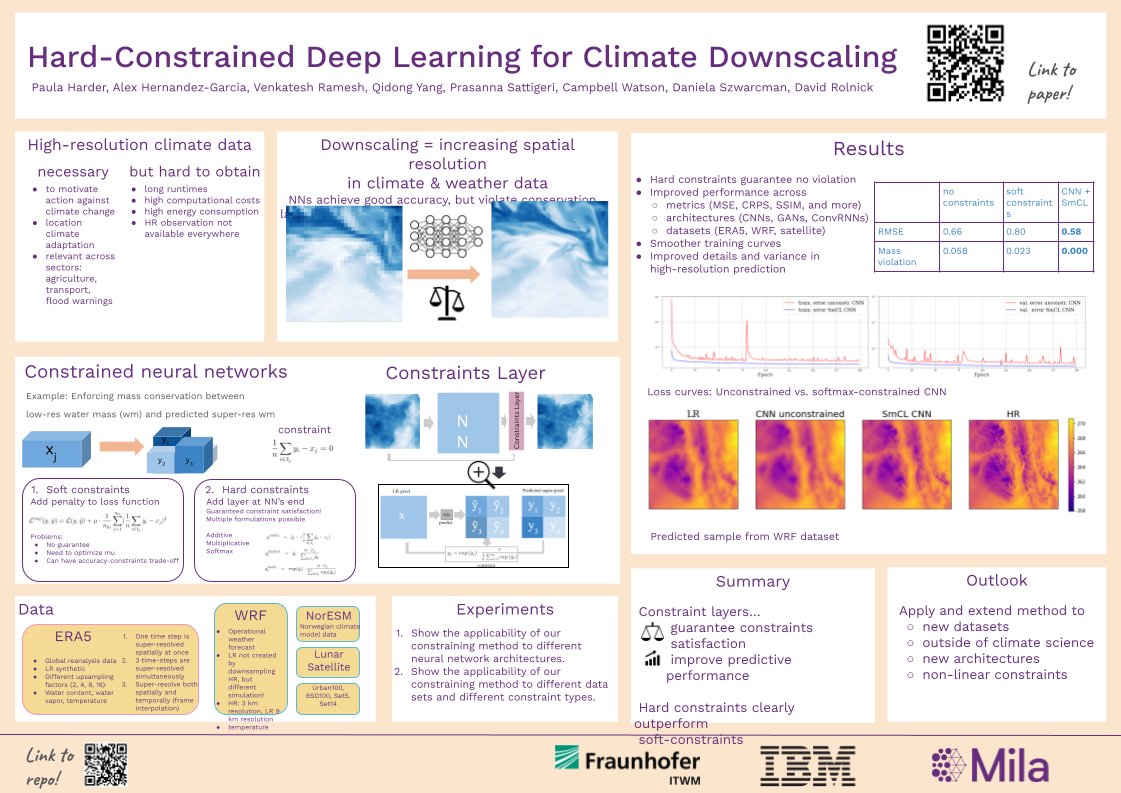
1. Poster “Hard-Constrained Deep Learning for Climate Downscaling”, Tue 4.30-6.30pm
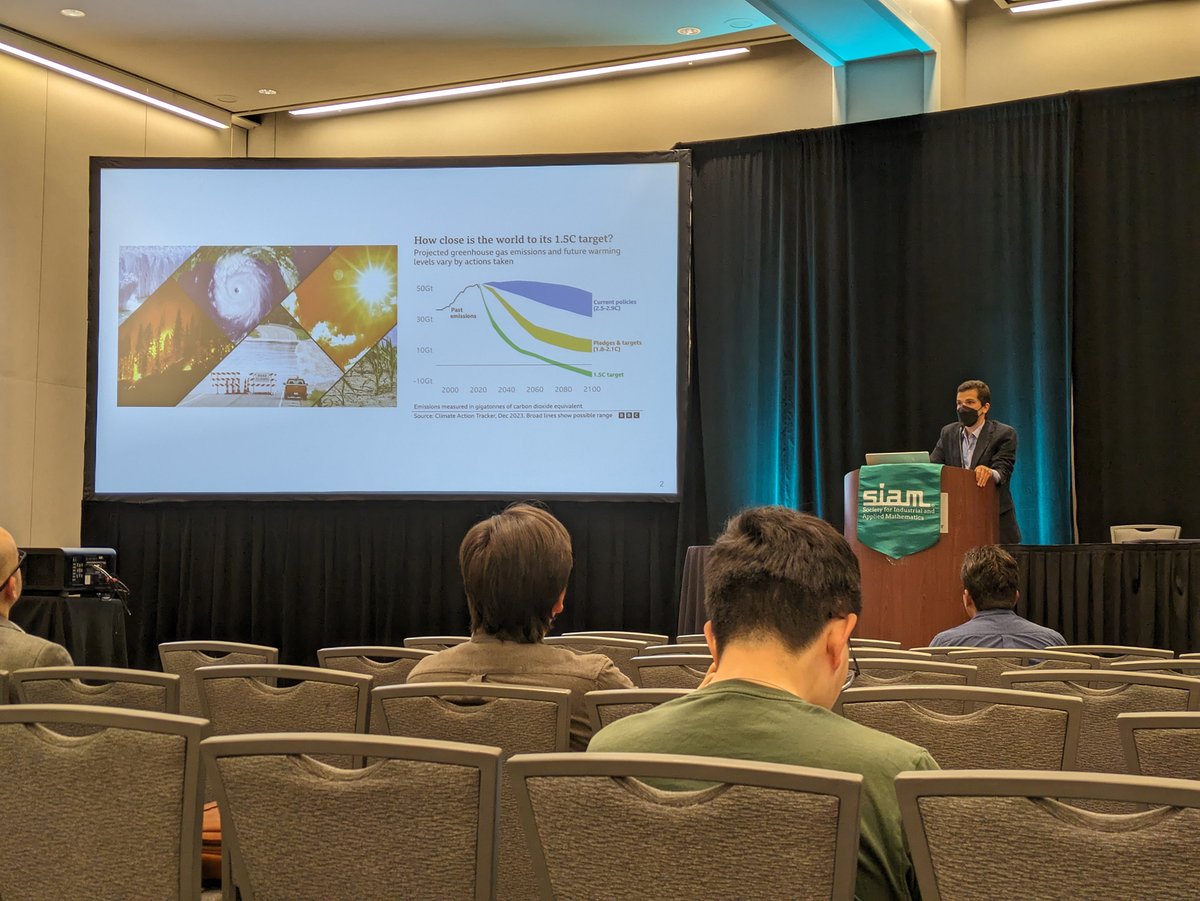
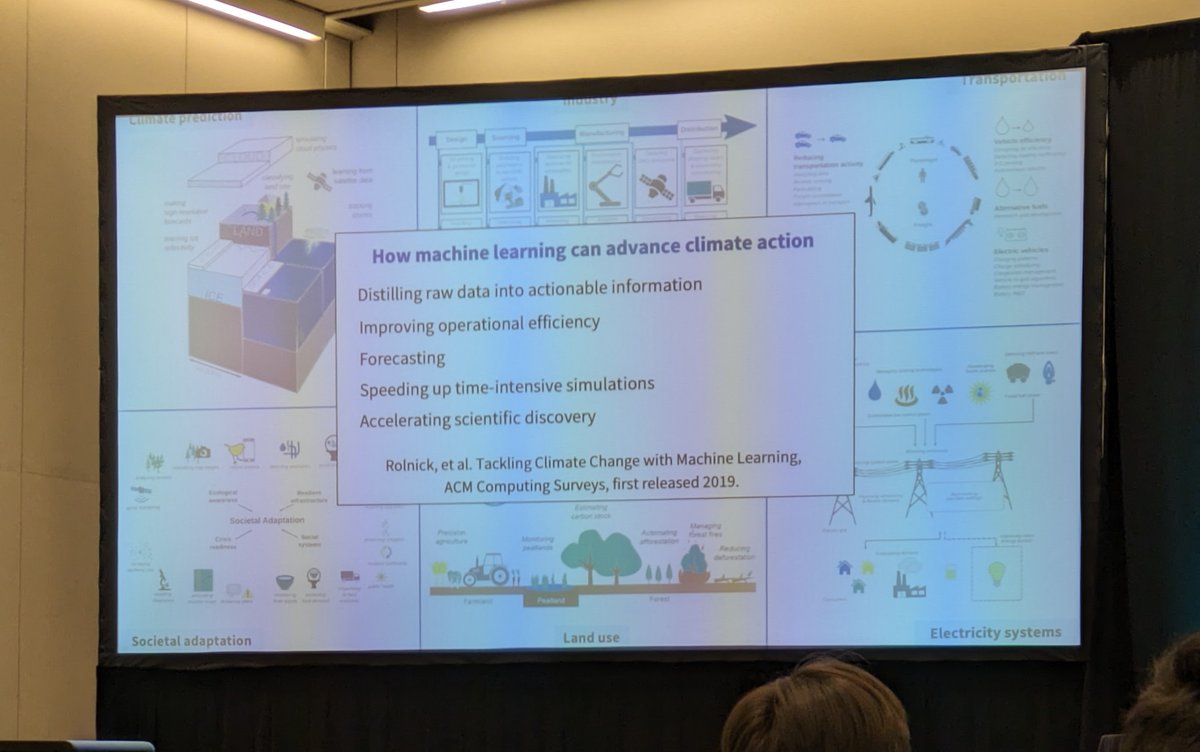
2. Invited talk, AI4Diff workshop, Sat 10.30am
3. Poster “Downscaling Benchmark”, CCAI workshop, Sat 8.45-9.30am + 2.30-3.15pm
#iclr24#iclr2024
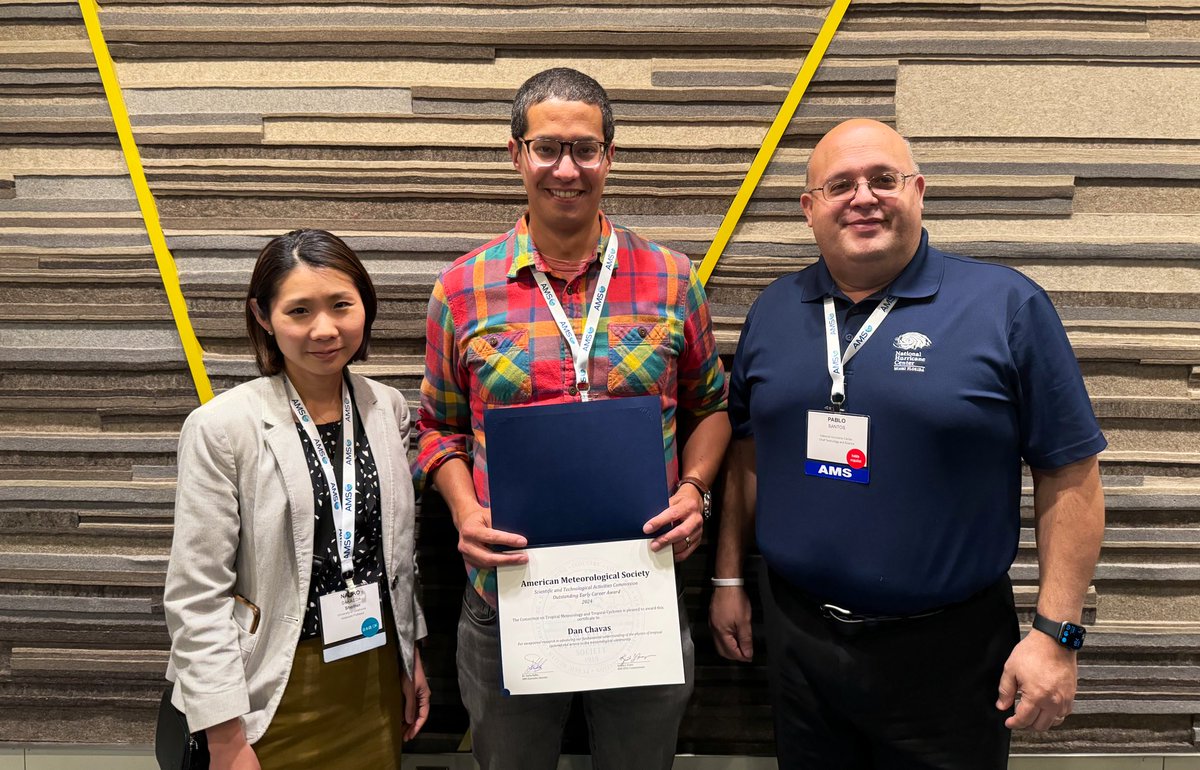
Let’s congratulate Dr. Dan Chavas, the recipient of the 2024 STAC Outstanding Early Career Award!
Pictured: Dan Chavas (awardee) with Naoko Sakaeda and Pablo Santos (conference co-chairs).
Join us at #GTC24 to hear Laure Zanna, Professor in Mathematics and Atmosphere/Ocean Science at @nyuniversity, showcase global simulations using #machinelearning to enhance climate projections and offer more reliable predictions. https://t.co/fIbWcgHWCj
For those interested in environmental technology, Sara is an inspiration.
She began as a ballerina and became interested in environmental technology attending public lectures at Georgia Tech (because the food was free). She became so interested, she began studying computer science and computer vision.
Today she is a professor at MIT and a leader in using AI to promote wildlife conservation. An amazing person doing incredible work.
Insects are nearly half of all described living species on Earth, and the ongoing sixth mass extinction threatens human society's very survival. This coverage by Global News talks about our work on AI for insect monitoring and new species discovery.
https://t.co/zQA7uPEluZ
I’m at #AGU2023 to present our work using deep learning and roadside imagery to map smallholder crops! We demonstrate the method by mapping rice, cassava, maize, and sugarcane for all of Thailand 🚙🌾
Session GC23B @ 3pm
Work led by PhD student @Jordilagua w/ @thomascygn
The ML community has been calling for a large scale climate dataset. In our recent Neurips 2023 publication, we introduce ClimateSet: A
➡️ large-scale
➡️ consistent
➡️ ML-accessible
climate model dataset 🌍. 1/8
https://t.co/lkXBYeUGun
https://t.co/GyNWO7Cm3x
@ParisPerdikaris@AnimaAnandkumar Neural fields conditions on multiple input functions. But the input functions must be represented in low dimensional spaces before going to conditional neural fields. Do you see a general way to achieve it considering input functions may be discretized on different grids?
If you're a prospective PhD student interested in statistics & uncertainty for ML 🤖⁉️, AI for science 🧪, or data with strategic behavior ♟️, I have openings in my group!
Consider applying to the MIT EECS PhD program and mention me in your application.
https://t.co/c34lwNAaNN
The hazards of interviewing at the Montreal Insectarium while wearing a blue shirt! Turns out the morphos are quite territorial... @MaximLarrivee@GloriaMTL@EspacePourLaVie