David Silver is one of the all-time greats. He was the creator of AlphaGo, which changed the course of history by showing that neural nets could achieve superhuman performance for the first time.
He also has a unique intuition and knack for forecasting when things will happen in AI. With computer Go, he predicted the Lee Sodol outcome 10 years before, right to the year. He got the year right for Starcraft and won a bet inside Deepmind. Same for AlphaProof. Same for the IMO.
David's prediction for superintelligence: 3 years. !!! He has a strong sense that now is the time to build a superleaner, and that superlearners are now possible, thanks to the enormous progress in compute, simulators, autoresearch, and the sophistication of technology in the stack since the AlphaGo days.
What is a “super learner”? A super learner discovers all knowledge from its own experience. Start from nothing (no internet pre-training), and go beyond human knowledge. Drop it into any stream of experience, simulated or physical, and the superlearner learns.
He expects the progress will be rapid. When you get the recipe for a superlearner just right and remove humans from the development loop altogether, a superlearner can learn extremely quickly. Just look at AlphaGo. AlphaGo took two years to develop with humans in the loop. When David and his team at @GoogleDeepMind got the formula for AlphaZero correctly, it surpassed the human-developed algorithms in just a few hours. Human data is a shortcut, but you have to let go of the human data to shoot beyond it.
In January, David left GDM to found @IneffableLabs, a research-led lab with one mission: build a "super learner" that discovers all knowledge from its own experience, and make first contact with superintelligence.
He joins us with co-founder Lasse Espeholt, who built IMPALA and SEED RL, the foundations of scaled-up RL, and now runs Ineffable's compute.
A few things we cover in this conversation.
— What a super learner is: depth (start from nothing, go beyond human knowledge) and breadth (drop it into any stream of experience, simulated or physical). The human brain is the only existence proof
— Why they're giving up human data: AlphaGo took two years with humans in the loop. AlphaZero outperformed it in a few hours. "You have to let go of the human data to shoot past the competition"
— Crucibles: simulated worlds with enough emergent complexity (physics engines, millions of interacting agents) for an agent to rediscover technology, science, maths and language on its own
— Simple rewards, emergent complexity: evolution optimized fitness and got all of life. Don't breadcrumb the objective, give the agent something simple to optimize in a world with a lot to learn about
— Go as the existence proof: one agent is the most boring game imaginable, two agents is "an infinite onion of layers of complexity"
— Why human language is probably not the endpoint for reasoning, and how training on it bakes in a flat earth and the four humors
— Can superintelligence be built in simulation? If the sim is Turing complete, computation, economics, language and maths are all expressible, and it happens 10-100x faster and safer
— Alignment: language-based monitoring is reaching its limits as agents learn to say one thing and do another. Shadow actions, superintelligences monitoring superintelligences, and building a real science of how they interact peacefully
— Accelerate in simulation, pace in the real world: Ineffable will gate real-world deployment on evidence that it goes well
— Timing as the determinant: Silver called Computer Go to the year, then StarCraft, then the IMO. He thinks this is the moment
— Predictions: True superintelligence within three years.
Timestamps:
0:00 – Introduction
1:09 – What held true from Go to today, and what the LLM era changed
3:35 – Why leave DeepMind to start a new lab
5:58 – Why "Ineffable" (and the secret second reason)
7:03 – Lasse's path: scaling RL at DeepMind and Google Brain
9:31 – Defining a super learner and first contact
12:35 – Super learners vs. LLMs that make discoveries
13:59 – Day to day: the RL stack, crucibles and human-journey milestones
16:13 – Don't breadcrumb the objective: simple rewards, emergent complexity
21:16 – What a crucible looks like
24:14 – Go: one agent is boring, two is infinite
25:41 – Will agents rediscover language?
27:22 – Removing human priors: AlphaGo to AlphaZero
32:05 – Keeping human bias out of the crucibles
33:35 – Confidence, timing and super forecasting
36:24 – Is compute the driver?
38:13 – The ceiling on simulation and Rich Sutton's objection
43:44 – Alignment and the science of superintelligence
47:45 – Monitoring agents that don't think in English
51:01 – Pacing the frontier
52:54 – The compute setup: Vera Rubin on GCP
55:18 – Training, inference, simulation and RL scaling laws
57:40 – IMPALA and SEED RL
1:00:58 – 20 people and the compute-per-person ratio
1:04:49 – A research-led culture
1:05:47 – Predictions
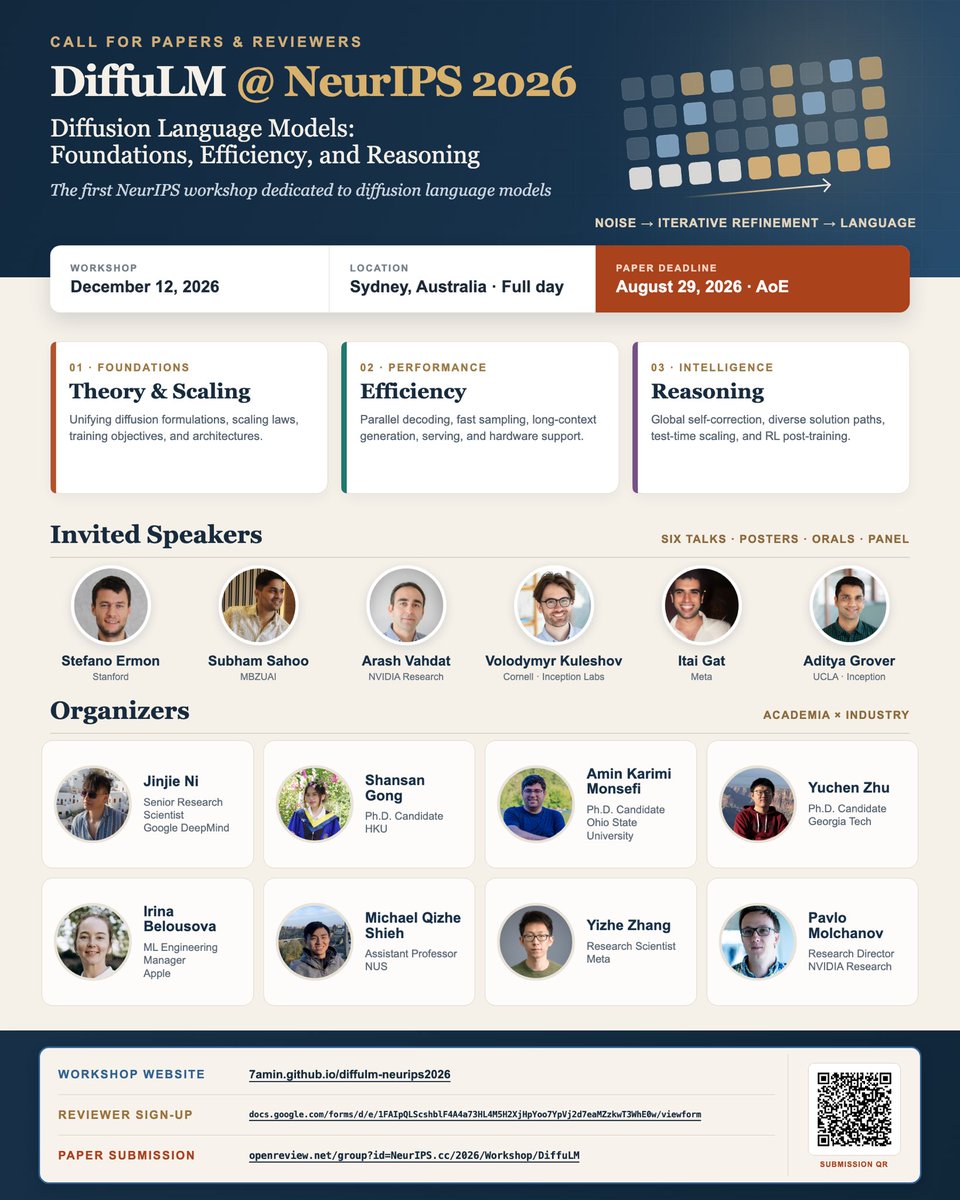
Pushing the frontier of Diffusion Language Models (DLMs)? Let’s do a quick sync!
🚀 We’re calling for papers for the DiffuLM workshop at @NeurIPSConf 2026!
The first #NeurIPS workshop dedicated to #DiffusionLanguageModels, featuring a fantastic lineup of speakers from academia and industry.
🗓️ Deadline: Aug 29 (AoE)📍 Sydney
🔗 https://t.co/xSVqT4TM8u
Robotics felt different this month. Google DeepMind and Anthropic made the same question hard to ignore: can a reasoning model decide what a whole body/robot should do next?
Gemini Robotics 2 put an embodied reasoning model above a VLA for whole-body control. Anthropic tested general-purpose reasoning models at several levels of control.
- https://t.co/2jQQp1HjyE
- https://t.co/ed0wZcIaRO
The bad news is clear. General-purpose reasoning models still cannot control a humanoid on their own. They need a pretrained policy underneath.
Still, I think this might actually work. A strong model (w/ excellent multimodal and reasoning capabilities) could really do it one day.
HumanCLAW is our attempt to get an early glimpse of that future.
With the stack fixed, can an AI agent choose data and experiment like a researcher?
At @Evolvent_AI, we built RSIBench-Data to test whether agents can diagnose failures, design data, train checkpoints, and use feedback. 🧵
📄 https://t.co/4jOwj0D3n4
💻 https://t.co/TnlbekcWwd
For my first post, I’m sharing a letter @NVIDIA signed on why open models matter.
AI will transform every industry, power every company, and be built by every country.
Open models strengthen safety and cybersecurity, accelerate innovation and diffusion, and enable sovereignty.
The world needs both frontier closed models and frontier open models.
https://t.co/AUKzoQ5Ikb
I feel that the right conceptualization is underappreciated. I was vibe coding a software for myself last week and I kept adding stuff but then it became obvious that the maintenance and bug fixing are very taxing.
I had to go back to the simplified model that I used during my PhD: store data in ways to facilitate easier understanding, decide the specific interaction between different data and really strip away all the extra stuff and only keep the core functionalities.
In the age of abundance, less is more. Understanding trumps execution. Simplicity is profundity.
My interpretation of this:
Right now, Anthropic and OpenAI are making a killing by selling enterprise FDE services to F500s, building workflows for them on top of proprietary models, then using the traces and context from this to build RL envs to improve the models.
This is crazy amounts of leverage - instead of buying this data they're getting paid gigantic consulting fees to extract it.
This also goes way beyond typical consulting in scope - organizations are effectively outsourcing key learning curves and domain knowledge to the AI labs.
Despite that, it's so far been worth it for them because the value of skilled FDE is so high and the ROI so fast, and orgs are willing to pay a premium for competent AI implementation.
But in the long run, one of two things happens: either orgs are gonna get hooked on this and end up paying for the model training that replaces their business, or they find a way to build and own their own model ecosystem.
What that looks like is developing some combination of AI models, evals, RL envs, and workflows. Initially probably the model will still be an off-the-shelf frontier model from a top lab.
But as firms build out more sophisticated eval / RL env (increasingly the same thing) infra, it starts to become viable to post-train an custom model on top of an OSS base. Cursor have done this successfully with their Composer model RL'd on top of Kimi.
Sidenote, this is the same conversation that a lot of national governments in Europe are having in the past week. When we look at what the rhetoric about 'sovereign AI' in the UK actually boils down to, it's doing custom post-training on top of an OSS model, and then running it on local GPUs.
Ultimately, the current feeding frenzy for AI services in all of its guises - FDE, AI consulting, etc - should raise questions about long-term sustainability. If consulting services are truly a value add and competitive advantage, then in the long term you want to in-house.
At Kimi, we do care about Notion use. Training K2.6 on remote apps such as notion was one of the most important projects during my internship.
A bit of Kimi flavor: we like to RL things that aren't supposed to be RL-able.
A lot of it came from RL. And it scales.
The emergence of OpenClaw marks a new chapter in agent evaluation.
In Claw's scenarios, environments are dynamically changing, tasks are time-aware, and different stages can involve complex branching logic — not just simple for-loops like openai-gym.
I think ClawMark is an early exploration of this direction.
Launch Week — Day 1: ClawMark
Most agent benchmarks give the model one shot, one prompt, one frozen environment.
Real coworker tasks span multiple days — and the world keeps changing while the agent works.
Introducing 🦞ClawMark: a multi-day, dynamic-environment benchmark for coworker agents. Built by Evolvent together with 40+ researchers from NUS, HKU, MIT, UW, and UC Berkeley. Open-sourced at: https://t.co/QN7XgIoaN1
100 tasks. 13 professional domains. Fully rule-based scoring.
Results from 6 frontier models below. 🧵👇
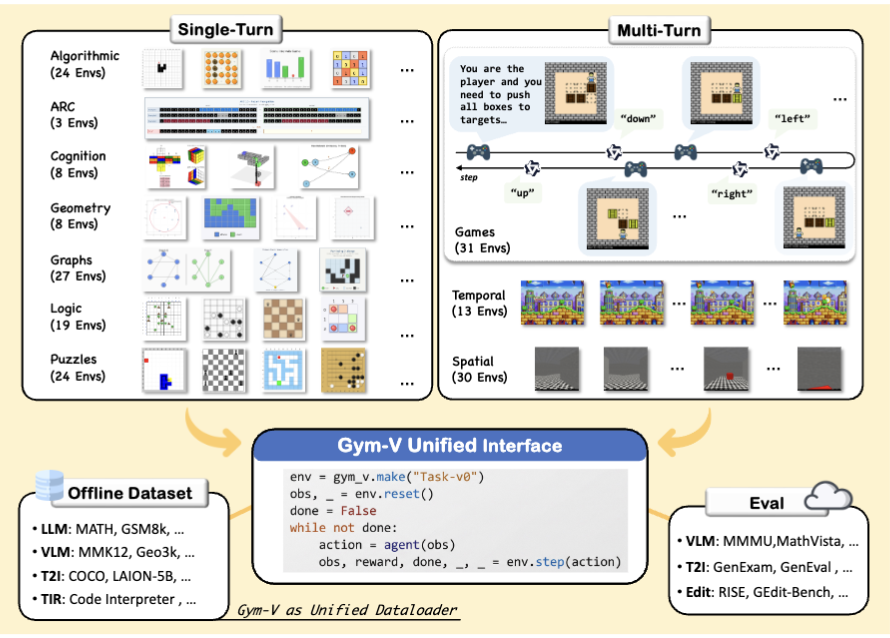
Text agents have their Gym. Vision agents? Not until now.
Introducing Gym-V — a unified gym-style platform for agentic vision research, with 179 procedurally generated environments across 10 domains.
One API to rule them all:
📦 Offline dataset
🤖 Agentic RL training
🔧 Tool-use training
👥 Multi-agent training
📊 VLM & T2I model evaluation
All under the same reset/step interface.
Key findings:
1. Observation scaffolding matters MORE than RL algorithm choice
2. Broad curricula transfer well; narrow training causes negative transfer
3. Multi-turn interaction amplifies everything
📄 Paper: https://t.co/WP4AgCuqSW
💻 Code: https://t.co/QSFRNzPWVb
Open the thread for a deep dive! 🧵
Thanks for sharing our new work! 🎉🎉🎉
Paper: https://t.co/BYl9zTxK1I
Code: https://t.co/otik4QG0Bv
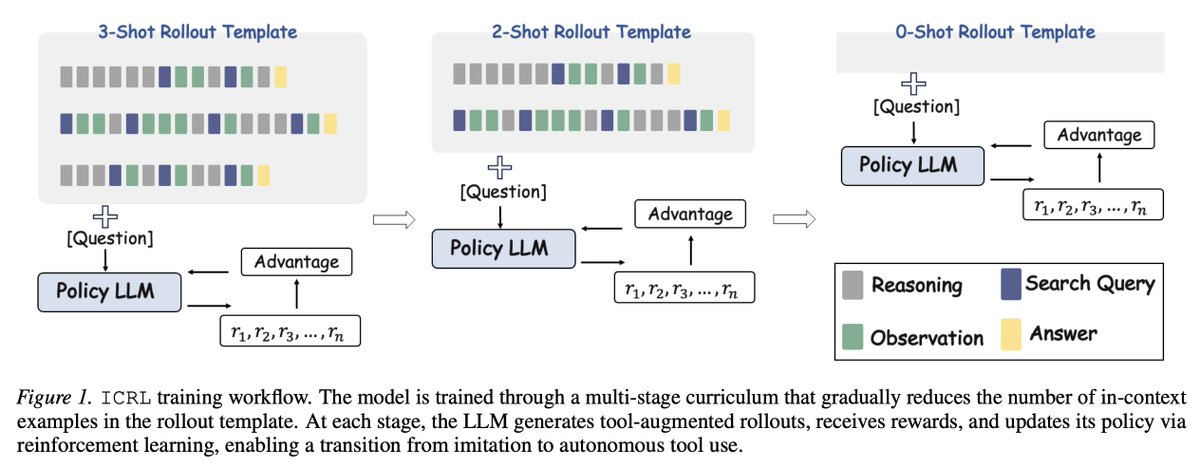
We introduce In-Context Reinforcement Learning (ICRL), an RL-only framework that eliminates the need for SFT by leveraging few-shot prompting during the rollout stage of RL. In general, ICRL introduces in-context examples within the rollout prompts to teach models how to call external tools. Then we gradually reduce the number of in-context examples to sustain the models' tool-calling ability while fitting into general question format without any in-context examples. 🔬
The improvement is significant: We conduct our method mainly on Qwen2.5-3B and Qwen2.5-7B.Both models outperforms the previous state-of-the-art works by nearly 10 points on various QA datasets (TriviaQA, HotpotQA, 2Wiki, Musique and Bamboogle). 💻
Scalability and Generalizability: We also conduct extra experiments with different scales of qwen models. The results from Qwen2.5-14B model also show ICRL can scale effectively. We also extend ICRL on code-writing ability and compare it with ReTool on AIME dataset, and we keep the model's performance while reduce the annotated data for cold-start SFT, which means ICRL still work for learning other tool-calling patterns.
Authors: Yaoqi Ye @yaoqiye318, Yiran Zhao @yiran_zhao924, Keyu Duan @Keyu_Duan, Zeyu Zheng, Kenji Kawaguchi, Cihang Xie @cihangxie, Michael Qizhe Shieh @michaelqshieh
#ToolUse #ICRL
PTL (Prune–Tune Loop): a compression method that reduces LLMs to nearly half their size while preserving reasoning performance. 🧠
Paper: https://t.co/xD5ODPLHiJ
The core idea: instead of pruning all at once (which causes dramatic performance drops), PTL divides compression into fine-grained iterations—each with a small prune step followed by lightweight recovery tuning. Like the "boiling frog" effect, gradual changes stay recoverable.
Each iteration identifies neurons or layers that are redundant for reasoning, removes them, then restores performance via continual pre-training on CoT data or reinforcement learning. 🔬
The results are compelling: Llama3-8B compressed from 8B → 5B parameters with 30% fewer FLOPs and 224% runtime efficiency gain, while holding near-original accuracy on GSM8K, Minerva Math, and MATH-500. Gemma2-9B pruned from 9B → 5B—the only method tested that preserved near-original performance after aggressive pruning. 📊
On Qwen2.5-7B, PTL was the only compressed model able to recover via RL fine-tuning. Competing methods produced incoherent outputs entirely.
PTL also extends beyond math—on code generation (MBPP), a 30% pruned Llama3-8B retained 90% of original accuracy with 2.56x speedup. 💻
Authors: Yiran Zhao @yiran_zhao924, Shengyang Zhou, Zijian Wu @Jaku_metsu, Tongyan Hu, Yuhui Xu @xyh6666, Rengan Dou, Kenji Kawaguchi, Shafiq Joty @jotyshafiq, Junnan Li @lijunnan0409, Michael Qizhe Shieh @michaelqshieh, @NUSingapore
#EnterpriseAI #FutureOfAI
History shows that when Karpathy tweets about something, it often skyrockets :) Variations of this auto-research, including research papers, have been shared and posted for months.
[1] AI can propose novel ideas https://t.co/LUtHgkZhwF
[2] AI can code https://t.co/nLHVL8OMNx
[3] So, yeah, AI can self-evolve to start the loop https://t.co/LyHywGpWLU
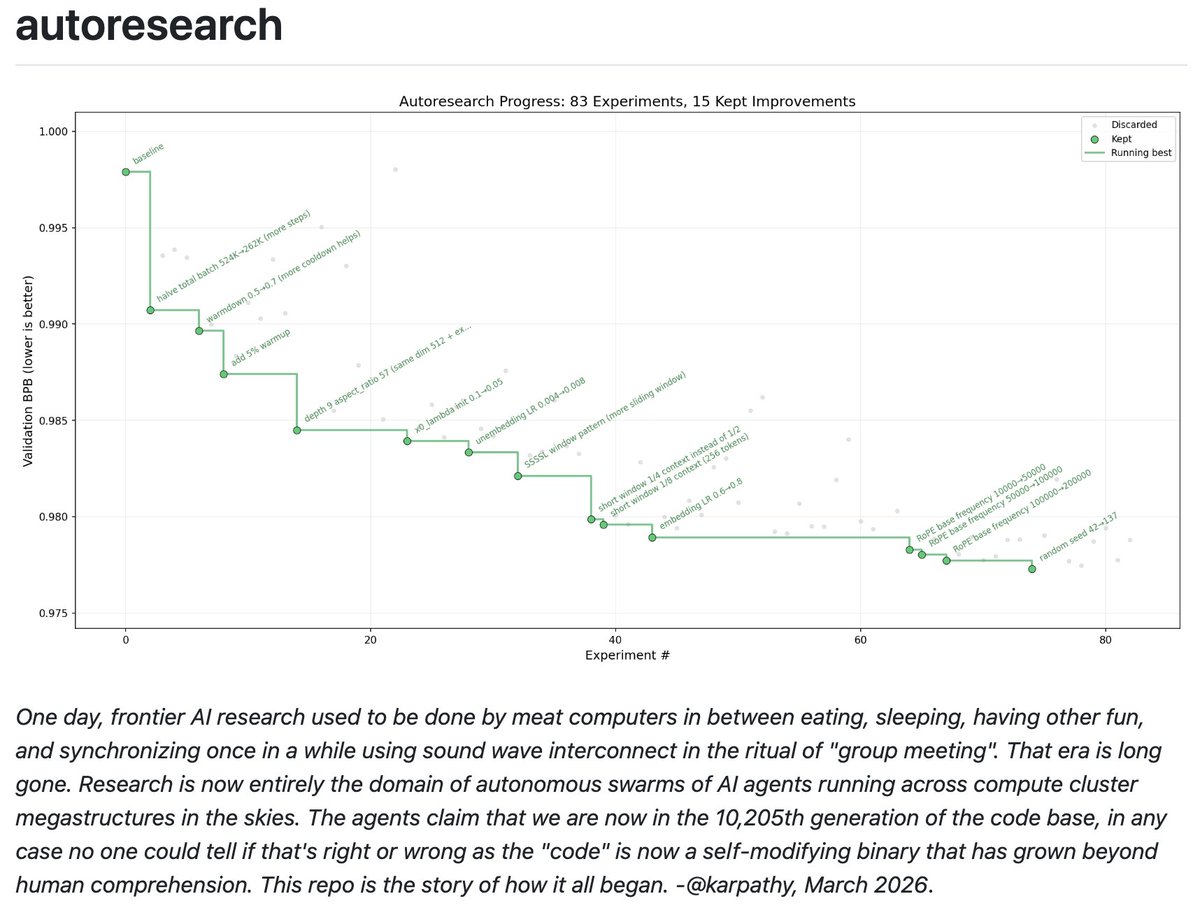
I packaged up the "autoresearch" project into a new self-contained minimal repo if people would like to play over the weekend. It's basically nanochat LLM training core stripped down to a single-GPU, one file version of ~630 lines of code, then:
- the human iterates on the prompt (.md)
- the AI agent iterates on the training code (.py)
The goal is to engineer your agents to make the fastest research progress indefinitely and without any of your own involvement. In the image, every dot is a complete LLM training run that lasts exactly 5 minutes. The agent works in an autonomous loop on a git feature branch and accumulates git commits to the training script as it finds better settings (of lower validation loss by the end) of the neural network architecture, the optimizer, all the hyperparameters, etc. You can imagine comparing the research progress of different prompts, different agents, etc.
https://t.co/YCvOwwjOzF
Part code, part sci-fi, and a pinch of psychosis :)