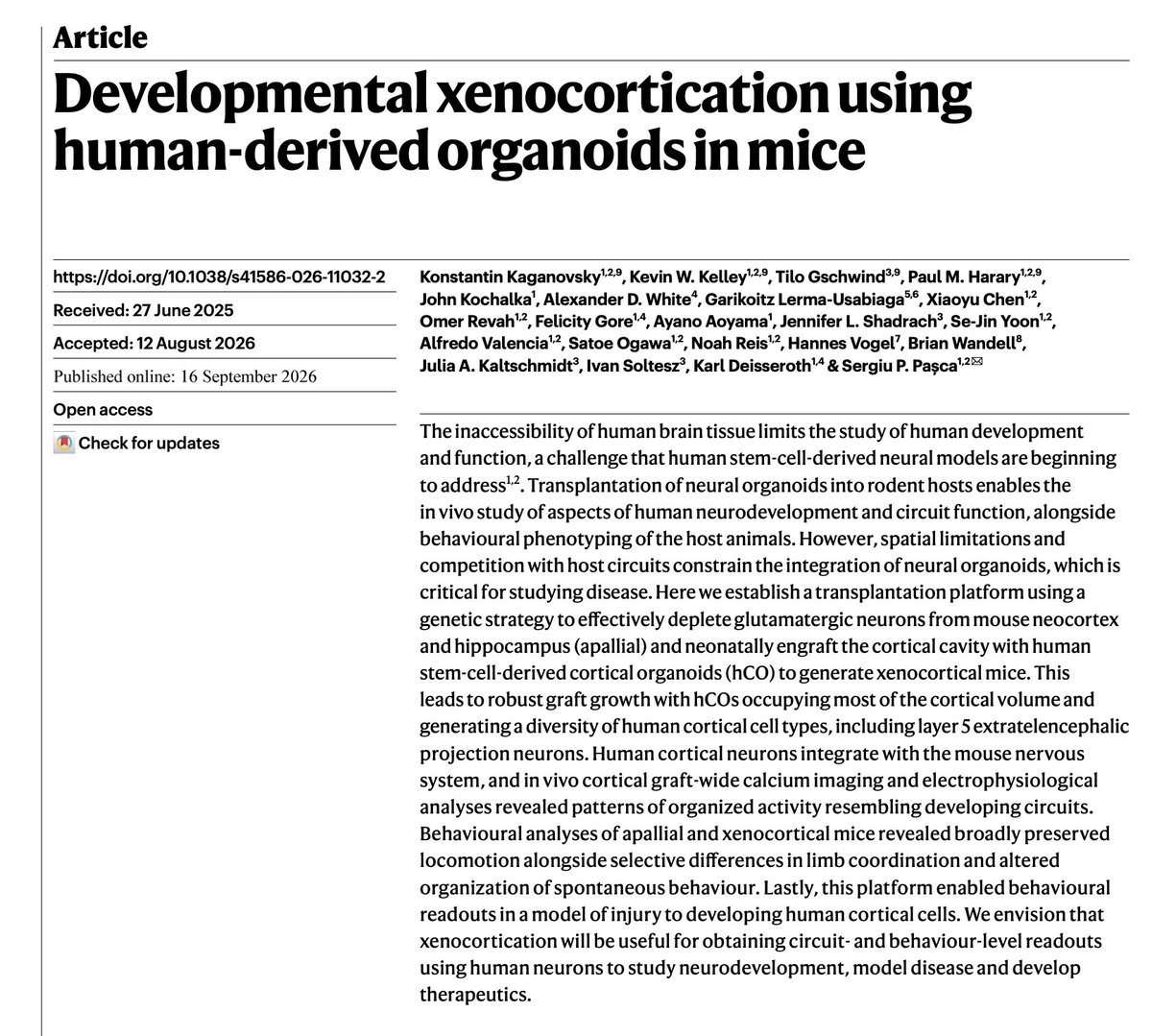
An extraordinary @Nature paper has just landed from the lab of @Sergiu_P_Pasca at @Stanford - led by Konstantin Kaganovsky. They have found a way to create "xenocortical mice" which have ~92% of their cortex occupied by a cortical organoid derived from human stem cells. This human-derived cortical graft integrates deeply with the host nervous system, supporting organised neural activity and behaviour.
This study is a milestone in synthetic biology and chimera research. It has the potential to generate multiple medical breakthroughs by providing an enhanced biological model of human brain tissue that allows behavioural as well as neural and genetic assays.
The Stanford team have been exceptionally thorough and proactive in addressing ethical concerns that comes from this frontier work. But their pioneering work nonetheless raises many open questions: are the xenocortical mice conscious? Do they have any human-like properties of consciousness or cognition?
@NitaFarahany and I will be addressing some of these questions in a forthcoming commentary - where we'll also offer an ethically-informed roadmap to guide this important research as it progresses. In this context, "pacing the frontier" really does make sense 😉
Read the Stanford @nature paper here, and buckle up. It's wild. https://t.co/Ky9HFb9nYI
@ProfBuehlerMIT Reading and re-reading this post to make absolutely no sense of it is just so emblematic of AI-in-science projects these days. Hope the token cost was worth it. If someone understands what this is about, would appreciate a short explanation
Our group discovered that reasoning models produce fractals when asked to solve hard problems. We can use nonlinear dynamics to probe the thinking processes of recurrent depth models on Sudoku, mathematics, and even ARC-AGI (1/N)
https://t.co/Q3u8OqylZf
hello there the jacobian conjecture is false thanx to my close friend akhil for asking about it and my other close friend fable for working during the world cup final
((1+xy)^3 z + y^2 (1+xy) (4+3xy), y + 3 x (1+xy)^2 z + 3 x y^2 (4+3xy), 2 x - 3 x^2 y - x^3 z): \C^3\to \C^3, has jacobian determinant -2, and sends (0, 0, -1/4), (1, -3/2, 13/2), and (-1, 3/2, 13/2) to (-1/4, 0, 0)
Cavendish researchers have found a new way to make forbidden molecular triplet states shine. This could lead to brighter OLED materials, better imaging technologies, and future quantum sensing 👉️https://t.co/1JCiv2MS4U
@HuangtianzhiZ@quantizedfella@zhongzheng_yu@stjohnscam
@AndrewGYork@zanehkoch Thanks! Thought something sounded fishy about the physics. Unsurprised that the biology doesn't check out too. Disappointing peer review and editorial oversight for this paper in Cell.
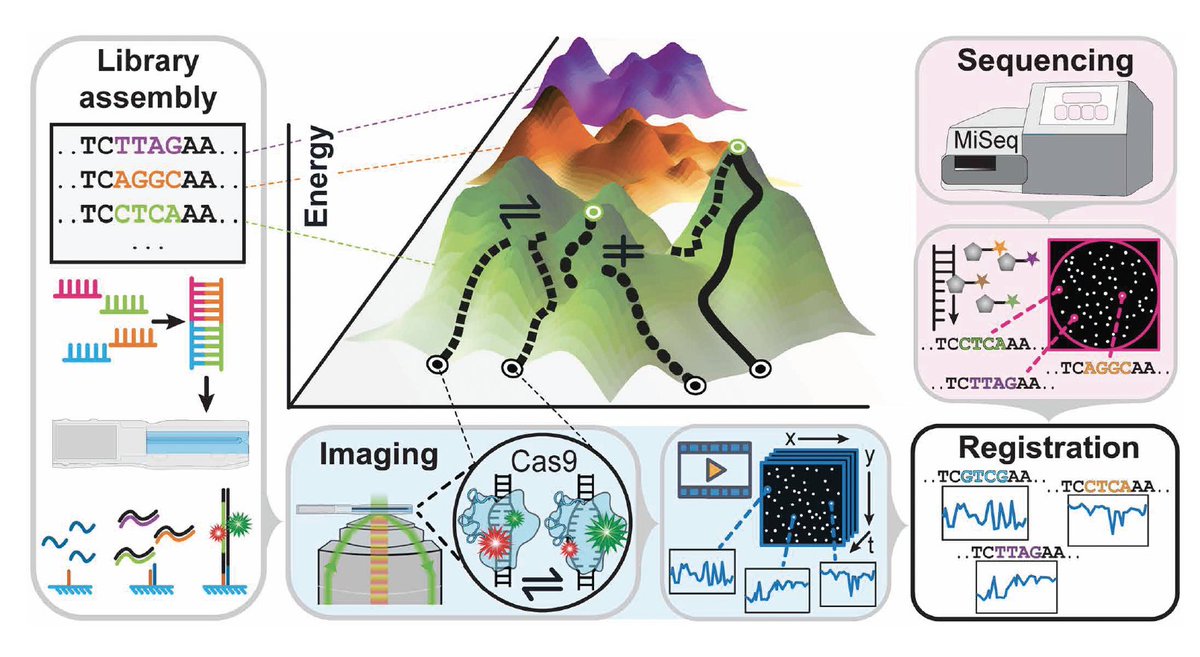
A tour de force single molecule review @ScienceMagazine
"the ongoing convergence of two foundational technologies in modern biology: sequencing and single-molecule biophysics......we are now poised to interrogate complex biological phenomena with previously
unattainable depth and precision."
https://t.co/GNpNYSWSMS
Cavendish researchers have developed a new technique using 'molecular antennas' to power nanoparticles that couldn't be electrically powered before🔋
This opens up exciting opportunities to use these excellent light emitters in everyday technology.
🔗https://t.co/tAjppQSn5w
Can a pinch of salt lead to better medical tests, cleaner energy, and smarter sensors?
Researchers have shown that a layer of chloride ions, like those in table salt, can fundamentally alter the behaviour of gold nanoparticles.
🧂 https://t.co/FRD0ggfXYS
Why fundamental research is fundamental to progress, seeding major breakthroughs
Editorial @Nature this week
And 7 basic science discoveries that changed the world
https://t.co/0YrKabc7ff
https://t.co/SM11QSJhWz
New 2 year postdoctoral research fellowship in @DeptofPhysics (NP,OE, AMOP), funded by a joint EPSRC-NSF research grant with @ucsd_yuen. If you're interested in AMO, room-temperature organic quantum technologies and nanophotonics, apply to join the team!
https://t.co/M6INugKiDv
Looking for an enthusiastic PhD student to come to Oxford next year to design and synthesise cool luminescent organics. Please share 🙂 @OxfordChemistry@ERC_Research
https://t.co/PIpPJGPqnR
✨ Cavendish researchers have found a way to tune tiny clusters of metal nanoparticles to interact with light in surprising ways.
The findings could improve non-invasive sensing technologies for #healthcare and environmental monitoring.
Read the article: https://t.co/XHvumz8Uxz
In 1974, the mathematician Douglas Hofstadter used a graphing calculator to find a fractal pattern in how electrons behave. His adviser dismissed it as numerology. The fractal, called the Hofstadter butterfly, is now known to be a real-life phenomenon. https://t.co/wZ6KDc2bU5
@Robert_Palgrave Mixed valency or problems with partitioning electrons neatly? Or chemistry-wise in that hydroxides and other surface species may be present for ambient processed oxides, and show additional peaks?