https://t.co/Fg9jjEAHtj
Excited to share that our work on "Simulating quantum dynamics in two-dimensional lattices with tensor network influence functional belief propagation" is now accepted in the Physical Review B Journal!
The annual @IQIM_Caltech retreat at Lake Arrowhead is an opportunity to spend the weekend with some of my favorite scientists. It is always an uplifting and illuminating experience.
Late advertisement of our new work on a novel hybrid method of combing fermionic tensor networks and neural networks for tackling fermionic ground state problems. https://t.co/G7QwcjWNfb
🔧 The CPTP property is particularly important when implementing dynamics on quantum hardware through a quantum channel.
Our framework opens a path to efficient quantum simulations of open quantum systems in near-term quantum platforms, such as trapped-ion ⚛️ devices.
🚀 New Paper on arXiv!
I’m excited to share our latest work:
“Coupled Lindblad pseudomode theory for simulating open quantum systems”
https://t.co/6ajwTKANPM
with Zhen Huang, Garnet Chan, and Lin Lin
🔍 This time, we ask:
Can we retain that efficiency without giving up the CP condition?
✅ The answer is yes - by introducing couplings between pseudomodes, we construct the coupled Lindblad pseudomode framework, which preserves the CPTP condition.
🚀 New paper out on arXiv!
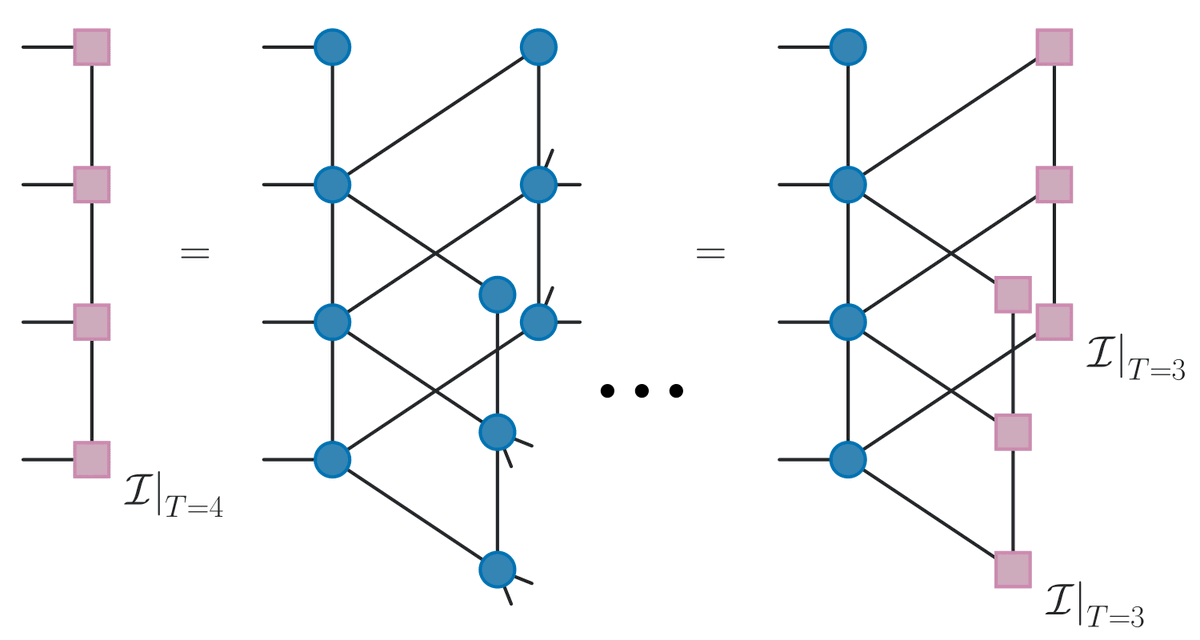
We developed a tensor network algorithm to simulate quantum dynamics in 2D lattices, combining the concept of tensor network influence functional (TN-IF) and belief propagation (BP).
https://t.co/k8Wypj8FVA
📊 With this new method, we benchmarked against recent IBM experiments on kicked Ising dynamics (heavy-hex lattice) and simulated 2D TFIM quenches on square lattices—capturing long-time dynamics beyond the reach of traditional methods!
https://t.co/k8Wypj8FVA
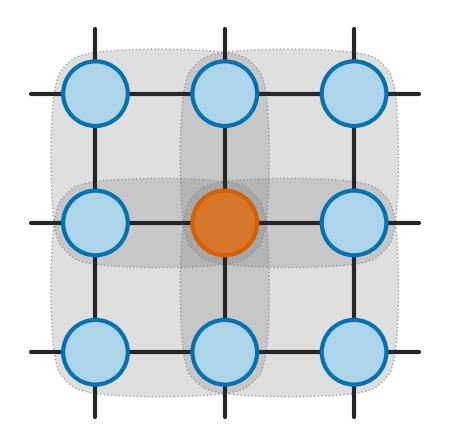
🧩 BP works well on tree-like lattices—but on 2D square lattices, loops introduce errors.
To go beyond this BP limit, we developed a cluster expansion for IF-BP that systematically captures loop-induced correlations.