What does data localization mean, and why is it so important for our next gen chips like Rubin?
Starting from Blackwell, NVIDIA has started packaging 2 dies into a single chip to continue packing more transistors on a single chip and help with yield. However, this introduces strong NUMA (Non-Uniform Memory Access) effects where it doesn't just matter when you access data (for cache locality reasons), but also where you access data from. As we move towards deploying many GW of Rubin, this becomes very important
Rubin is more sensitive to cross-die traffic than Blackwell because of the relative ratio between HBM bandwidth and stitch bandwidth (fig1). The stitch is the on-chip interconnect between the 2 dies, and it has begun to limit the effective bandwidth in memory bound kernels. When a lot of data crosses the stitch, our off-chip bandwidth gets throttled well below our achievable HBM bandwidth, which is quite damaging for inference decode
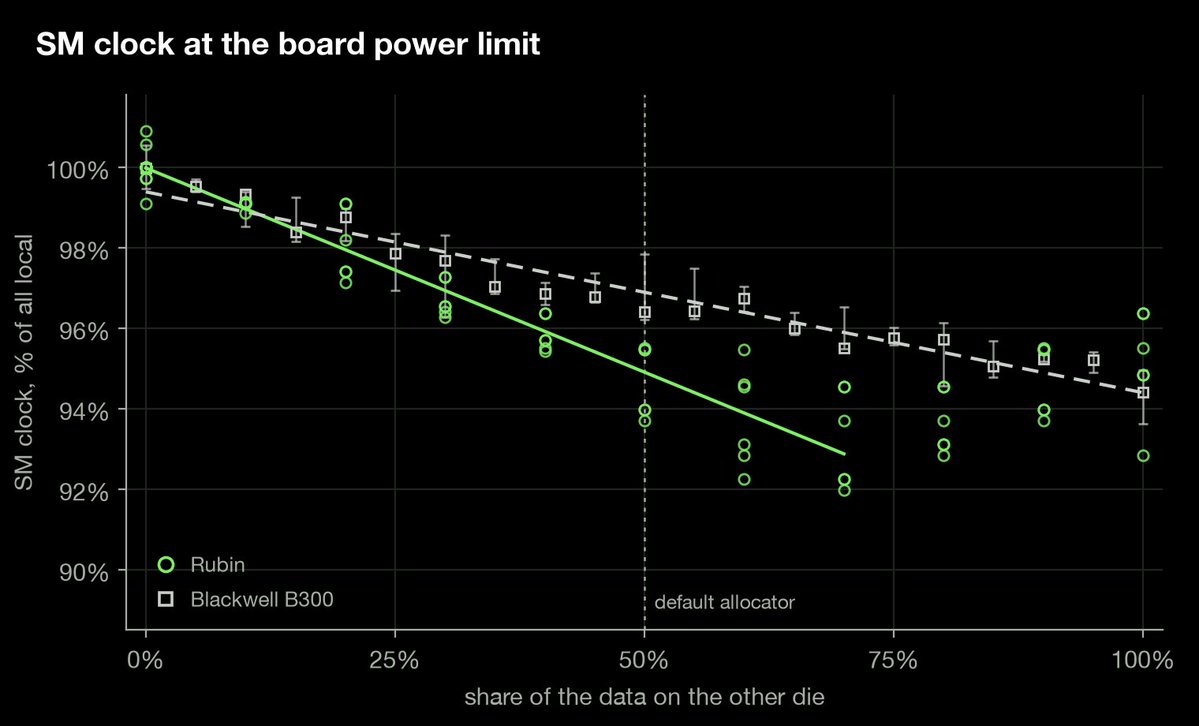
However, contrary to intuition that compute bound kernels are not sensitive to memory bandwidth, cross-die traffic is also important in compute bound kernels. In any current chip, extended compute bound kernels are actually power bound (because end of dennard scaling = smaller transistors burn more power). When we're power bound, we have to throttle our clock to keep the chip below max TDP (fig2), which keeps us well below the peak FLOPs we want to hit. Traffic across the stitch is avoidable and thus wastes power (we can microbenchmark the energy cost per bit across the stitch in fig3), so eliminating this helps us clock higher and unlock more achievable FLOPs!
Localization means keeping data physically close to where it will be computed. In Rubin, this means that we want to keep our data in the HBM stacks and L2 cache of the die whose SMs we will eventually read it into. By keeping data on the local die and avoiding traffic across the stitch, this helps with perf + energy efficiency for both memory bound and compute bound kernels
CUDA 13.5 (fig4) exposes each die as a “locality domain” where you can allocate a buffer on a specific die instead of letting the default cudaMalloc interleave pages 50/50 across both, and each SM can read which die it’s on at run time. So explicit localization looks like splitting your weights or state in half (workload-specific), placing each half in one die’s HBM, and having each block in the kernel check its die and only work on the half that lives with it
Localization will clearly be important in Rubin class chips and beyond because of the bandwidth and power savings, and it will define a major focus of Rubin-specific optimizations in the coming years. But its also quite apparent that localization will not just be an NVIDIA specific optimization (AMD MI355 is also 8-die chiplet, and I anticipate that all frontier AI ASICs will package multiple dies unless they can solve this problem with small chips + good scale up interconnects)
Expect plenty more interesting technical content from Modal in the coming weeks - turns out that with the right hardware-specific optimizations, Rubin is a great (maybe even the GOAT) inference chip!
Sources for all info in comments
is the Anthropic IPO chart a better LR schedule than warmup cosine decay?
let's find out! @mridul__agarwal@ananthsiyer and i are running 4 identical pretraining runs, with the LR driven live by ANT, SPCX, SPY, and NVDA.
watch the models train at https://t.co/z9JTXXLpkg
we got LLMs to do weight space programming on a CNN for CIFAR-10, and found lots of cool behaviors in the reasoning traces!
models invented their own training data, reasoned about images through ASCII art, and learned to map features to labels entirely in-context.
had fun experimenting with Ripple-65B and other LLMs alongside @mridul__agarwal@Vedang_A at the hackathon, we wrote up what we found 🧵
Kimi K3.1 Pro from @Kimi_Moonshot is now available on Modal.
A major post-training update to Kimi K3, with expanded reinforcement learning for stronger coding, financial research, and long-horizon agentic work.
Kimi K3.1 Pro supports text and images with 1M context.
The secret to Modal's speed is our custom lazily loaded container filesystem, ImageFS. ImageFS is built on a massive tiered distributed filesystem, layering local NVMe disks, regional and p2p caches, and global blob stores.
When we launched VM Sandboxes this month, we wanted to make sure they could take advantage of ImageFS in the same way our gVisor containers do. To do that, we built out a new filesystem stack that tricks a VM's ext4 driver into thinking it's talking to a normal disk.
My Modal journey started in SF 4.5 years ago as an intern. Since then I've learnt so much from my mentor @akshat_b and our two desks in a shared WeWork have become hundreds in a new SF office.
What compels me about Modal's growth is not the number but the mindset. You can hire to grow 2x per year, but any more and you damage culture.
How do you scale growth past 2x? Grow the people.
This is most important thing Modal has done -- it's figure out how to find people with high potential, and grow them 4-5x per year. It creates a happy culture, and the company grows way faster than you can hire.
Come to mentor, and come to grow. https://t.co/K1WO6rU8rA
Today we're announcing that Modal has crossed $1B in annualized run rate, as well as raised a $750M Series D at a $15.75B valuation, led by @Accel.
Since our Series C, usage has tripled and we’ve grown more than 15x year-over-year.
We are deeply grateful to the developers and companies building on Modal. There's still so much more to build, and we can't think of a better time to be building software.