Multi-HMR has been accepted to #ECCV2024🤸.
With Multi-HMR, we won the ROBIN challenge on 3D human reconstruction at #CVPR2024.
Today, we're releasing the training code on top of the existing demo code: https://t.co/gCnYhJGL9o
See you in Milano 👋
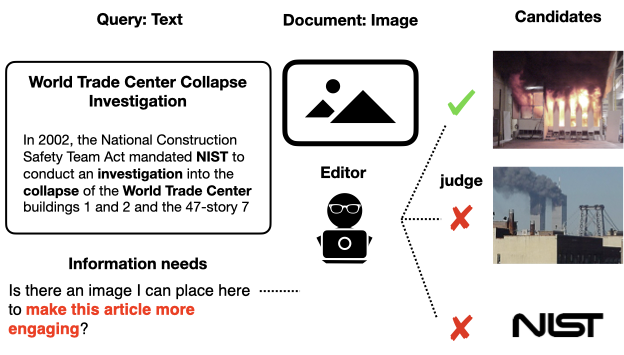
Interested in Cross-Modal retrieval? Feel that evaluation on caption datasets is limited and noisy?
The @TREC_AToMiC task is here: a real, large scale problem (retrieve illustration for @Wikipedia sections), with human judgements. Deadline in 45 days!
@krishna2@lintool
@wightmanr CUB200, Cars196, and Stanford online products are probably the most used benchmarks for deep metric learning/image retrieval. Are they the type of dataset you're looking for?
A recurring mis-conception in ML is that setting standards for ethical research practice is the same as censorship. It's not - it's about meeting community norms / expectations. This would be like saying a reviewer's request for reporting ablations or uncertainty was censorship.
@chriswolfvision Which should serve as an example of how fundamentally broken this idea is. It turns out, when one "tries" to select "the smartest and most driven", they just select a set of smart wealthy kids. Related read: https://t.co/n4PwPypcGb
Happy to finally announce the release of our models! Improvements due to the data from: https://t.co/YiJDNQE3Ff and the PLM from https://t.co/ZhQgB7OOB0. We also added the needed code to index and retrieve using Anserini!
You can start using FFCV today: check out the repo (https://t.co/6RPIThoGdo) and docs (https://t.co/sYUtGq1f6d)---we even have a Slack! Stay tuned for a blog post, and a paper explaining the details. w/ @gpoleclerc@andrew_ilyas@logan_engstrom@smsampark@hadisalmanx (3/3)
Vision Transformers (ViTs) are an interesting development in computer vision. One downside: they are more data hungry than CNN. Presumably because they have less of a spatial / locality inductive bias so they require more data to obtain acceptable visual representations 🧵 [1/7]
@mribeirodantas Basta lembrar que há pelo menos 7 anos nos dizem que "em 5 anos teremos carros que se dirigem sozinhos", ou ver empresas superestimando serviços médiocres/antiéticos sob a faixada de ser "IA".
We finally have the final (live) invited talk today.
ImageNets of "x": ImageNet's Infrastructural Impact
by @cephaloponderer and @alexhanna
See you at the live Zoom!
https://t.co/6TiAtcAmuQ
https://t.co/C5zcIJTzHr
3rd session of our WS has begun
@SharonYixuanLi Uncovering the Deep Unknowns of ImageNet Model: Challenges and Opportunties
@wightmanr ImageNet models from the trenches
@dawnsongtweets@hendrycks Using ImageNet to Measure Robustness and Uncertainty
https://t.co/sGfPxW6b4y
Oops I forgot announcing the second track!
"Are we done with ImageNet?" by
@__kolesnikov__ is now live and other talks by
@BeccaRoelofs Is ImageNet Solved? Evaluating Machine Accuracy
@ShibaniSan From ImageNet to Image Classification
are also available
https://t.co/K7hEHBSfLM
@michalwols@SanghyukChun@HugoTouvron The recording should be available in the workshop virtual place in around 1 month, according to NeurIPS guidelines.
We start the workshop from the future of ImageNet:
Mon 04:30-5:00
Olga Russakovsky & Kaiyu Yang
- Fairness and privacy aspects of ImageNet
Mon 5:00-5:30
Vittorio Ferrari
- OpenImages: one dataset for many computer vision tasks
(4/N)
In about 3 hours, we going LIVE on the #NeurIPS2021 workshop on ImageNet: past, present and future. Come check the amazing talks, panel and poster sessions! You can check the schedule 👇 or here: https://t.co/P06goe50D7
What can we learn from the decade of history of ImageNet? Are we done with ImageNet? What will be the future of ImageNet-based vision researches?
We organize the workshop on ImageNet: past, present, and future for answering the questions!
https://t.co/W8o5bNSmxT
Speakers:
(1/N)