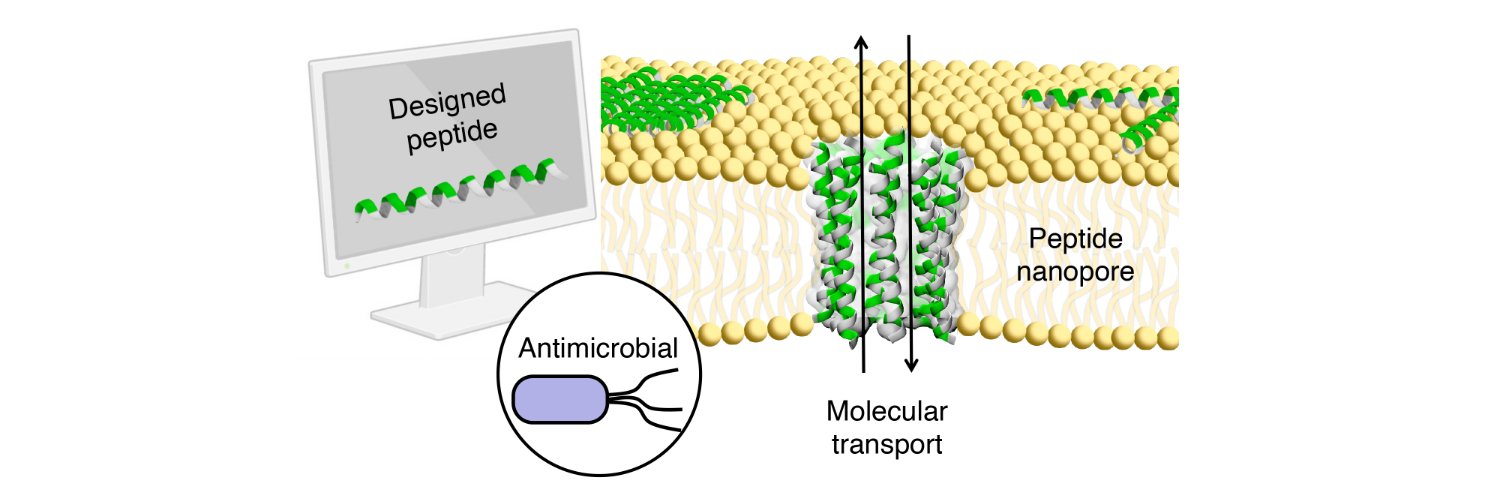
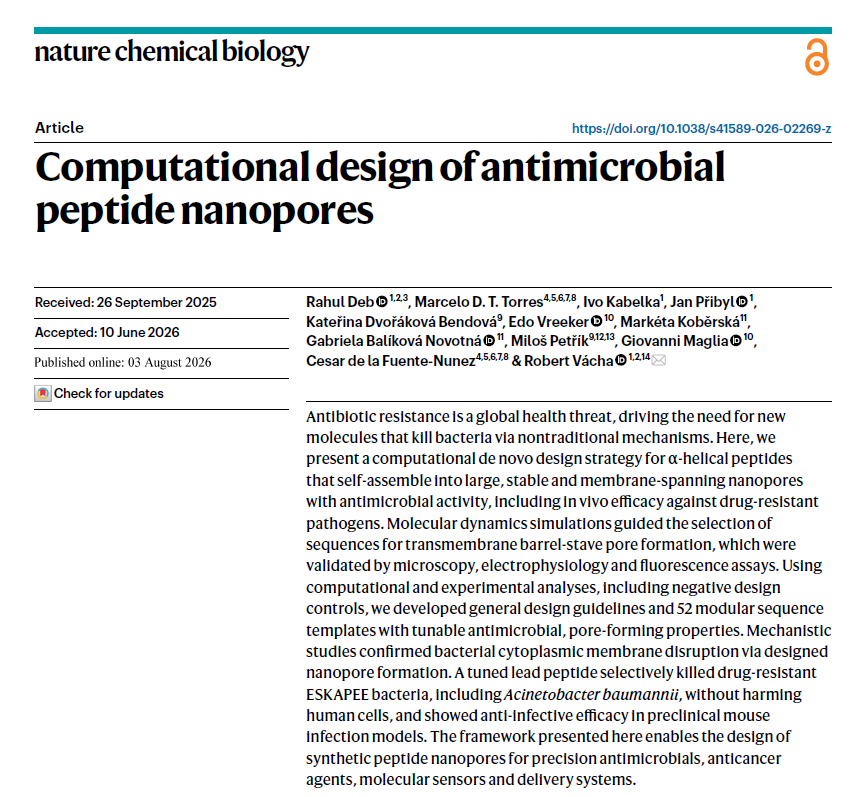
Today in @nchembio, we report a new class of synthetic antimicrobial peptides that self-assemble into barrel-stave nanopores in cell membranes, effectively killing drug-resistant bacteria and showing efficacy in mouse infection models.
https://t.co/L9qA2lZOZZ
🧵 1/4
Today in @nchembio, we report a new class of synthetic antimicrobial peptides that self-assemble into barrel-stave nanopores in cell membranes, effectively killing drug-resistant bacteria and showing efficacy in mouse infection models.
https://t.co/L9qA2lZOZZ
🧵 1/4
Published today in @nchembio@NaturePortfolio: a framework for the de novo design of antimicrobial α-helical peptides that assemble into transmembrane barrel-stave nanopores.
By combining computational design with mechanistic and experimental validation, we developed 52 modular sequence templates and demonstrated in vivo efficacy against drug-resistant pathogens.
This work advances our broader goal of learning the principles that govern biological function—and using them to engineer new therapeutic molecules.
Grateful to an outstanding team of collaborators: @rahuldeb60991, @mdt_torres, @EdoVreeker, @KoberskaMarketa, @MagliaGiovanni, @LabVacha, Ivo Kabelka, Jan Přibyl, Kateřina Dvořáková Bendová, Gabriela Balíková Novotná, and Miloš Petřík, @muni_cz, @jisuniversity, @univgroningen, @Penn@PennBioeng@PennEngineers@PennMedicine@PennChemistry@CBE_Penn@PennMicro@PennPsych@PennSAS
https://t.co/WzNMnFfsmf
Today in @nchembio, we report a new class of synthetic antimicrobial peptides that self-assemble into barrel-stave nanopores in cell membranes, effectively killing drug-resistant bacteria and showing efficacy in mouse infection models.
https://t.co/L9qA2lZOZZ
🧵 1/4
Thanks to all our co-authors and collaborators for making this possible!
@LabVacha@delafuentelab@MagliaGiovanni@mdt_torres@EdoVreeker Markéta Koběrská, Ivo Kabelka, Jan Přibyl, Kateřina Dvořáková Bendová, Gabriela Balíková Novotná, and Miloš Petřík.
🧵 4/4
Physicists say they have successfully demonstrated via high-resolution simulations that a DNA molecule can in principle behave like an Archimedes screw in nanoscale.
Learn more: https://t.co/KsDUDxzkj5
Large-diameter DNA-scaffolded nanopores created by @ZPeng_Scientist are now available. Loosely packed alamethicin peptides enabled stable synthetic nanopores that detect DNA and peptides. Thank you for the wonderful collaboration with @futaki_lab !
https://t.co/ESCyFJyJh4
De novo design of DNA origami with a generative diffusion model
1 Generative SNUPI introduces diffusion-model-based inverse design for DNA origami: given a user-defined line-based target geometry, it generates base-pair-level 3D structures that are physically plausible, then automatically produces scaffold routing and staple sequences for experimental fabrication.
2 A key bottleneck in generative DNA origami—lack of large standardized structural datasets—is addressed by training on simulated equilibrium conformations: 450 wireframe 2HB designs (216 2D, 234 3D) whose base-pair coordinates were generated with the SNUPI multiscale model.
3 The generative core is a denoising diffusion probabilistic model operating on base-pair coordinates as a point-cloud-like representation, implemented with a scalable graph Transformer using random graph construction and SE(3)-aware geometric handling to avoid alignment during training.
4 To follow a target shape, the model uses conditional guidance based on optimal transport: classifier-style gradients derived from Wasserstein Distance (WD) bias diffusion sampling so generated structures converge toward the provided geometry, improving shape fidelity and routing success.
5 Across 100 diverse conditional generations (hundreds to ~15,000 base pairs), the WD to the target drops from widely varying initial values (192.69–2178.54 nm) to a low final average of 2.21 ± 1.32 nm, indicating consistent convergence to the intended geometry across sizes and complexities.
6 The pipeline goes beyond shape generation by integrating a deterministic routing program: generated geometries are converted into loop representations, spanning trees, scaffold routes, and staple sets (20–60 nt), with bond-length regularization (0.34 ± 0.05 nm), and export to atomic models via CNDO → oxDNA → PDB post-processing.
7 Generative SNUPI also embeds fast, in-workflow physics evaluation using SNUPI-based simulation to predict equilibrium shapes and flexibility (RMSD, RMSF) without heavy molecular dynamics; for 100 designs, many cluster around RMSD 2.49 ± 1.29 nm and average RMSF 1.72 ± 0.15 nm, enabling pre-experimental screening.
8 Experimental validation shows the simulation-guided design loop is actionable: a “Face 1” dog design predicted to have locally high RMSF folds with high monomer yield yet shows AFM distortion; adding edges to stiffen flexible regions (“Face 2”) improves AFM agreement and reduces RMSD (4.07 ± 0.48 nm to 3.45 ± 0.35 nm).
9 The framework supports functional free-form mechanics and assembly: auxetic metastructures (rotating triangle, re-entrant) are designed and experimentally transformed open→closed using junction gaps plus site-specific connectors, achieving mean enclosed-area reductions of 34.9% and 47.3%; modular dog face/body components with matched curved interfaces assemble into dimers with >65% yield across combinations.
💻Code: https://t.co/4KigxW10Ij
📜Paper: https://t.co/degbRVGCMd
#DNANanotechnology #DNAOrigami #GenerativeAI #DiffusionModels #InverseDesign #ComputationalBiology #Biophysics #Nanorobotics #StructuralBiology #MachineLearning
Don't miss it: THE meeting on single molecule protein sequencing in Thailand in november: https://t.co/XRQr8WFVsx
Abstract deadline flor #SMPS5 is June 15!
Excited to share that I recently joined the @KawanoLab__tuat!
These photos are from the warm welcome parties — first by the Kawano Group, and second by the university. Grateful for the kind welcome and looking forward to exciting research in nanopore sensing technologies ahead!
Finished working with JIS University after 1y3m: taught pharmaceutical chemistry (UG & PG), guided master’s research, and worked with academic teams. I leave with a grounded, first-hand understanding of private academic culture in Kolkata—carrying this perspective forward.