Great clip from VALUExBRK 2026 where Bill Ackman breaks down the $META thesis concisely.
The market occasionally gets nervous about Mark Zuckerberg treating side projects as expensive hobbies. Ackman believes Zuckerberg's long-term track record proves he is a highly rational capital allocator. I agree. Holding a single failure/misstep against what Zuck built does not make sense to me.
AI is a significant copper demand driver. Data centers need copper for power distribution, cooling, and connectivity, and analysts see AI infrastructure adding to the same structural trend as EVs and grid upgrades.
The copper demand story keeps getting stronger and Kamoa-Kakula, the world's highest-grade major copper complex, is set to ramp up to over 500,000 tonnes from 2028.
$IVN
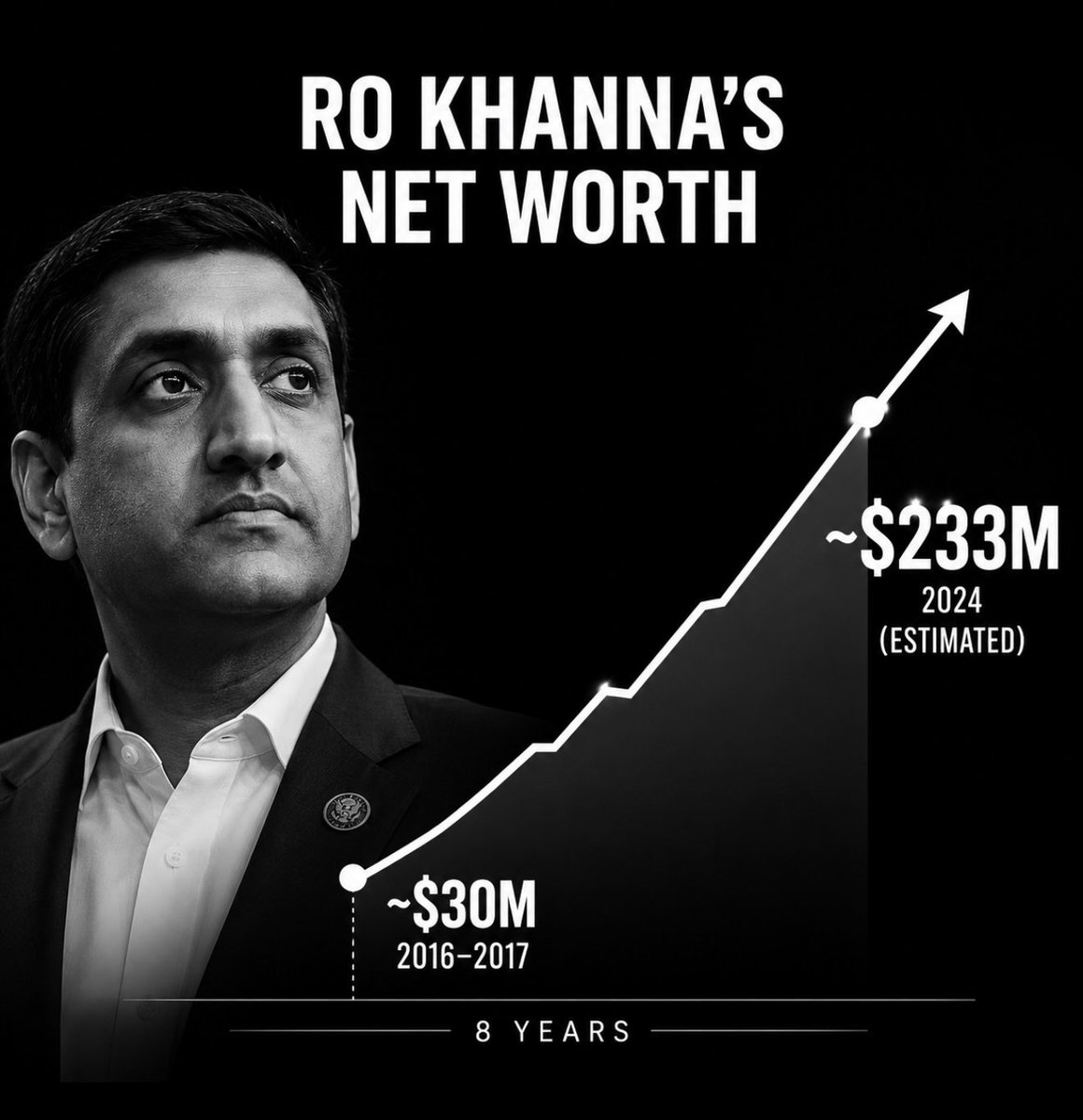
BREAKING: Elon Musk calls out Ro Khanna as his household wealth reportedly grew from roughly $27–46 million to an estimated $232.7 million.
• 631 million total trade volume across 38,666 trades since entering Congress, most prolific Democratic trader in House history.
• 2022 investigation found 15% overlap between his legislative work and family stock holdings
• Ro Khanna’s AI-focused trades returned +112.1% excess over the S&P 500 from January 2024 through April 2026, far beating Nancy Pelosi’s +38.5% outperformance.
• 143% return on Nvidia shares bought via wife’s trust in Feb 2024, right before CHIPS Act helped double the stock
Ro 'the Robber' Khanna seems to be the most active insider trader in Congress.
"The world needs another private equity fund like a hole in the head."
That is the founder of private equity talking. Henry Kravis, at Columbia Business School, on why he would never start a PE fund today.
China alone has more than 5,000 PE funds. The model he invented is now saturated.
His alternative: the Berkshire route. Buy one company, install a great CEO, compound forever, keep 100% of profits instead of 20% carry.
When the man who built the model says it is second-best, LP capital concentrates at the survivors.
Why this is bullish for the mega-managers: https://t.co/nkzEGCxycz
Source: Columbia Business School - https://t.co/wzXIR2KPJr
Chime $CHYM: Unhappily Ever After?
In the year since its IPO, Chime’s execution has been solid. It is thoughtfully monetizing its member base to drive attractive top-line growth while maintaining a sizable cost advantage relative to incumbent banks and other fintechs, leveraging ChimeCore—its proprietary processing platform and ledger system, which was delivered ahead of schedule—to innovate faster and lower costs, and moving toward meaningful GAAP profitability sooner-than-expected. Still, shares have languished, down about one-third from their IPO price of $27. I believe there are a handful of contributing factors:
Total spending-based volume growth is slowing. In its latest quarter, Chime’s total spending-based volume, which includes card purchases and outbound instant transfers, or OITs, grew 14.5%, slowing from more than 19% growth at the start of 2025. This is a continuation of a longer-term trend that has seen Chime’s spending-based volume growth fall below active member growth, suggesting fewer active members are adopting Chime as their primary financial relationship.
At the time of its IPO, the company reported 67% of its active members used Chime as their primary financial relationship, driving 55 transactions per month, on average, across its member base. Although Chime has not updated these metrics, their language has shifted…slightly. Now, a ‘majority’ of members use Chime as their primary financial relationship, driving ‘more than 50’ transactions per month, on average, across its member base. While the change may sound trivial, minor changes in the trajectory of Chime’s most important KPI—primary financial relationships—can be meaningful for a fast-growing, and high-multiple company, like Chime.
Lending-based revenue is becoming a larger part of Chime’s business. As of Q2 2024, lending-based contributions to Chime’s revenue were minimal. Now, they make up about 20%. By the end of 2026, with the planned expansion of Instant Loans, they could make up closer to one-quarter of Chime’s revenue. While lending products are important, and a key reason why some members join Chime, the market places a lower value on their associated revenue and profit, in my opinion. Overall, slowing spending-based volume growth and an increasing mix of lending-based revenue is generally not a good combination, and was particularly problematic for Block’s Cash App. I believe spending-based volume growth must stabilize or improve before shares of Chime can move materially higher.
Competition is increasing. Chime faces a range of competitors: incumbent banks, domestic fintechs like Cash App $XYZ, Venmo $PYPL, SoFi $SOFI, Dave $DAVE, MoneyLion, now owned by Gen Digital, OnePay by Walmart, Green Dot, and Netspend, BNPL providers like Affirm $AFRM and Klarna $KLAR, and global fintech heavyweights like Nubank $NU and Revolut. Although not dramatically different, in my opinion, an argument can be made competition is increasing. By Chime’s own admission, since SpotMe, Chime’s fee-free overdraft product, was launched in 2019 banks in the United States have cut overdraft fees in half. Given that avoiding fees is one of the main reasons why a new member joins Chime, lower—or zero—overdraft fees at incumbent banks may make it less likely people switch. Among domestic fintechs, incentives are on the rise as they all chase the coveted direct deposit relationship. Launched in November 2025, Cash App Green provides similar benefits—a higher savings rate, special rewards, and higher borrowing limits—as Chime Plus to entice greater engagement. Likewise, Venmo is offering enhanced rewards (5% cash back) at select brands when a user direct deposits $500 into their Venmo account each calendar month. Both Affirm and Klarna offer a card that can flex between everyday spend funded by a checking account and BNPL loans for larger discretionary purchases. Finally, Nubank and Revolut have applied for bank charters in the United States and promise a concerted effort to expand in the country if (once) approved.
From my perspective, Chime is among the most consumer-friendly fintechs in the world, which should stand for something. What I believe it provides Chime is greater visibility into sustained revenue growth of 15-20% and substantial progress on reaching the company’s long-term adjusted EBITDA margin goal of 35%, or more. At less than 16x my 2027 EBITDA estimate of $409 million, which is burdened for stock-based compensation, Chime starts to look attractive. However, to borrow a biblical phrase, there is no room left at the inn given an abundance of higher-quality payment and fintech companies trading at, what I believe, are similarly attractive valuations. While Chime is a name to consider for gaining exposure to fintech lending, I still prefer Block $XYZ over Chime, and the best values I see today across payments and fintech—and where I’m allocating capital—are Mastercard $MA, Intuit $INTU, Adyen $ADYEN, and Broadridge Financial $BR, in no particular order.
Full report is in link below
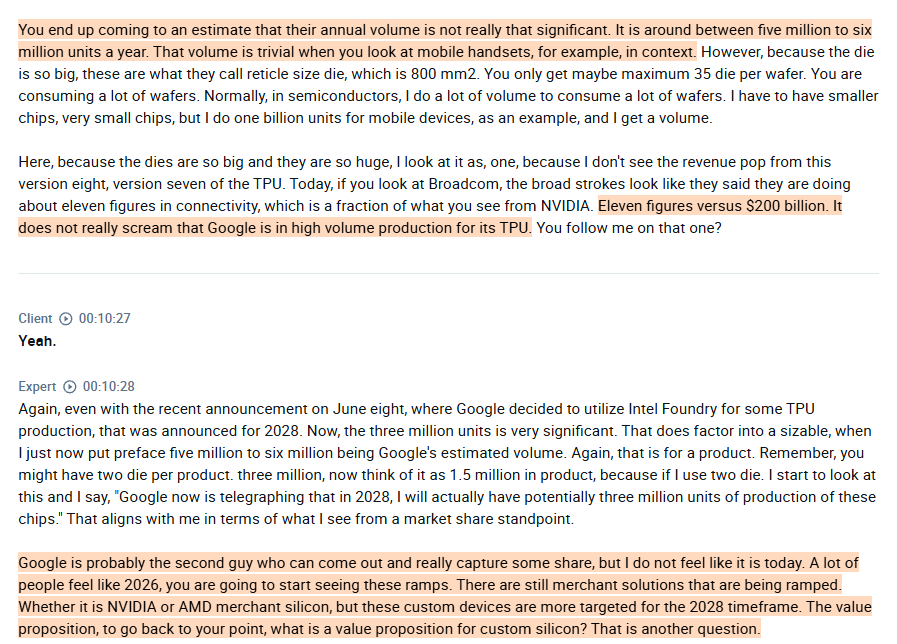
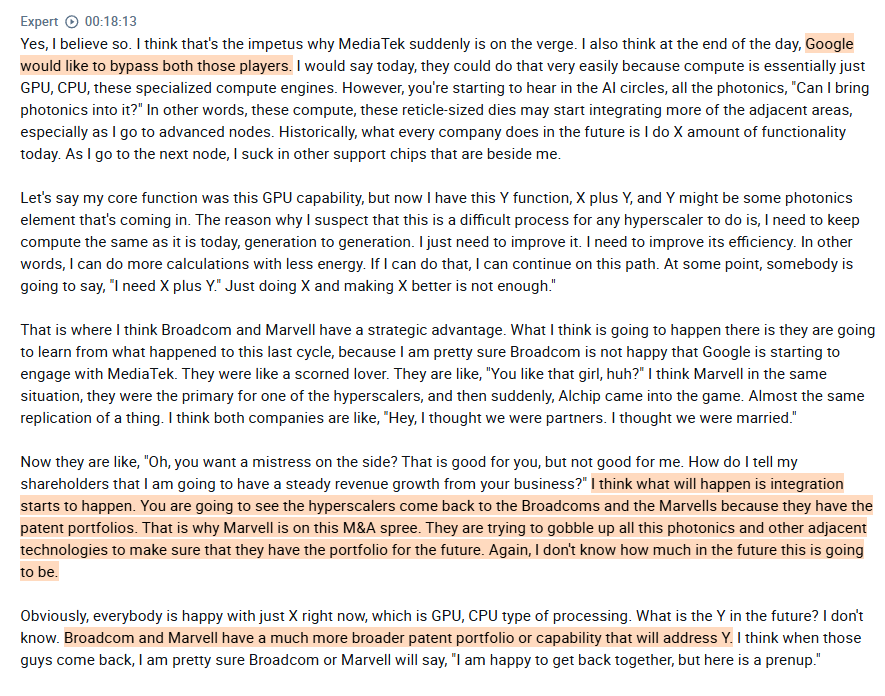
Interview with an $AMD employee on why photonics and next-generation chip complexity will bring hyperscalers back to $AVGO and $MRVL ( $AMZN, $GOOGL, $MSFT ):
- The expert sees $GOOGL's approach to $AVGO and MediaTek as a deliberate move to never rely too heavily on one supplier, alternating chip development between vendors across generations so that no single partner can take advantage of the relationship, something the expert notes silicon companies have been known to do.
- The margin differential is a strong financial incentive, with $AVGO running at 70%+ gross margins compared to MediaTek's 50-60% range, and a newcomer potentially going even lower to win business, creating savings that $GOOGL could redirect toward building more internal silicon independence.
- $GOOGL already handles the front-end chip design itself, which is the most valuable part of the process, while outsourcing backend layout, manufacturing, and $TSM coordination to partners like $AVGO or MediaTek, meaning the switching cost is lower than it might appear from the outside.
- The expert sees custom silicon, including $GOOGL's TPU, still in an early phase rather than at meaningful volume production when measured against $NVDA's scale. He believes that 2028 is the more realistic inflection point, citing $GOOGL's recent announcement that $INTC Foundry will produce around 3 million TPU units that year as the first real signal of meaningful scale.
- The expert emphasizes $GOOGL's biggest challenge in scaling TPU adoption as an ecosystem problem rather than a hardware one. $NVDA's CUDA has years of developer familiarity behind it, and $GOOGL's tooling, while improving, has not yet reached the point where it can automate the heavy lifting without engineering support. For high-value customers like Anthropic, $GOOGL can afford to dedicate engineering resources to make the transition work, but that model does not scale to the broader market.
- The expert believes things will get more interesting when chips need to do more than just compute, with photonics and other technologies starting to get pulled into next-generation designs. That is where $AVGO and $MRVL have an advantage, given their broader patent portfolios in these areas. The expert expects hyperscalers to come back to these players as chip complexity grows beyond what pure compute improvements can handle, and notes that $AVGO and $MRVL will be in a stronger negotiating position at that point, having learned from being sidelined.
$KXIAY “JPMorgan now forecasts roughly 160% EPS CAGR over the next three years and has raised its price target from ¥80,000 to ¥155,000. Revenue is expected to increase almost eightfold between FY2026 and FY2029 while EBITDA margins approach 80%.”
Krishna Rao is the CFO of Anthropic, and this is his first podcast appearance.
He joined the company two years ago when run-rate revenue was about $250M. Today it is $30B. He has helped raise ~$75B and is responsible for the procurement and allocation of compute.
I feel lucky we get to hear what it is like to sit inside a company this consequential at a moment this pivotal.
We discuss:
- The cone of uncertainty
- How he allocates compute across Trainium, TPUs, and GPUs
- What investors misunderstand about model companies
- Why the returns to frontier intelligence keep rising
- Platform vs application and where Anthropic builds its own products
- How Anthropic uses Claude internally
I have asked my closing question about the kindest thing more than 500 times. Krishna's answer is one I have never heard before.
Enjoy!
Timestamps:
0:00 Intro
2:38 The Compute Canvas
6:51 The "Cone of Uncertainty"
11:58 Why the Returns to Frontier Intelligence Are So High
16:45 Recursive Self-Improvement
20:20 Scaling Laws
23:30 Sourcing $100 Billion in Compute
28:05 Platform vs. Application Strategy
32:52 Pricing Dynamics
38:48 How Anthropic’s Finance Team Uses Claude
43:24 Raising Capital & Overcoming Investor Skepticism
52:32 Public Perception, Risks, and Government Regulation
57:25 Mythos Release
1:12:33 What Could Derail the AI Revolution?
1:13:47 Biotech and Healthcare
1:15:31 The Kindest Thing
Kingstone Companies ($KINS), a NY specialty coastal insurer trading at 6x our FY26 EPS estimate. $220M market cap. Just posted the best year in its 17-year history: 43% ROE, 75% combined ratio, $40.8M net income. Peers with similar ROEs trade at 12-15x. Here's why this could be a multibagger:
The market sees a NY coastal insurer with weather-dependent earnings and a failed multi-state expansion behind it. We see a fundamentally different company. The CEO is ex-Bridgewater, former advisor to Ray Dalio. He took over a company on the brink of bankruptcy and rebuilt it from scratch.
The turnaround numbers speak for themselves. Expense ratio cut from 41% to 30%. 60% of the book shifted to a new product with 33% lower claims frequency. Direct written premiums grew 15% to $277.8M . The holding company is now debt-free. The dividend has been reinstated after a three-year pause.
The market is pricing structural ROE at 16-17%, the level the old management achieved before their reckless expansion blew up the company. Management is guiding 24-30% ROE for FY26, and that assumes above-average catastrophe losses. We think structural ROE sits at 22-25% with line of sight to 30%+. The business has been rebuilt with modern data-driven underwriting pricing solutions and a permanently lower cost base. This is not a reversion to the old KINS. This is a new company trading at the old multiple.
Growth is multi-year structural. Organic premium growth was 16% in Q1 2026 ex-acquisitions. New York policy terms are three years, so the AmGUARD non-renewal alone delivers an estimated $ 25-35M of premium over 2025-2028. Management's five-year target of $500M in DWP implies a 15.8% CAGR, slightly below their 14-year historical pace of 14.7% annual growth through two management eras and a major crisis.
California entry is not a repeat of 2017. Back then, legacy product, no data-science underwriting, admitted lines where you can never exit a bad risk. Today: E&S lines with mid-policy non-renewal rights, the Select product modified by the same actuarial firm, capped at less than 5% of 2026 premium with a 30% quota share. California is a $15B homeowners market, twice the size of New York, with major carriers exiting. If it works, it adds diversification and growth. If it doesn't, they walk away with minimal damage.
The shareholder alignment is as strong as it gets. An activist with a 7.6% stake ($12.3M deployed) filed a 13D in March demanding a strategic review including a sale. The chairman just bought $200K in shares on the open market. The CEO holds a meaningful stake. Combined insiders plus the retired founder hold over 11%.
Investment income is another tailwind nobody talks about. Portfolio yield went from 3.7% to 4.3%, with $34M of low-coupon bonds rolling off into ~5% reinvestment rates through year-end 2026. Net investment income grew 44% in FY25 and 63% in Q1 2026.
Insurance is largely unaffected by macro. And it will probably be a net winner from the AI revolution as niche insurers build better pricing models to underwrite more profitably. While tech investors are paying 30x hoping AI creates value, insurers like KINS are already using it to compound returns.
Base case: structural ROE confirmed, multiple re-rates from 6x to 10-12x forward EPS. $25-30 per share. +65% to +100%. Bull case: California works, multiple expands to 14-15x. $35-45. +130% to +200%. Bear case: ROE normalizes to 17-18%, stock stays around today's price. About -20% downside.
You're paying 6x earnings for a company printing 43% ROE with double-digit growth, a debt-free balance sheet, a reinstated dividend, a buyback for 7% of shares, and an activist pushing for a sale. The market is still pricing the near-bankruptcy. Management has already proven otherwise. The risk-reward is asymmetric.
Full 40-page deep dive on Undervalued and Undercovered.
Joel Greenblatt's "Special Situation Investing" notes from his Columbia class might be the best free investing resource on the internet.
One of the best 10-year track records (~40% a year), teaching the course he wished he'd had as a student.
https://t.co/81giJoT6f1
Weekend reading recommendations:
• JPMorgan — AI Drives Resurgence in Custom Chips (ASICs): ASIC Market Overview/Update
• SemiAnalysis — Stop Saying Half of 2026 US Datacenter Capacity Is Canceled
• Bernstein — Global Semis: The CPU Renaissance? Beneficiaries of a $223bn TAM…
• UBS — Largan Precision: CPO catalysts alongside firm core smartphone lens demand support further upside
Everyone talks about GPUs, memory, and lasers.
But the real bottleneck is the only one both humans and data depend on to run.
IT'S WATER.
$ERII is up 8% today since I dropped my long thesis yesterday to clients.
So here's why this $500M water tech stock down 50% in 3 months could be an asymmetrical bet.
I first spotted $ERII in March, but I was too early.
Now I think a few catalysts put this small cap gem in prime re-rating territory.
$ERII makes a special piece of tech that makes desalination plants economical. The PX Pressure Exchanger recycles the pressure inside a seawater reverse osmosis plant and cuts its energy use by up to 60%. This hero product accounts for over 90% of $ERII's revenue and commands gross margins over 60%.
I love $ERII because it feels like a high margin IP business, not a low margin industrial, despite being priced like one.
So why is the stock trading half off its February $16 price and a fraction of its comps?
The Middle East, the world's largest desalination market, is 50% of their revenue. And two huge gut punches nuked the stock across two ER's.
1) Revised 26 guidance down before the Iran War started.
2) Removed 26 guidance entirely during the War due to the massive ME concentration of business. Then the CEO and CFO both left.
But the business isn't broken. And the Iran War looks to be resolved, making more signals of sustained ME peace a real catalyst.
Q1 is their smallest quarter historically and revenue still grew 20% YoY. The ugly Q1 loss was a one time charge from killing their CO2 side project. Q4'25 was a record $66.9M at 67% gross margin.
The balance sheet is a fortress too. $77M net cash, almost no debt, a 9x current ratio, ~$27M TTM FCF, and they buy back stock at a ~9% yield. You get paid to wait and this is not a small cap where you get diluted.
The tailwinds are massive for $ERII's desalination business and I think the market may be mispricing $ERII's growth potential on 4 vectors.
1) Fast Growing Market
Water scarcity isn't a regional story anymore, it's a global one. Rivers and aquifers are drying up while population, industry, and now AI all pull harder on the same shrinking supply, and desalination is the backstop the world keeps falling back on. Reverse osmosis dominates new capacity, every RO plant needs an energy recovery device, and the PX is the standard, so $ERII's installed base scales as desal scales globally.
2) Water As Warfare
The Iran war turned water into a weapon. Plants got hit across Bahrain, Kuwait, the UAE and Iran, and with desal supplying up to 90% of water in some Gulf states, every ministry just learned a centralized, aging fleet is a strategic weak spot. The answer isn't to build less. It's to harden, decentralize, and build MORE, which means more PX sales.
3) Middle East AI
Every gigawatt of compute landing in the Gulf has to be cooled, and up to 90% of the region's water comes from desal, so water is the constraint of where you can build. PwC sees Gulf data center capacity tripling to ~3.3GW by 2030, all running through RO where $ERII sells the picks and shovels. Management isn't even telling this story yet, but when they bring in a new permanent CEO, I could see him pushing AI + water scarcity angle.
4) AI Factory Wastewater Upside
This one is early but $ERII just carved wastewater out as its own segment, it's ~6% of revenue today. It's the OTHER end of the AI water story: data centers and the chip fabs feeding them discharge dirty water and the laws require treatment before it leaves. ERII uses the same PX tech here with same 60% margin profile, and management expects this to get bigger in 2027.
The comps do a ton of the work to feel good about the valuation here.
$ERII has the smallest market cap and the highest gross margin in water tech (63%) while trading at the LOWEST 24x TTM PE multiple. ~25x vs $XYL 28x, $BMI 30x, $FELE 31x.
The catalysts?
- Iran War peace deal finalized
- $300B Iran investment would boost any stocks with strong ME geography exposure
- Company re-affirms guidance for 2026 in Q2 or Q3 call
- New CEO joins replacing interim CEO and maybe introduces AI angle to boost narrative
The risks.
Re-escalation. If Israel and Iran flare back up, the momentum dies and this might retests the lows. Projects will get even more delayed.
Guidance. The reinstatement they flagged for Q2/Q3 could be pushed to Q3/Q4 and come later than we hope.
Leadership. The CEO retired and the CFO resigned in the same quarter, and the permanent CEO search is still open.
Lumpy revenue. This is a project driven, back half-weighted business where big orders slip without warning. February proved it.
But the floor is real. ~$77M net cash (nearly 1/5 MC), no debt, a 9% buyback. A $500M company growing 20% retiring its own shares is not the kind that drops to 0.
DYOR. NFA.
Make sure to join my VIP discord through my Substack at the link in my bio to chat with me and our analysts about this name.
Chamath says his father chose welfare and drinking over working
"My father couldn't get a job. So, we were on welfare and welfare was probably 17, 18, $19,000 a year at the time in Canada. And it's a family of five."
...my dad just spent this cycle between drinking and not working, drinking and not working......But could he have gotten a job making eight or 10 bucks an hour at a store? He could have. He chose not to. "