Scheduling virtual machines (VMs) is like a puzzle game with disappearing pieces. Here we present LAVA, an AI-based scheduling algorithm that continuously re-predicts & adapts to the lifetimes of VMs to optimize resource efficiency in cloud data centers. https://t.co/EUwx1fKZcO
✨ Internship Opportunity @ Google Research ✨
We are seeking a self-motivated student researcher to join our team at Google Research starting around January 2026. 🚀 In this role, you will contribute to research projects advancing agentic LLMs through tool use and RL, with the goal of enabling breakthrough applications.
We are particularly interested in PhD students with a strong background in these areas. If interested, please send a brief self-introduction and your CV to [email protected]. Looking forward to connecting with talented researchers in this exciting space!
Here's a link to similar CTF problem in case anyone is interested.
The vulnerability relies is in the way money is stored and rounded off.
https://t.co/fPe2Oy8Q5k
An early rule you learn in computer science is:
“Never store currency as floats”
Nearly every popular language has special, built-in types for money. But why?
The *majority* of money-like numbers have no float representation, accumulating to massive errors over time:
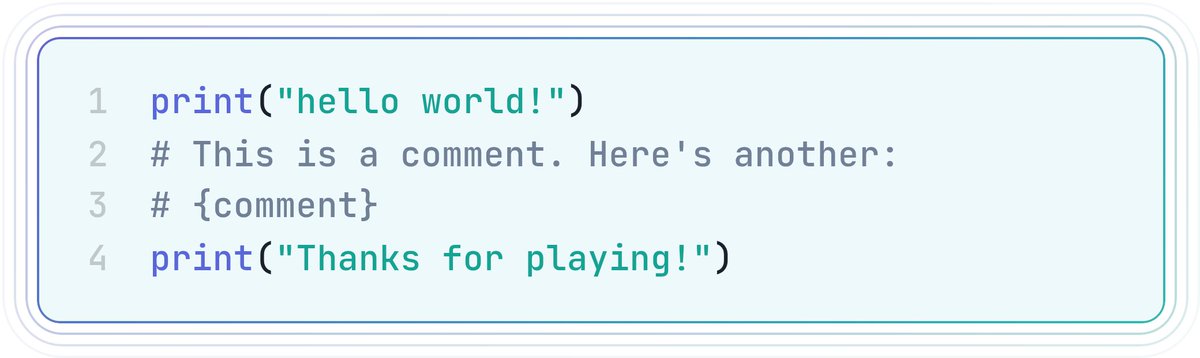
Can you execute arbitrary Python code from only a comment? This was the premise of a recent CTF challenge, which I solved after diving into the CPython source code with the help of @HacktronAI (after a long night chasing a dead end, customising a few Hacktron agents helped me to solve it in 2 hours the following morning).
Here's how Python's overzealous zip file detection can lead to unexpected code execution vulnerabilities when well-escaped user input is injected into comments or string literals in Python source files.
👇Link below...
@evilsocket Medium used to disarm the paywall when a direct post link is clicked from Twitter. Mimicking referer header used to work. Not sure if it is still the case.
This is my lecture from 2 months ago at @Cornell
“How do I increase my output?” One natural answer is "I will just work a few more hours." Working longer can help, but eventually you hit a physical limit.
A better question is, “How do I increase my output without increasing input as much?” That is leverage.
We hear “leverage” so often that its implication is easy to overlook. My personal favorite categorization of leverage is by Naval Ravikant: human labor, capital, and code / media. Each has powered major waves of wealth creation in history.
However, once a leverage source becomes popular (think YouTube channels today versus ten years ago) competition compresses the margin. So when a new leverage appears, it’s a rare chance for outsized gains.
In this talk, I describe AI as that emerging leverage. An AI agent blends labor leverage (it does work for you and is permissionless) with code leverage (you can copy-and-paste it).
It’s cliché to say AI will create massive wealth. But using this leverage lens lets us interpret the noisy AI news cycle in a consistent way and spot the real opportunities.
Thanks @unsojo for hosting me!
@kenjin4096 While this is not directly related to CPython's JIT, I would like your thoughts on feasibility/utility of a tool to AOT compile a Python package. Like pyinstaller, but without packing the full interpreter inside. Instead, generate machine code stencils and patch in runtime.
The is diabolical... a Python object that hallucinates method implementations on demand any time you call them, using my LLM Python library https://t.co/z2fHhirW9z
Just published. I think everyone who uses git would benefit from this information. While git reflog by itself is a simple log, it takes a lot to understand its output.
Credits to the amazing Git zine from @b0rk.jvns.ca
https://t.co/rKnSB410qZ