We were pleased to have our account featured in a new article by The Times of India. If it wasn't for our X account and followers, we'd just be playing and governing cricket on a frozen volcanic rock in the North Atlantic.
#HYDTPweBringAwareness
📢 Attention Vehicle Owners!🚗📢
Ensure that your mobile number and e-mail ID are updated on the VAHAN Portal to receive important vehicle-related communications, including e-Challans, directly through:
✅ SMS
✅ WhatsApp
✅ E-mail
Updating your contact details helps you stay informed and avoid penalties due to missed notifications.
🌐 Update your details today:
https://t.co/uolsLMvuc6
📱 You can also scan the QR code provided to update your registered mobile number quickly and easily.
⚠️ As per the Government notification, challans sent to the registered mobile number or e-mail ID available on the VAHAN Portal shall be deemed as duly served to the vehicle owner.
🔹 Update Today. Stay Informed. Avoid Penalties.
#HyderabadTraffic #RoadSafety #TrafficAwareness #StayUpdated #DigitalGovernance #CitizenServices
FIFA Facts That Hit Like a Red Card:
1. Brazil is the only nation to have played in every single FIFA World Cup, all 22 editions from 1930 to 2022, never missing a single one.
2. The ball used in the 2010 World Cup (the Jabulani) was so aerodynamically unpredictable that goalkeepers across the tournament compared it to a "plastic bag in the wind."
3. Messi holds a record 8 Ballon d'Or awards, more than the combined total of most entire national teams have won major international trophies.
4. A professional footballer makes over 1,000 individual decisions per game, most in under half a second.
5. The fastest player speed recorded in the Premier League is 37.38 km/h, set by Micky van de Ven, and players hit these speeds mid-match, under fatigue, in real competitive pressure.
6. Cristiano Ronaldo became the first individual in history to surpass 1 billion social media followers. His Instagram alone has over 639 million, more than the combined populations of the US, UK, and Germany.
7. The net behind a goal is not required by the Laws of the Game. It's technically optional.
8. India qualified for the 1950 World Cup but withdrew, not because FIFA banned barefoot play as the myth claims, but due to funding issues, logistical chaos, and the AIFF simply not prioritising the tournament over the Olympics.
9. A goalkeeper defending a penalty has to dive before the ball is struck. The human eye simply cannot react fast enough afterward.
10. The entire Laws of the Game that govern football worldwide fit into a document shorter than most corporate employee handbooks.
11. Paul Pogba's 2016 transfer fee of €105 million was, at the time, larger than the entire annual GDP of several small island nations.
12. In high-altitude stadiums like La Paz, Bolivia (3,600m), the ball travels measurably faster and farther. Visiting teams have called it "physically impossible" to play there.
13. The World Cup trophy cannot be kept by the winning nation. They receive a gold-plated replica. The real one stays with FIFA permanently.
14. A football player runs on average 10–13 km per match, the equivalent of running two 5K races back to back, while sprinting, tackling, and thinking tactically the whole time.
15. A football pitch's grass is cut to exactly 25–30mm for top matches. Groundskeepers spend more preparation time on the surface than most fans ever notice.
16. During a penalty shootout, players' heart rates can exceed 180 bpm, the same as a full sprint, while standing completely still.
17. The first World Cup in 1930 had no qualification rounds. Countries were simply invited, and several said no because the boat trip to Uruguay was too long.
18. VAR can detect an offside by a margin of just a few centimetres, roughly the width of a thumb, and disallow a goal scored from 70 metres away.
19. Some Premier League clubs generate more revenue on a single matchday than entire national football federations earn in a full year.
20. The fastest goal in World Cup history was scored by Turkey's Hakan Şükür, just 11 seconds into the third-place match against South Korea in 2002. Most fans in the stadium hadn't even found their seats.
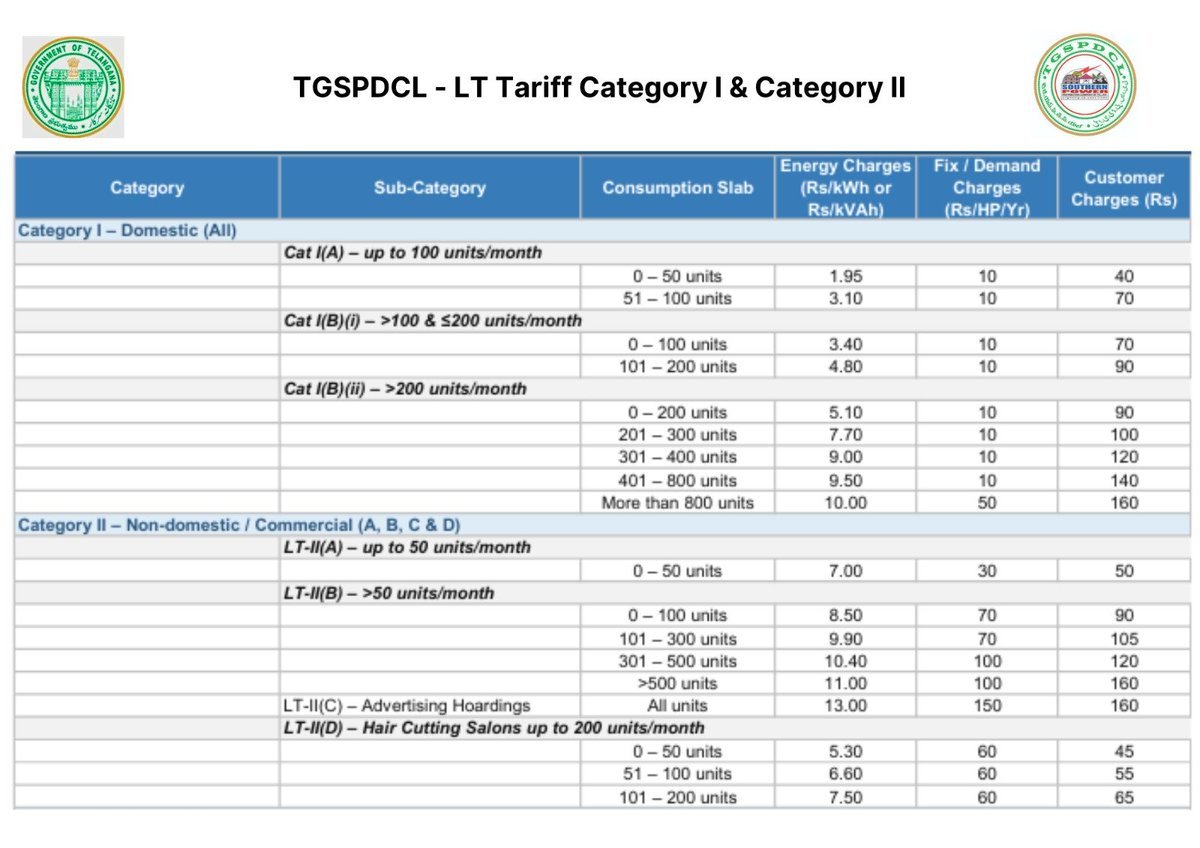
💡 *మీ విద్యుత్ బిల్లు మీకు పూర్తిగా అర్థమవుతుందా?*
వినియోగదారుల సౌలభ్యం కోసం TGSPDCL మీ విద్యుత్ బిల్లులోని ప్రతి అంశం మరియు అమల్లో ఉన్న విద్యుత్ టారిఫ్ రేట్ల వివరాలను అందిస్తోంది.
✅ మీ వినియోగ యూనిట్లు ఎలా లెక్కించబడతాయి?
✅ ఏ కేటగిరీకి ఏ టారిఫ్ వర్తిస్తుంది?
✅ Energy Charges, Fixed Charges, Customer Charges అంటే ఏమిటి?
✅ మీ బిల్లును మీరు స్వయంగా ఎలా ధృవీకరించుకోవచ్చు?
సరైన అవగాహనతో విద్యుత్ వినియోగాన్ని ప్రణాళికాబద్ధంగా నిర్వహించండి – పొదుపు చేయండి.
*TGSPDCL – పారదర్శక సేవలు, వినియోగదారుల విశ్వాసమే మా లక్ష్యం.*
#TGSPDCL #ConsumerAwareness #ElectricityBill #PowerForAll #Telangana
*విద్యుత్ బిల్లుపై పూర్తి అవగాహన – వినియోగదారుల కోసం TGSPDCL ప్రత్యేక సమాచారం.* ⚡
📢 కరెంట్ బిల్లు ఎలా లెక్కిస్తారో తెలుసా ?
🔸 మీ విద్యుత్ బిల్లులో యూనిట్ల లెక్కింపు ఎలా జరుగుతుందో తెలుసుకునే అవకాశం కల్పిస్తోంది టీజీఎస్పీడీసీఎల్.
🔸 మీ కనెక్షన్కు ఏ టారిఫ్ కేటగిరీ వర్తిస్తుందో, దాని ప్రకారం బిల్లు ఎలా రూపొందుతుందో వివరాలు అందిస్తోంది.
🔸 ఎనర్జీ ఛార్జీలు, ఫిక్స్డ్ ఛార్జీలు, కస్టమర్ ఛార్జీలు వంటి అంశాలు బిల్లులో ఎలా లెక్కిస్తారో అవగాహన కల్పిస్తోంది.
🔸 వినియోగదారులు తమ బిల్లు వివరాలను స్వయంగా ధృవీకరించుకునే విధానంపై కూడా సమాచారం అందుబాటులో ఉంచింది.
#TGSPDCL #ElectricityBill #ConsumerAwareness #Telangana #Muchatlu
గిరివలం అంటే అలాచేయాలి!!
రమణులు ఎక్కడ ఇన్ని గంటల్లో గిరివలం పూర్తి చేసాడు .. ఇంత తొందరగా చేసాడు అని ఉండదు. ఆయన హ్యాపీ గా గిరివలం వెళ్లి, అక్కడే ఎక్కడో ఏదో కొంచెం తిని ,పడుకొని మర్నాడే ఎప్పుడో కంప్లీట్ చేసేవాడు. మనం ఆటోలో చూసి కోరికల చిట్టా ముందెడతాం
You've seen this scar on older people's arms. That weird little starburst on the shoulder.
It's not from a normal shot.
The smallpox vaccine wasn't injected like a regular jab. They used a bifurcated needle - basically a tiny fork with two prongs. Invented in 1965 by a guy named Benjamin Rubin, who ground down the eye of a sewing machine needle to make it.
Here's the wild part. You dip the needle in the vaccine and one drop gets caught between the prongs. That's the whole dose. Then you jab the arm 15 times, fast. Quick shallow pricks, just deep enough to draw a bit of blood and slip the weakened virus into the skin.
Your immune system does the rest. Red bump. Blister. Pus. Scab. Falls off. Scar for life.
The mark isn't from the needle. It's from your body fighting the virus. And the reason it looks like a starburst instead of a dot? Those 15 rapid punctures.
That scar is basically a receipt. Proof you survived one of the deadliest diseases in human history before we wiped it off the planet.
¿Por qué una parte del mundo usa 110 Voltios y el otro medio 220V, achicharrando tus aparatos cuando viajas? Este caos global que te obliga a comprar adaptadores es culpa del ego de Thomas Edison y su enfermiza obsesión por proteger una simple bombilla. Tira del hilo 🧵👇🏽👇🏽👇🏽
సెంట్రల్ హిందూ కళాశాల, బెనారస్ వారు 1916లో హిందూ మతం, నీతిశాస్త్రంపై ముద్రించిన సనాతన ధర్మం ప్రాథమిక పాఠ్యపుస్తకం (Sanatana Dharma: An Elementary Text-Book of Hindu Religion and Ethics) Link:
https://t.co/ijKO8ISEHi
ఈ పాఠ్యపుస్తకం భారతీయ హైస్కూల్ విద్యార్థులకు వారి జాతీయ మతం (సనాతన ధర్మం) గురించి సరైన ప్రాథమిక అవగాహన కల్పించడానికి రూపొందించబడింది. ఇది ఏ ఒక్క ప్రత్యేక శాఖకు లేదా సిద్ధాంతానికి పరిమితం కాకుండా, హిందూ మతం యొక్క సాధారణ మరియు ప్రాథమిక సూత్రాలను బోధిస్తుంది. ఇది విద్యార్థులలో భక్తి, కర్తవ్య నిర్వహణ, బలం, స్వయంసమృద్ధి మరియు ధర్మబద్ధమైన వ్యక్తిత్వాన్ని పెంపొందించడం లక్ష్యంగా పెట్టుకుంది.
పుస్తకంలోని ముఖ్యాంశాలు:
హిందూ మతం యొక్క పునాదులు, వేదాలు, మరియు సనాతన ధర్మం యొక్క ముఖ్య భావనల వివరణ
సృష్టి తత్త్వం: సృష్టికర్త (బ్రహ్మ), పోషకుడు (విష్ణువు), మరియు లయకర్త (శివుడు) వంటి ఈశ్వరుని త్రిమూర్తి స్వరూపాల వివరణ.
దేవతల పాత్ర: దేవతలు ప్రకృతిలో ఎలా పనిచేస్తారో, మరియు మనుషులకు వారితో ఉన్న సంబంధ వివరణ.
సనాతన ధర్మం: మనిషి తన జీవితంలో పాటించవలసిన సంస్కారాలు, యజ్ఞాలు, మరియు దైవ ప్రార్థనల గురించిన వివరణ.
వర్ణాశ్రమ ధర్మాలు: హిందూ సమాజ వ్యవస్థలో వర్ణాలు, ఆశ్రమాల ప్రాముఖ్యత, ప్రతి వర్గం పాటించవలసిన బాధ్యతలు మరియు ధర్మాల గురించిన వివరణ.
నీతిశాస్త్రం: జీవితంలో సరైన మరియు తప్పును గుర్తించడం, ఇతరులకు కీడు చేయకుండా జీవించడం, మరియు ప్రేమ, సత్యం, కరుణ వంటి సుగుణాలను పెంపొందించుకోవాలని బోధన.
ఈ పుస్తకం కేవలం చదువుకోవడానికే కాకుండా, ఉపాధ్యాయుల ద్వారా వివరణలతో నేర్చుకోవలసినది ప్రతి అధ్యాయం చివరన ఇచ్చిన శ్లోకాలను కంఠస్థం చేయడం ద్వారా మతంపై అవగాహన పెరిగేలా రచించబడింది.
సంక్షిప్తంగా చెప్పాలంటే, ఈ పుస్తకం హిందూ మతంలోని ఉమ్మడి విశ్వాసాలను విద్యార్థులకు పరిచయం చేస్తూ, వారిని మంచి పౌరులుగా, ధర్మబద్ధమైన వ్యక్తులుగా తీర్చిదిద్దే లక్ష్యంతో రూపొందించబడిన ఒక సమగ్ర పాఠ్య ప్రణాళిక ✊🙏
#SanathanaDharma @BHUOfficial
@MinOfCultureGoI @ignca_delhi
@ASIGoI @narendramodi #HinduReligion #HinduEthics
#SanatanaDharma #AncientWisdom #IndianHeritage #IndianEducation #VedicKnowledge #CentralHinduCollege #ValueBasedEducation #Samskara #EducationalHeritage #SpiritualEducation #ధర్మం #సనాతనధర్మం #హిందూమతం
A man married for 15 years says he has to fantasize about other women before he can remain sexually aroused and perform for his wife during sex.
He adds: "I no longer find my wife attractive."
He asked a sex therapist what to do about it.
Here's how the therapist replied...
Navodaya Book House ఇప్పుడు Xలో కూడా.
1990 నుండి కాచిగూడలో పుస్తక దుకాణం. తెలుగు సాహిత్యాన్ని ప్రేమించే ప్రతి ఒక్కరితో కలిసి ఈ ప్రయాణం కొనసాగించాలని.
Follow చేసి, మీ favorite Telugu book ని commentలో రాయండి. 📖
📍 Navodaya Book House
🌍 https://t.co/rCvmp5SxDC
The Navy rejected her for being too old and too thin—so she invented the code that still runs your bank account, and became an Admiral.
In 1943, Grace Hopper was 37 years old with a PhD in mathematics from Yale when she tried to enlist in the U.S. Navy during World War II. They turned her down. She exceeded the age limit by two years. She was 15 pounds underweight. And she was a woman trying to work with military technology—something the Navy didn't believe women could handle.
Grace found another way in through the WAVES program and received a waiver. They gave her a uniform and assigned her to an impossible challenge: the Harvard Mark I computer.
It was 1944. The Mark I filled an entire room, weighed 5 tons, contained 750,000 mechanical parts, and made strange clanking sounds as it calculated artillery trajectories. Few people understood how it worked. Even fewer believed a woman could master it.
Grace Hopper didn't just master it—she taught it to speak English.
THE REVOLUTIONARY IDEA
In the 1940s and 1950s, programming meant writing in machine code—endless strings of ones and zeros that only computers understood. It was tedious, error-prone, and required programmers to think like machines.
Grace thought that was backward.
"Why should humans have to speak the computer's language?" she asked. "Why can't we teach computers to understand ours?"
The computing establishment told her it was impossible. Computers could only process numbers. They could never understand words or human language. You were wasting your time even trying.
In 1952, Grace proved them spectacularly wrong.
She invented the first compiler—a program that could translate human-readable instructions into machine code. She called it the A-0 System, and it was revolutionary.
"Nobody believed it," she recalled years later. "I had a running compiler and nobody would touch it. They told me computers could only do arithmetic."
But Grace kept pushing. Her compiler evolved into something even more transformative.
THE LANGUAGE THAT RUNS THE WORLD
By the late 1950s, Grace was leading the team developing COBOL—Common Business-Oriented Language. COBOL was designed to be readable by non-programmers. Instead of cryptic symbols, it used actual English words: READ, WRITE, COMPUTE, ADD.
For the first time, business people could understand what a program did just by reading it.
The programming elite dismissed it. It was too simple. Too English. Real programmers didn't need "readable" code.
COBOL became the most widely used business programming language in history.
Today—right now, as you're reading this—COBOL still processes:
95% of ATM transactions
80% of in-person credit and debit purchases
Most airline reservations
Major credit card systems
Social Security payments
Trillions of dollars in daily financial transactions
The code Grace championed in the 1950s is still running the world's financial infrastructure seventy years later.
THE MOTH
In 1947, Grace was debugging the Mark II computer when it malfunctioned. Her team opened it up and found a moth trapped in Relay #70.
Grace carefully taped the moth into the logbook with the notation: "First actual case of bug being found."
That moth is still preserved at the Smithsonian. Grace didn't invent the term "bug"—engineers had used it for decades. But she loved the story because it perfectly captured her philosophy: Find the problem. Fix it. Document it. Move forward.
THE NANOSECOND
Grace remained in the Navy for decades, becoming one of its most respected officers. She became famous for a teaching technique that made the abstract concrete.
She carried pieces of wire exactly 11.8 inches long—the distance light travels in one nanosecond, one-billionth of a second. She'd hand them to generals and admirals and say:
"This is how far your signal travels in one nanosecond. Now you understand why satellite communications have delays."
Then she'd show them a coil of wire nearly 1,000 feet long—one microsecond.
"This is why you can't waste time," she'd say.
It was brilliant. She made the invisible visible. She made the incomprehensible concrete. She turned abstract computer science into something you could hold in your hand.
THE ADMIRAL
Grace was recalled from retirement multiple times because the Navy desperately needed her expertise. Each time, she said yes.
She finally retired in 1986 at age 79—the oldest active-duty commissioned officer in the United States Navy. By then, she was Rear Admiral Grace Hopper. She'd received the Defense Distinguished Service Medal and over 40 honorary degrees. She'd been inducted into the National Women's Hall of Fame.
In her final interviews, she wore her uniform with sharp precision and still handed out those nanosecond wires.
"You have no excuse to be slow," she'd say with a smile.
THE LEGACY
Grace Hopper died on New Year's Day 1992 at age 85.
The Navy named a destroyer after her: USS Hopper (DDG-70). Yale named a supercomputer in her honor. Google named a building after her. Microsoft created the Grace Hopper Celebration—the world's largest gathering of women in technology.
But her real legacy is something you experience every single day.
Every time you use a computer and it understands what you want, you're using Grace Hopper's vision. Every time you read code that makes sense, you're reading in the language she championed. Every time you debug a program, you're using the process she helped define.
She was told computers were too complicated for women.
She was told humans couldn't make computers understand English.
She was told she was too old to serve her country.
She proved them all catastrophically wrong.
Grace Hopper didn't just program computers. She programmed the future. She proved that technology should serve humans, not the other way around. She showed that the best code is code people can understand. She demonstrated that age means nothing when you have vision and determination.
They called her "Amazing Grace."
She preferred Admiral.
Every time you withdraw cash from an ATM, swipe a credit card, book a flight, or use a computer that speaks your language instead of binary code—you're standing on her foundation.
Rear Admiral Grace Hopper (1906-1992): The woman who taught computers to speak English and changed the world forever.
"The most dangerous phrase in the language is, 'We've always done it this way.'" — Grace Hopper
She never did things the old way. And we're all better for it.
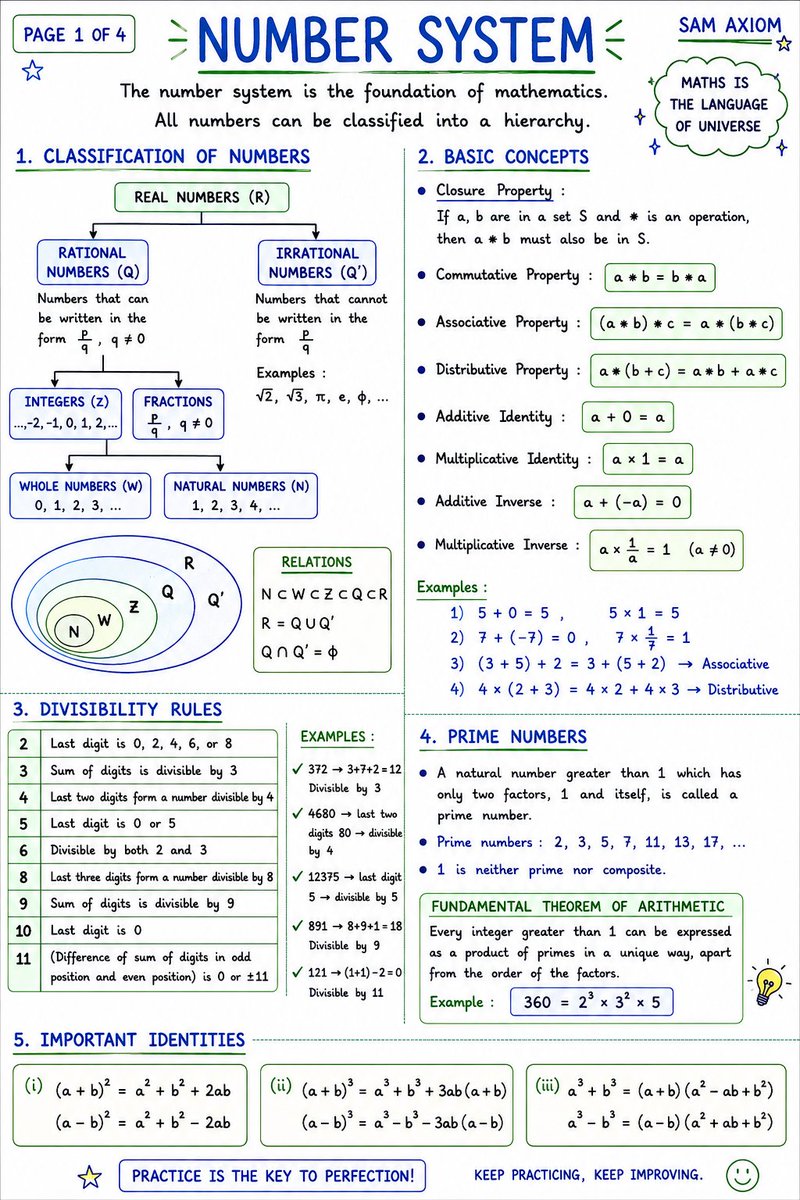
NUMBER SYSTEM — Complete Formula Sheet Series
The chapter that builds your entire maths foundation 📖✨
Complete revision notes
with formulas, concepts, tricks & examples.
SOME BASIC LIFE RULES
1. Don’t lend money to your family. Give it.
2. Never shake a hand while sitting down.
3. Stop telling people more than they need to know.
4. Never eat the last piece of something you didn’t buy.
5. Don’t throw your friend under the bus to impress someone.
6. Never insult the cooking when you are the guest.
7. Don’t take out your phone during a conversation.
8. Never take credit for work you didn’t do.
9. Listen, nod, and most of all, make eye contact.
10. Don’t make fun of your friend in front of his kids.
11. Never eat with a hat on.
12. Never beg for a relationship.
13. Dress well no matter what the occasion.
14. Never kick a man when he is already down.
TIME IS NOT TREATED THE SAME EVERYWHERE:
1. Germany: Being late is disrespectful. Meetings start to the second. Punctuality here is not a habit. It is a moral standard.
2. Brazil: An invitation for seven means nine. Relationships matter more than schedules. Rigidity kills the atmosphere.
3. Japan: Trains run to the minute. A sixty second delay comes with a formal public apology. Time is a system. The system is everything.
4. India: Events begin when people arrive. The gathering defines the time. Presence matters more than precision.
5. Polynesian cultures: Time was tied to stars, seasons, and the ocean. Circular, not linear. The clock came later and from somewhere else.
6. United States: Time is money. Literally. Every hour is billable. Every minute is scheduled. Rest has to earn its place.
7. Spain: Lunch at three. Dinner at ten. The day bends around the person. Not the other way around.
8. Ethiopia: A different calendar entirely. Thirteen months. New Year in September. A different year than the rest of the world. Time here is a cultural choice, not a global agreement.
9. France: August belongs to rest. Emails go unanswered. Shops close. Nobody apologizes for this. Leisure is a right, not a reward.
10. Kenya: The clock starts at sunrise. Six in the morning is hour zero. Noon is hour six. Time is built around light, not an arbitrary number on a wall.
11. China: One time zone for the entire country. A landmass that should span five. In the far west the sun rises at ten in the morning. Unity was chosen over accuracy.
12.Australia: Aboriginal communities have always read time through seasons, animal movements, and the stars above. For over sixty thousand years the land itself served as the calendar. No clock was ever needed. Nature told them everything.
13. Mexico: Mañana means not right now. Urgency is often self-imposed. The present moment has its own demands and they are considered legitimate.
14. Greece: A guest arrives at any hour. You welcome them fully. The clock adjusts to the person. The person never adjusts to the clock.
15. Scandinavia: Months of darkness then months of endless light. The body follows seasons, not schedules. This is ancient. Science is only now catching up.
16. Nigeria: Start times are a suggestion. What matters is that everyone arrives, connects, and the evening becomes what it was meant to be. The experience always outranks the schedule.
17. Indonesia: Jam karet. Rubber time. Time stretches around mood, traffic, and social obligation. Rigidity is considered uncomfortable, not professional.
18. Russia: Eleven time zones. Vast winters. Long silences. Time here is treated with patience that outsiders often mistake for slowness.
19. Egypt: One of the first civilizations to invent a calendar. Yet modern Egyptian social time is deeply flexible. Hospitality always comes before the clock.
20. Congo: Community shapes the day more than any schedule. Time belongs to the people in the room, not the hands on the clock.
21. Philippines: Filipino time is a known and accepted reality. Six in the evening means seven or eight. Arriving before the host is ready is the real social mistake.
22. Vietnam: Built on endurance and long horizons. Planning here thinks in years and generations. Short deadlines feel foreign to a culture that measured time in struggles spanning decades.
23. Tanzania: Pole pole. Slowly slowly. A phrase that governs daily life. Rushing is not a virtue here. Moving with intention is.
24. Argentina: Dinner at ten. Parties at midnight. The night is its own world. Compressing it into earlier hours would make it something lesser.
25. Turkey: A meeting can become a meal can become a long evening. Nobody considers this a deviation. It is simply what time is for.
26. Iran: Its own solar calendar. New Year on the spring equinox. Time tied to nature, poetry, and a civilization so old that modern urgency feels like a passing trend.
Dear sir, Kindly download the "NextGen mParivahan" mobile app. It is the official Government of India application and allows you to store your Driving Licence, RC digitally.
The documents shown in the app are legally valid across India.
Note: There are fake “NextGen mParivahan” apps and APK links circulating via WhatsApp/SMS. Always download only from Play Store / App Store.