Don’t waste energy outfighting your opponent.But out think him. Incredible, Intellectual, Invincible, A true patriot, Dr Subramaniam Swamy ! My salute!
The best men are supposed to be elected by the people. The members serve without pay and therefore, it must be assumed, only for the public weal. The electors are considered to be educated and therefore we should assume that they would not generally make mistakes in their choice.
I will give the benefit of the doubt to Ramesh ji here, because he is a satirist & we should treat his statement exactly like that, as a punchline. But beneath the joke lies a deeply rooted, systemic issue within our collective psychology.
Many look at a finished Western product (like a mature WhatsApp/X) & treat it as a static, perfect system, while looking at an Indian alternative as an isolated, flawed event.
In control systems engineering, no system can reach peak performance or stability w/o going through a continuous, iterative Closed-Loop Feedback loop. Silicon Valley products did not drop out of the sky perfectly formed. They spent a decade inside a massive, highly forgiving home market that acted as a positive validation loop.
When an Indian company tries to build a foundational alternative, parts of our own demographic act as an unfiltered noise vector rather than a correction filter. By trying to crash/ridicule/dismiss the product at version 1.0, they starve the engine of the operational data & evolutionary runway it needs to reach version 10.0. They demand a mature output while actively sabotaging the developmental cycle.
In ancient Indian logic (Nyaya), an argument must be rooted in valid validation (Pramana). The immediate tendency to look at a growing domestic product & declare "We can never build a global tech giant" is a textbook logical defect known as Asiddha (unproved premise), heavily driven by a colonial hangover.
Ancient logicians categorized this kind of lazy intellectualism as empty cynicism that confuses a temporary state of development with a permanent lack of capability.
We cannot mock a sapling for not yielding timber on day 1, while proudly importing wood from an older forest. If we want our own Google/X/WhatsApp, our mindset must shift from being cynical consumers to being active stakeholders in our own technological ecosystem. Sridhar Vembu disabling a feature to comply with regulatory changes is how a robust system adapts to changing real-world parameters.
@rvaidya2000 Are you sure extreme Sri Vaishnavites will agree with this?
Will they accept Shiva as equivalent & recognise the Trinity as equivalent & NOT hierarchical?!
For the record: Sanatana tradition nvr had a concept of blasphemy//When Dinnaga a bhuddist wanted Kalidasa to be censored for his sensual lyrics//Ppl laughed at him and left it at that--Blasphemy idea came from desert cults much later--Akhal Takht and Mann to note:!!!RT
To love India, we have to shift our cognitive lens away from the simple, clean eqns of Euclidean Geometry (where everything fits into neat straight lines) & upgrade to the complex eqns of Fractals (where patterns emerge out of infinite, self-repeating chaos).
China built a beautifully engineered machine. India is a self-evolving, organic jungle. A machine is orderly until it breaks; a jungle is chaotic, but it never stops living.
Ancient India's strength was its modular decentralization. The central king (Chakravartin) rarely interfered with the local governance laws (Shreni-Dharma of merchant guilds/Grama-Sabhas of villages). Every community had its own unique operating system.
When Nooyi says "the beauty of India is in its chaos," she is instinctively recognizing that India's survival mechanism for 5000 yrs has been its ability to absorb, metabolize & integrate turbulence, rather than trying to sanitize it through forced, top-down uniformity.
In the Western mindset, "chaos" implies a total lack of structure/failure of a system. But in physics & mathematics, Chaos Theory proves that complex, seemingly random systems actually have deep, underlying patterns & feedback loops that are highly adaptive.
Ancient Indian thought, specifically Sankhya Darshana, formalized this exact reality through the interplay of 2 cosmic entities: Purusha & Prakriti.
China’s model is built on artificial Purusha: absolute, rigid, uniform order. India’s model is rooted in Prakriti: a living, breathing, non-linear ecosystem where 1000s of variables (languages, sub-cultures, independent decentralized units) interact simultaneously.
Prakriti looks chaotic from the outside, but it is highly resilient because a collapse in 1 node does not crash the entire network. Rigidly uniform systems are efficient in the short term, but they suffer from brittleness under unexpected systemic shocks.
Order requires single-variable compliance, whereas India operates on multivariable coexistence.
In ancient Indian epistemology, the Jain school perfected a highly sophisticated logical framework called Anekantavada (the doctrine of non-absolutism/manyness of reality). It states that reality is infinitely complex & has multiple facets (Ananta-dharmatmakam vastu). No single perspective can claim absolute monopoly over the entire system.
A homogenous society (like China) operates like a single-threaded software program. It executes commands seamlessly & cleanly because there are no competing logic loops. India operates like an massive, multi-threaded, open-source asynchronous protocol. It looks messy, it looks confusing & it lacks standard symmetry, but it allows completely contradictory truths, lifestyles & economic layers to occupy the exact same physical space w/o destroying 1 another. 🙏🙏
To love India, we have to shift our cognitive lens away from the simple, clean eqns of Euclidean Geometry (where everything fits into neat straight lines) & upgrade to the complex eqns of Fractals (where patterns emerge out of infinite, self-repeating chaos).
China built a beautifully engineered machine. India is a self-evolving, organic jungle. A machine is orderly until it breaks; a jungle is chaotic, but it never stops living.
Ancient India's strength was its modular decentralization. The central king (Chakravartin) rarely interfered with the local governance laws (Shreni-Dharma of merchant guilds/Grama-Sabhas of villages). Every community had its own unique operating system.
When Nooyi says "the beauty of India is in its chaos," she is instinctively recognizing that India's survival mechanism for 5000 yrs has been its ability to absorb, metabolize & integrate turbulence, rather than trying to sanitize it through forced, top-down uniformity.
In the Western mindset, "chaos" implies a total lack of structure/failure of a system. But in physics & mathematics, Chaos Theory proves that complex, seemingly random systems actually have deep, underlying patterns & feedback loops that are highly adaptive.
Ancient Indian thought, specifically Sankhya Darshana, formalized this exact reality through the interplay of 2 cosmic entities: Purusha & Prakriti.
China’s model is built on artificial Purusha: absolute, rigid, uniform order. India’s model is rooted in Prakriti: a living, breathing, non-linear ecosystem where 1000s of variables (languages, sub-cultures, independent decentralized units) interact simultaneously.
Prakriti looks chaotic from the outside, but it is highly resilient because a collapse in 1 node does not crash the entire network. Rigidly uniform systems are efficient in the short term, but they suffer from brittleness under unexpected systemic shocks.
Order requires single-variable compliance, whereas India operates on multivariable coexistence.
In ancient Indian epistemology, the Jain school perfected a highly sophisticated logical framework called Anekantavada (the doctrine of non-absolutism/manyness of reality). It states that reality is infinitely complex & has multiple facets (Ananta-dharmatmakam vastu). No single perspective can claim absolute monopoly over the entire system.
A homogenous society (like China) operates like a single-threaded software program. It executes commands seamlessly & cleanly because there are no competing logic loops. India operates like an massive, multi-threaded, open-source asynchronous protocol. It looks messy, it looks confusing & it lacks standard symmetry, but it allows completely contradictory truths, lifestyles & economic layers to occupy the exact same physical space w/o destroying 1 another. 🙏🙏
The scenario we witnessed today in the Belgium vs. Senegal game is literally a one-in-a-million occurrence!
Senegal completely outplayed Belgium in every aspect—possession, transitions, chance creation, expected goals—you name it. They went 2–0 up and stayed in control until the 86th minute. The game looked over. They were about to win and book their place in the Round of 16.
Then chaos unfolded.
Romelu Lukaku scored in the 86th minute, and Youri Tielemans equalized in the 89th after Senegal’s goalkeeper completely misjudged the ball, making it 2–2 in the space of just three minutes out of absolutely nowhere!
And somehow, the madness didn’t stop there. Belgium were awarded a penalty in the 120th minute, converted it to make it 3–2, and completed a comeback that even they probably can’t explain, sealing their place in the Round of 16 in what felt like a science-fiction script.
The Senegal players probably won’t be able to sleep tonight after the nightmares they’ll have from this collapse. Without a doubt, it’s the biggest shock of the World Cup so far.
Lebron says Thank you to Lakers and in search of new team.
Heat , cavs and warriors are in the fray.
Raptors re sign kawhi from clippers who gave up two time mvp sga to pair him with paul george .
Giannis to Heat , Morant to blazers.
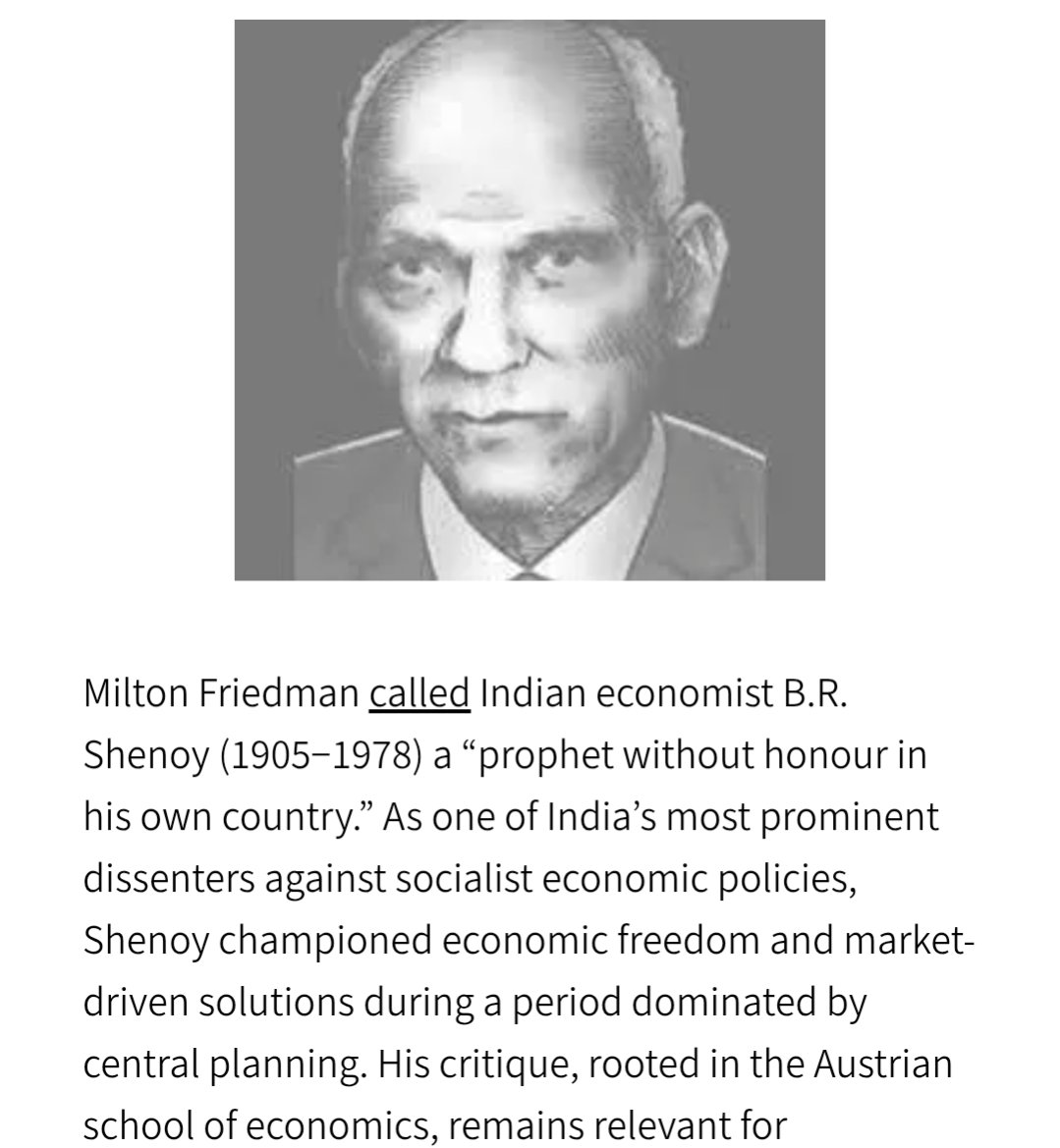
Picture the scene: New Delhi, April 1955.
Twenty-one of India's most accomplished economists are assembled to review the draft of the Second Five-Year Plan, a blueprint for state-led industrialisation that Prime Minister Pandit Jawahrlal Nehru and his planners believed would finally lift the nation out of poverty. Twenty of the economists endorse the plan. One does not.
Bellikoth Ragunath Shenoy, a monetary economist trained at the Benaras Hindu University and the London School of Economics, submits instead a Note of Dissent. In it, he warns that deficit financing on this scale will trigger runaway inflation, that central planning will breed inefficiency and corruption, and that the controls required to make the plan work will, over time, hollow out India's democratic institutions. He wrote, "to force a pace of development in excess of the available real resources must necessarily involve uncontrolled inflation… once inflation begins, it tends to gather momentum. We should, therefore, be forewarned about the dangers of an over-ambitious plan."
Nobody listened. The plan went ahead. Prices rose by 30% over its course. A balance of payments crisis arrived in 1957, exactly as Shenoy had forecast. The licence-permit-raj he warned against evolved into a system so entrenched it took four more decades to begin dismantling. When Milton Friedman read the dissent note in 1963, he said it did not read like a forecast but like a retrospective account of what had already happened.
Shenoy was largely forgotten until 1991, when India's reforms proved, almost point by point, everything he had argued for in 1955. He is sometimes called India's Hayek.
Newly published: A landmark book on Indian mathematics
I am honoured to be one of the first recipients of this new book by Prof. K. Ramasubramanian of IIT Bombay. “The Elusive Ratio and the Advent of Calculus in India” is the result of meticulous multidisciplinary research in mathematics and Sanskrit.
Prof. Ramasubramanian is a renowned scholar of both Sanskrit and mathematics (he holds a doctorate in Theoretical Physics, a master’s degree in Sanskrit, and a bachelor’s degree in engineering). He has authored three books on Indian mathematical treatises—“Gaṇita-Yukti-Bhāṣā”, “Tantrasaṅgraha”, and “Karaṇapaddhati” (all published by Hindustan Book Agency and later by Springer Verlag).
In his latest book, running to around 450 pages, Prof. Ramasubramanian documents and explains the development of approximations of and expressions for pi (π, “the elusive ratio”) given by Indian mathematicians over hundreds of years. It starts with Vedic ritual geometry and the Śulbasūtras, covers the seminal contributions of Āryabhaṭa and Brahmagupta, and culminates in the infinite power series for π given by Mādhava of Saṅgamagrāma. The book thus traces the lineage of mathematical ideas that predated some aspects of modern calculus, developed in Europe, by three hundred years. The book offers an accurate account of the history of mathematical ideas in India: there is no hyperbole, no tall claim, and no sweeping history in the book. It situates the Sanskrit works in their historical and intellectual context, presents the Sanskrit verses and text, and explains their meanings with detailed diagrams, tables, and notes.
The book is a must-read for students and scholars of the history of mathematics and Indian Knowledge Systems. I congratulate Prof. Ramasubramanian and the publisher, Garuda Prakashan, for bringing out this landmark book. I also thank Prof. Ramasubramanian for sending me a complimentary copy.
Bibliographic details: K. Ramasubramanian. “The Elusive Ratio and the Advent of Calculus in India”. City of Gurugram: Garuda Prakashan Pvt. Ltd., June 2026. ISBN 978-93-476-9139-3. Paperback.
Dr Subramanian @Swamy39 Seeking Blessings of His Holiness Pujya Sri Sankarcharya Vijayendra Saraswati ji of Sri Kanchi Kamokoti Peetham at the Kumbha Abhishekam of Sri Devi Kamakshi Temple at New Delhi today morning. @KanchiMatham@vhsindia
Forgive me, but it's difficult to take seriously, Indian analysts who are so emotional & reactive (from #entrapment to #abandonment & back).
🙏🏽can any1 give references to foreign policy analysts who do fact based analysis/research, before giving policy suggestions & views 🙏🏽
S&P 500 and Nasdaq posted their best quarter in six years.
S&P 500 up 15% & Nasdaq 21%, their best three‑month gains since 2020.
Remember reading an article in outlook which claimed dow will hit 1000 pn account of credit deflation 😐🤐