BREAKING: @BlueOrigin has removed the first tower module at Launch Complex-36.
This tower is being de-stacked to allow each module to be repaired/modified in parallel.
A full LC-36 update video in the replies.
📽️ Space Coast Live/@NASASpaceflight
NASA have confirmed the Swift rescue mission launched this morning! That's the first of many tasks that need to be completed to make this ambitious mission a success.
https://t.co/XOAtweiIcW
Reports that Pegasus has been launched were wrong!
After takeoff of the L-1011 aircraft carrying the Pegasus-XL, a launch vehicle issue temporarily prevented teams from deploying the rocket.
New launch date will be set after review of the data.
https://t.co/9Uy5agYJGv
@IntlLma40928@JonesBoysRoktry L1011 and Pegasus launch vehicle returned to runway after technical issue temporarily prevented teams from deploying the rocket.
Just because CBS kneels to Trump doesn’t mean the rest of us have to.
Pass this along on every one of your social media accounts.
Make sure it is seen far and wide in our country.
It’s important that you understand what happened last night.
Last night, Stephen Colbert interviewed Democratic Texas Senate candidate James Talarico, a candidate who, by all accounts, is on track in the polls to flip Texas blue.
In response, Trump’s FCC reportedly threatened CBS if the interview aired.
CBS caved and pulled the segment, citing “financial reasons.”
In modern American history, no president has been more hostile to free speech than Donald Trump.
But censorship always backfires.
Here’s the full segment Trump didn’t want you to see.
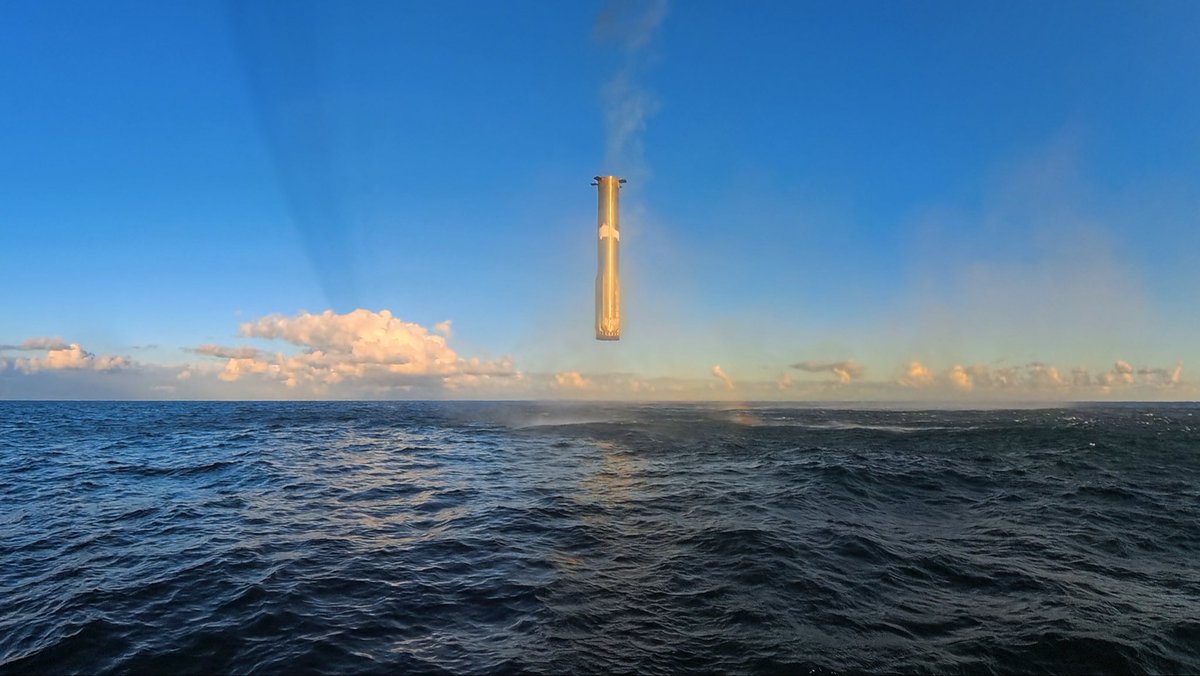
Super Heavy lit 13 engines for the landing burn, dropped to 5, then down to 3 hovering over the Gulf. That hover looks wild 🤯 This tested out the landing burn sequence for the next generation booster & demonstrates the unbelievable control that it will enable for booster catch!
In honor of Generals serving who were forced to listen to an awful speech, here's an awesome speech from General Mark Milley. “We don't take an oath to a wannabe dictator. We take an oath to the Constitution...
...and we're willing to die to protect it.”
The Higgs...Once it gives mass, spacetime takes notice — even inside a black hole. All other fields may freeze, but Higgs is the only one that leaves its mark behind: Mass. The Higgs field is the universe’s mass ledger. Gravity? It’s just the interest rate on your mass debt.”
Technological advances enable us to study our Universe in greater detail. Better telescopes give us clearer images, and better detectors enable clearer measurements of binary black holes.
#GW250114 is a similar signal to GW150914, but our detectors are much better!
#GW10Years
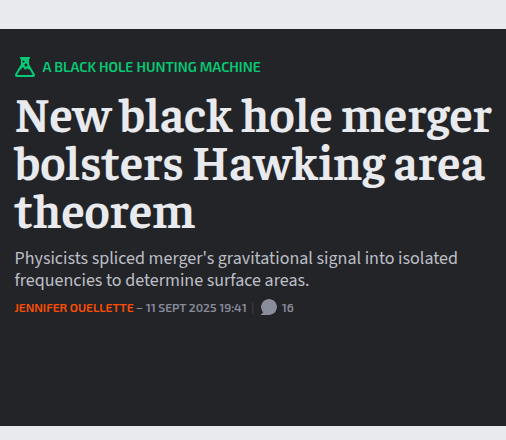
“LIGO just confirmed Hawking’s area theorem: black holes only grow, horizons never shrink. Entropy rises, no white holes in sight — just Higgs receipts keeping the cosmic books balanced forever.
Astronomers have tapped into gravitational waves, subtle ripples in spacetime first predicted by Einstein, to peer into what they describe as a “stellar graveyard,” where the remnants of massive stellar deaths lie in abundance. Drawing on data from the @LIGO, Virgo, and KAGRA observatories collected between May 2023 and January 2024 during the early phase of their fourth observing run, researchers detected 128 new merger events involving neutron stars and black holes.
This includes the doubling of observed mixed mergers, that is, collisions between a black hole and a neutron star, from one known case to two. In addition, among these newly "heard" signals were the heaviest black hole binaries ever detected.
This expanded catalog shines fresh light on the life cycles of the densest stellar remains, suggesting that some black holes may be offspring of earlier collisions, black holes birthed from previous mergers, adding layers to the cosmic narrative. As team members explain, gravitational-wave astronomy is offering a fossil-like record of massive stars’ final fates, enriching our picture of how these extraordinary objects form, evolve, and interact.
Beyond unpacking dramatic collision events, the data have broader cosmological implications. Each merger isn’t just a collision; it’s a beacon that carries information about the expanding universe. Because gravitational waveforms directly encode distance information, each detection contributes to refining measurements of the Hubble Constant, the rate at which the universe expands.
Among the standout events is GW230814, the loudest gravitational-wave signal yet recorded by the network, enabling more precise tests of Einstein’s general relativity.
So far, Einstein’s predictions hold firm, but with stronger signals like these, the scientific community is poised for deeper scrutiny.
👉 https://t.co/oiMt5EtE8y
Do black holes cast "gravity wave shadows"?
Apparently yes, and they get lensed! Phrase might be a good teaching aid?
You guys Rock! Keep it up!
@ego_virgo@KAGRA_PR@LIGO
Astronomers have tapped into gravitational waves, subtle ripples in spacetime first predicted by Einstein, to peer into what they describe as a “stellar graveyard,” where the remnants of massive stellar deaths lie in abundance. Drawing on data from the @LIGO, Virgo, and KAGRA observatories collected between May 2023 and January 2024 during the early phase of their fourth observing run, researchers detected 128 new merger events involving neutron stars and black holes.
This includes the doubling of observed mixed mergers, that is, collisions between a black hole and a neutron star, from one known case to two. In addition, among these newly "heard" signals were the heaviest black hole binaries ever detected.
This expanded catalog shines fresh light on the life cycles of the densest stellar remains, suggesting that some black holes may be offspring of earlier collisions, black holes birthed from previous mergers, adding layers to the cosmic narrative. As team members explain, gravitational-wave astronomy is offering a fossil-like record of massive stars’ final fates, enriching our picture of how these extraordinary objects form, evolve, and interact.
Beyond unpacking dramatic collision events, the data have broader cosmological implications. Each merger isn’t just a collision; it’s a beacon that carries information about the expanding universe. Because gravitational waveforms directly encode distance information, each detection contributes to refining measurements of the Hubble Constant, the rate at which the universe expands.
Among the standout events is GW230814, the loudest gravitational-wave signal yet recorded by the network, enabling more precise tests of Einstein’s general relativity.
So far, Einstein’s predictions hold firm, but with stronger signals like these, the scientific community is poised for deeper scrutiny.
👉 https://t.co/oiMt5EtE8y
SpaceX just flew the same Falcon 9 booster 30 times.
It's an amazing milestone, but it becomes even more insane when you look back at this video of SpaceX trying to land an orbital class rocket for the first time.