Looking to build a high-quality single-cell reference atlas? Check out this fantastic review by @KHrovatin & @SikkemaLisa, guided by @MDLuecken! Packed with nuanced yet practical advice - from preprocessing to integration and downstream applications! 🚀
Excited to share our practical guide to building and using integrated atlases. This was an exciting 2 year journey, spearheaded by @KHrovatin and @SikkemaLisa from the @fabian_theis lab, for which @shitov_happens added a metadata parser to investigate trends in SCG datasets.
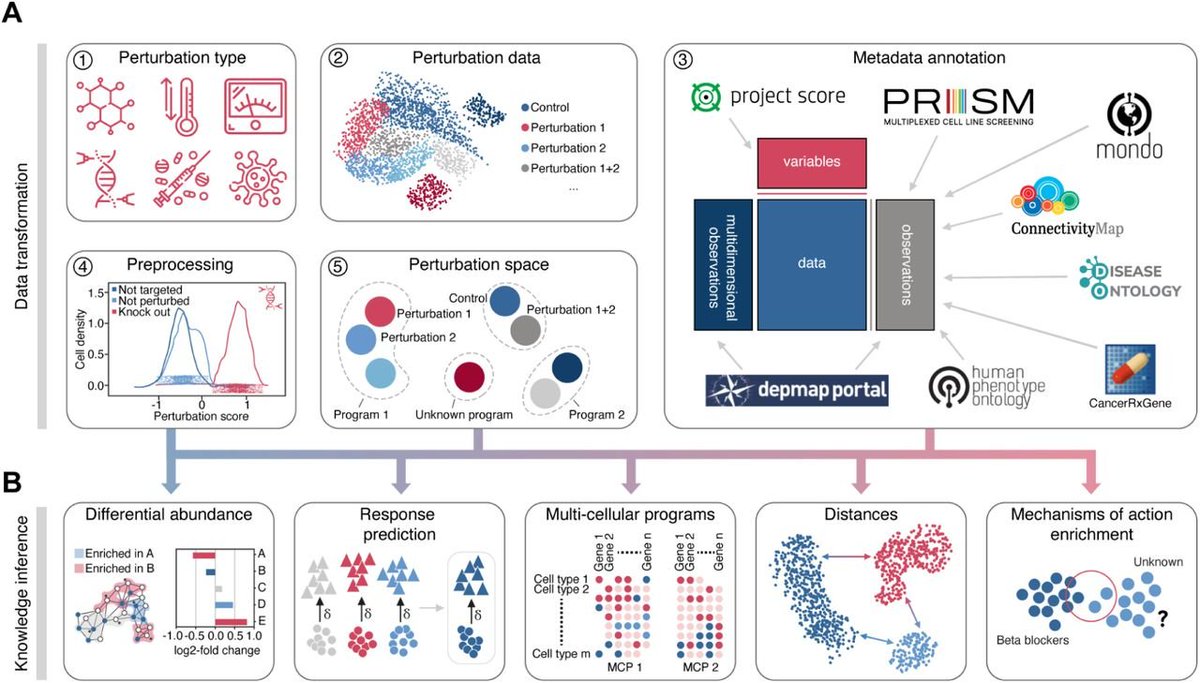
I'm stoked to announce our new end-to-end framework for perturbation analysis! Our scverse advisory committee highlighted that a maintained and well-documented framework for perturbation analysis is missing. Pertpy is our attempt to satisfy this request
https://t.co/eaNB41HuOt
⚡️🔬📣Excited to share our two new @NatureMedicine articles, we develop computational pathology foundation models,
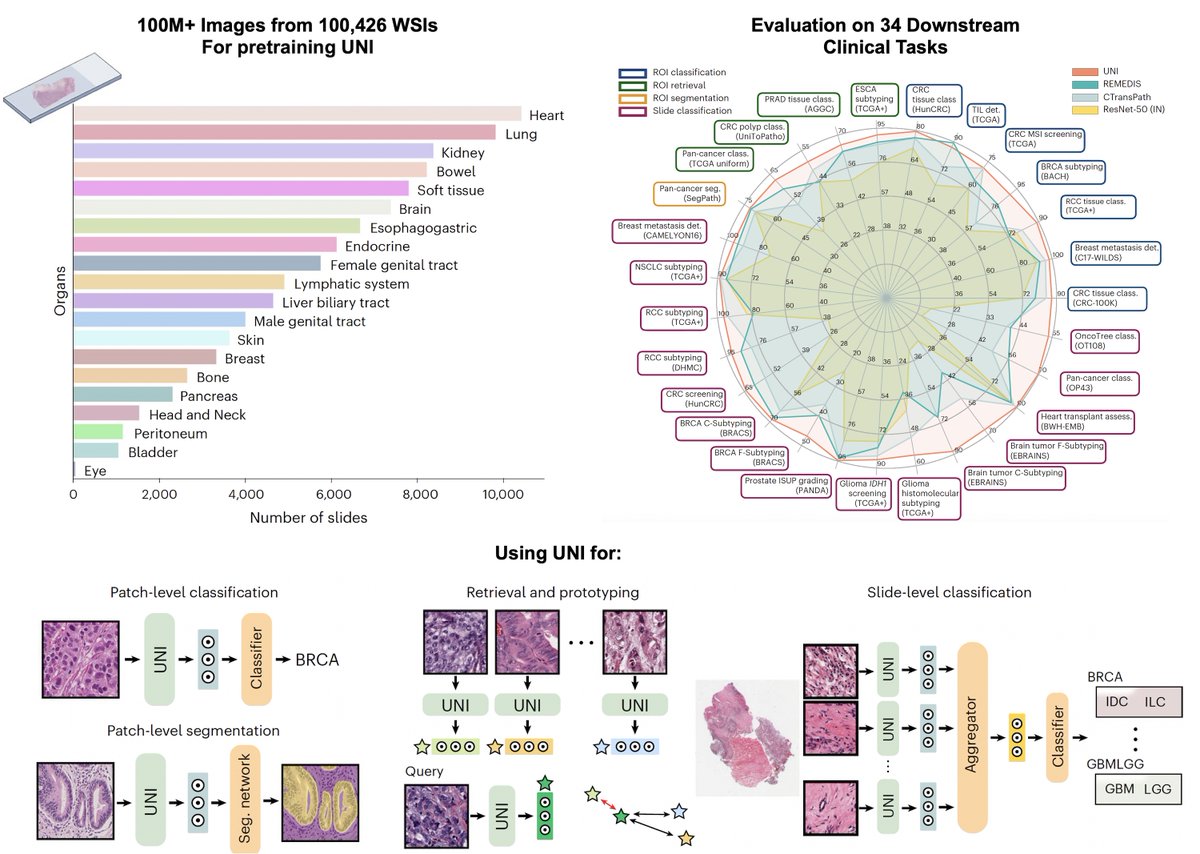
1. UNI, a self-supervised computational pathology model trained on 100 million pathology images from 100k+ slides.
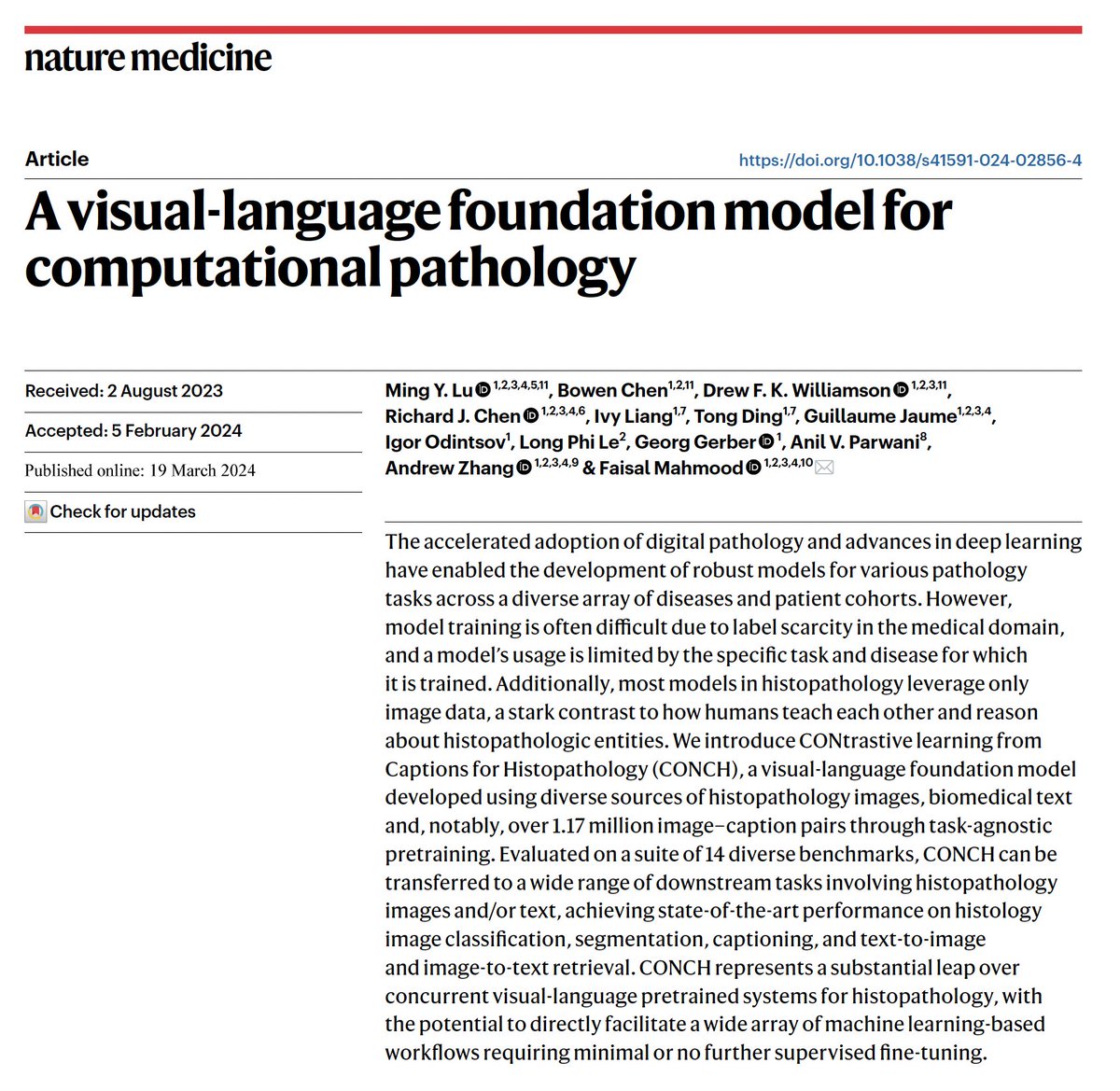
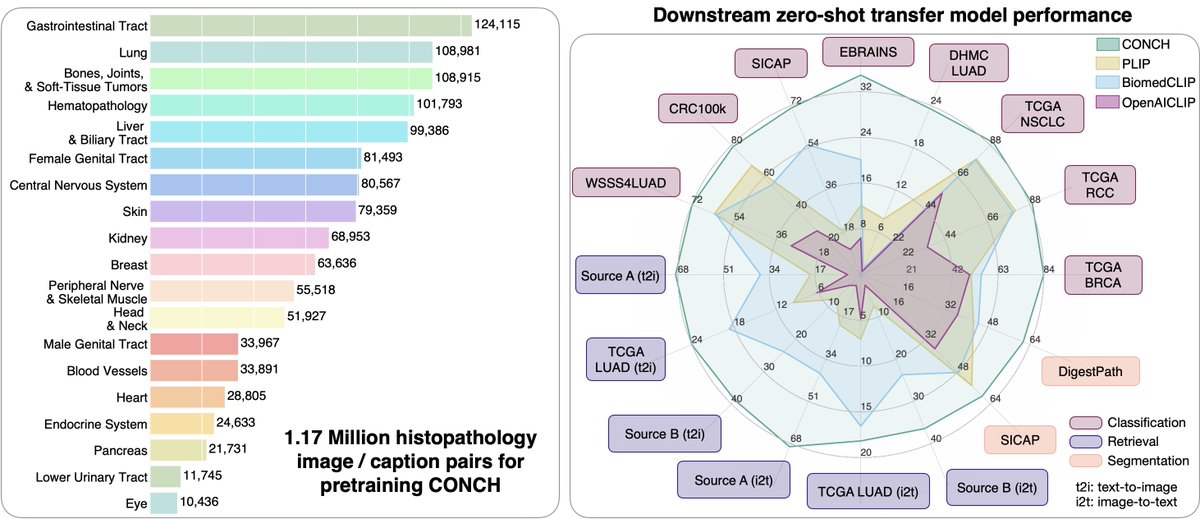
2. CONCH, a vision-language model for computational pathology trained on 1.17 million pathology image-text pairs.
Access the articles @NatureMedicine
UNI: https://t.co/f207RP0JKs
CONCH: https://t.co/9eHXwjZMub
Access the code, models:
UNI: https://t.co/5Gkyzd8R8a
CONCH: https://t.co/BLG2G3bTuO
Interesting aspects:
- Both models are evaluated on a host of different clinically relevant tasks for WSI classification, ROI classification, segmentation, image retrieval, image-to-text retrieval, text-to-image retrieval, in 0-shot, few-shot and supervised settings. These adaptations encompass the utility of large public datasets and evaluations on independent test cohorts.
- Both models exclude commonly used public computational pathology benchmarks from pre-training allowing for a much more holistic evaluation.
Some limitations: Both UNI and CONCH represent early developments in foundation models for pathology. More data, and additional evaluation is needed to realize the full potential of these models. Nevertheless, we show the models capabilities on a variety of different benchmarks with several demonstrating state-of-the-art performance.
Future work and insights: While these developments are exciting, they represent work we did about a year ago when the pre-prints were made available, since then we have been busy collecting significantly larger datasets and hope to make larger models available in the future. We have also used UNI and CONCH as the backbone for our Pathology specific chatbot, PathChat (https://t.co/OuVsJvrLTQ), which is further trained on hundreds of thousands of pathology specific Q-A instructions.
We are also excited to see foundation models for several other areas of biomedicine including for single cell data (https://t.co/vkvE3ulri9), radiology (https://t.co/c5CLbgmcrG) and the general trajectory towards general purpose AI for biomedicine.
Congratulations to our superstar leaders @richardjchen@MYLu97 @DFKW_MD @TongDing99, Bowen Chen and everyone else who contributed to these studies @GuillaumeJaume@GreatAndrew90@sharifa_sahai@Aparwani_dpath and others.
It was a great experience and pleasure to writhe this review with @PittetLab@MempelThorsten@csgarrix ! DC journey just started 😀
https://t.co/cFI71Umaub
(1/7) As part of a suite of #CPTAC papers published across #CellPress today, we introduce our study @CellCellPress, led by @GeffenYifat, on how #PanCancer analysis of post-translational modifications reveals shared patterns of protein regulation: https://t.co/wuvYpsKgXf
Please check our CellTypist 2.0! https://t.co/ckQ4uN3cvO
It incorporates single-cell data harmonisation & integration, aiming to assemble existing annotated single-cell datasets across the community into a uniformly annotated dataset. https://t.co/IwvWfB0FGN
#singlecell
Positioning of cells in tissue matters! Cxcl10 expression in splenic red pulp limits formation of TCF1+ virus specific CD8+ T cells and promotes their terminal differentiation during chronic infection. Thanks to all coauthors for their important contributions!
Very proud to have my very first first-authorship published at @CellCellPress. Deeply grateful to my brilliant mentors @DiPilatoLab and @MempelThorsten for that amazing scientific journey. And of course to all other authors and collaborators!
https://t.co/KUacK9SVw1
Online now! CXCR6 plays an important role in tumor-infiltrating cytotoxic T cells to sustain T cell-mediated immune control of tumors
#cancerresearch
https://t.co/nWKh1WRq1E
Breaking News: Pfizer completed its coronavirus vaccine trial. It says the shots are 95 percent effective, have no serious side effects and work for older people. https://t.co/PX1rCS8mxr