Our new paper in @NatImmunol explores this question through PPARδ, a lipid-sensing transcription factor that we identify as a regulator of the #fitness balance between #cancer and #immune cells. You can read the open access paper here: https://t.co/7iYvfAR0M6
@DMSabatini@MatthiasNahrend They should have paid you more. I just couldn’t imagine the amount of stress and premature aging this put you though. Justice prevails slowly.
@exosome Convincing the establishment and general public that T cells (1 step removed from cancer cells) are core effectors took a long time, but those T cells wouldn’t be effectors without Dendritic cells. I think minds will be convinced over time.
@exosome Perhaps naive, but I don’t see it as a nefarious attempt to stifle a cure, rather than tremendous groupthink inertia to overcome that a cell 2 steps removed from the cancer cell is one of the prime drivers of immunotherapy response.
I asked the DC question because, although it is yet to be proven in humans, there was an interesting paper on cDC2 cross-dressing priming of CD8 T cells from mRNA vaccination; insinuating that mRNA vaccine induced anti-tumor responses were equivalent with or without cDC1. https://t.co/lISDse2w5I
However, some of the data they report on T cell state indicates less stem-like cells in settings where cDC1 are deficient, and possibly more stem-like cells in cDC2 deficient settings. This raises the possibility that the type of DC performing the presentation may indeed matter (perhaps more over the long term?) compared to the short interval they tested.
@train_computer@BenjaminGVincen@3DiMMUNE@iskander We're not debating that T cells, engineered or otherwise, are core effectors of anti-tumor immunity. However, to date, successful CAR-T are not tumor Ag specific per se, but rather either tumor associated or lineage marker driven. EGFRvIII had some serious limitations.
@BenjaminGVincen@3DiMMUNE@iskander Will you also be profiling the state of dendritic cells/macrophages (potentially other APCs too)? I hear they’re important and you don’t always need tumor intrinsic antigen presentation to drive an anti-tumor response?
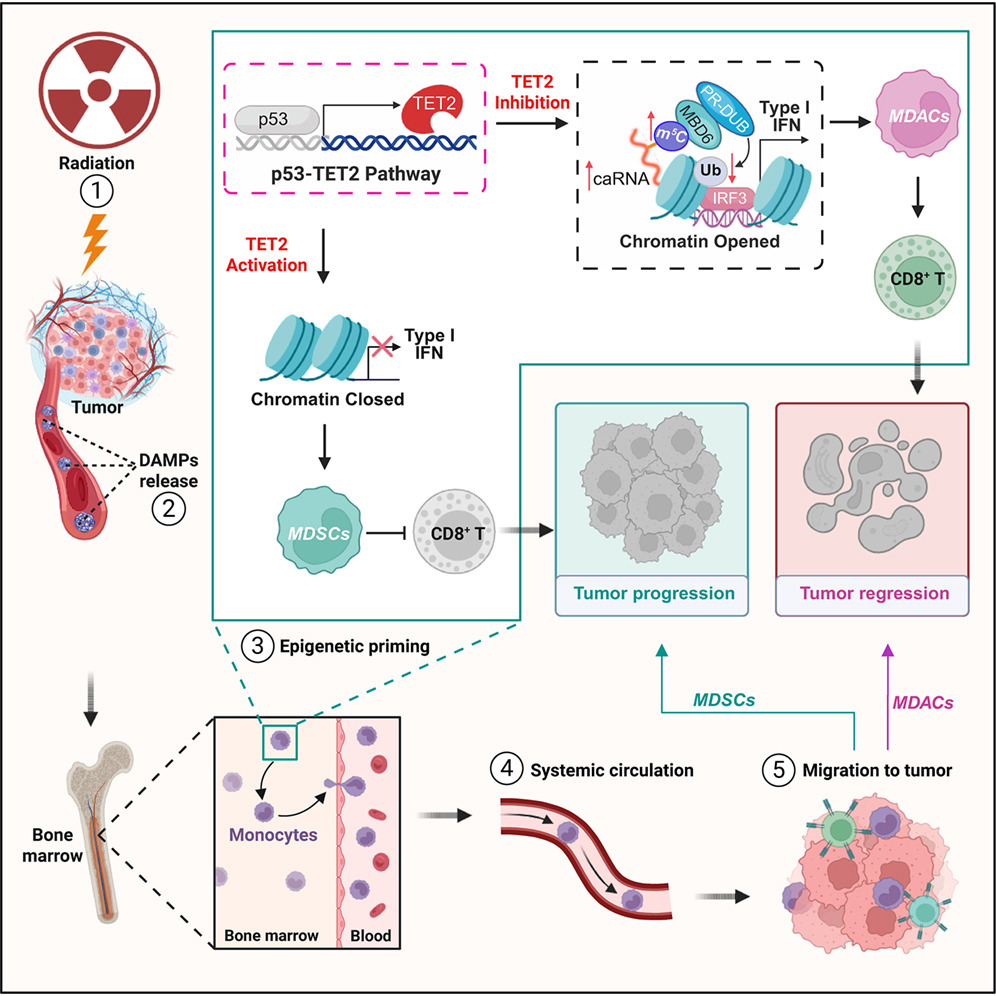
🔥Hot off the press: A new study in @Cancer_Cell from Dr. Weichselbaum (@rweichselbaum) and colleagues show how high-dose radiation increases TET2 expression, activating immunosuppressive MDSCs to drive tumor progression. @UChicagoRadonc@UChicagoMed
https://t.co/jMREugPJk9
@3DiMMUNE This property is also leveraged in part by T cell engager therapies, however the responses in solid tumors are not as robust as liquid tumors. Though there are modest successes such as Tarlatamab in SCLC.
@3DiMMUNE This has been a burning question for some time in the bladder cancer community, as intravesical BCG is a standard of care for localized bladder cancer yet it seems that BCG has an adjuvanting effect to direct anti-tumor immunity to the cancer.
@blekhman@baym I like to think of it like training to be a chef versus writing down recipes. Chefs excel at sourcing ingredients and cooking. The grant is a recipe. You need to show the committee that you can cook.
@LocasaleLab I think leaning into the more human aspects is how we can complement AI. High risk gambles are what humans do best. AI patches all the incremental stuff together and trains on what made the gamble work, to expand knowledge. We’re the tip of the spear… you just gotta be crazy.