🚀 Rapid-MLX 1.0.2 is live. Local AI on your Mac just took a massive leap forward.
What’s new?
🎬 Local Video + Audio generation (Pika H3 Flex)
🛑 "Stop Generating" for video jobs
🔗 Paste Hugging Face links anywhere
⚡ 1.6GB hyper-fast first run
💤 Idle Unload (save RAM, keep API up)
Upgrade: `rapid-mlx upgrade`, or download the new DMG: https://t.co/rmBN6TJoxj
Notes: https://t.co/ri1MpdWYWD
Tencent's Hy4 flash is a 267 GB model. We made it run on a 128 GB Mac.
Our own 4-bit GPTQ build for Rapid-MLX: ~102 GB in memory, with its lookup tables streamed from SSD.
Quality held up:
GPQA Diamond 80.8
MMLU-Pro 83.3
MBPP+ 93.1
https://t.co/UFFNZPwh8z
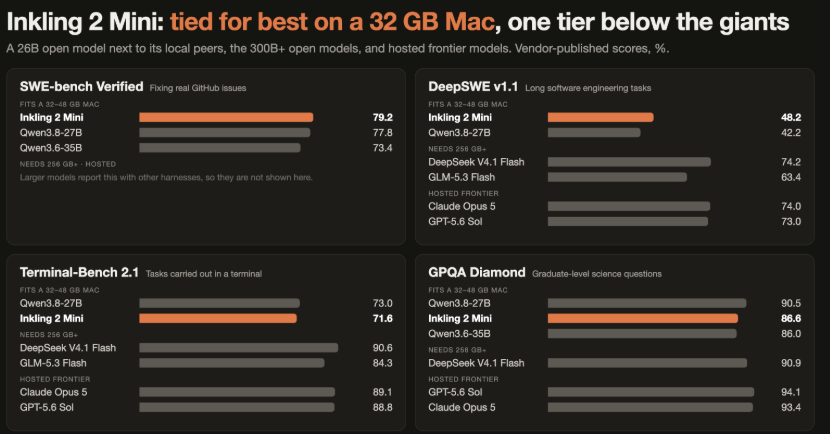
Tested Inkling 2 Mini (4-bit) locally on Mac with Rapid-MLX.
It just took the #1 spot for coding & agents on a 32 GB Mac, beating Qwen3.8-27B.
Our local scores:
• GSM8K: 94.0 | IFEval: 90.7
• MBPP+: 85.3 | MMLU-Pro: 82.1
• GPQA: 79.3 (vs 86.6 vendor full-precision)
Key takeaway:
Amazing instruction following, but it overthinks. On 27/198 GPQA questions, it burned through the entire token budget before answering. Always cap thinking tokens.
TL;DR Mac Tier List:
💻 32 GB Coding/Agents → Inkling 2 Mini
🧠 32 GB General/Science → Qwen3.8-27B
🚀 256 GB+ → DeepSeek V4.1 Flash
Run it now: rapid-mlx serve inkling-2-mini-4bit
NEW: Inkling 2 Mini is the most efficient model we've tested:
- #1 on efficiency (cost vs. intelligence)
- #9 on intelligence (78.4) overall
- #1 on intelligence among open-weights models
- Lowest cost per correct answer ($25.80)
- Biggest accuracy gain from adding web search
It uses a looped transformer, which runs its middle layers three times for every token. That lets a 26B-parameter model reason more without generating more tokens, which keeps costs low. A model that size can't store as many facts, so it relies on search to fill the gaps, and that's where it gains the most.
Free and open source (Apache-2.0). Install in one line 👇
curl -fsSL https://t.co/5i5Bz4DybP | bash
Then: rapid-mlx serve inkling-2-mini-4bit
Upgrading? rapid-mlx upgrade
What Mac are you on? Reply with chip + memory and I'll suggest a model. 👀
⭐ https://t.co/3ryn9PCAqG
Inkling 2 Mini from @thinkymachines, a 26B model, thinking, calling a tool and answering on a Mac. 🧵
Measured on an M5 Max, 36 GB, 4-bit:
⚡ 43 tok/s single stream
🚀 80 tok/s total over 8 parallel requests
💾 23 GB peak memory
🎬 Real time, not sped up
This is Rapid-MLX 1.1.0: a free, open-source local AI engine and desktop app for Apple Silicon.
Building an app on a local model?
🏗️ It's an OpenAI-compatible server you can leave running:
♻️ Crashes? It restarts itself
📋 rapid-mlx status, log, jobs: who called, what's queued
🚦 Mark batch work as background and chat goes first
🔌 Load and unload models over the API
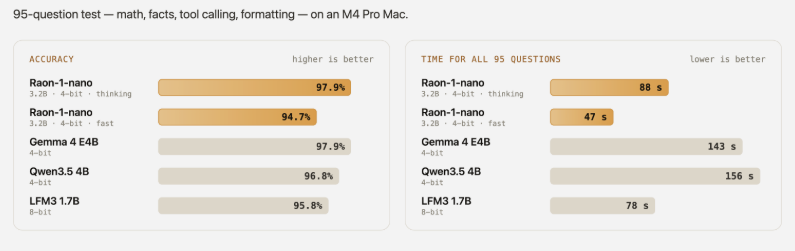
🚀 The powerhouse behind @PUBG, @KRAFTON_Inc, just dropped a massive win for on-device AI: Raon-1-nano!
It's a 3.2B open model (Apache 2.0) featuring a hybrid gated-delta + MLA architecture, native tool calling, and built-in thinking. 🔥
We immediately added native support to Rapid-MLX and pushed it to the limit on an M4 Pro Mac. The results absolutely blew us away:
🥇 97.9% accuracy — tied for #1 among small models!
⚡️ Blazed through our 95-question test in just 88s (vs 143–156s for typical 4B models).
🛠️ Thinking & tool calling work flawlessly right out of the box.
Merged to main today. Shipping in the next Rapid-MLX update. Your Mac is about to get even smarter. 💻✨
📢 Meet Qwen4-Max, your new AI teammate for work, creativity, and discovery!
Qwen4-Max is built on a new MoE architecture with native vision and a 1M-token context window.
Highlights:
- Outperforms Qwen3.8-Max with up to ~50% fewer tokens, while average cost per task drops over 60% in our internal evaluation.
- Advances real-world productivity through greater proficiency with professional tools, stronger long-horizon execution, and higher-quality deliverables.
- Handles real tasks, including 3D modeling, game development, manufacturing, finance, law, healthcare, and frontier scientific discovery.
- $1.5/M tokens for input, $4.5/M tokens for output, and $0.075/M tokens for implicit caching — all lower than Qwen3.8-Max, with implicit caching down by 70%.
The API is live on QwenCloud. You can also try Qwen4-Max on Qwen Studio, QwenWork and Qoder.
Start building today! 🚀
- Blog: https://t.co/AuiWxugjE6
- API: https://t.co/aS1QEkS8nu
- Token Plan: https://t.co/YRvcGdB9Bv
More to come! The open weights of smaller Qwen4 models will be released. Stay tuned. 👀
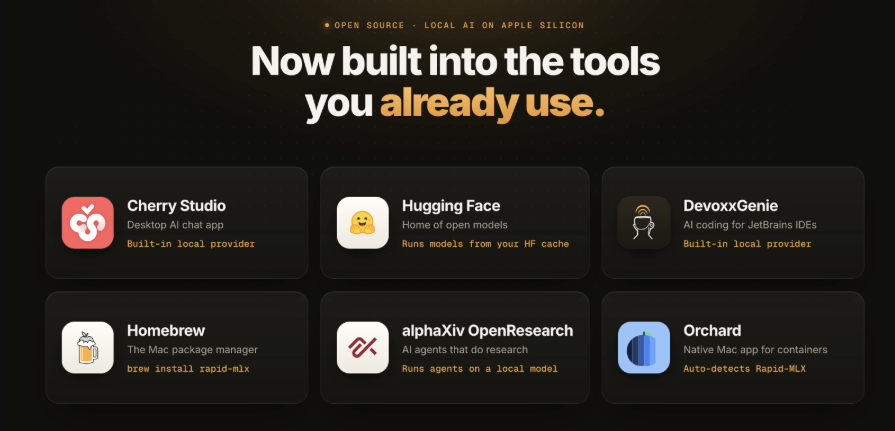
Rapid-MLX is now built into 6 tools you already use 🧵
🍒 @CherryStudioHQ: the 53k★ desktop AI chat app. Pick Rapid-MLX as a built-in local provider and chat with models running on your own Mac.
🔬 @askalphaxiv OpenResearch (8k★): turns coding agents into research agents. Run them on a local model through Rapid-MLX.
🧞 DevoxxGenie by @Stephan007: AI coding assistant for JetBrains IDEs. Rapid-MLX is a built-in local provider, so your code never leaves your machine.
🌳 Orchard: the native Mac app for Apple containers and MLX sandboxes. It auto-detects your Rapid-MLX server.
🍺 @MacHomebrew: the Mac package manager. One line: brew install rapid-mlx
🤗 @huggingface: the home of open models. The Hub docs list Rapid-MLX as an app that runs models straight from your local Hugging Face cache, with no re-downloading.
We are constantly pushing the limits of what Apple Silicon can do locally.
Update to Rapid-MLX 1.0.3 today and try the new Text-to-Video engine yourself.
https://t.co/uq0XKjTkb0
Rapid-MLX 1.0.3 is here. 🎬 Local Text-to-Video is now a reality on your Mac.
Generate 480p MP4s entirely locally with @TencentHunyuan 1.5 on 64GB+ Apple Silicon.
We also shipped:
⚡️ +12.6% faster Qwen decode
🛠️ Rock-solid agent tool calls
🌐 1-click LAN API access
Thread 🧵👇
🌐 Turn your Mac into a local AI server.
Enable LAN access to let your laptop, a second Mac, or any OpenAI-compatible app securely use your host Mac's local models. Secured via Keychain bearer token.
Settings → Tools → "Allow access from other devices".
Auto Research on a Mac, 100% local! 🐆
No cloud, no API keys, and zero risk of your ideas getting front-run or stolen by big tech.
We spun up an open-source auto-research framework (running Qwen3.6-27B via Rapid-MLX) and gave it one question: does label smoothing actually improve calibration?
The agent took over completely. It wrote a numpy MLP, ran the seeds, computed ECE, and plotted reliability diagrams—all autonomously.
The twist? The trick backfired. ECE worsened from 0.253 → 0.332. The baseline was already under-confident, so smoothing pushed it the wrong way. The agent saw the data and independently rejected its own hypothesis. Science works!
Step-by-step guide 👇👇