TideLM runs models bigger than your memory.
It watches which experts your workload actually routes to and keeps those resident. The rest stay on disk, so decoding never waits on a read. Up to 49 tok/s on DeepSeek V4.1 Flash.
DeepSeek V4.1 Flash · MXFP4 · 2 Sparks
GLM-5.3 Full · EXLR8 3.25 bpw · 2 Sparks @mmastrac
GLM-5.3 Flash · EXL3 4.0 bpw · 1 Spark @MiaAI_lab
Inkling-2-small · EXL3 4.0 bpw · 2 Sparks @0xSero
It was started from the fork of @0xBakeer 's engine.
MIT · https://t.co/ayAQjHdTdl
SmallTide: a 30B MoE in 16 GB of VRAM.
An open-source inference engine, written in Rust with custom RDNA 4 HIP kernels, that runs @thinkingmachines Inkling-2-Mini with its native weights on a single AMD Radeon RX 9070 XT.
• Up to 93.8 tok/s on code, 238 ms to first token
• 95.9% top-1 agreement with the full model, native weights, no 2-bit quant
• Lossless speculative decoding with a 3-layer drafter
• 131K context, OpenAI-compatible API, image input
• A live expert map at /expert-map
How it fits: the experts that carry your routing stay in VRAM. Misses are read up from host RAM or NVMe in the background, and heavy ones are rescued inline on the GPU, so decoding never waits on a read.
The result: about the speed of running the whole model on a 24 GB card, on a 16 GB one, with almost no loss.
Windows 11, pre-built release: no Rust toolchain, no ROCm SDK, no Python. Download and serve.
NVIDIA next? The kernels are HIP, so a CUDA port is a natural step, but I don't have 5070ti for now.
The small sibling of TideLM. The DNA inherited.
https://t.co/TccQr4NbNF
I'm cooking Inkling-2-mini for my Windows PC.
- Windows, Inkling-2-mini, RX9070XT
- Native 4 bit weight
I'm not sure how it goes.
Applying what I learned from TideLM.
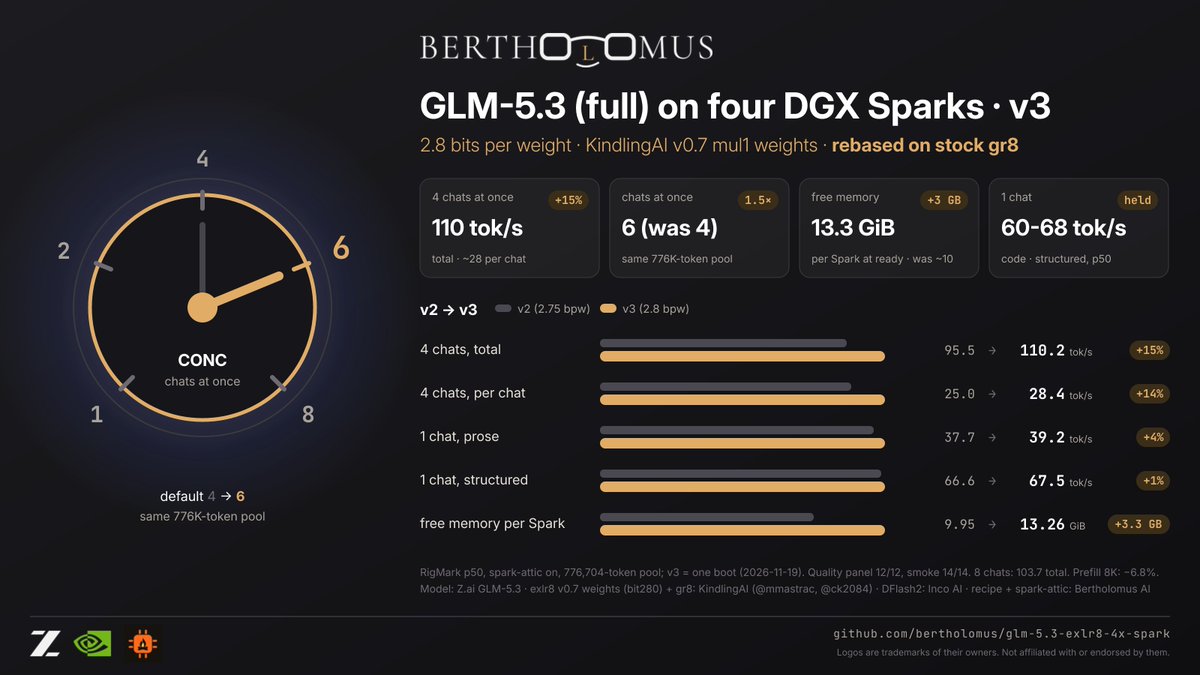
GLM-5.3 (full) on four DGX Sparks, v3: 2.8 bpw on KindlingAI's new mul1 weights, rebased on current gr8.
• 4 chats: 110 tok/s total, ~28 each (was 95)
• 6 chats at once (was 4), same 776K pool
• ~3 GB more free memory per Spark
• 1 chat: 60-68 tok/s
https://t.co/QIF5bC7cjP