❕The landing site for the Dragonfly drone on Titan has been named.
The International Astronomical Union has approved the name *Ahmakiq Undae* for a vast dune field south of Selk Crater.
It is here that Dragonfly will explore organic dunes and impact deposits associated with Selk Crater—a location where liquid water and complex organic compounds may have once coexisted.
🚀 The probe is scheduled to launch in the summer of 2028, with arrival at Titan expected in late 2034.
Apollo 13’s damage was far worse than anyone realized.
After separating from the Service Module, the crew of Apollo 13 saw a blown-out panel and extensive external destruction — the result of an oxygen tank explosion that crippled the spacecraft’s power and life-support systems.
With systems failing, the astronauts relied on the Lunar Module as a lifeboat, looping around the Moon before beginning their tense journey back to Earth.
The haunting image of the damaged Service Module remains one of NASA’s most sobering reminders of how close the mission came to catastrophe — and how ingenuity turned crisis into survival.
We’re not sitting on this one, Uranus has another Moon!
Webb discovered an unknown moon orbiting the planet, expanding its known satellite family to 29.
https://t.co/uc9CdPnB7w
The James Webb Space Telescope has picked up the first ever potential sign of biological life in space.
The exoplanet K2-18b, which is 124 light-years away, is believed to be fully covered by water and have large amounts of dimethyl sulfide, a gas only made by living organisms.
#Voyager2 update: After taking all steps possible to avoid it, @NASAVoyager engineers have turned off the plasma science instrument aboard the probe due to its gradually shrinking electrical supply.
Four science instruments remain operational. https://t.co/i1wkqO8KQL
Earth has a new ‘mini-moon’! 🤏🌖
Asteroid 2024 PT5 has been ‘catching up’ with us for years. It recently got close enough to begin interacting with Earth’s gravity, leading to a short #MiniMoon phase from now until late November during which it will be bound to our planet.
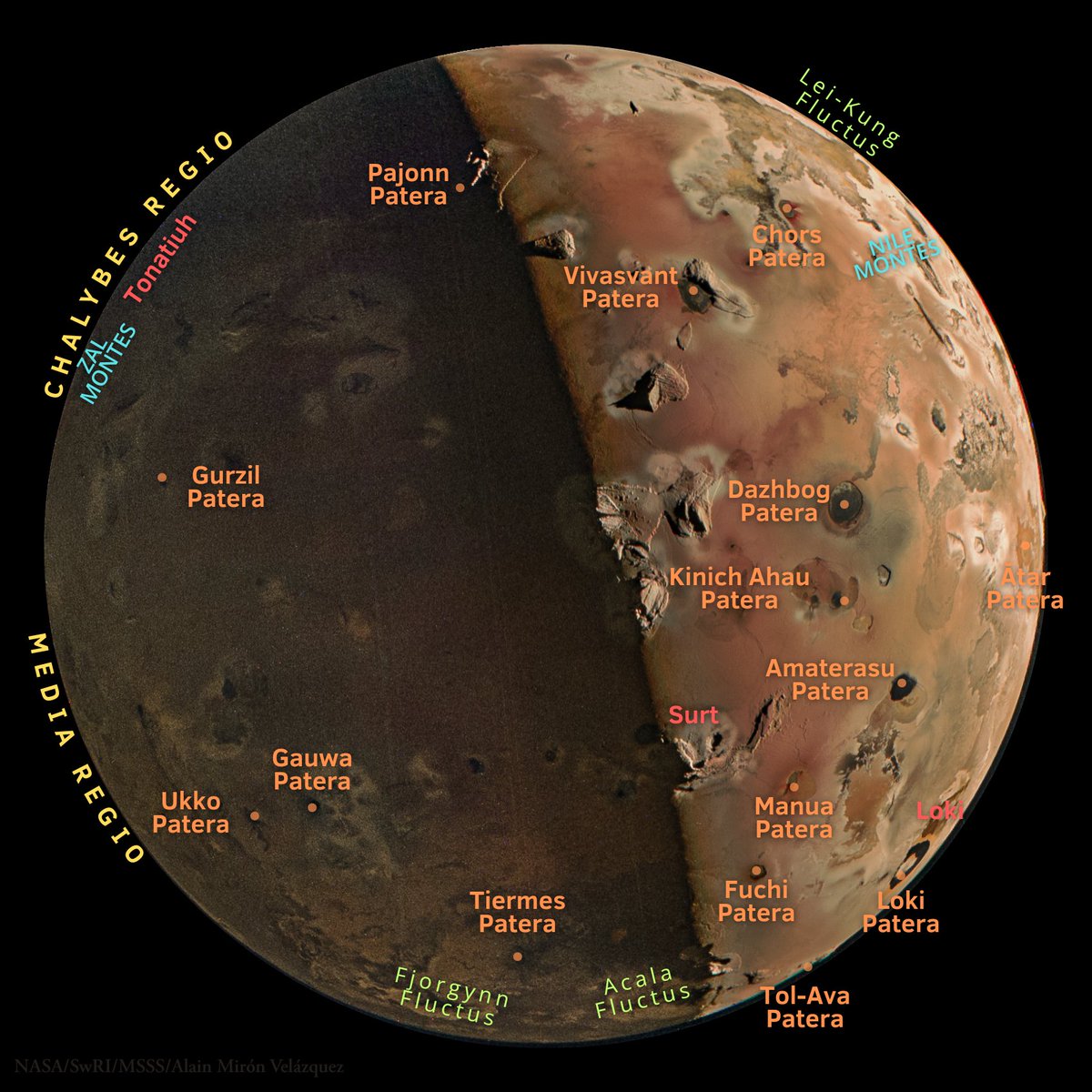
Ío con nombres.
He colocado los nombres (aprobados por la IAU) de las características visibles durante el sobrevuelo del 30 de diciembre, llama la atención la escasez de nombres para muchas regiones llamativas que simplemente no habían sido vistas con este nivel de detalle.
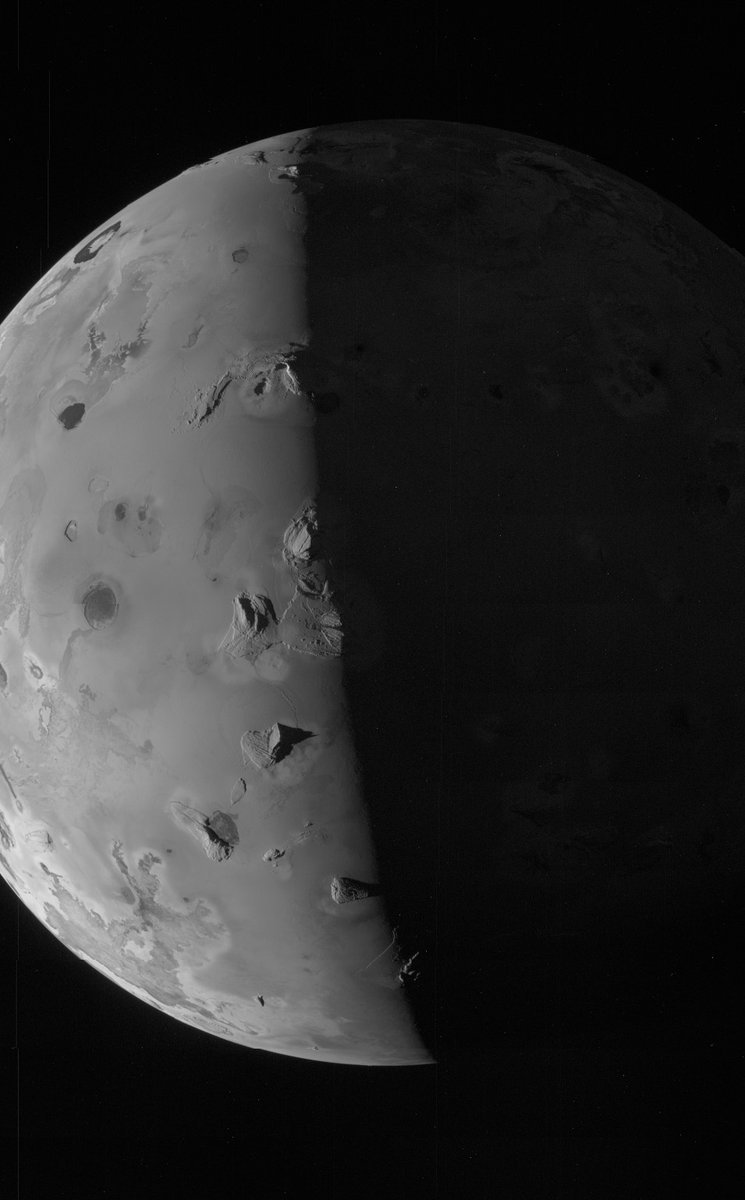
The JunoCam instrument aboard our #JunoMission acquired six images of Jupiter's moon Io during its close encounter today. This black-and-white view was taken at an altitude of about 1,500 miles (2,500 kilometers). More images will be available soon at https://t.co/mGfITRe57Y
Problem-solving beyond the heliopause.
The @NASAVoyager team is investigating an issue with #Voyager1's Flight Data System. The spacecraft is receiving and executing commands sent from Earth but not returning useable data.
More on the evolving situation: https://t.co/SYuVX7lt45
Jupiter has 80 known moons in a wide range of sizes and shapes. This video compares their size using Manhattan, NYC and part of the New York state as a reference
[📹 MetaBallStudios]
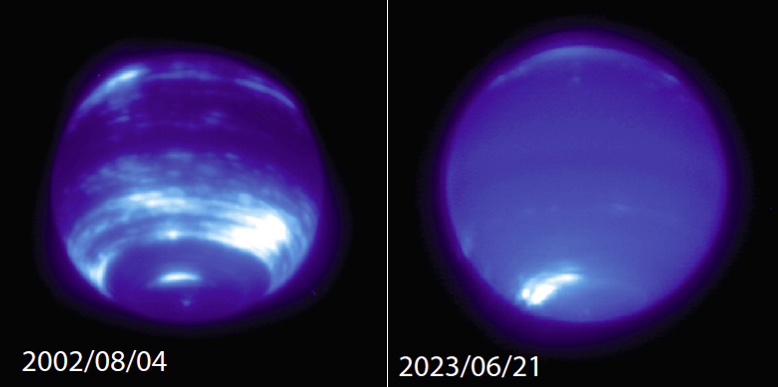
Where did Neptune’s clouds go? It looks like the Sun has something to do with their disappearing act. For the first time in nearly 30 years of observations using @keckobservatory, @lickobservatory & @NASAHubble , astronomers witnessed Neptune’s clouds all but vanish. The study led by @UCB_Astronomy shows a surprising link between changes in Neptune’s cloud cover and the solar cycle 👉 https://t.co/eeGw8W8qj6
#keckobservatory #maunakeaobservatories #hawaiiastronomy