Apparently there's a volcano erupting right now in the Philippines. I'm watching a livestream when suddenly there's this extremely bright green fireball coming from a completely unrelated trajectory. Is that a meteor?
Ejemplo a escala del cráter Barringer en Arizona, EUA.
🏙️ En el centro, la figura blanca representa la Torre Latino a escala.
🪨 La pequeña piedra junto a ella corresponde al tamaño real del impactador que originó el cráter.
Gracias a @alanmir por el gran trabajo.
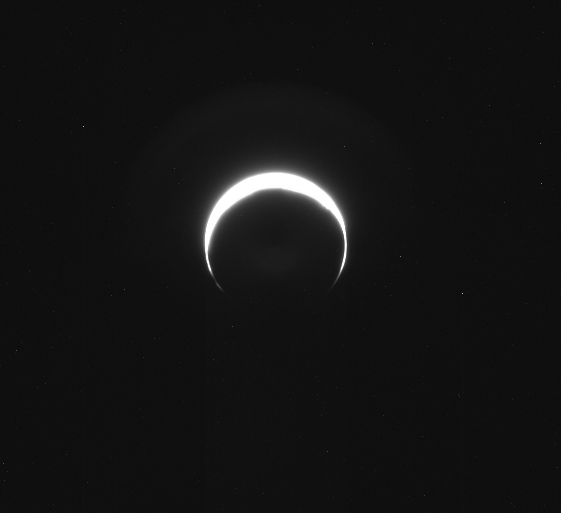
This is not an eclipse, but an even more rare sight: a crescent Mars as seen by NASA’s #MissionToPsyche spacecraft.
The unprocessed image — taken by Psyche today — shows the night side of Mars as the spacecraft approaches the Red Planet for a flyby on May 15. The glowing crescent is sunlight reflected from the day side of the planet's surface, as well as sunlight passing through its atmosphere. The irregularities in the crescent are likely caused by surface features, and dust and clouds in the atmosphere. 1/2
NASA’s Juno spacecraft captured this view of Thebe, the second largest of Jupiter’s inner moons, during a close pass on May 1, 2026.
Thebe is believed to play a role in the formation of the planet’s “gossamer” ring through the shedding of dust. Read more: https://t.co/OUGGbApsCs
Amigos ya pueden escuchar nuestro episodio 22 de #CocteldeRocas, en esta ocasión hablamos de la misión #ArtemisII. En esta ocasión tuvimos a @alanmir de invitado especial.
Episodio 22 Misión Artemis II https://t.co/SeCq2zSohq
Only one chance in this lifetime…
Like watching sunset at the beach from the most foreign seat in the cosmos, I couldn’t resist a cell phone video of Earthset. You can hear the shutter on the Nikon as @Astro_Christina is hammering away on 3-shot brackets and capturing those exceptional Earthset photos through the 400mm lens. @AstroVicGlover was in window 3 watching with @Astro_Jeremy next to him.
I could barely see the Moon through the docking hatch window but the iPhone was the perfect size to catch the view…this is uncropped, uncut with 8x zoom which is quite comparable to the view of the human eye. Enjoy.
Artemis II is home
NASA's Orion spacecraft carrying Artemis II crew members Reid Wiseman, Victor Glover, Christina Koch, and Jeremy Hansen splashes down in the Pacific Ocean near San Diego, California, at 5:07 p.m. PDT, (8:07 p.m. EDT) on Friday, April 10th, 2026.
NASA’s Landing and Recovery team and the U.S. military are coordinating efforts to extract the Artemis II crew from the Orion spacecraft.
Credit: NASA/Josh Valcarcel
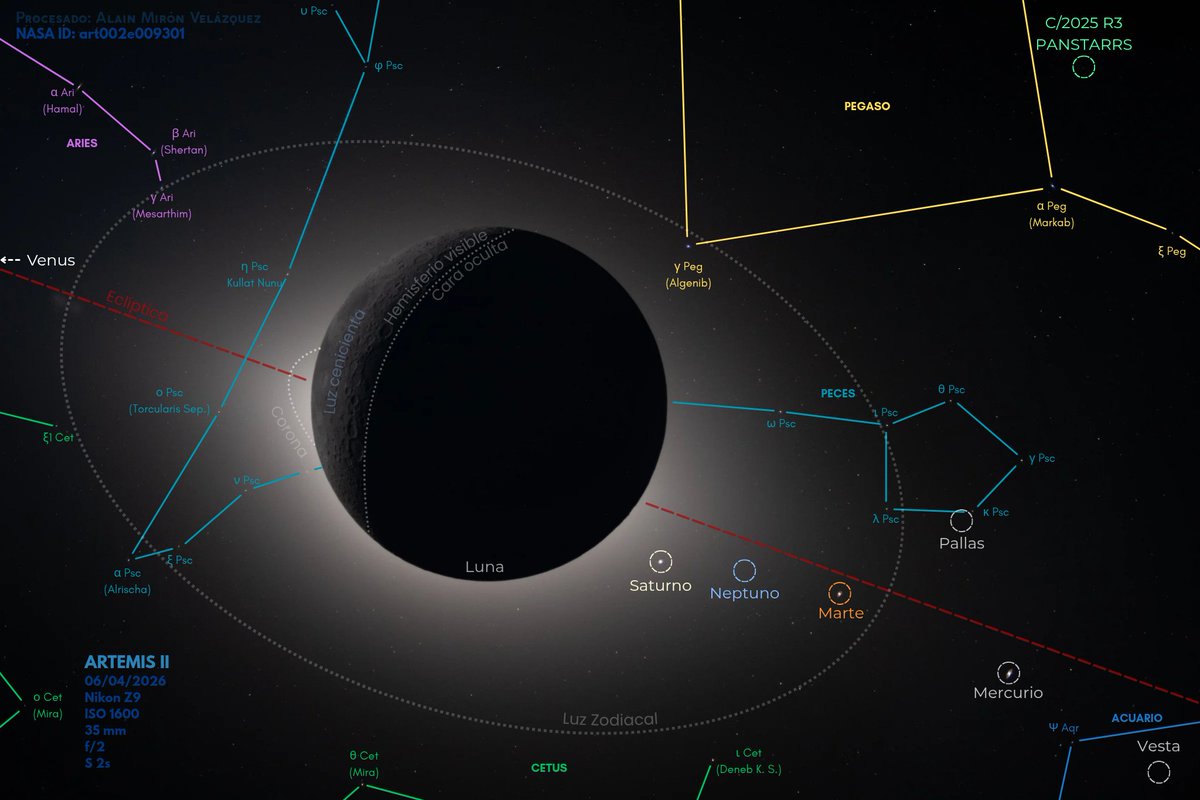
@NASA In the photograph of the "eclipse," in addition to the planets, you can see Comet PanSTARRS, as well as some asteroids, of course.
I added labels to the photo to better understand what's visible.
El eclipse de Artemis, planetas y un cometa.
Vuelvo a subir esta fotografía anotada de Artemis porque me di cuenta que aparece el cometa C/2025 R5 PANSTARRS en la esquina superior derecha como una pequeña mancha verdosa.
¿Que otros detalles irán apareciendo?
@PepeChambo
#ArtemisII 🔥
Die @NASA hat heute eine der bisher beeindruckendsten Aufnahmen des #SLS-Starts veröffentlicht.
Werfen wir einen genaueren Blick auf die SRB-Trennung👀❗️
(Zoom, Tracking, 0,25x Slo-Mo🫡🔧)
Esta mañana logré fotografiarlo desde la Ciudad de México utilizando un Dwarf mini de @dwarf_lab33747
A falta de un par de semanas para su perihelio, el cometa ya supera la magnitud 6 y es visible con prismáticos.